Il Cimitero
Protestante detto 'degli Inglesi' è costituito da un
ovale racchiuso all'interno di uno dei viali fioretini,
dove un tempo si ergeva un tratto delle mura cittadine.
Nacque nel 1827, quando il governo del Granduca Leopoldo
II di Lorena cedette alla Chiesa Evangelica Riformata
Svizzera una montagnola di 8.000 metri quadrati per
farne il suo cimitero. Fino ad allora l'unico cimitero
protestante presente in Toscana era a Livorno: fu
l'intraprendenza dello svizzero Jean Pierre Gonin che
riuscì a ottenere il terreno e a impiantare il Cimitero,
che è ancor oggi proprietà della Chiesa Evangelica
Riformata Svizzera. La denominazione 'degli Inglesi',
ormai radicata non solo nell'uso popolare, è dovuta al
fatto che per i fiorentini dell'epoca essere un
protestante equivaleva ad essere un inglese, come del
resto è la maggior parte dei personaggi sepolti nel
Cimitero. La colonna che si erge sulla sommità della
montagnola costituisce un dono dell'imperatore Federico
Guglielmo di Prussia, ed è stata innalzata nel 1859.
The so called
'English' Cemetery is an oval surrounded by the traffic
of one of Florence's boulevards, where once had stood a
part of the medieval city wall. It was opened in 1827,
when the government of the Grand Duke Leopold II of
Lorena granted to the Swiss Evangelical Reformed Church
a hill of 8,000 square metres to make their cemetery.
Until that time the only Protestant cemetery in Tuscany
had been in Livorno. It was the enterprising Jean Pierre
Gonin who succeeded in obtaining the land and planning
the Cemetery which is today still owned by the Swiss
Evangelical Church. The name 'English', now enshrined
through popular use, is owing to the fact that for
Florentines of that time, being Protestant was
equivalent to being English, as were, indeed, the
majority of the persons buried in the Cemetery. The
column that rises from the summit of the hill was a gift
by Emperor Frederic William of Prussia and was set up in
1859.
Le sepolture presenti
nel Cimitero 'degli Inglesi' sono 1409, per la maggior
parte appunto di inglesi, poi di svizzeri, e infine di
nordamericani, italiani e russi. Fra i primi è da
ricordare che è qui sepolta la famosa scrittrice
Elizabeth Barrett Browning, morta a Firenze nel 1861, lo
stravagante poeta Walter Savage Landor, nonchè il padre
di Frederick Stibbert, il collezionista inglese che ha
lasciato alla città di Firenze la sua villa-museo. Fra
gli svizzeri, oltre al fondatore del Cimitero, è da
ricordare Jean Pierre Vieusseux, di famiglia ginevrina,
fulcro della cultura fiorentina contemporanea, fondatore
del Gabinetto di Lettera e morto nel 1863. Americano era
invece Hiram Powers, scultore di fama internazionale,
mentre gli italiani compaiono solo verso la metà del
secolo XIX, con i primi convertiti alla religione
protestante, che subirono anche dei processi per la loro
nuova fede: fra questi è qui sepolta Giulia
Guicciardini, figlia del conte Giulio. Fra i russi, di
religione ortodossa, sepolti nel Cimitero 'degli
Inglesi' è da ricordare una piccola schiava nera di nome
Kalima, nativa della Nubia e portata quattordicenne
dall'Egitto a Firenze nel 1827 (tomba 1); fu accolta in
una famiglia russa che la liberò e la fece battezzare
con il nome di Nadezda (Speranza). Mori all'età di 38
anni: costuisce il legame diretto del Cimitero con la
lontana terra d'Egitto.
Burials in the
'English' Cemetery number 1409, the majority being
English, then Swiss, and finally Americans, Italians,
and Russians. Amongst the most famous are the writer
Elizabeth Barrett Browning, who died in Florence in
1861, the flamboyent poet Walter Savage Landor, and,
formerly, the father of Frederick Stibbert, the English
collector who gave to Florence his villa-museum. Amongst
the Swiss, apart from the founder of the Cemetery, we
should record Jean Pierre Vieusseux, from a Genevan
family, the centre of Florentine nineteenth-century
culture, founder of the Gabinetto Vieusseux, who died in
1863. While Hiram Powers was American, a sculpture of
international fame; the Italians coming later, the first
converts to Protestantism undergoing trials for their
new faith, among these being buried Giulia Guicciardini,
the daughter of Count Giulio. Among the Russians, of the
Orthodox faith, buried in the 'English' Cemetery, we
should note a black slave named Kalima, brought here
from Nubia at fourteen in 1827; she was taken in by a
Russian family who freed and baptised her with the name
of Nadezda (Hope). She died at 38: she is the Cemetery's
direct link with Egypt.

La
piramide e l'obelisco
The
pyramid and the obelisk
Tutti i motivi egizi
presenti sulle tombe del Cimitero 'degli Inglesi' sono
legati alla simbologia del sole. Anche la piramide
costituiva per gli antichi egiziani un simbolo solare:
rappresentatava infatti il colle primordiale sul quale era
sorto per la prima volta il sole all'inizio dei tempi.
Dalla prima piramide a gradoni ideata dall'architetto
Imhotep del faraone Djoser della III dinastia (circa 2630
a.C.), in cui la tomba del re si avvicinava al cielo e
quindi al sole, con il passaggio alla forma piramidale
vera e propria la costruzione fu paragonata ai fasci di
raggi solari che proteggevano la tomba del faraone. Le
piramidi furono costruite per seppelire i faraoni
dell'Antico e del Medio Regno (2630-1785 a.C.); nel Nuovo
Regno (1550-1070 a.C) invece, i sovrani si fecero scavare
le tombe nella Valle dei Re e piccole piramidi, chiamate pyramidia, furono utilizzate
allora dai nobili per decorare le loro cappelle funerarie.
All the Egyptian motives
present on the 'English' Cemetery's tombs are related to
sun symbolism. Even the pyramid built by the ancient
Egyptians was a solar symbol: it represents, in fact, the
primordial hill from which the sun rose for the first time
at the beginning of time. From the first stepped pyramid
conceived by the architect Imhotep for the Pharoah Djoser
of the Third Dynasty (circa 2630 B.C.), in which the tomb
of the king is raised to the sky and thus to the sun, to
the development of the true and proper pyramid form whose
construction is shaped by the rays of the sun which
protect the Pharoah's tomb. The pyramids were constructed
to bury the Pharoahs of the Ancient and Middle Kingdoms
(2630-1785 B.C.); in the New Kingdom (1550-1070 B.C.),
instead, the kings had their burials excavated in the
Valley of the Kings and little pyramids. called pyramidia, were used then by the
noblity to decorate their funeral chapels.
Fin dall'epoca romana era
ben conosciuta la funzione funeraria di queste costruzioni,
la cui forma fu ripresa ad esempio per la celebre tomba del
I sec. a.C. di Caio Cestio a Roma. Agli inizi dell'Età
Cristiana le piramidi furono ritenute dei grandi granai, con
riferimento alla parola greca pyros, che significa
'frumento'. Presto però le piramidi furono riconosciute di
nuovo come tombe e nel XVII secolo la grande piramide di
Cheope a Gizah era ritenuta la tomba del dio dei morti
Osiride, sede di misteri e tesori. La morte e la
resurrezione di Osiride erano per l'antico egiziano il
simbolo della continuità della vita dopo la morte, nonché
della vittoria del bene sul male: per questo motivo la
piramide, intesa come tomba di Osiride, divenne simbolo di
vita eterna, ed è presente spesso sulle tombe ottocentesche,
come anche nel fiorentino Cimitero 'degli Inglesi' (tomba
2).
From the Roman period the
funerary use of this construction was well known, whose form
was taken, by example, with the famous tomb of the first
century after Christ of Caius Cestius in Rome. At the
beginning of the Christian era the pyramids were considered
to be great granaries, with reference to the Greek word pyros
for 'grain'.
Quickly however the pyramids came to be understood as tombs
and in the seventeenth century the great pyramid of Cheops
at Gizah was held to be the tomb of the god of the dead,
Osiris, seat of mystery and treasure. The death and
resurrection of Osiris was for the ancient Egyptians the
symbol of life after death, as well as the victory of good
over evil; for this reason the pyramid, held to be the tomb
of Osiris, became the symbol of eternal life, and is often
present in nineteenth century tombs, as we find also in the
Florentine 'English' Cemetery (Tomb 2).
L'obelisco, la cui denominazione deriva dalla parola greca che significa 'piccolo spiedo', rappresenta l'evoluzione dei primitivi culti per i monoliti, sparsi un po' in tutto il mondo. In Egitto, a Heliopoli, veniva adorata la pietra sacra chiamata benben, ritenuta la prima manifestazione del dio sole sul colle primordiale: i primi obelischi avevano dunque una forma più tozza, come il benben, ma dal Medio Regno in poi assunsero l'aspetto più conosciuto, allungato. Anche l'obelisco dunque, come la piramide, è legato al culto solare: rappresenta un raggio di sole e probabilmente aveva sempre la punta ricoperta d'oro per riflettere da lontano la luce del sole.
The obelisk, whose name
derives from the Greek word meaning 'little spear',
represents the evolution from the primitive cults of the
monolith, spread throughout the world. In Egypt, at
Heliopolis, they worshiped the sacred stone called benben, considered to be the
first manifestation of the sun god on the primordial hill.
The first obelisks were squat in form, like the benben, but in the Middle
Kingdom came to assume their more elongated famed shape.
Also the obelisk, like the pyramid, is tied to the solar
cult: it represents a ray of the sun and probably always had
its point covered with gold to reflect the sun's light from
a distance.

La piramide e l'obelisco furono dunque utilizzate nelle tombe ottocentesche come simbolo solare e quindi di speranza nella vita eterna e di resurrezione.
The pyramid and the oblisk were therefore
used in nineteenth century tombs as solar symbols and thus
represent the hope of eternal life and resurrection.

Il disco solare alato e lo scarabeo alato
The winged sun disk and the winged scarab
Per
gli
antichi
egiziani
il sole era fonte di vita e pertanto il disco solare
costituiva il simbolo della nascita e della
resurrezione. La vita dell'uomo era paragonata al
cammino dell'astro: come il sole infatti sorgeva
all'orizzonte, così l'uomo nasceva alla vita, e come
il sole tramontava la sera a occidente, così l'uomo
moriva e scendeva nel mondo dell'aldilà, che si
riteneva fosse a occidente. Ma come il sole ogni
giorno risorgeva, così gli egiziani pensavano che le
anime dei defunti risorgessero nel mondo chiamato
appunto degli Occidentali, per continuare la vita in
eterno, secondo un concetto molto vicino a quello
della religione cristiana. Il disco solare dunque
divenne simbolo di rinascita e di vita eterna; veniva
raffigurato, soprattutto in Epoca Tarda, con due ali
di falco, che ricordano l'animale sacro del dio sole
Ra, rappresentato di solito con corpo umano e testa di
falco.
For
the
ancient
Egyptians
the sun was the source of life and so the solar disc
was a symbol for birth and resurrection. The life of a
man was compared to the celestial journey: as the sun
rose on the horizion, so is man born into the world,
and as the sun sets at evening in the west, so does
man die and descend into the nether world, which they
held to be to the west. But as the sun also rises each
day, so did the Egyptians think that the souls of the
dead would rise in the world they called 'West', to
continue their life in eternity, according to a
concept that is very close to that in the Christian
religion. The solar disk therefore became the symbol
of rebirth and eternal life; it came to be shown,
above all in the Late Period, with two falcon wings,
which recall the sacred animal of the sun god Ra,
figured usually as with a human body and the head of a
falcon.
Presso
gli
antichi
egiziani
anche lo scarabeo era ritenuto un animale sacro, ed
era identificato con il simbolo del dio sole Ra al suo
sorgere: il geroglifico a forma di scarabeo ha infatti
il significato di 'divenire', 'rinnovarsi',
'risorgere'. Anche lo scarabeo è spesso raffigurato
con ali di falco, e non con le sue elitre aperte, come
riferimento all'animale sacro del dio sole.
The
ancient
Egyptians
also
held the beetle, the scarab, to be a sacred animal,
and it was identified as the symbol of the sun god Ra
at his rising: the hieroglyph in the form of the
scarab has in fact the meaning of 'becoming',
'renewing', 'rising'. Also the scarab is often shown
with falcon wings, and not with its own wing cases
open, in reference to the sacred animal of the sun
god.
Nel
Cimitero
'degli
Inglesi'
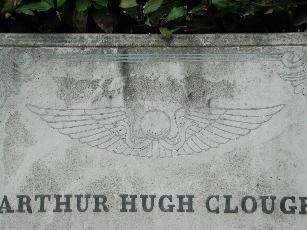
è presente una sola tomba con lo scarabeo alato (tomba
3), mentre sono numerose quelle che riportano il disco
solare alato (tomba 5). In particolare una tomba
presenta l'immagine classica del serpente cobra, o
ureo, il simbolo della regalità, nonché figlio del dio
Ra: si tratta della tomba del poeta Arthur Hugh Clough
(tomba 6), marito di una cugina della celebre Florence
Nightingale, e dedito anch'egli alla causa dei feriti
di guerra. Visitò diverse volte Firenze e qui morì nel
1861; la moglie Blanche volle raffigurare sulla sua
lapide l'immagine egizia del disco solare alato e
chiese all'amica Susan Horner di procurasi dal
fiorentino Marchese Torrigiani il volume di
Champollion sull'Egitto per ricopiarne il disegno. E'
questo il segno più concreto della scelta, in ambito
cristiano, di un motivo egizio per il suo significato
di eternità.
In
the
'English'
Cemetery
there is only one late tomb with the winged scarab
(Tomb 3), while there are numerous tombs with the
winged solar disk (Tomb 5). In particular one tomb
presents the image of the cobre or ureo serpent, the
symbol of kingship, or the son of the god Ra: this is
the tomb of the poet Arthur Hugh Clough (Tomb 6),
husband of a cousin of the famous Florence
Nightingale, and like her given to caring for the
war-wounded. He visited Florence several times and
died here in 1861; his wife Blanche wanted the
Egyptian winged solar disk to be on his tombstone and
asked her friend Susan Horner to obtain Champollion's
book from the Florentine Marchese Torrigiani to copy
the design from it. And this is the most concrete
evidence of the choice, in the midst of Christianity,
of an Egyptian motive for its meaning of eternity.


Influenza
egizia e simboli massonici nel Cimitero 'degli Inglesi'
Egyptian
influence and masonic symbolism in the 'English' Cemetery
Nell'architettura funeraria vengono spesso
rispettate e tradotte, per l'avvenuto passaggio a 'vita
eterna', le stesse simbologie che guidano il percorso in
vita di ciascun individuo; si tratta di simbologie
ricorrenti di indubbio interesse, riferibili alla stessa
natura umana e alla sua temporaneità.
In funerary architecture the same symbolism
is often employed for the passing to 'eternal life',
which show the way in life to each individual: we speak
of the recurrent symbolism of undoubted interest,
referring to the same human nature and to its temporary
quality.
Il cimitero protestante fiorentino non
sfugge a questa logica, anzi ne costituicse un valido e
significativo esempio. Molte delle sepolture sono
caratterizzate da forme scultoree a tutto tondo o
bassorilievi che riproducono da un lato elementi tratti
dall'antico Egitto, e dall'altro simbologie che, pur
avendo in parte gli stessi riferimenti storici, si
rifanno a significati più generali e talvolta complessi,
legati alla provvisorietà dell'esistenza umana, ma anche
alla sua ricorrente ciclicità. Una sorta di speranza di
eternità legata alla stessa grandezza della natura in
senso materico e generale.
The Florentine Protestant Cemetery is not
divorced from this logic, indeed it becomes a valid and
significant example of it. Many of the tombs are
characterized by sculptural forms, either in full or in
bas relief that reproduce on one side elements taken
from ancient Egypt, and of other symbols that, while in
part sharing similar historic references, are
refashioned into meanings both more general and
frequently more complex, related to the impermanence of
mortal existence, but also to its recurrent cycle. A
sort of hope of eternity tied to the same grandeur of
nature in the material and general sense.
Fra queste simbologie troviamo spesso
l'uroboro, serpente mitico il cui nome significa 'coda
in bocca', che viene raffigurato appunto in atto di
mordersi o di inghiottire la propria coda. Nell'antico
Egitto l'uroboro avvolgeva con le sue spire
l'Oltretomba, simboleggiando l'eternità; anche nelle
tombe ottocentesche personifica, attraverso il rettile
che si attacca a sé stesso, una sorta di 'eterno
ritorno', una metafora espressiva della ciclicità dei
tempi e delle cose che li attraversano, una sempre nuova
rinascita, in questo caso morte e resurrezione alla vita
eterna.
In this
symbolism we often find the ourobouros, the mythological
serpent whose name mean 'tail in mouth', which is shown in
the act of biting or swallowing its own tail. In ancient
Egypt the ourobouros embraces
within its coils the Other World, symbolizing
eternity; also personified in the nineteenth century
tombs, through the reptile which attacks itself, a
sort of 'eternal return', a metaphor expressive of the
cycle of time and the things through which they
passed, an always new rebirth, in this case death and
resurrection to eternal life.
Spesso l'Uroboro è associato ad altri
simboli, come ad esempio la farfalla (tomb 7), che dalla
condizione di bruco (vita terrena), divenuta agile e
bella, spicca il volo verso l'alto dei cieli (vita
eterna) (tomba 8). Sull'onda della riscoperta della
civilta egizia nella cultura architettonica, prima nel
Settecento e poi alla fine dell'Ottocento, sono da
ascriversi altri simboli, tutti compositi e pertanto con
significati aggregabili, quali la piramide posta sul
cubo nella tomba di Robert Hart (tomb 9), dove su un
lato del cubo troviamo l'emblema massonico della squadra
e del compasso, il cui significato è da ricercarsi in
una appartenenza alla istituzione iniziatico-muratoria.
Nei rituali della loggia massonica e della Libera
Muratoria infatti, proprio la punta del compasso, pronto
a tracciare il cerchio cosmico della perfezione, viene
fissata nel cuore dell'iniziato, mentre la squadra
(simbolo della rettitudine) è lo strumento che lo unirà
a tutti gli altri fratelli. Nel caso in questione, come
si usa in gergo massonico, è 'il compasso finalmente
sovrapposto alla squadra': siamo quindi in presenza di
un individuo che in vita aveva il grado di Maestro
nell'ambito della Massoneria.
Often the Ourobouros is associated with other
symbols, for example the butterfly (Tomb 7), which from
its existence as larva (the life in the word), becomes
agile and beautiful, directing its flight towards the
highest heaven (eternal life) (Tomb 8). On the wave of
the rediscovery of Egyptian civilization in
architecture, first in the eighteenth century and then
again at the end of the nineteenth century, came
other symbols, somewhat muddled, among them the pyramid
placed on the cube of the tomb of Robert Hart (Tomb 9),
where on one side of the cube we find the masonic emblem
of the square and compass, whose meaning belongs to
masonry's initiation. In the rituals of the masonic
lodges and of Freemasonry, in fact, the compass point
itself, ready to trace the cosmic circle of perfection,
is fixed in the heart of the initiand, while the square
(symbol of rectitude) is the instrument which unites him
to all the other brethren. In the case in question, as
it is used in masonic jargon, it is the 'compass on the
square'; we are therefore in the presence of an
individual who in life had attained the level of Master
in masonic circles.
La piramide invece è una forma geometrica
molto antica che in genere è associata al quadrato,
simbolo della materia che assume, volumetricamente
parlando, la forma cubica. Il cubo rappresenta la terra
e il passaggio terreno dell'uomo; il triangolo invece,
che volumetricamente diviene piramide sorretta dal cubo
(tomb 2), è simbolo dello spirito e della essenza
volatile che si libera dal corpo in costante definiva
ascensione. Risulta evidente quindi il passaggio del
defunto dalla materia allo spirito.
The pyramid instead was a very ancient
geometric form that in general is associated with the
square, symbol of the material that takes, speaking
volumetrically, the form of the cube. The cube
represents the world and man's journey in the world; the
triangle, instead, that volumetrically becomes the
pyramid rising from the cube (Tomb 2), is the symbol of
the spirit and its volatile essence that is freed from
the body in constantly ascending. It is thus evident
that the journey of the dead is from matter to spirit.
1. Tomba della schiava Nadezda/ Tomb of the slave
Nadezda
2. Tomba dello
scultore americano Robert Hart/ Tomb of the American
sculptor, Robert Hart
3. Tomba del Cav.
Dott. Carlo Ernesto Della Torre e della moglie Amina
Ostrogovich/ Tomb of Cavalier Doctor Ernesto della Torre and
his wife Amina Ostrogovich
5. Particolare
della tomba di Helen Colquhoun, con disco solare alato/
Detail of
the tomb of Helen Colquhoun, with the winged solar disk
6. Tomba del
poeta Arthur Hugh Clough/ Tomb of the poet Arthur Hugh Clough
7. Particolare
della tomba di Jean Claude de Lagersward, con uroboro e
farfalla/ Detail of the tomb of Jean Claude de Lagersward,
with ourbouros and butterfly
8. Particolare
della tomba di Bentink Yelverton, con farfalla che esce
dal bozzolo/ Detail of the tomb of Bentinck Yelverton, with
butterfly emerging from the crysalis.
9. Particolare
della tomba di Robert Hart, con simbolo massonico/ Detail of the tomb of
Robert Hart, with masonic symbol
MINISTERO PER I BENI E LE
ATTIVITA CULTURALI
SOPRINTENDENZA PER I BENI
ARCHEOLOGICHE DELLA TOSCANA
MUSEO EGIZIO IN FIRENZE
MOTIVI
EGIZI NEL CIMITERO 'DEGLI INGLESI' A FIRENZE
FIRENZE,
MUSEO
ARCHEOLOGICO
NAZIONALE
23 SETTEMBRE 2006 -
27 MAGGIO 2007
Mostra a cura di: M. Cristina
Guidotti
Testi: M.
Cristina Guidotti, Mario Pagni
Foto: Roberto
Magazzini
Restauro della
tomba di Arthur Hugh Clough: Roberto Venturini
Collaborazione:
Paolo Bitossi, Julia Bolton Holloway, Vinicio Pianigiani
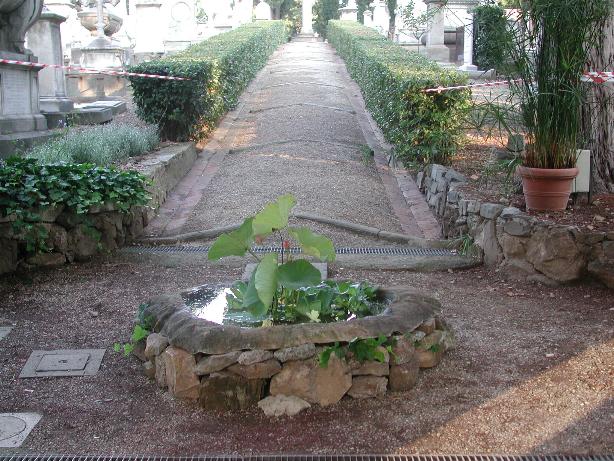
Loto e papiro,
Giardino Torrigiani/ Lotus and papyri, courtesy of Dott. Vieri
Torrigiani Malaspina