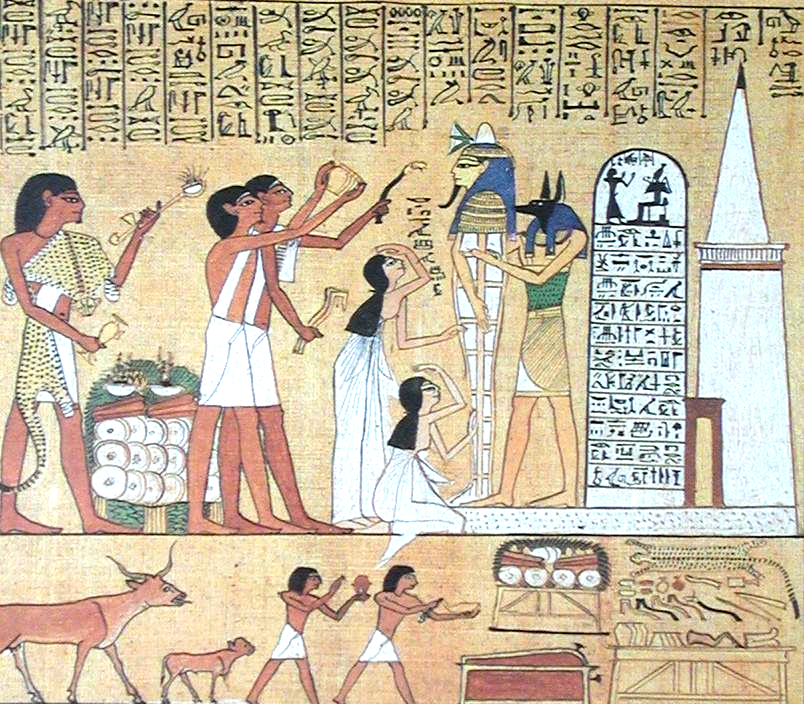
In the British
Museum in London one can see the unrolled papyrus sheets of
the Book of the Dead, traditionally wrapped around the
mummies when they were buried as their prescription for the
happy 'After Life'.These are magnificently
illuminated in some of the rolls, which are filled
with representations, as well, of the lotus and the
papyrus. As later, the words of the gods are written
in red, rubricated, amidst the black ink. They date
from the fifteenth century before Christ, but
represent a tradition that goes back even a thousand
years earlier, as can be seen in the hieroglyphs
sculpted on rock monuments.
Important in these
texts is the legend of Osiris and Isis, the dead
person being identified with Osiris whose wife
brings him back to life from death, their son being
Horus. Apuleius would
give us the most information about that tale in his
Golden Ass, which Elizabeth Barrett Browning would
partly translate. Thus husband and wife are
represented together in these Books as if Osiris and
Isis. Together they are represented as carrying out
agriculture, sowing and reaping flax and barley, in
the Field of Reeds, with its fertile waterways. The
dead would inhabit the circumpolar stars as an akh, be
restricted in the tomb as a ka, but also
visiting the living, inhabiting the Elysian Fields,
and travelling across the skies and the Underworld,
as a ba,
the human headed bird. Essential for the return of
the ba to
its akh
and ka was
the name and the portrait on the tomb and in the
Book.
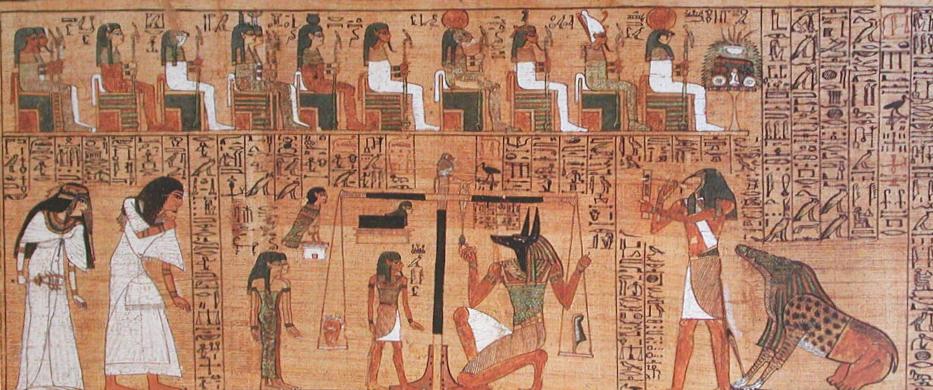
In the Judgement scenes in the papyri, the dead
person appears before Anubis who balances his evil
against an ostrich feather, while Thoth writes down
the result and Ammit, the monster dog, waits to
swallow up any soul enveloped in sin. Husband and
wife are judged for their equal fidelity to the
other and for their generosity to the poor, their
truthfulness, their piety, their refusal to destroy
what has been made or to cause suffering to others.
Parallel to the great Egyptian treasures in London
are those in Paris and in Florence. For Napoleon
encouraged the study of Egyptology with his conquest
of that land. Champollion deciphered the
hieroglyphs, discovering that they were phonetic.
Then he and Rosellini from Pisa were sent by the
Grand Duke Leopold II of Tuscany to visit Egypt and
Nubia in 1828. Florence's 'English' Cemetery had
been founded in 1827 by the Swiss Evangelical
Church, who purchased its land from that same Grand
Duke. For this reason we find countless examples
amongst our tombs and even on our building, which
has the closed lotus flowers, of Egyptian motifs, which
this past year were catalogued and exhibited by
Florence's Museo Archeologico Nazionale where half
the treasures brought back by Champollion and
Rosellini are housed.
In 1861 Elizabeth Barrett Browning would be
buried there, along with Arthur Hugh Clough, the tomb of the
latter having designs on it taken from Champollion's book on
the Expedition to Egypt and Nubia. The pet name for Elizabeth
in her family had been 'Ba', while that for her brother Edward
had been 'Bro'. She writes a sonnet to Robert about his coming
to call her by that name, as used earlier by her now-dead
mother and brother. Robert, letting
Frederic Leighton design her tomb, never returned to Florence,
and indeed interfered with the tomb's design to see that her
name is not given upon it, merely the cheapness of the letters
of 'E.B.B.', nor her recognizable portrait placed there. In
Egyptian mythology that is to subject someone to a double death.
Leighton, who had illustrated her poem 'A Musical Instrument'
and who deeply appreciated her, was furious. Robert next wrote
his tale of the murder of a wife by her husband, The Ring and the Book,
speaking of Elizabeth there as a bird, seeming in reference to
the Egyptian ba.
How much did Robert know of the Egyptian Book of the Dead and
of the need for the name and the portrait to be upon the tomb?
Elizabeth Barrett Browning. Aurora Leigh and Other Poems. Edited,
John Robert Glorney Bolton and Julia Bolton Holloway.
Harmondsworth: Penguin
Classics,
1995. xx + 517 pp. ISBN 0-14-043412-7
  IN STOCK

Oh Bella Libertà! Le Poesie di Elizabeth Barrett Browning. A cura di Rita Severi e Julia Bolton Holloway. Firenze: Le Lettere, 2022. 290 pp.


To donate to the restoration by Roma of Florence's formerly abandoned English Cemetery and to its Library click on our Aureo Anello Associazione's PayPal button:
                THANKYOU!
 IN STOCK
IN STOCK