MARY SOMERVILLE
AND FLORENCE


COUNTESS CHARLOTTE SOPHIA
GIGLIUCCI/ ENGLAND/ [Coat of Arms]/ CHARLOTTE SOPHIA, MOGLIE
DEL CONTE GIOVANNI GIGLIUCCI/ NATA A LIVERPOOL IL 4 AGOSTO
1841/ MORTA A FIRENZE IL 12 FEBBRAIO 1920/ ET LAUDENT EAM IN
PORTIS OPERA TUA/ C30M
COUNTESS EDITH MARGARET GIGLIUCCI/ ENGLAND /
[Coat of Arms]/ EDITH MARGARET/ MOGLIE DEL CONTE MARIO
GIGLIUCCI/ NATA LIVERPOOL IL 26 AGOSTO 1847/ MORTA IN
FIRENZE IL 16 NOVEMBRE 1909// CHARITATEM/
DILEXIT/ C29M
CONTE GIOVANNI GIGLIUCCI/ ITALIA/
[Coat of Arms]/ CONTE GIOVANNI GIGLIUCCI/ PATRIZIO
FERMANO, NATO A FERMO IL 18 NOVEMBRE 1844/ MORTO A FIRENZE
IL 6 DICEMBRE 1906/ VIRTUTE ET FIDE BENE QUI LATUIT BENE
VIXIT/ C30L

CONTE MARIO GIGLIUCCI/ ITALIA/ [Coat of Arms]/ CONTE MARIO GIGLIUCCI/ PATRIZIO FERMANO/ NATO A FERMO IL 19 NOVEMBRE 1847/ MORTO A FIRENZE IL 13 GENNAIO 1937/ RECTE ET SUAVITER/ C29M

See in Biblioteca e Bottega Fioretta
Mazzei, Clara Novello's Reminiscences, edited by her
daughter, Contessa Valeria Gigliucci, with a memoir by Arthur D.
Coleridge (London: Edward Arnold, 1910), Biography Section.]
Frances Power Cobbe “Italics” 1864
One more of the " People one meets in Italy " remains for me to describe. It seems almost like trespassing
on sacred ground to speak publicly of one most dear and reverenced; yet to omit the name of Mary Somerville in an account of
the residents in Italy would be impossible. There is no need to tell the world now that she is the most learned woman
(as regards physical and mathematical science), who has ever lived; that her books are masterpieces of their kind ;
 or that her life has been the example to which all who have at heart the elevation of her sex,
point to prove that the greatest intellectual height is attainable by the best of wives and mothers.
 That life, however, has so long been quietly passed far away from England, and her works have been for a generation
so familiar as scientific class-books among us, that there are many, I imagine, to whom it will come as a pleasant surprise
to learn that she has outpassed the common limits of human mental activity, and is now, in her eighty-third year,
 engaged in completing a treatise which will probably be considered her greatest work. The book is devoted to the elucidation
of the most recent discoveries of science regarding the ultimate particles of matter, organic and inorganic ;
the revelations of the microscope and of the solar spectrum ” everything, in short, to which its beautiful epigraph
from St. Augustine may fitly apply” " Deus magnus in magnis, maximus in minimis".*(* God, great in great tilings ;
greatest in the least).  Probably the mere copying of this book in writing similarly firm and clear would be a task
beyond almost any other woman of equal age. What its actual value as a literary work may be, it would, of course,
be mere impertinence for me to say. Mrs. Somerville is truly the Humboldt of Women, and this is her "Cosmos,"
the great work done after the common working hours of life are over. Yet something very different from Humboldt in gravest ways
is Mary Somerville. There are qualities in human nature nobler than even the quenchless thirst of knowledge
and untiring energy in its dissemination ; and those nobler and diviner gifts of which the man had little share,
the woman has much. The clearest brain probably ever granted to one of her sex has been vouchsafed, not to a woman lacking
 in tenderness, or simplicity, or vividness of religious consciousness, but to one in whom these have all had their highest
development.
It is surely a thing to be very grateful for in this world of fainting hearts and wavering minds, if we can point
to one who has passed through fourscore years with ever widening vision and ever growing faith; and whose long sojourn
 here has left still all "unspotted from the world." Eighty blameless years, full of duty and of honour,
all glorified by that high pursuit of Truth which is the loftiest of human joys ” what blessed sight is
this! Beholding it, we know that old age is not the dim closing of life's scene, but only the shade of the portal
of immortality ” a twilight, indeed ” but the twilight, not of the Evening, but of the Dawn.

Perhaps, there is no great force in the testimony of ordinary minds respecting their convictions of things unseen.
Carrying onward through life without examination the religious ideas instilled into them in childhood, their witness of
consciousness is hardly more than the witness of their teachers at second hand. It is hard to calculate, however,
on the contrary, the value of the evidence afforded us by one who has faced the dread problems of existence through
a long life of independent study ; and who, educated in such a creed as that of Scotland in the last century, has followed
 the progress alike of religion and of science, and stands at last in old age abreast of the foremost thought of our time.
 This is a voice to which we listen with thankfulness when it tells us that the result of knowledge is Faith.

Does the reader ask what is the bodily presence of this great and good woman? Is that strong brain lodged in a powerful form,
 or does she, in her mental superiority, weary of common men and women, dwell a little aloof, keeping her
" solemn state and intellectual throne"? Perhaps it would not be very marvellous if it were somewhat difficult for her
 to descend to such common gossip as befits a morning visit, or a little evening social gathering. Natural or not, however,
 it is always quite clear that  it is no difficulty at all to Mrs. Somerville to throw herself into the interests of those
around her ” to converse with each in his or her own way ” to be, in short, simply the kindest and pleasantest member of society. I
recollect once asking a friend to describe to me (before I had met him) the outward semblance of Theodore Parker. After telling me of
his looks, she wrote, "Parker is a gentleman- a small word for a great man, yet worth somewhat, also." It would be idle to say Mrs.
Somerville is a "lady;" a daughter of the old House of Fairfax was not very likely to be anything else.*(* Her father was Admiral Sir
William Fairfax, Bart., a collateral descendant of the Parliamentary general.)
Yet, to imagine her rightly, it is needful to bear in mind that this most learned of women so far diverges from the
proper type of that order, as to be quite simply a high-bred lady with the peculiar charm of manner of the elder generation
- alas ! now so nearly passed away. In nearly every respect, indeed, Mrs. Somerville must be a sad stone of stumbling to those
 who delight to depict that heraldic creature, "the Strong-minded Female," and have established it as a fact that the knowledge
 of Euclid is incompatible with the domestic affections, and that an angular figure, harsh voice, and brusque behaviour,
 are the necessary preparatives for feminine authorship. Mrs. Somerville is learned enough to alarm the best constituted mind ;
 she is ardently interested in the education and elevation of women, and she has even divulged such terrible opinions about
the Creation and the Flood, as to have incurred the penalty of being preached against in York Cathedral. Yet that slight
and fragile figure, clothed in rich brown moire antique ” that head, rather delicately formed than large,
 surmounted by that soft lilac cap (which surely came from Paris?) ”those features so mild and calm, with all their
intelligence ”that smooth hair, more brown than grey, even now ” those kind mild eyes, aged, indeed, but needing no glasses”
 that lady, in short, who is talking in a low voice (probably about the last new novel, or the merits of Gounod's "Faust"),
 or laughing merrily over some little jest of her visitor's ” that is said to be the translator of La Place's Mecanique Celeste,
 the authoress of the Connexion of the Physical Sciences. It is very distressing and unaccountable, but the identity seems
 pretty well established !
All hearts must rejoice to know that an old age so beautiful and venerable is surrounded by everything which can make it happy.
 Mrs. Somerville is the centre of more care and affection than can ordinarily fall to the lot of the aged. Though she has
 survived both her husbands (the last, who loved her so devotedly, died two years ago), she has her three children,
attached old servants, and very literally "honour, obedience, troops of friends." It is touching to live near her, and see how
 English and Italians alike vie to offer her any gratification ” flowers, music, or social pleasures of any kind she might be
disposed to accept. Among the most congenial of these friends, and whose daily intercourse forms no small share of her enjoyment,
 is that same Marchesa (Teresa) Doria, of whom I have spoken as among the ablest and most patriotic of Italian ladies.
Mrs. Somerville habitually spends her mornings in writing for several hours before she rises ” her books and papers on her bed,
and her little pet sparrow (passero) hopping about, now perching audaciously on the precious manuscripts, now on the head so
full of knowledge he little recks of ! A certain splendid white Pomeranian dog and a parrot complete the circle.
 Very fond is the Padrona of her animals, and of all animals ; and only this last winter has she exerted herself vigorously
 to bring all possible influence to stop the hateful practice of vivisection which disgraces the science she loves.
 In the afternoons she drives round the beautiful shores of Spezzia or the Acqua Sola at Genoa. Her son's visits from England
are her great seasons of pleasure. He comes to her as often as his office may permit, but her two daughters never leave her and
 seem to live only to surround her with their cares. All strive to conduce to her happiness. And she is happy ” happy in the
 innocent and noble pleasures she has found in this life” happier still in her firm faith in a yet holier and nobler life to
 come. The "Pilgrim" has reached the "Land of Beulah where there is no more night." Nature has led her most faithful follower
 w up to Nature's God."
Travelling much through the world, and seeing the great glories of scenery and of human art, or conversing with the larger
minds of our age, is a matter for which I think we can hardly fail to be thankful when it falls to our lot. At
every turn there is room for present enjoyment, and the certainty of future gain in memory thereof. Only this reflection injures
 our satisfaction ” how many others who could have more enjoyed and better profited by our experience,
find it denied them! How many who, in comparison of us, are "prophets and kings," " have desired to see the things we see,
and have not seen them" - nor shall ever see them in this world ! But among the greatest of all the pleasures, and the
 most dear and sacred treasure of memory which many wanderings have given to me, the one. for which I am most grateful is,
 not that I have seen all the chief masterpieces of art - nor visited the loveliest scenes in Europe -
nor beheld the "temples made with hands" of St. Peter's, and Milan, and the Parthenon, and Baalbec, and the Holy Sepulchre
 of Jerusalem : it is that I have been allowed to see and know and love Mary Somerville - and learn that Age can
be so blessed, and Womanhood so perfect, and Immortality so secure.
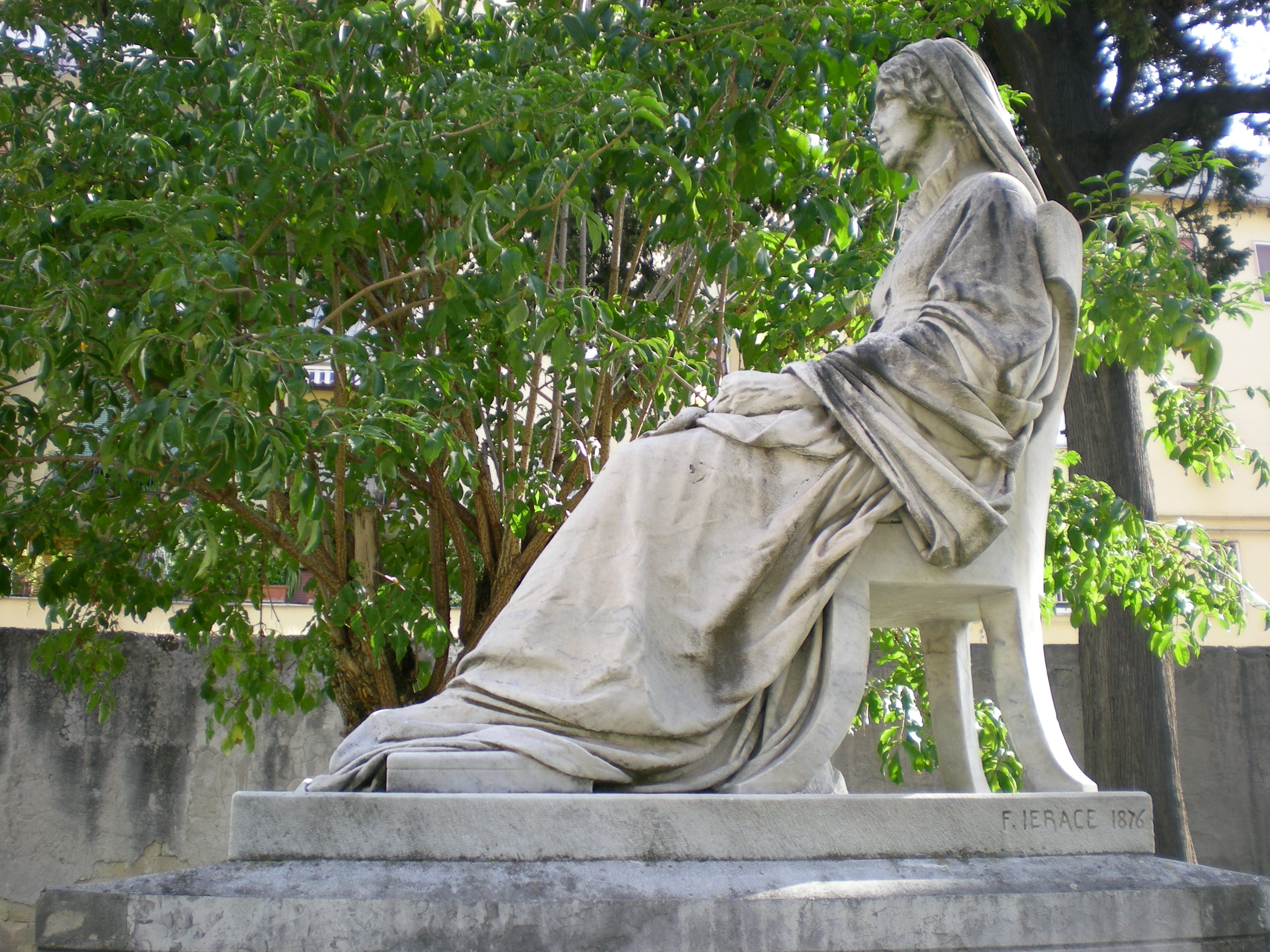


To donate to the restoration by Roma of Florence's formerly abandoned English Cemetery and to its Library click on our Aureo Anello Associazione's PayPal button:
                THANKYOU!