FLORIN WEBSITE © JULIA BOLTON HOLLOWAY, AUREO ANELLO ASSOCIAZIONE, 1997-2019:
MEDIEVAL: BRUNETTO LATINO, DANTE ALIGHIERI, SWEET NEW STYLE: BRUNETTO LATINO, DANTE ALIGHIERI, &
GEOFFREY CHAUCER || VICTORIAN: WHITE SILENCE:
FLORENCE'S 'ENGLISH' CEMETERY || ELIZABETH BARRETT BROWNING ||
WALTER SAVAGE LANDOR || FRANCES TROLLOPE || ABOLITION OF SLAVERY ||
FLORENCE IN SEPIA ||
CITY AND
BOOK CONFERENCE
PROCEEDINGS I, II, III, IV, V, VI, VII || MEDIATHECA 'FIORETTA
MAZZEI' || EDITRICE
AUREO
ANELLO CATALOGUE || UMILTA
WEBSITE || RINGOFGOLD
WEBSITE || LINGUE/LANGUAGES:
ITALIANO, ENGLISH || VITA
New: Dante vivo || White Silence
FLORENCE'S
PROTESTANT CEMETERY
OUR APPEAL TO AMERICA

This Protestant Cemetery in Florence is a means to studying the
history in exile of Americans, British, Russians and Swiss. We
seek your help in saving this treasure. We need to restore its
American tombs (we have over 80
American burials), about which we held the fifth
international conference on The City and the Book at Florence's
Lyceum Club, 11 October 2008, on the Americans in Florence in
the nineteenth century.
The beautiful but abandoned Swiss-owned Protestant/Orthodox
Cemetery in Florence was first bought from the Grand Duke
Leopold II of Tuscany in 1827. The Cemetery was then closed in
1877, following 50 years of intense use, when the medieval city
wall was torn down, following which it could only be used for
the burial of ashes, not bodies. Some of the American burials
precede its closure, others, of ashes, were later. Quite often,
Americans had themselves buried in lead, then shipped to the
States.
These fifty years were a time of great cultural energy for the
Florence of the Risorgimento, briefly the capital of Italy, in
which Americans, as well as English and Russians participated
fully. Sculptors like Hiram Powers and Joel Tanner Hart came
here. Anti-slavery advocates like Theodore Parker, his tomb
visited by Frederick Douglass, and Richard Hildreth came here,
there also being buried here the black Nubian Nadezhda (Hope)
who came to Florence at 14 with Jean-François Champollion and
Ippolito Rosselini's 1828 expedition, funded by the Grand Duke,
her story being told on the marble of her tomb in Russian in
Cyrillic characters, while Lord Leighton sculpted a broken slave
shackle on Elizabeth Barrett Browning's tomb, for her family had
been slave owners in Jamaica but which she passionately hated,
writing her famous sonnet on the American Hiram Powers' 'The
Greek Slave', the sculpture that had been at the centre of the
1851 Crystal Palace Exhibition and her ballad 'The Runaway Slave
at Pilgrim's Point'. English Fanny Trollope, who lived for a
while in Cincinnati, and who is buried here, wrote the first
anti.slavery novel, Jonathan
Jefferson Whitlaw; the American Unitarian Richard
Hildreth, the second, The
Slave; Harriet Beecher Stowe copied both of them.


Among the American Consuls were Hiram Powers and James Lorimer
Graham, the latter having his portrait medallion sculpted by
Launt Thompson, and who created a fine library and collection of
art, which Daniel Willard Fisk, who lived in Walter Savage
Landor's Fiesole villa, would in turn follow with his
magnificent collection of books on Italian and Icelandic
writers, now at Cornell University. Henry Adams' sister, Louise
Adams Kuhn, is buried here following her death from tetanus in
Bagni di Lucca, and The
Autobiography of Henry Adams describes this in his
'Chaos' chapter.
Not all Americans who visited Florence came to be buried here
but these tombs record their friendships: Henry James was to
write of Isa Blagden; Nathaniel Hawthorne having written of Isa
Blagden and Theodosia Garrow Trollope in his Miriam in The Marble Faun; and Sophia
Hawthorne of Hiram Powers and Elizabeth Barrett Browning, in her
Diary; while Margaret
Fuller was likewise Elizabeth Barrett Browning's friend, and who
becomes the eponymous heroine of Aurora Leigh, complete with the Brook Farm
phalanstery in the nine-book epic Elizabeth wrote following
Margaret's drowning with her baby and Italian husband off Fire
Island, Emerson sending Thoreau to look for their bodies.

Emily Dickinson
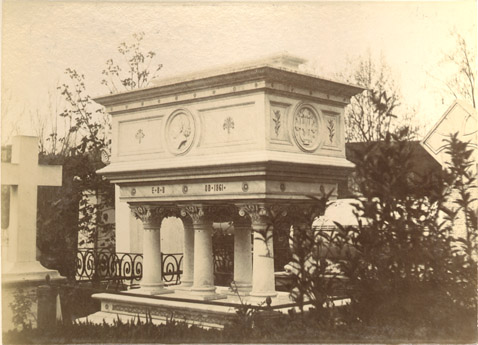
Elizabeth Barrett Browning is England's greatest woman
poet. A photograph of her tomb by Lord Leighton was treasured by
Emily Dickinson, America's greatest poet, and this and Aurora Leigh be alluded to
in her 'The soul selects her own society' and other poems. See
http://www.florin.ms/emperor.html.
In this pre-1870 postcard photograph, one can see the
ivy-covered medieval wall as still present.
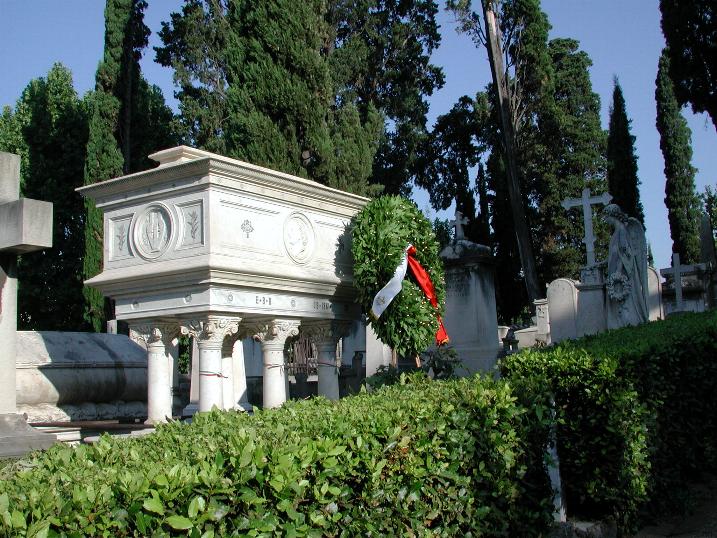
This 2006 photograph shows the newly-restored tomb and the
laurel wreath laid on it by the city of Florence to honor
Elizabeth Barrett Browning's Bicentennial. From her tomb and
those of our Americans one can see the dome of Florence's great
cathedral.
Many American babies are buried here, one with a poignant poem
about his being by the shores of Florence's Arno River, Italy
being then subject to diseases like malaria, about which Henry
James wrote, though several of Florence Nightingale's friends
find burial here, including the Unitarian physician Southwood
Smith in a tomb with a medallion sculpted by the American Joel
T. Hart, and the epitaph by Leigh Hunt that he advocated 'fresh
air and sunlight in the home/ of the rich poor of happier years
to come'.
Many Americans have helped make this web essay possible, among
them, Jeffrey Begeal, Carolyn Carpenter, Marilyn Richardson,
Robert J. Robertson, Naomi Slipp, Don and Mary Williamson. The
Swiss and the English thank them. We shall be even more grateful
when the conservation of the American tombs can be carried out
(some of which are sculpted by Hiram Powers and by his son,
Preston Powers, some by Joel T. Hart, one by William Wetmore
Story).
See http://www.florin.ms/americantombs.html,
http://piazzaledonatello.blogspot.com
FLORIN WEBSITE © JULIA BOLTON
HOLLOWAY, AUREO
ANELLO ASSOCIAZIONE, 1997-2019: MEDIEVAL: BRUNETTO LATINO, DANTE ALIGHIERI, SWEET NEW STYLE: BRUNETTO LATINO, DANTE
ALIGHIERI, & GEOFFREY CHAUCER || VICTORIAN:
WHITE SILENCE: FLORENCE'S
'ENGLISH' CEMETERY || ELIZABETH BARRETT BROWNING
|| WALTER SAVAGE LANDOR
|| FRANCES TROLLOPE
|| ABOLITION OF
SLAVERY || FLORENCE
IN SEPIA || CITY
AND BOOK CONFERENCE PROCEEDINGS I, II, III,
IV, V,
VI,
VII || MEDIATHECA
'FIORETTA MAZZEI' || EDITRICE AUREO ANELLO CATALOGUE || UMILTA WEBSITE
|| RINGOFGOLD
WEBSITE || LINGUE/LANGUAGES:
ITALIANO, ENGLISH || VITA
New: Dante vivo || White Silence