I wish to express my
gratitude to all of you for being allowed to write and say these
words, to Little Rock for the courage in which you led the
United States to what Elizabeth Barrett Browning called 'man's
ideal sense', and to Michael Kleine for his book on my book.
Elizabeth Barrett Browning came
from a family of Jamaican slave-owners. She hated slavery. She married Robert Browning 12
September 1845. His similar slave-owning family came from St
Kitts. The couple immediately fled England for Italy, settling
in Florence where she died 15 years later. Elizabeth knew she
was herself part Black from her slave-trading Moulton
grandfather. She guessed that Robert was part Jewish, praising
his Bells and Pomegranates
as from Aaron's High Priestly robe. When pregnant in Pisa,
before coming to live in Florence, she wrote The Runaway Slave at Pilgrim's
Point, speaking in the voice of a raped Black
slave who then kills her white child.
The first Duke of Florence, Alessandro de'
Medici, whose bones lie in one of the two tombs sculpted by
Michelangelo, the one to Lorenzo, Duke of Urbino, his
supposed father, the one that has the statues of Dusk and
Dawn, was
himself the son of Simonetta, a black slave. But his father
was more probably Lorenzo's brother, Giulio de' Medici who
became Pope Clement VII. Elizabeth constantly referred to that
statue by Michelangelo of Dawn, who wakes in anguish,
discussing it and Michelangelo's poetry about it in Casa Guidi Windows, and
giving it as title to her epic novel, Aurora Leigh.
For this
reason, among others, I believe, Florence became a place of
openness, of tolerance, and of immense creativity. So many who
knew each other eventually came to live and to die in Florence
and be buried here, among them Elizabeth Barrett Browning,
Theodosia Trollope, Hiram Powers, Maurice Baruch, and Isa
Blagden. They turned, by the alchemy of poetry and sculpture,
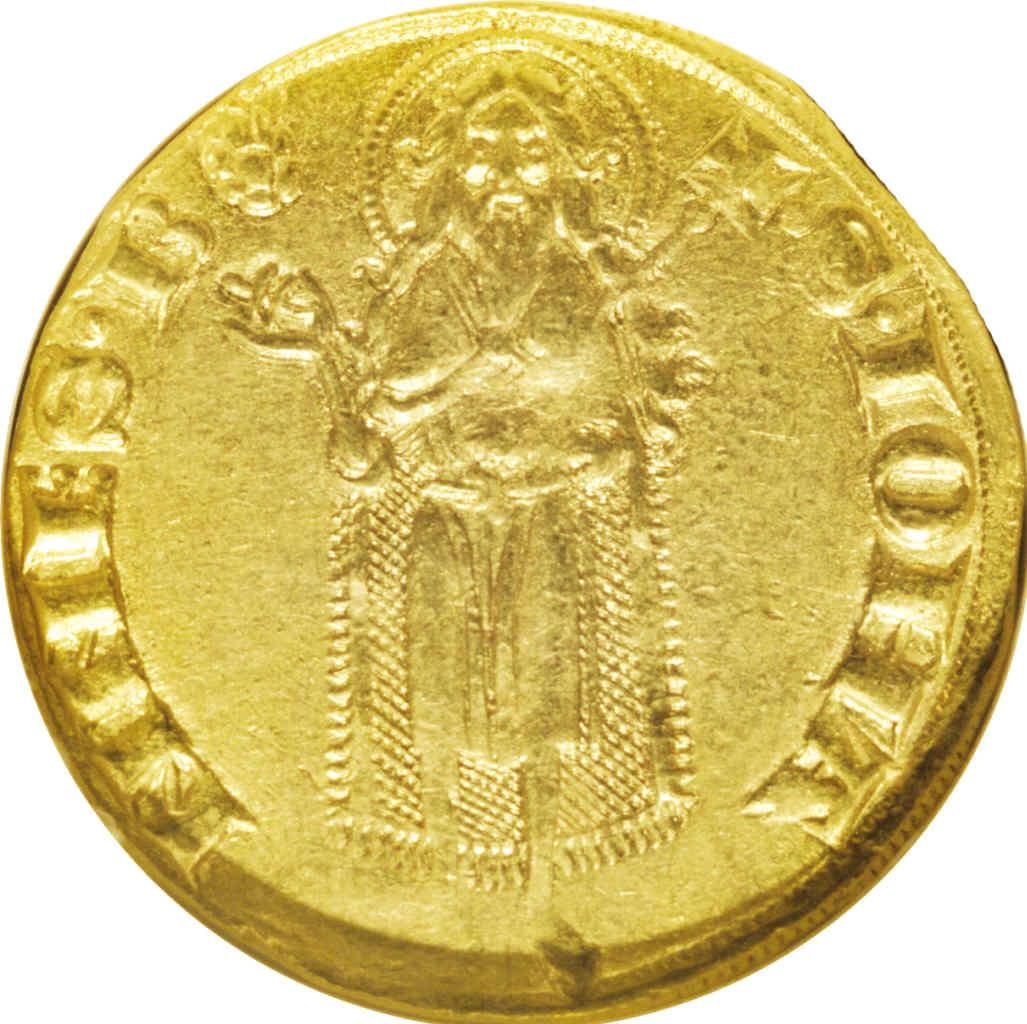
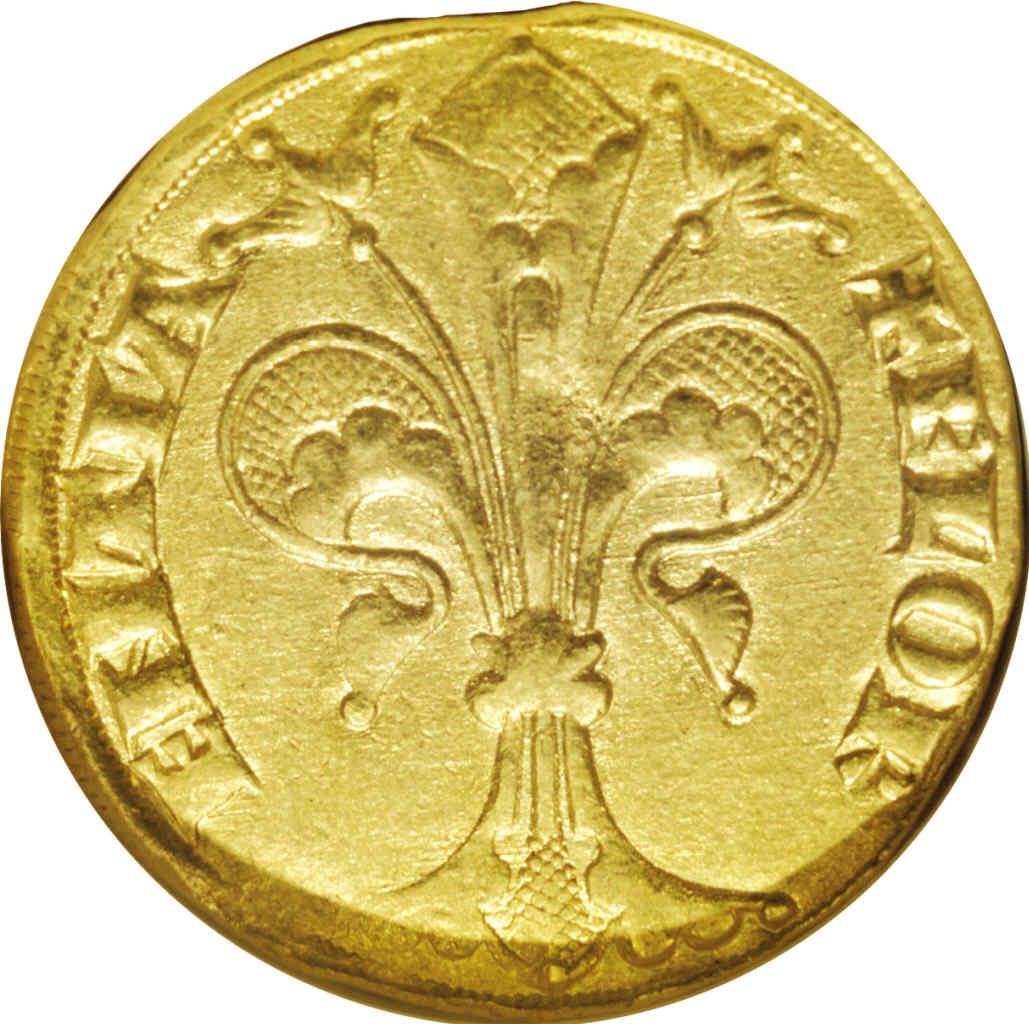
the iron chain of slavery, the barrier of discimination, into
the golden ring of freedom.
This is the 'English' Cemetery,
where Elizabeth Barrett Browning and her friends are buried, in
a recent photograph, its oval having been designed at the
Risorgimento by Giuseppe Poggi. Behind, to the center, you can
see the studio of Michele Gordigiani who painted the famous
portraits of Elizabeth Barrett and Robert Browning.
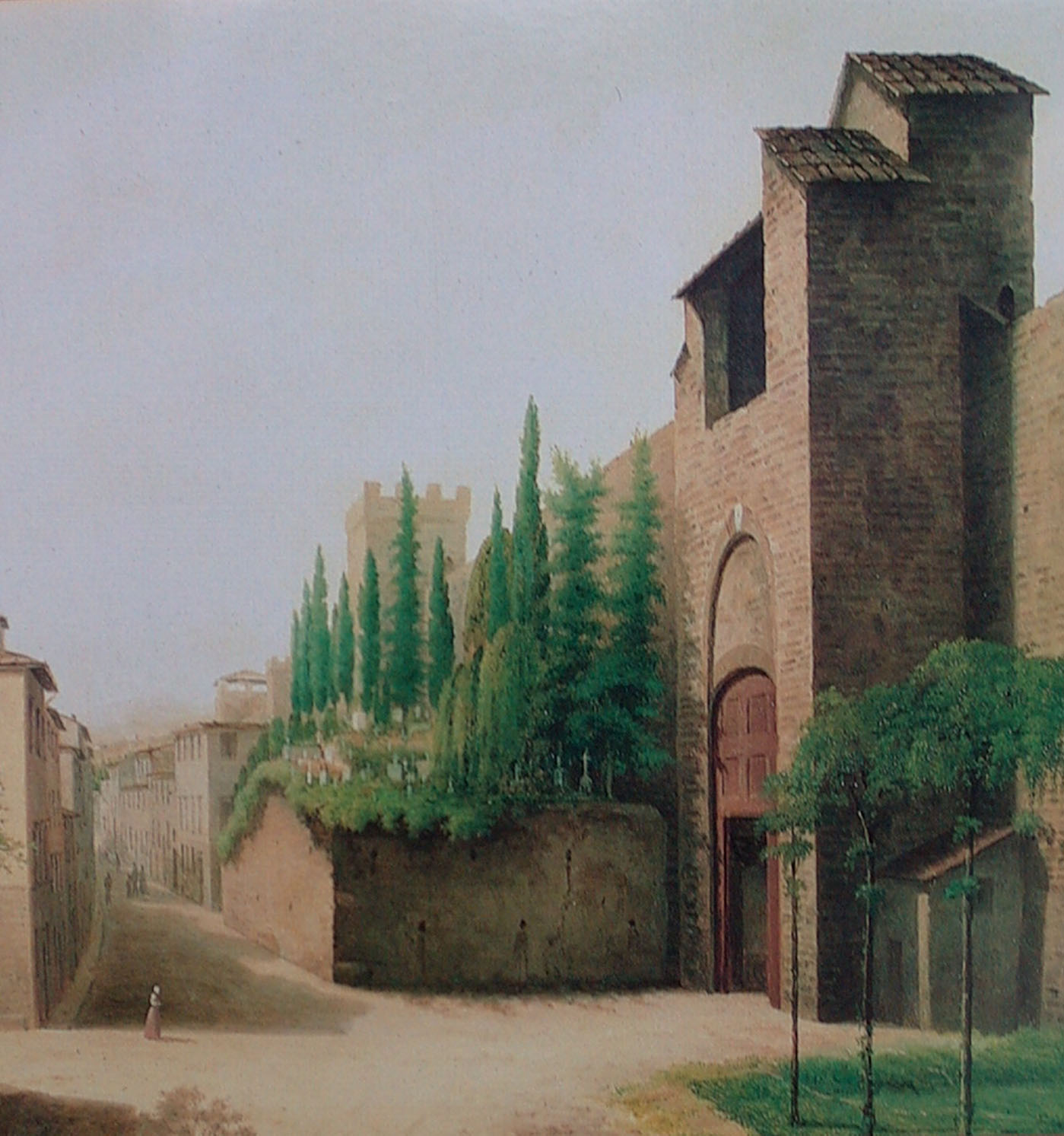
But when Elizabeth was buried here 1 July 1861, this
is
how the Cemetery then looked, nestled up against the great
medieval wall built by Arnoldo di Cambio and Michelangelo
Buonarotti that Poggi would later tear down. Robert
and their son Pen Browning, Isa Blagden and Robert Lytton, who
would become Viceroy of India, the Trollopes, the Powers, the
Storys, Kate Field and many others were present on that day at
her graveside, but not Walter Savage Landor, as they had forgot
to send a carriage for the old King-Lear-like poet. Robert
Browning never again visited her grave side, indeed interfered
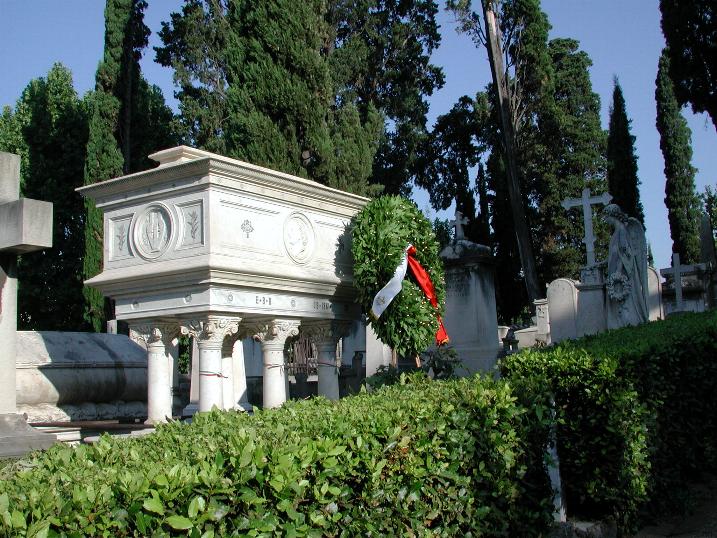
with the very beautiful tomb Frederic Lord Leighton designed for
her, Robert seeing to it that her name was not present on it,
only her initials, and that the intended portrait became as
unlike hers as was possible.
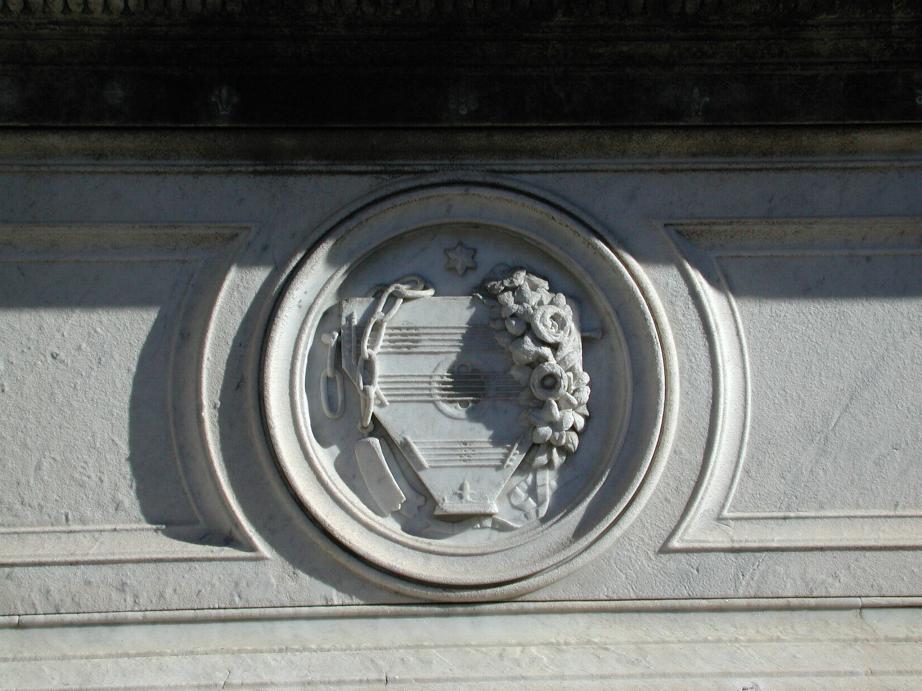
Leighton, however, paid tribute to Elizabeth's passion
for the freeing of the slaves by showing in the marble on the
hidden back of the tomb a broken slave shackle.
Leighton Sketch Book, Royal Academy Library
____
Greek
Lyre
Christian
Harp
Hebrew
Harp
Tragedy and Comedy
Cross
Jubilee with Broken Slave Shackle
Indeed, several of the ex-patriot women of the
Anglo-Florentine circle came of mixed blood, different colours
and other faiths, being therefore scarcely marriageable in
English society. Elizabeth herself referred to her part slave
ancestry. Maurice (Moisé)
Baruch, the conscientious librarian of the English Church in
Florence, a Jew converted to Christianity, found his resting
place in the English Cemetery, buried by the Anglican Reverend
Tottenham, his tomb inscribed in English and in German, the
latter in fraktura script in 1867. Thomas Adolphus Trollope noted that the
Hungarian patriot Ferencz Pulszky's talented beautiful
Viennese wife, Therese Walther, was Jewish. While Thomas
Adolphus' friend, Isa Blagden, and his own wife, Theodosia
Garrow Trollope, were part Jewish, part East Indian. Nathaniel
Hawthorne creates a composite of these in the exotic and
beautiful character of Miriam in The Marble Faun.
There were . . . stories
about Miriam’s origin and previous life . . . It was said, for
example, that Miriam was the daughter and heiress of a great
Jewish banker, (an idea perhaps suggested by a certain rich
Oriental character in her face,) and had fled her paternal
home to escape a union with a cousin, the heir of another of
that golden brotherhood; the object being to retain their vast
accumulation of wealth within the family . . . According to
a[nother] . . ., she was the offspring of a Southern American
planter, who had given her an elaborate education and endowed
her with his wealth; but the one burning drop of African blood
in her veins so affected her with a sense of ignominy, that
she relinquished all and fled her country . . .
Elizabeth Barrett Browning described Isa Blagden's hospitable
home in Bellosguardo with its view down upon Florence as that
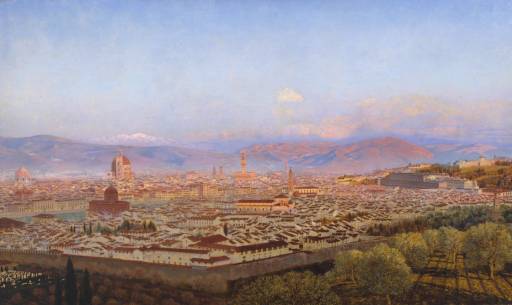
for her heroines, Aurora Leigh and Marian Erle. Henry James
likewise delighted in visiting this vibrant exotic hostess. John
Brett's fine painting from Isa's balcony includes the medieval
walls as they were then, and huddled outside of them, to our
left, the Hebrew Cemetery.
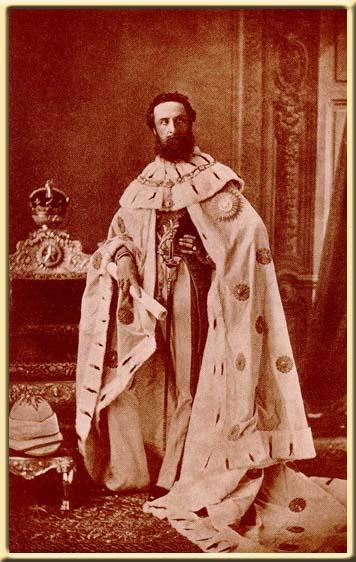
Robert Lytton, who had
attended Elizabeth's funeral along with Isa, was the son of
Edward Bulwer-Lytton, had published poetry under the name of
'Owen Meredith' and became Viceroy of India.
Elizabeth had hoped Lytton
would marry Isa Blagden, for she had saved his life one
summer in Bagni di Lucca, when the Brownings were also
there, but Isa's mixed blood, part Jewish, part East Indian,
prevented the match. They both wrote works about their
romance: Lytton's Lucile,
a kind of Aurora Leigh,
in verse; Isa's Agnes
Tremorne in prose. I am hoping
someone will write a book about Isa and Lytton.
In Florence, because of its openness,
both English and Americans could be friends of each other
more readily than could have been the case in either England
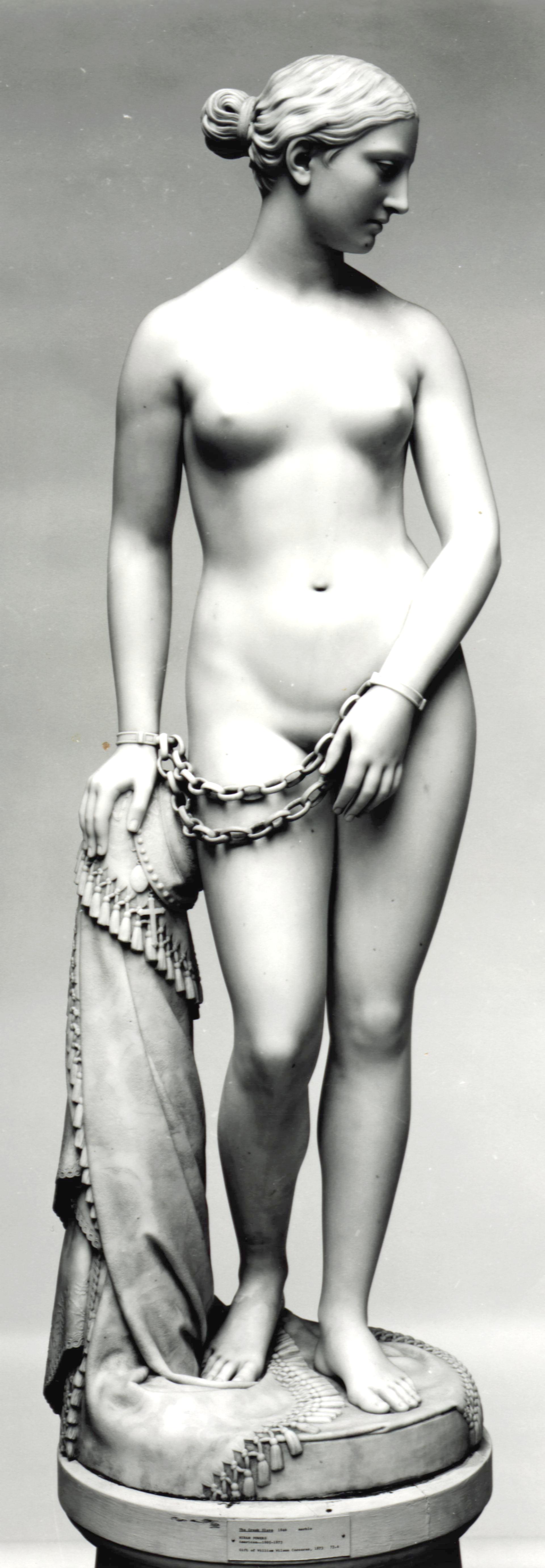
or in America. Among Florence's residents was Hiram Powers,
whose sculpture the 'Greek Slave' was the very centre of the
1851 Crystal Palace Exhibition,
In the Collection of the Corcoran Gallery of Art.
Gift of William Wilson Corcoran.
whose
'America' was not accepted by Congress because he showed her
trampling on slave chains,
and whose
'Last of the Tribes' is exquisite.
He was
himself part Native American and Elizabeth speaks of his
great flashing eyes, while the brilliant artist Sophia
Peabody, married to Nathaniel Hawthorne, studied sculpture
under him.
Elizabeth
Barrett Browning saw his sculpture of the 'Greek Slave' in his
studio in Florence and was so moved by it that she wrote this
sonnet.
In the Collection of the Corcoran Gallery of Art.
Gift of William Wilson Corcoran.
They
say
Ideal
Beauty
cannot
enter
The
house
of
anguish.
On
the threshold stands
An
alien
Image
with
the
shackled hands,
Called
the
Greek
Slave:
as
if the sculptor meant her,
(That
passionless
perfection
which
he
lent her,
Shadowed,
not
darkened,
where
the
sill expands)
To,
so,
confront
men’s
crimes
in different lands,
With
man’s
ideal
sense.
Pierce
to the centre,
Art’s
fiery
finger!
–
and
break up erelong
The
serfdom
of
this
world!
Appeal, fair stone,
From
God’s
pure
heights
of
beauty, against man’s wrong!
Catch
up
in
thy
divine
face, not alone
East
griefs
but
west,
-
and strike and shame the strong,
By
thunders
of
white
silence,
overthrown!
Elizabeth is
speaking here against slavery in America, in Russia.
Buried also
in our Swiss-owned so-called 'English' Cemetery, amongst
servants from England, serfs from Russia, is Nadezhda, who
came at 14 to Florence, a Black slave from Nubia, who was
baptized in a Russian Orthodox family and who lies beneath
a most beautiful Orthodox cross in white marble, her story
told in Cyrillic on its base. We recall that Pushkin, who
wrote of a friend as buried under the sweet myrtle of
Italy at Leghorn, was himself the grandson of 'Tsar
Peter's Negro'.
'Zdes' pokoitsja telo/ negritjanki Kalimy/ vo Sv.
Kresenii/ Nadezdy/ privezennoj vo Florenciju iz Nubii/ v 1827
godu . . . 1851// Primi mja Gospodi/ vo Carstvie Tvoe'/Qui
giacciono le spoglie mortali della nera Kalima, nel Santo/
Battesimo chiamata Nadezda (Speranza) che è stata portata a
Firenze dalla Nubia nel 1827 . . 1851, Accoglila Signore nel
Tuo Regno/
Mary Somerville buried her husband William
here in July of 1860, being interred herself later in a
magnificent tomb in Naples. Her husband's father, a Scottish
clergyman and historian, wrote powerful essays against slavery.
We recall that Scotland was an integral part of the slaves,
sugar, rum triangle, still giving us our Dundee marmalade. Now
Mary Fairfax Somerville, with no university education, merely a
few months of school where she was placed in an iron contraption
for her spine, discovered two planets and taught mathematics to
Ada Lovelace, Lord Byron's daughter, who then, with Charles
Babbage, invented the computer. At least that is what IBM told
us back in the 1950s in Silicon Valley, where I was in college.
Mary's books are exquisitely written - and were used as science
textbooks by the University of Cambridge in the Victorian
period. At 92, Mary regretted she would not live to see the end
of the disgrace to humanity that is slavery. When I was at the
UNESCO conference on computers and culture in St Petersburg two
years ago we found many of us were women and/or Blacks, seizing
this new information technology for our freedom.
The Admiral Sir Fleetwood Broughton
Reyolds Pellew buried his Creole wife and heiress, the
daughter of Lady Holland, Harriet Webster Pellew, here in
August, 1849, having her tomb sculpted by Félicie de
Fauveau, the Royalist sculptress living in exile following
her imprisonment in France, in Florence. She also sculpted
his tomb when he died in Marseilles, July, 1861, placing on
it his father's Coat of Arms won through the victory of the
Battle of Algiers against Moroccan slave traders. I tried to
tell my childhood friend, Godfrey Webster, of these tombs
but my letter reached him in Brazil too late. I had already
told Godfrey, an Old Etonian, of his Creole ancestry. We had
grown up together at Battle Abbey to which he should have
been heir, had not the Trust sold it. We found Félicie de
Fauveau's sculpure in photographs owned by Lord Crawford in
Scotland, for she had willed them to his ancestor, the great
art historian who had lived in Florence, Lord Lindsay. The
tombs themselves have been vandalized.
*
On 28 December 1827, the ship
'Edward' had set sail from the Port of London for the Port
of New Orleans. On board were Frances Trollope, 40, Cecilia
Trollope, 12, Emily Trollope, 10, Henry Trollope, 14, all
English, Frances Wright, 28, American, and August Hervieu,
23, French. Frances Wright, associated with Lafayette, had
invited the Trollopes to Nashoba where she had a settlement
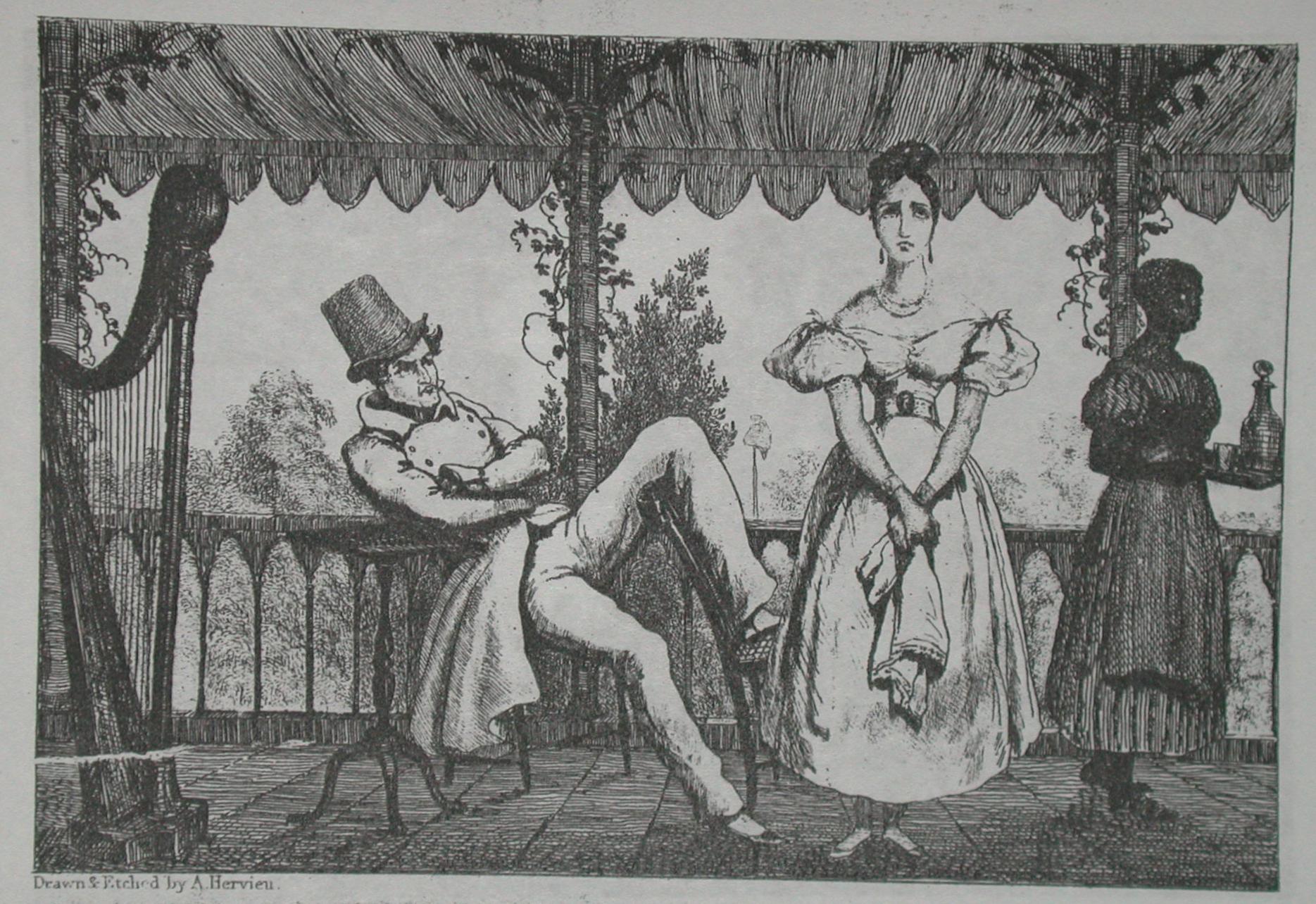
for the education of Negro slaves. Auguste Hervieu, a
brilliant young artist, was the children's tutor and
companion. With them also were Hester Rust and William
Abbott, their servants. Often Hervieu had to sell his art to
feed and house them all.
Fanny and her family next voyaged up the Mississippi to
Natchez and then through the forests to Nashoba in
Tennessee. All this became grist to her mill in her
anti-slavery novel, Jonathan
Jefferson Whitlaw, or Lynch Law, 1835, 1857. It is
not in print. It is now very rare. You can see it, instead
of read it, through Auguste Hervieu's
engravings,
which
I
have
placed
in a separate file so they not crash this one.
She published Jonathan Jefferson Whitlaw or
Life on the Mississippi in 1835. Already she had
become famous for her Domestic
Manners of the Americans, 1832. This first book she
wrote to pay the family's debts. In it she describes Fanny
Wright's Nashoba as a place of utter desolation, no
schooling happening at all. Eventually Fanny Wright would
ship these slaves to the free Republic of Haiti.
Fanny Trollope and her household
travelled on to Cincinnati where she set up a Museum and a
Bazaar. Hervieu set to work on a huge canvas on General Lafayette Landing in
Cincinnati. While there she commissioned a young part
Native American genius, to sculpt Dante's Commedia in waxworks. That
began Hiram Powers' career as a sculptor of world fame, whose
Greek Slave of the 1851 Crystal Palace Exhibition is
immortalized in Elizabeth Barrett Browning's poetry.
Fanny, however, did
not like America. People then spat tobacco into spittoons
everywhere. She loathed slavery. She also disliked American
sexual segregation.
On her way home she
also visited Niagara and Philadelphia. In Philadelphia she
describes being allowed, during the Ladies Only Hour, to see
plaster casts of nude statues. Here we see the Trollope's
maid, Hester Rust, Fanny and her daughter Cecilia gazing at
us! Or at least at Hervieu! Or at Hiram Powers' chaste
neo-Classical nudes, pulsing with freedom.
The family then
returned home to England.
In the late 1830s
early 1840s Lord Ashley, who later became Lord Shaftesbury,
was preparing the groundwork for Parliamentary legislation
against the abusive labour of children in factories and
mines in England. He asked Fanny Trollope to investigate and
what she saw filled her with horror. Slave-owners did not
kill or cripple their slaves, wanting to keep them alive for
their labour. Factory and mine owners treated their child
employees as expendable. Families were so poor that there
would always be replacements. Fanny saw conditions in
England for English children as demonstrably worse than what
she had already witnessed, with horror, for slaves on
American plantations. Requested by Lord
Ashley to write in support of his work for children in
factories and mines, she published The Life and Adventures of Michael Armstrong,
Factory Boy, in 1840.
She and Hervieu
actually travelled to the milltowns and she and he together
witnessed the most terrible scene in the book, where the
starving children working in the mill steal from the pigs
their swill.
Richard Hengist
Horne worked with Southwood Smith on this same campaign. He
had engaged Elizabeth Barrett Browning to work with him on A New Spirit of the Age.
The first essay in the collection is a full length study of
Southwood Smith who advocated the use of fresh air and
sunlight and slum clearance and who came to be buried in
Florence's 'English' Cemetery under a fine obelisk, its bust
by the sculptor from Kentucky, Joel Tanner Hart.
Other essays in that
two volume collection, The
New Spirit of the Age, included those on Elizabeth
Barrett Browning, Robert Browning, Alfred Tennyson, William
Wordsworth, and Fanny Trollope. Most of these were
accompanied by signed portrait engravings. Elizabeth had
those of Browning and Tennyson framed and placed on her
Wimpole Street mantelpiece.
aaa
She had jokingly proposed to both of them in her 1844 poem, Lady Geraldine's Courtship,
before meeting either poet, when speaking of her heroine
reading with her lover hero, of
Tennyson's enchanted reverie, -
Or
from Browning some 'Pomegranate', which if cut deep down the
middle
Shows
a heart within blood-tinctured, of a veined humanity! -
Thus she proposed marriage to both of
them, not having met either of them, in her Lady Geraldine's Courtship.
It was Robert who
responded to those lines, dashing off his first love letter to
her. Whenever
he came a'courting she instructed her brothers to turn both
portraits to the wall. She also, for Hengist Horne, for
Southwood Smith and for Lord Ashley, composed 'The Cry of
the Children' which was read in the House of Lords and
translated into Russian by Dosteivsky's brother Mikhail.
The couple became friends with the Tennysons.
These two engravings from Hengist Horne's New Spirit
of the Age, which she had helped edit in her Wimpole
Street sickroom, of Lord Tennyson, Poet Laureate, and Robert
Browning, author of Paracelsus, would be joined on the mantlepiece in Casa Guidi by
Dante Gabriel Rossetti's sketch of Tennyson reading 'Maud', at
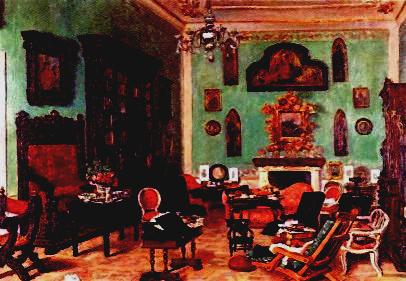
which the Brownings were present, October 1855. Robert, meanwhile, furnished the vast room in Florence
in which Elizabeth wrote (and which she said was 'like a room in
a novel') with antiques, including its great gold-framed mirror,
and paintings, many pieces resulting from the suppression of
monasteries, bought in San Lorenzo Market where, one day, he
found 'The Old Yellow Book' about a man's murder of his wife. I
have argued elsewhere that Robert may have been responsible for
Elizabeth's death.
Fanny Trollope had
written the first anti-slave novel with Jonathan Jefferson Whitlaw,
the American Richard Hildreth wrote the second one, The Slave, publishing
it within six months of hers. Harriet Beecher Stowe, who
came to Cincinatti after Fanny Trollope had left from there,
copied both their novels in her Uncle Tom's Cabin, 'the little book that
started the great war'. Hildreth is buried near his fellow
Unitarian Theodore Parker, who had preached so passionately
against slavery that Frederick Douglass, who liked to visit
the tombs of famed Abolitionists, came straight from
Florence's railroad station to it. The busts of both Parker
and Southwood Smith are sculpted by yet another American in
Florence, Joel Tanner Hart, who came from Kentucky. My own
legal name, 'Holloway', to my shame, comes from a Kentucky
slave-owning Quaker family. To my pride, I share it with a
Black Princetonian, formerly President of the Whig-Clio
Society, America's oldest debating club, who came to me when
I taught there to ask if we might be related. I almost said,
'Thee should be Dwight X, I Julia X. For neither of us is
"Holloway" our true name'.
The English Cemetery, Florence's
'God's Acre' for foreigners, where Harriet Webster Pellew
was buried in August, 1849, Kalima Nadezhda De
Santis was buried in August, 1851, Theodore Parker in May,
1860, William Somerville in July, 1860, Elizabeth Barrett
Browning in July, 1861, Admiral Fleetwood
Broughton Reynolds Pellew in July, 1861, Southwood Smith in
December, 1861, Fanny Trollope in October, 1863, Theodosia
Trollope in April, 1865, Richard Hildreth in July, 1865,
Hiram Powers in June, 1873, has monuments celebrating the
writers of books, the sculptors of statues, of those who
hated slavery and child abuse with a passion and who all
interconnect, who were each others' friends. I had to
resuscitate Elizabeth Barrett Browning's strong poetry from
oblivion, insisting on editing her, rather than writing yet
another sentimental love story as biography, sweeping
unwanted facts under the carpet. It was because of my
edition with Penguin of her poetry, that I was given the
Gatehouse of the English Cemetery in exchange for being its
Director. Fanny Trollope's anti-slavery novel has not been
in print for decades. It thoroughly deserves its
re-publication. Hiram Powers' sculpture fell from grace, was
even rejected by the United States' Congress because of its
political desire to continue slavery. Our Swiss-owned
Cemetery is a window on to American history, on to English
history, on to Italian history, on to world history. It is,
perhaps, through our Cemetery, itself so much at risk to
being closed and abandoned, that we can find truth, and
write it again true, instead of false. That
we can turn, through the alchemy of freedom, iron shackles into
golden rings.
To donate to the restoration by Roma of Florence's formerly abandoned English Cemetery and to its Library click on our Aureo Anello Associazione's PayPal button:
                THANKYOU!




__
__






 aaa
aaa