FLORIN WEBSITE
A WEBSITE
ON FLORENCE © JULIA BOLTON HOLLOWAY, AUREO ANELLO ASSOCIAZIONE,
1997-2024: ACADEMIA
BESSARION
||
MEDIEVAL: BRUNETTO
LATINO, DANTE
ALIGHIERI, SWEET NEW STYLE: BRUNETTO
LATINO, DANTE
ALIGHIERI, &
GEOFFREY CHAUCER
|| VICTORIAN:
WHITE
SILENCE:
FLORENCE'S
'ENGLISH'
CEMETERY
|| ELIZABETH
BARRETT BROWNING
|| WALTER
SAVAGE LANDOR
|| FRANCES
TROLLOPE
|| ABOLITION
OF SLAVERY
|| FLORENCE
IN SEPIA
|| CITY AND BOOK CONFERENCE
PROCEEDINGS
I, II, III,
IV,
V,
VI,
VII
, VIII, IX, X || MEDIATHECA
'FIORETTA
MAZZEI'
|| EDITRICE
AUREO ANELLO CATALOGUE
|| UMILTA
WEBSITE
|| LINGUE/LANGUAGES: ITALIANO,
ENGLISH
|| VITA
New: Opere
Brunetto Latino || Dante vivo || White Silence
THE LIFE
AND ADVENTURES OF
JONATHAN
JEFFERSON
WHITLAW
OR
SCENES ON THE MISSISSIPPI
BY
FRANCES TROLLOPE
LONDON: RICHARD
BENTLEY, 1836

TO
THOSE STATES OF THE AMERICAN UNION
IN WHICH
SLAVERY HAS BEEN ABOLISHED
OR
NEVER PERMITTED THESE VOLUMES
ARE
RESPECTIVELY DEDICATED BY THE AUTHOR
LONDON,
27 APRIL, 1836
EDITORIAL INTRODUCTION
First published in
1836 by Richard Bentley in London in three volumes, then again
in that same year in Paris by Baudry's European Library, it
was next published in 1857, with a title change, Lynch Law: The Life and
Adventures of Jonathan Jefferson Whitlaw. This novel,
in reality, is a documentary. When it was written the camera,
whether for still or moving pictures, was not yet in use.
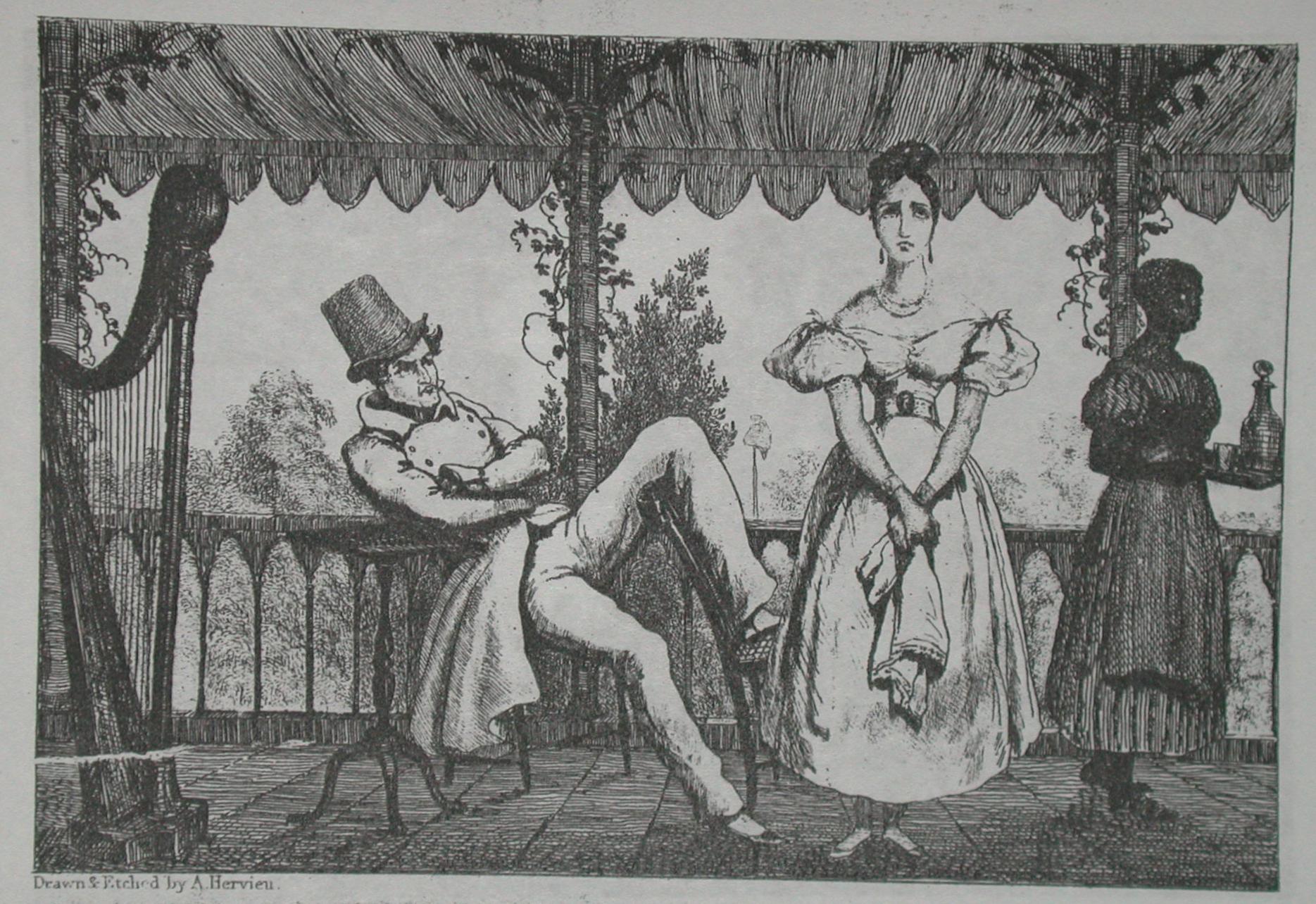
Instead, it is illustrated by Auguste Hervieu who accompanied
Mrs Trollope and her family to New Orleans, Louisiana, up the
Mississippi to Nashoba, Tennessee, and Cincinatti, Ohio. The
Englishwoman's novel, published just before the American
Richard Hildreth's The
White Slave, with that work next were used as models
by Harriet Beecher Stowe for her Uncle Tom's Cabin. As we see in its
illustrations by Auguste Hervieu, which costume its
participants in Empire and Regency style, it is earlier
than Victorian. It is high-waisted Jane Austen but with
more vinegar and more compassion. It draws upon the plays,
poems and novels of Shakespeare, Milton, Fielding, Sterne,
Smollett and Scott. It describes the barbarity of
racial lynchings which continue into living memory. I was
grateful for the opportunity to speak of it at the
University of Arkansas, fifty years after the Little Rock
Nine had, with great courage, risked their lives to end
segregation in American schools.
We re-publish this novel in honour of Frances Trollope
who, with four other members of her household, her
daughter-in-law Theodosia, Theodosia's father, Joseph
Garrow, and Theodosia's half-sister Harriet Fisher, and
their maid, Elizabeth Shinner, are all buried in
Florence's 'English' Cemetery. For years these vivid and
direct observations of slavery written into the pages of Jonathan Jefferson Whitlaw
have been silenced, the book allowed to go out of print.
Nor has the history of the 'English' Cemetery been
explored until recently, to find that it is filled with
anti-slavery advocates, among them, Elizabeth Barrett
Browning, Thomas Southwood Smith, Theodore Parker, Hiram
Powers, Richard Hildreth, and even buried here is the
black slave who at fourteen years of age was brought to
Florence from Nubia and who was baptized in a Russian
Orthodox family with the name of Nadezhda, which means
'Hope'. Frederick Douglass visited this cemetery, in
particular the graves of Theodore Parker and Elizabeth
Barrett Browning, to honour their eloquence that effected
his freedom.
Jeannette Marks published, in the year of my birth, a book
on Elizabeth Barrett Browning's Jamaican slave-owning
background, The Family
of the Barrett. For years, this book, like
Trollope's, was neglected and ignored. Elizabeth
Barrett Browning, herself of slave-owning stock and indeed
of slave stock, over-reacted to Frances Trollope's novel
as too close to home. Indeed, the death of one of its
heroines was to be like her own, from an overdose of
laudanum. The essay EBB submitted on Fanny to Hengist
Horne's New Spirit of
the Age is an appallingly vicious attack upon
her. The two famous women writers were, in time, to come
to be in the same city, Florence, to die there, and to be
buried together in her 'English' Cemetery outside the
medieval walls, along with so many others deeply involved
in slavery and its abolition.
A further reason for my desire to republish this novel,
along with Elizabeth Barrett Browning's anti-slavery
poetry, her sonnet to Hiram Powers' 'Greek Slave', and her
'Runaway Slave at Pilgrim's Point', is my own marriage to
a descendant of Kentucky Quaker slave-owners. His aunt's
real name 'Bertha Gertrude' was always instead given as
the far more beautiful 'Chloe May', the name of my
husband's grandfather's beloved Black 'Mammy'. We see in Jonathan Jefferson Whitlaw
the wonderful names, 'Clio, Portia, Phoebe, Juno'. In my
husband's family there were two histories, that they sold
their slaves down river, that they freed them, when they
pulled up stakes and went on to Texas to herd cattle,
then, further, to California at the Gold Rush. My husband
from reading Aristotle on women being less than slaves,
scoffingly called me 'Aristotle's creature', and
considered me sub-human. Trollope's Juno heals those
wounds. Once, at Princeton, the President of their
Whig-Clio Club, the oldest debating society in America,
founded in the 1760s, came to my office to ask if we might
be related. I felt like saying 'We share the same name
because of a slave-owner and, yes, we might be related by
marriage and less than marriage'. A ninety-year-old Quaker
woman doctor came bustling up to me at Philadelphia Yearly
Meeting to ask 'Is Holloway thy name or thy married name', to
which I answered 'It is my married name. My Quaker
ancestors were Cashes, Frys, Cadburys and Glorneys from
Coventry, Norwich and Dublin, not from Kentucky'.
There is a derogatory word used throughout the novel - but
it is only placed in the mouths of the novel's villains.
Among the villains, the chief one, in fact, though
masquerading as hero, a 'whited sepulcrhe', is Jonathan
Jefferson Whitlaw, whose 'white laws' are those of racial
injustice, slavery and lynching. The author and the true
heroes and heroines, black and white, speak instead of
'negro' and 'negress' with dignity, respect and love. My
son, Richard Holloway, photographed the people of whom
Jonathan David wrote in Together
Let Us Sweetly Live, where the praying and
singing bands of blacks are celebrated and which show the
results of such liberating missionary movements from early
times amongst the slaves. This is the world of Edward and
Lucy Bligh, decades later, almost two centuries later,
still celebrating faith in the midst of despair. Indeed
there is a continuum between the freeing celebrations of
people by Frances Wright, Frances Trollope and Auguste
Hervieu, by James Agee and Evan Walker, by Jonathan David
and Richard Holloway, and by Karen Graffeo in her
photographs of the Roma in Europe, which deserves
recognition, not the silencing that has been meted out to
this novel for nearly two centuries.
We shall find Auguste Hervieu and Frances Trollope
differing on the spelling of Mohanna/Mohana Creek, and of
Riechland/Reichland. But they both witness just such a
family shivering with ague on the banks of the
Mississippi, Hervieu sketching them first for Domestic Manners of the
Americans. Indeed that other book by Anthony
Trollope's mother serves as the Writer's Diary from which
this novel is constructed, just as much as do the
Hawthornes' Diaries become Nathaniel Hawthorne's Romances.
Principally, Jonathan
Jefferson Whitlaw is a novel about families, the
Whitlaws, the Steinmarks, the Blighs, amongst the whites,
and black families fractured by slavery, Phebe's family,
and Juno's family. Of these we should read the Steinmark family as an
idealized portrait of Frances Trollope's own household
that worked so energetically against slavery.

A Louisiana Love Scene
ILLUSTRATIONS TO JONATHAN
JEFFERSON WHITLAW
Click on titles for full size images
VOLUME THE FIRST
A LOUISIANA LOVE SCENE
BIRTH OF JONATHAN JEFFERSON WHITLAW
DEPARTURE FROM MOHANNA CREEK
JONATHAN JEFFERSON'S VISIT TO REICHLAND
A STORE AT NATCHEZ
VOLUME THE SECOND
A PLANTER'S LADY
MRS SHEPHERD'S WORK-ROOM
CLEAR-STARCHING IN LOUISIANNA
A BILLIARD TABLE AT NEW ORLEANS
A LOVER'S VENGEANCE
VOLUME THE THIRD
JUNO'S LAMENT OVER THE LAST OF HER RACE
LUCY BLIGH AND THE CHOCTAWS
EDWARD BLIGH'S FAREWELL TO HIS
CONGREGATION
LYNCH LAW
RETRIBUTION
For Harvard University's copy see Google Books:
http://books.google.it/books?id=oTAWAAAAYAAJ&printsec=frontcover&dq=Frances+Trollope+Jonathan+Jefferson+Whitlaw&source=bl&ots=hiFiQ94CLK&sig=x1yV7jeW-W-uRLGiBJC_ybZZYtw&hl=it&ei=MSJ5TeHqGIbIswauyangBw&sa=X&oi=book_result&ct=result&resnum=1&ved=0CBcQ6AEwADgK#v=onepage&q&f=false
THE
LIFE AND ADVENTURES OF
JONATHAN JEFFERSON WHITLAW
CHAPTER I
 t
one of those bold sweeps of the Mississippi river which
occasionally vary the monotony of its scenery by giving a
portion of its dark, deep waters the appearance of a lake,
may yet be seen the traces of what was once - some dozen
years ago perhaps - a human habitation. The spot is
fearfully wild, and possesses no single feature of the sweet
heart-cheering beauty which a lover of Nature would select
for the embellishment of his familiar home; yet it is not
altogether without interest, - that species of interest, at
least, which arises from a vague and shadowy outline, and
the absence of every object, either of grace or of
deformity, which might lower by its insignificance the
effect of the moody grandeur that seems to brood over the
almost boundless plain through which the father of waters
rolls his mighty waves.
t
one of those bold sweeps of the Mississippi river which
occasionally vary the monotony of its scenery by giving a
portion of its dark, deep waters the appearance of a lake,
may yet be seen the traces of what was once - some dozen
years ago perhaps - a human habitation. The spot is
fearfully wild, and possesses no single feature of the sweet
heart-cheering beauty which a lover of Nature would select
for the embellishment of his familiar home; yet it is not
altogether without interest, - that species of interest, at
least, which arises from a vague and shadowy outline, and
the absence of every object, either of grace or of
deformity, which might lower by its insignificance the
effect of the moody grandeur that seems to brood over the
almost boundless plain through which the father of waters
rolls his mighty waves.
There is in truth an unbroken vastness in the scenes
displayed at many points of the Mississippi river that
seizes very powerfully on the imagination; and though
composed for the most part of objects that chill and revolt
the mind, the combination of them would, I think, detain the
eye for some short space from many a fairer landscape, were
it possible that such could rise beside it.
Unwonted to European eyes, and mystically heavy, is the
eternal gloom that seems settled upon that region. Whatever
wind may blow - however bright and burning that southern sun
may blaze in the unclouded sky, the stream is for ever
turbid, and for ever dark, turning all that is reflected on
its broad breast to its own murky hue, and so blending all
things into one sad, sombre tint, till the very air seems
tinged with gray, and Nature looks as if she had put on a
suit of mourning to do honour to some sad solemnity. Nor can
one look long upon the scene without fancying that Nature
has indeed some cause to mourn; for at one moment an
uprooted forest is seen borne along by the rapid flood, its
leafy honours half concealed beneath the untransparent wave,
while its faithless roots mock the air by rearing their
unsightly branches in their stead. At another, the sullen
stillness is interrupted by a
blast that will rend from the earth her verdant mantle
- there her only boast, and leave the groaning forest, crushed,
prostrate, unbarked and unboughed, the very emblem of ruin,
desolation and despair.
It is perhaps this very perfection of melancholy dreariness
which creates the interest experienced on viewing the singular
scenery of the Mississippi. But though one may feel
well disposed to linger for a moment to gaze on its strange and
dismal vastness, it offers little to tempt a longer stay. The
drowsy alligator, luxuriating on its slimy banks, or
the unsocial bear, happy in the undisputed possession of its
tangled thickets, alone seem formed to find prolonged enjoyment
there.
Yet this was the spot selected and chosen, at no very distant
period of the earth's history, as the abode of a man
who nevertheless had all the world before him where to
choose; and, what is perhaps more extraordinary still, he
never either regretted his choice, or felt the slightest
inclination to change his habitation for the space of at
least ten years after he made it.
This chosen spot was thenceforward distinguished by the name
of Mohana Creek; an
appellation borrowed from a deep ravine not a hundred yards
distant from it, which during the winter and spring carried
a huge stream of pine-stained water to the river.
It was indeed this valuable creek which attracted the
careful and skilful eye of Jonathan Whitlaw,
and
finally led him to select its vicinity for the erection of a
permanent dwelling for himself and his family.
What the original cause might have been which induced Mr
Jonathan Whitlaw to 'squat in the bush' (as the taking
possession of any heretofor unappropriated land is called in
Transatlantic phrase), was never, I believe, very clearly
understood; and as the point is not likely to be one of much
interest to the general reader, I will not delay the
progress of my narrative by repeating the various
conjectures on the subject which have reached me: it is
sufficient for my purpose to state, that about three o'clock
P.M. on a certain Tuesday in the month of
April 18--, a very small boat, formed of unpainted deals,
with nothing but a few articles of old household furniture
for its cargo, and two women, one man, and a dog for its
crew, came down the stream, and by the aid of its paddles
was brought within grappling-reach of the bank immediately
above Mohana Creek.
Little and light as was her lading, the boat was deep in the
water, and the two women had perched themselves with the
feet drawn up on an old chest, that formed the most
substantial part of the cargo, in order to keep themselves
out of the water, which a very considerable leak was
permitting to enter in such abundance as to render the frail
craft not only very uncomfortable, but very unsafe.
'By the living Jingo', cried the man, springing on shore,
'it is time to be smart, or we shall be going down where
nobody ever comes up. Be spry, gals!' he continued,
stretching out his hand to assist the disembarkation of the
females: 'you hold her fast on with the hook, Portia, till I
can grapple her tight to a tree; and you, Clio, look sharp
and fix them notions safe and dry on shore as fast as I can
pitch them at ye'.
The individual who thus, in the true Columbian style, now
planted his foot on the land, and thereby took possession of
it, was a powerful muscular man somewhat past thirty. His
features were regular, and might have been called handsome,
had the expression of his countenance been less unpleasing;
but labour and intemperance had each left traces there.
The women who were his companions appeared both of them to
be under twenty, and of the very lowest order of society. Their
garments
were
scanty
and
sordid,
and they had much the look and air of that poorly-paid class
known in every manufacturing town in the United States as
'the gals of the factory'.
Whatever else they might be, however, they seemed to possess
one excellent feminine quality to perfection, - they were
most 'obedient to command'; and though one of them was very
evidently in a state which rendered her little fit for hard
work, they both of them readily and actively performed the
task allotted to them, till the boat was disembarrassed of
all the load she had carried, save the water - and that was
visibly increasing upon her rapidly.
'It don't signify thinking of anything else,' observed Mr
Jonathan Whitlaw, 'till I have saved them elegant
sawed planks. Wood is plenty enough, and to spare, no doubt;
but sawing is sawing all the world over, so you must jest
wait a spell, gals, till I'm ready to fix you: and if you
will but bide clever a bit, and say not a word till I bid
you, why then I'll set to fix you and all your notions about
you outright, as slick as may be'.
A goodly axe being part of the treasure landed, it required
but a few minutes to demolish the frail vessel, and deposit
her timbers on the bank. This done, Jonathan Whitlaw turned
to his wife and his sister, nothing dismayed, as it should
seem, at the apparent impossibility of leaving the dreary
spot on which they stood; and having filled the hollow of
his left cheek with tobacco, and settled himself in his
ill-fitting attire with sundry of those jerks and tugs
incomprehensible to all who have not looked at the natives
of the New World face to face, he thus addressed them:
'Well, now, this is what I call a right-down elegant
location. D'ye comprehend the privilege of that handsome
creek, gals? Maybe you don't, and maybe I do. Mind now what
I say: if that creek don't prove as good as a dozen axes,
say my name's not Jonathan',
'My!' - exclaimed the matronly Portia, drawing her thin
shawl more tightly round her; for the April sun, though it
had almost scorched them on the river, could not prevent the
deep, dank shade of the spot from sending a cold shiver
through her limbs. 'Well, now, Jonathan, but that will be
considerable convenient anyhow'.
'I expect so,' replied the man, folding his arms, and
turning himself slowly round to every point of the compass
to ascertain the capabilities of the spot for the
'improvements' he meditated, 'I expect so', he repeated with
an absent air, as if his faculties were wholly absorbed by
the examination he was making.
To an unpracticed eye, a single glance might have seemed
sufficient to discover everything that the desolate spot had
to show. Before them spread the mighty mass of muddy waters,
bounded, as it seemed, on all sides by the matted foliage of
the level forest, above whose unvaried line sprang the high
arch of heaven. Beneath their feet was a boggish, peat-like
soil, that looked as if occasionally it might itself become
a part of the swollen river's bed. Around them rose
innumerable tall, slender trees, between whose stems the eye
could not penetrate two hundred yards in any direction, so
thickly was the ground covered with an undergrowth of
bear-brake and reeds.
To an unpracticed eye, one glance would have been enough,
and too much, to show all that could there be seen; unless
the next might have discovered a friendly bark upon that
muddy stream, which might have borne the gazer from it for
ever.
But with Jonathan Whitlaw the case was very different.
Not a stem, not a stick, not a reed, not a hollow half
filled withh stagnant water, nor a crevice that might
facilitiate its escape, but was examined with as much
earnest attention, and reasoned upon with as much provident
wisdom as might suffice to decide the locality of a palace.
The women meanwhile again seated themselves on the chest
which had done them such good service in the boat, and for a
time sat silently watching the master of their destiny as he
mediated in the secret council-chamber of his own breast the
plans on which it hung. A low whispering then commenced
between them, the result of which was a half-timid,
half-coaxing attempt on the part of Clio, the bolder
spirited of the two, to draw his attention from the future
to the present.
'I say, Bub', she began, 'I say, - do you know that Porchy
and I are right down dead almost for summet to eat? I can
get at the bag with the corn-cakes in no time. Shall I,
Jonathan?'
Jonathan turned his quid of tobacco deliberately from one
cheek to the other, and then replied,
'I'll tell you what it is, sis, - we are here - no matter
why, - Perhaps 'tis because I happen to like this here part
of the country best - but at any rate here we be, and I can
tell you that here we must bide - but as to spending our
days in nothing but eating, it's what I'm not provided
for. Now look you, both of you, and I'll tell you the case
at once. The nearest town to this here bit is Natchez, and I
calculate that is not over nigh for a walk through the bush,
seeing it can't be less than twenty miles right a-head. I
won't say that we can't buy a bushel of corn-meal no nigher,
but I won't say that we can; but this I will say, that near
or far, we shan't never get it at all without having the
Spanish wheels ready, I expect; and concerning that
commodity I'll tell you no lies, - I have got no more of it
than a mouse might carry easy at full trot. But, however,
there stands the meal-tub chock full, and dry as a ripe
tassel, - I took care of that. And here's five gallons of
whiskey, and there's my axe, and here's my arms', baring
them as he spoke to the shoulder. 'So be good gals, and I'll
fix a palace for you; but don't be for everlasting talking
of eating, jest in the beginning, - I shall be wrathy enough
if you do, I tell you that: so mind and say no more about
it, but each of you take a drop with me, and you'll be after
helping me build in no time'.
With a celerity which showed the effect of habit, Jonathan
Whitlaw produced a horn from his pocket, and skilfully
appying it to the little cask, drew forth what he considered
as a fitting portion for each, and presented it in
succession to the two females. This generous and gallant
office performed, he swallowed a treble dose himself, and
instantly set to work.
His prophecy was speedily fulfilled - the poisonous
inspiration did its work, and under its feverish influence
the young women dragged and pulled, and pushed and carried,
according to his orders, with a degree of strength and
perseverance greatly beyond what their age and appearance
promised.
The increase of vigour which he had himself acquired from
the draught showed itself not only in the activity with
which he laboured, but by a more than ordinary degree of
loquacity - a part of which may serve to explain his future
plans.
'This here tree must down smack - and them there three small
ones into the bargain; then this one, and that one, and they
two t'others, shall have their heads and branches cut off
slick; and there's the four corners of the house as clean as
a whistle, and we must roll up the logs around them. I say,
gals, don't I know the river? I expect this will prove the
most profitable privilege of a wooding-station of any 'twixt
New Orlines and Cincinnati. What with that there elegant
creek, and this here handsome elevation' (the spot selected
for his house was at this time at least six or seven inches
above the level of the river); 'and what with them there
capital hickories, and this dreadful beautiful sweep in of
the river, that will bring the steamers up to me whether
they will or no; - I say, gals, that if things do but go on
at New Orlines as bravely as they do now, I'll make dollars
enough, by wooding their boats for 'em, to open a store for
all the notions in creation at Natchez, before ten years are
out. Why, since we've landed I've see half a dozen
first-rate timbers shoot the creek; and I'll soon see if I
can't find a way to stop 'em short, as soon as I've got a
pair of hands to spare'.
While his tongue was thus active, however, the hands he
talked of were by no means idle. The rapidity and apparent
ease with which trees were felled, and the allotted space
cleared, might have been mistaken for an effort of more than
mortal skill by any but a back-woosdman. What was to
Jonathan Whitelaw the work of one stroke of the axe, would
to any unused to the mystery have required a dozen; and
where the unskilled would have raised the instrument on
high, and brought its edge and weight to bear with a violent
exertion of strength, he achieved the object with an easy
dexterity, which seemed not to require one half the power
that the brawny arm which wielded the axe could well have
bestowed had it been needed.
Notwithstanding all that skill and perseverance could do,
however, the sturdy woodsman and his tottering assistants
were overtaken by darkness ere they had completed such a
shelter as might permit them to sleep securely on the spot
they had chosen.
A shed on the banks of the Mississippi, twenty miles above
Natchez, may now perhaps be considered as tolerably secure,
except from the occasional visits of an exploring bear, or
the rambling propensities of an hungry alligator: but in the
year 18-- it was much less so; and as the leaden gloom of
the short twilight settled upon the woods, the bold squatter
was fain to suspend his labour, with no better comfort for
his weary companions than a confession that, after all, they
should not be able to get a spell of sleep except turn and
turn about, because they might be waked by the varment, with
half a leg eaten off, before they had done dreaming.
'I expect I must die then, Jonathan', said the poor young
wife, in a voice so feeble as somewhat to alarm her
companions, - 'I expect I must die before morning'.
'You a back-woodman's lady, Porchy', said her husband,
approaching her, 'and talk of dying the first night that you
gets to the bush! Come come, gal, no faints, or my dander
will be up pretty considerable. Here, Cli, shake down the
straw bed upon that there lot of boughs, and give her that
sack of notions for her head, and she will be fast and
snoring in no time; and then you and I will be after
kindling an elegant blaze to scare them devils the varmint -
bears, painters, wolves, alligators, and all'.
Poor Clio promptly set about performing this new task, and
with much tenderness assisted the over-worn young wife to
lay herself as much at her ease as her rude couch might
permit: but while thus engaged, another whisper was
exchanged between the sisters, which produced exactly the
same petition as the former one, some five or six hours
before.
'But I say, Bub,- I expect Porchy will never sleep a wink
unless you give her a morsel to eat first'.
'One word for Porchy, and two for yourself, eh, Cli?'
Howsomever, you have been considerable good gals both of ye;
so you shan't ax for nothing, this time'.
If the hungry Clio was alert before, she now became doubly
so, as she sought and found the bag containing the treasured
corn-cakes.
'Well now! - wouldn't a herring grilled over a handful of
stikcs be first-rate?' said the poor girl coaxingly, and
holding up the tempting morsel she had found, before the
eyes of her brother.
'Why, I can't say but what I expect it would be eatable',
replied the autocrat, producing flint and steel; 'so pick up
your sticks, Cli, and set about it'.
With zealous activity, the now happy Clio prepared to obey
the welcome mandate, and showed almost as much skill and
dexterity in selecting and kindling the boughs which lay
scattered round her, as her brother had done in strewing
them.
In a few minutes a thick column of smoke rose through the
still air, the faggots crackled, and the herring, as it hung
suspended over the flame from the ingenious machine erected
for it, sent forth an odour so powerful and enticing, that
when it reached the nostrils of the half-famished Portia,
she rose with renovated strength, and approached the
manifold comforts of the blazing fire, The three weary and
hungry wanderers then sat down around it, and devoured their
repast with as great a degree of enjoyment as it is possible
for the act of eating to bestow; and even the dog, though in
general expected to provide his own meals, was not
forgotten. To complete the luxury of the banquet, Jonathan
dipped their one precious iron crock into the muddied but
sweetest of streams, and having boiled it, permitted the
ladies, in compliance with the delicacy of their ordinary
habits, to mix it, in the proportion of half and half, with
the one and only liquid which he deemed worthy to enter the
lips of a free-born man. In his own case, therefore, he
suffered not the vital stream from his beloved whisky-keg to
be contaminated by the admixture of any alloying Mississippi
whatever; and the portion he permitted himself to swallow
was, as he said, in just proportion to the work he had done.
The repast ended, the weary Portia once more stretched
herself upon her welcome bed of straw; while her companions
were employed, first, in removing the thickly-scattered
branches from the immediate neighbourhood of the fire, to
guard against that most fatal of forest disasters, a
conflagration amongst thick underwood, where there is no outlet
for escape; and then in collecting together, at safe
distance, such a quantity of them as might supply their
watch-fire during the night. This
done, the residue of the corn-cakes carefully tied up and
slung upon a bough, and the invaluable crock as
scrupulouslyt attended to as if it had been a silver
casserole, the gracious Jonathan told his yawning sister
that she too might lay herself down beside his sleeping
wife; adding, that when daylight came, he would wake them
both, and turn in to take a spell himself.
In less than five minutes Clio was as deeply asleep as her
friend Portia; and Jonathan, seated on the hearth with his
dog beside him, and supporting his back against a tree,
prepared to endure his weary watch, which the low long howl
of wolves in the distance already showed to be no
unnecessary precaution; and so strong is the instinct of
self-preservation, that the united influence of labour and
whisky failed to overpower the feeling which kept the aching
eyes of the wanderer open through the long hours of that
painful night.
However miserable beyond endurance the fatigues and
privations above described may appear to the European
reader, they form no exaggerated picture of that tremendous
enterprise, the first 'settling in the bush' on the
Mississippi, at the period at which my tale commences. The
undertaking is even now one both of danger and difficulty;
though both are now greatly lessened by the comparatively
near neighbourhood that the new settler is likely to find,
let him place himself at what point of the river he may,
below its junction with the Ohio. Whenever a new settler
arrives it is now the custom for about a dozen of the
nearest residents to assemble at the spot he has chosen, for
the purpose of assisting him to rear his log-hut; the only
payment expected for this timely service being a 'pretty
considerable' allowance of whisky, to be socially swallowed
before the party separates: so that it generally happens
that the first sleep taken by the stranger in his new abode
is long and sound, though perhaps not particularly
refreshing.
Such is the custom of the present time; but two or
three-and-twenty years ago, the stout-hearted pioneer of
population on the distant and unhealthy banks of this
singular river must have perished for want of a shelter if
incapable of providing one for himself.
The laborious but very profitable employment of supplying
the innumerable steamboats with fire-wood, which now bribes
so many to brave ague and privation of all kinds, was then
in the hands of very few; and none who ventured to embrace
it could hope to do so without encountering at least as much
of danger and difficulty as Jonathan Whitlaw.
CHAPTER II
 t
is not my intention to enter upon a lengthened detail of the
'get along' process of Jonathan Whitlaw in his new abode:
the events I wish to dwell upon are of more recent date. It
will therefore be sufficient for my purpose to state, that a
spirit of industry which even intemperance could not
conquer, enabled him to raise, unaided by any hands but
those of his female companions, such a shelter as appeared
completely to satisfy the wishes of those for whose use it
was constructed. What praise could the most skilful
architect desire more? Nor were their daily necessities less
fully answered: Clio had often the supreme enjoyment of
banqueting on a grilled herring; Portia had never yet seen
the bottom of her meal-tub; and Jonathan's shanty soon came
to be so well known to the flat-boat traders going down, and
the steam-boat traders going up the river, that there was no
need of his taking a journey to Natchez to ensure the
replenishing of his whisky-cask.
t
is not my intention to enter upon a lengthened detail of the
'get along' process of Jonathan Whitlaw in his new abode:
the events I wish to dwell upon are of more recent date. It
will therefore be sufficient for my purpose to state, that a
spirit of industry which even intemperance could not
conquer, enabled him to raise, unaided by any hands but
those of his female companions, such a shelter as appeared
completely to satisfy the wishes of those for whose use it
was constructed. What praise could the most skilful
architect desire more? Nor were their daily necessities less
fully answered: Clio had often the supreme enjoyment of
banqueting on a grilled herring; Portia had never yet seen
the bottom of her meal-tub; and Jonathan's shanty soon came
to be so well known to the flat-boat traders going down, and
the steam-boat traders going up the river, that there was no
need of his taking a journey to Natchez to ensure the
replenishing of his whisky-cask.
He had, in truth, chosen his location well. With a species
of skill and exertion peculiar to himself and his class, he
contrived to abstract from his elegant Mohana Creek so many
uprooted trees, that till the dry summer months stopped the
supply, he had rarely occasion to fell one for the
construction of the well-packed piles of wood, which it was
the especial province of the strong-armed Clio to
arrange upon the river's bank. To use his own language,
'Natur was in partnership-like with him,' and being a
partner that never slept, he not unfrequently found leisure
himself to take a spell in the bush with his rifle, an
instrument which he used as skilfully as the axe. The result
of this agreeable variety of occupation was, that Clio was
almost as often employed to roast a turkey, as to grill a
herring; and the table constructed of the timbers of his
flat boat not unfrequently smoked with a service of game
which an European board might have been proud to boast.
Meanwhile that hour, important alike in the palace or the
hut - at least to the individual most concerned in it -
overtook poor Portia; and on returning one evening from a
'gunning frolic' in the forest Mr Jonathan Whitlaw was
greeted with the intelligence that he was the father of a
thriving boy.
Clio, whose genius for usefulness seemed universal,
performed the duties of a nurse both to mother and child as
successfully as if she had studied the profession at the Hospice de la Maternité
at Paris; and when she presented the new-born babe to her
brother, she felt as much pride in the office as if
conscious that she held in her arms a latent President.

Birth of Jonathan
Jefferson Whitlaw
Jonathan, too, though not
particularly susceptible of the tenderer feelings of our
nature, looked on the boy with considerable satisfaction.
'That's jam, gal,' said he, addressing his wife. 'Boys be
the right sort for the bush, mind that. Not but what Cli is
up to a thing or two, too. But boys is most profitable,
that's a fact. I calculate now that this younker will be fit
to turn a dollar one way or another by the time ten years is
gone done; and if we can keep him from starting for five
more -'
But here our hero gave so prodigious a squall, that Clio
started off with him to his mother, and the remainder of the
predicition was left unspoken.
However favourable it might have been, however, the years
which followed gave the provident father no cause to think
his first impression respecting his heir were in any degree
too favourable. Jonathan Jefferson Whitlaw, for so was the
young back-woodsman named, testified innumerable qualities
that might have justified the hopes of the most sanguine
father in America. Spite of occasional 'shaking' he was
stout in limb; and considering the rather restricted nature
of his position as compared to society at large, his
knowledge and intelligence increased with surprising
rapidity.
Never certainly did any child, even among the most
precocious wonders of the European world, display a more
eager desire of profiting by every opportunity of acquiring
information and experience than the young Jonathan
Jefferson. No steam-boat ever approached his father's
station from the time he completed his third year, without
finding him standing at the very extremity of the log
platform that projected from the bank for the convenience of
the engine-men who took their fuel there, and happy was
Jonathan Jefferson when it chanced, which was not
unfrequently, that his keen black eyes and curly head
tempted some good-humoured idler to give him a hand, that he
might spring on board and gaze upon the wonders to be seen
within her. These favours were requited by so knowing and
fearless a nod on the part of the young explorer, that the
first playful act was often followed by very active
patronage as long as the operation of 'wooding' lasted; and
the bold boy generally returned to his sickly mother, or his
much better loved aunt Cli, with nearly all his scanty
garments held up in a most firm and careful grasp, lest the
biscuits, raisins, apples, and cents bestowed on him by the
passengers should escape.
At the age of five, if any old acquaintance held out the
accustomed hand to aid his boarding, it was thrust aside by
a saucy action of the little sturdy elbow, and Jonathan
Jefferson was on the deck, in the cabin, beside the engine,
or in the inmost recesses of the steward's pantry, before
any one knew where he came from.
It will be readily supposed that a man like Jonathan Whitlaw
did not suffer the abilities of such a boy as this to remain
idle. He was early given to understand that all he ate, he
must earn; and as he soon manifested a family affinity to
his good aunt in his love of a savoury morsel, the prudent
father failed not to turn this discriminating palate to
advantage, selling every shot of his own rifle for a due
proportion of labour performed in building up the cords of
wood, or in exploring the creek, by his active boy.
Not only one, but many dollars had the child earned or
turned in some way or other, before the ten years named in
his father's prediction had elapsed. Nor had the the
stalwart woodman gone half as far in his daring hopes for
the future, formed for himself when first he stood houseless
and hungry on the swampy bank which he had selected, as the
result justified. No wood was so well cut and so well
'sawed' as Whitlaw's: no woodsman was so ready in counting,
so quick in settling, and so every way convenient for men in
a hurry to deal with, as this our fortune-favoured squatter.
Ague and fever seemed to keep clear of him lest they should
be baffled in the strife, and turning from his close-knit
iron frame, poured all their vengeance on his poor shrinking
wife. But Clio, whose constitution bore a close resemblance
to his own, still continued his zealous and most efficient
fellow-labourer. After 'shaking a spell' during the autumn
of the first year or two, she too defied the foul fiend that
haunts the western world in the shape of ague, and
thenceforward appeared to suffer no more from the climate
than the wolves and the bears, which the busy noises of
their active establishment had driven back into the woods.
At the end of the third year, a cow, whose coat seemed to
indicate some affinity to her neighbouring bears, was added
to the 'plenishing of the lot'; and the omnipotent Clio
contrived to sell the best milk on the river to all the
yellow-tinted or woolly-headed stewards, whose interest it
is to make the breakfasts, dinners and suppers on board the
steam-boats atone by their excellence for the tedious hours
between. Good store of hogs, which grubbed most delicate
fattening in the forest, contributed not a little to the
family fund of wealth and good living; and lastly, an
additional room was added to the shanty, over the door of
which directly fronting the river, was inscribed with red
paint in letters of a foot high -
WHITLAW'S WHISKY STORE.
The cents, fips, picciunes, bits, levys, quarters, halves,
and dollars, which in the course of four years' - were left
within this shed, very greatly exceeded the most sanguine
calculations of Whitlaw; and as 'Prime Bacon' - 'Capital
Chewing Tobacco'
- 'First-rate Domestic' and 'Fine Meal', were successively
added to the announcements, the store soon became the
resort of every squatter within ten miles, as well as the
favourite stopping-place of all the craft on the river.
The son and heir of this prosperous settler had just
completed his tenth year, when an accident occurred to him,
the consequences of which entirely changed the position and
circumstances of his family.
Early in the month of August 18--, one of the noblest and
largest steam-boats ever launched on the Mississippi was
seen to bend gracefully round the projecting swell of the
bank below Mohana Creek, and approach the landing-place in
front of the store.
Young Whitlaw was occupied, at the moment she came in sight,
in poking a long pole into a hole in the bank, in which he
fancied he should find some 'crocodile's eggs'. Struck
by
her splendid appearance, he left his employment, and placing
himself at his accustomed post on the edge of the platform,
impatiently awaited her arrival.
Before the steam had been let off, or the paddles ceased to
play, the impatient boy decided to spring on board, and
trusting to his pole, which he fixed, as he thought, firmly
on the platform, he attempted to swing himself into the
vessel - a distance of at least twelve feet. So active and
well practised were his young limbs, that it is probable he
would have succeeded, had not the slippery log on which he
had placed his pole permitted it to give way at the very
moment its firmness was most essential to his safety, and
the instant it sank from his hand the adventurous child fell
headlong into the water.
Above two hundred persons saw the accident; and the boy's
greatest danger now arose from the variety and eagerness of
the measures put in practice to save him. But it appeared
that the little fellow never lost his presence of mind for a
moment, for, without paying the slightest attention to the
contradictory cries of 'Hold fast to this rope' from one
quarter, and 'Catch by this tub' from another, the bold boy,
who swam like an otter, deliberately turned from the
dangerous projection of the gallery, and marking the moment
when the open gangway approached, sprang upwards, seized its
railing, and in an instant stood unharmed on board the boat.
That awful peculiarity of the Mississippi river, which
causes it to bear away whatever sinks beneath its surface
beyond the reach and power of the most skilful search that
would recover it, is so well known to every inhabitant of
the region, that the sight of a human being falling into its
fatal wave creates a much stronger sensation than any
similar accident would do elsewhere. Young Whitlaw,
therefore, was instantly surrounded by a crowd of anxious
and friendly faces.
'A pretty considerable escape you've had, my boy', exclaimed
one.
'Your fate is not drowning, at any rate, you young devil',
cried another.
'A famous swimmer you are, and that's a fact, boy,' observed
a third.
'And a bold heart as ever I see', observed a fourth.
'Are you not wet to the skin, my poor fellow?' inquired a
kind-hearted gentleman, shuddering sympathetically.
'And what does it signify if I be', replied the boy with an
accent which implied more scorn than gratitude. 'But I say',
he continued, fixing his eyes on a very handsome rifle which
the compassionate gentleman held in his hand, 'what will you
sell that there rifle for?'
The offended philanthropist turned away, muttering,
'Impudent young varment!' or some such phrase, while a
chorus of laughter from those around testified the general
feeling of admiration excited by the dauntless spirits of
the saucy boy.
There was one spectator, however, who, though by no means
less observant than the rest, had hitherto only looked on in
silence. He remarked that the boy followed the rifle with
his eyes as the indignant bearer of it walked away; and
wisely judging that it was Jonathan Jefferson's innate love
of barter which had dictated the question, and no idle
ebullition of impertiinence, as the mistaken laughers
imagined, he determined to find out who it was, who at so
early an age evinced such undaunted courage, a wit so ready
at command, and a disposition for bargain-making which, even
at a moment so agitating, did not forsake him.
The observant and judicious stranger continued to keep his
eye fixed on the boy, but did not address him till the crowd
which had witnessed his escape was dispersed, and then,
laying a hand gently on his shoulder, he said - 'What is
your name, my fine fellow?'
'Jonathan Jefferson Whitlaw', replied the boy civilly: for
he looked up into the inquirer's face as he addressed him,
and a something, which, if it be not instinct, it would be
difficult to name, whispered to him that he was rich.
'Jonathan Jefferson?' replied the stranger; 'a good name
that, boy, - an exceedingly good name: I expect your
father's no fool. Who is your father, my good lad? Where do
you come from?'
'My father is a first-rate capital back woodsman, and we
keep a store; and that's Aunt Cli milking our own cow for
the steward, and I sell all the skins I can snare, and I've
got an axe of my own'.
'Can you read, my boy?
'No.' responded Jonathan Jefferson in an accent somewhat
humbled.
'Will you work for me, and do all that I bid you, if I take
you home with me and have you taught to read?'
The cautious child did not immediately reply - and at this
moment the bell was rung which gave the signal for
departure.
'Off with you, my lad', cried the steward as he stepped on
board with his jug of milk, 'or we shall run away with you'.
The boy's eyes were still fixed on the face of the person
who had addressed him, as he stepped towards the edge of the
boat preparatory to springing on shore, but the important
question was still left unanswered.
'I shall stop here again, perhaps, coming down,' said the
stranger, nodding to him; 'and I will come on shore and see
you again, and then you shall answer me'.
When the labours of that eventful day were ended, and the
family were assembled round the evening meal, young Whitlaw,
after a silence of several minutes, said abruptly, 'Father!
- why can't I read?'
The question seemed a puzzling one; for the person to whom
it was addressed repeated the words twice over before he
attempted to answer it.
'Why can't you read, boy? - why can't you read? Well, now,
if that don't beat all natur! When did ever a body hear such
a question from a brat of a chicken, and he but ten years
old this very month?'
As this speech seemed to be addressed, like most of Mr
Whitlaw's speeches, to his sister Clio, it was his sister
Clio who answered it.
'Well now, Bub, I'll tell you a piece of my mind: you'll
find no good reason, if you look from Georgia to Maine, why
this 'ere smart chap of our's shouldn't be President - and
so I say too, why don't the boy be learnt to read?'
'The vixen's mad, as sure as the moon's in heaven!'
exclaimed the master of the dwelling with much vehemence;
yet something in his eye and his voice taught those whose
interest it was to understand his humour, that he was
neither displeased nor indifferent.
'What put that into your head, boy', said he, turning short
round towards his son, and rousing him from a reverie into
which he seemed to have fallen, by raising the toe of his
hob-nailed shoe so as gently to touch the boy's chin - 'What
put reading into your head?'
'That don''t much matter, I expect', replied the young
republican; 'but I've got it into my head somehow, I can
tell you that - and I guess that if I can't be learned here,
I'll run away to where I can'.
Clio looked at her brother's face with some anxiety, not
feeling quite sure whether her darling might not this time
get a kick in good earnest; but she saw there was nothing to
fear.
'You're a chip of the old block, I calculate, my fine one',
said the proud father, eyeing the boy from top to toe; 'but
I shall play another sort of game with you, from what my
father was often playing with me - I'll make a gentleman
off-hand of thee, boy - so no need to run'.
'Father, I must begin reading to-morrow'.
'Well, now, Jonathan', said the father, laughing, 'my notion
is that you had best wait a spell for it. Next month I shall
go down to Natchez for goods; and if you'll behave yourself,
and not badger me about it, I'll take you with me, and maybe
leave you at some real right-down college for a few
quarters'.
'My --!' exclaimed the neglected Portia, whose opinion was
seldom asked on any subject, 'you won't leave him that far
away, Jonathan, will you?'
'Your boy'll never be in Congress, Porchy, if he can't
read', said Clio kindly: 'so don't you put a spoke in his
wheel, anyhow. But, Bub', she continued, 'why for should we
all bide here, if he be to take his learning at Natchez? You
and I know, don't we, that you may open a store any day in a
grander place than this? And I mind, when first we put foot
at Mohana Creek, that you said, "That very creek shall make
dollars enough in ten years to open store at Natchez:" and
isn't it ten years? and arn't the dollars made? and wouldn't
it be an elegant sight to see us all set off in a steamer?
and couldn't you sell the good-will for silver?'
These pithy questions followed each other with such rapidity
- for the eloquence of Clio seemed to warm as she proceeded
- that it was not very surprising that she received no
answer to them. It was not, however, a knavish speech that
slept in a foolish ear; for it suggested many thoughts
which, working with those already awakened by young
Jonathan's wilfulness, produced the results that will
hereafter be seen.
For the present, however, all further discussion of the
subject was suspended; for the voice which had hitherto been
absolute beneath that roof pronounced -
'Now let us all go to bed'.
And not another syllable was uttered by any of them that
night.
CHAPTER III
 oung
as Jonathan Jefferson was at this time, he understood his
father's ways and humours, and how to manage them too,
better than many highly-educated youths of twice his age,
who, having passed all their vacations under the paternal
roof, have only arrived at the conclusion that their father
was - their father, without troubling themselves to
attribute to him any other characteristics whatever. Far
different was the case with young Whitlaw. If he wanted a
few cents with which to chaffer for some coveted article on
board the next steam-boat, he watched his moment for asking
for them as carefully and as skilfullly as a hawk for the
instant of seizing her prey. Jonathan Jefferson already
loved a quid, yet he would suffer days and days to elapse
without ever asking the paternal hand to share the luxury
with him; but Jonathan Jefferson was seldom or never without
a store of prime chewing tobacco in the pocket of his
jacket, given him cheerfully and willingly by his careful
father.
oung
as Jonathan Jefferson was at this time, he understood his
father's ways and humours, and how to manage them too,
better than many highly-educated youths of twice his age,
who, having passed all their vacations under the paternal
roof, have only arrived at the conclusion that their father
was - their father, without troubling themselves to
attribute to him any other characteristics whatever. Far
different was the case with young Whitlaw. If he wanted a
few cents with which to chaffer for some coveted article on
board the next steam-boat, he watched his moment for asking
for them as carefully and as skilfullly as a hawk for the
instant of seizing her prey. Jonathan Jefferson already
loved a quid, yet he would suffer days and days to elapse
without ever asking the paternal hand to share the luxury
with him; but Jonathan Jefferson was seldom or never without
a store of prime chewing tobacco in the pocket of his
jacket, given him cheerfully and willingly by his careful
father.
It was this principle of 'watching his time' which sent the
ambitious youth so silently and obediently to bed, in the
manner recorded in the last chapter. His young mind was,
however, stiffly decided upon leaving Mohana Creek one way
or another before the winter set in, as Napoleon's was upon
marrying an Austrian archduchess. As he laid his head on his
bag of Turkey feathers, he determined not to go to sleep
till he had thought a great deal about the stranger, and
about Natchez, and about being a great man. But here the
universal law of nature captured the force of incipient
character; and no sooner had he decided what to think of,
than Jonathan Jefferson dropped asleep.
With the earliest light, however, he was beyond the reach of
any human eye, seated at the foot of a maple-tree, where the
prickly pear was not. The spot had no other advantage,
except indeed that it was so shut in by brambles, that even
Aunt Cli had never discovered the retreat, though it was one
to which he constantly resorted when it was his wish and
will to be idle and alone. Another boy might have chosen one
of the many nooks within his reach which the wild vine
embellished with its graceful and fragrant festoons; but
little Jonathan Jefferson had 'no such stuff in his
thoughts;' he wanted a place where he could sit easy, count
his levys and picciunes wiithout being looked at, and be
very sure that nobody could find him out till he chose to
let them.
Here then he sat down to meditate on the new hopes that had
broken in upon him.
Had not the boy spent so many brilliant half-hours on board
the steam-boats, his native shed and the dark world around
it would not thus early have appeared so contemptible in his
aspiring eyes; but as it was, he never left the silk
curtains, gilt mouldings, gay sofas, and handsome mirrors of
the cabins behind him, without wishing that he might live
among them for ever, and never, never more behold the dirty
dismal 'get along' style of living to which he seemed
destined.
The words of the well-dressed, rich-looking stranger
resounded in his ears --
'Will you work for me, if I take you home with me, and have
you taught to read?'
'Work for him?' soliloquised the boy. 'He can't give me
harder work than father; and when I'm learning to read, I
can't be working, anyhow. - Go home with him? Why, his home
must be as fine as a steam-boat,
to
look
at
his
beautiful
hat and white shirt, and shiny boots. I'd run away and go
home with him to-morrow, if it wasn't for leaving Aunt Cli,
and having no one, maybe, to give me all the nice bits at a
sly time, and to praise me up everlasting for all I do'.
The idea of his aunt led his thoughts to another direction.
'There's no need for me to run away to anybody, if father
would give me all his money, as he ought to do. They fancy I
know nothing about it; as if, because I was abed, and mother
snoring t'other side, I must be asleep too. But I can lie
still and peep a spell; and I've seen father and aunt haul
out as many dollars upon the table as would buy me a house
as fine as a cabin, and leave a lot to count over when I
went to bed besides. - If I could but get at them dollars -
'
Such, had his thoughts been spoken, would have been the
language of the urchin as he sat scarifying the soft moss
beside him with a twig that had dropped on it from the
maple-tree. And then his mind wandered back again from his
father, Aunt Cli, and their hoarded treasure, to the
stranger, of whose offers and promises he had spoken to no
one.
'And they need know nothing about it', was the well-weighed
judgment to which he came at last. 'We'll see what father
means about Natchez; but if I tell him about the gentleman
first, maybe he'll do nothing at all'.
Once arrived at this conclusion, and steadfastly determined
to abide by it, young Jonathan started to his feet, slipped
as cautiously as an Indian through the bushes that enclosed
his retreat, and walked home to eat his breakfast, and tell
his father that he had set a first-rate snare, which he was
sure would trap a possum afore night.
'Arn't he a smart boy, Porchy?' said Clio, who wanted
to attack her brother again, without directly addressing
him. 'Ten years old last Wednesday was a week, and
hunting and snaring, and swimming and fending, as if he was
twenty! Now won't it be a burning shame if he bean't taught
to read?'
'Wait a spell, gal,' said her brother somewhat
sternly, 'and you shall see what metal I'm made of, if you
don't altogether know already. But don't bother me, or my
dander will be up, I tell you, and I'll be as wrathy as an
affronted alligator; and then you'll wish you'd stayed
longer a-draining the drippings from Sue-cherry, maybe.'
Clio did know something of his metal, and secretly
determined never to allude again to the literary
deficiencies of her nephew till the subject was started by
the imperious back-woodsman himself. This truly wise
resolution, so well deserving the attention of my female
readers, was founded especially upon two points of his
character with which she was well acquainted: namely, that
Jonathan Whitlaw never abandoned a notion he had once taken
into his head, till he had tried, and found it wanting
either in feasibility or profit; and that he never promised
to be in a passion without keeping his word.
It is probable that Jonathan the younger had come to
something like the same conclusions; for that day passed
away, and the morrow, and the day after it, without one word
being uttered by either of them about Natchez, or the art of
reading. The sickly, silly, lazy, languid Portia, never
troubled herself to ask for more informatiion on any subject
than was proffered to her; and being on the whole pretty
effectually guarded from the imperious temper of her
republican husband by the ready good-nature and adroitness
of his sister, she continued to 'get along' as peaceably as
ague, fever, and dyspepsia would let her. Poor Porchy,
therefore, was not likely to break through the very
diplomatic silence preserved by the other members of the
household; and thus the subject which wholly occupied the
minds of three out of the four of the party appeared to be
utterly forgotten by all.
Meanwhile other boats passed by both up and down the river,
and Jonathan Jefferson's visits were continued, though in
somewhat a less animated manner; for now his father
generally accompanied him, and the boy felt or fancied that
he was watched by him as he proceeded in his customary
pursuit of forage and adventure. On one occasion, indeed, he
was utterly discomfited; for Jonathan senior having entered
into conversation with a passenger going down the river, he
in his turn fancied he had a domestic spy near him, and,
turning sharply round, commanded Jonathan junior to clear
off, and assist his aunt in measuring the wood for the
engine-men.
To a command uttered in such a tone the boy well knew that
prompt obedience must be shown, and accordingly he did obey;
but in his secret soul he determined to give up whatever
hopes of wealth and dignity the vision of 'a store at
Natchez' had generated in his fancy, and watching patiently
for the return of the stranger, to elude his father's
vigilance, put himself under the rich man's protection, and
turn his back upon tyranny and Mohana Creek for ever.
The precocious lad had had quite enough energy of character
and decision of purpose to have executed this mental threat;
and it was fortunate for the subsequent prosperity of the
family that Mr Jonathan Whitlaw had decided upon his plans
before his son and heir found the opportunity of carrying
into execution his own.
The day following his dismissal from the steam-boat, young
Jonathan was startled by the unusual sound of a horse's feet
advancing by the narrow path which the reputation of the
store had of late years cleared through the forest. Only
twice before had such a phenomenon appeared at Mohana Creek,
and most eager was the haste and curiosity with which the
whole came forth to greet it.
Clio and the boy both instantly perceived that the guest
whose approach was made in so unwonted a manner, was
expected by Whitlaw; but their curiosity was excited only to
be baffled; no sooner had the man alighted, and fastened his
beast to a tree, than that voice whose breath was the law of
the Creek pronounced its mandates thus: -
'Cli! be smart - hand me the whisky demi-john and two cups -
and then clear yourself off to your suds. Porchy! be after
looking up the hogs, and drive 'em home. And you, Sir
Peeper', he added, turning to the boy, who had ensconced
himself very snugly behind the meal-tub, 'you take yourself
to the bush, or the devil, or where you will, - only take
care I don't find your ears within reach of my fist'.
The next moment saw the back-woodsman and his guest téte-à-téte, and each
with a cup of whisky before him. The conference lasted
nearly an hour, and appeared to have been amicable and
satisfactory; for when they walked forth together from the
shanty, the banished family, who were sitting together at
very discreet distance upon one of the cords of wood,
observed that the aspect and manner of both were cheerful
and well satisfied; and as Whitlaw civilly held the stirrup
of his guest as he mounted, they heard him say in his
gentlest accents.
'Well, Major, next Wednesday then - '
'Next Wednesday then?' what a world of conjecture was
created by these three words!
'Come along in', said Whitlaw to his family, as he turned
from the farewell nod of his visitor and re-entered
the shanty.
Jonathan junior looked into the face of Clio. She answered
the appeal by giving him a wink, and laying her finger on
her lips, to enforce his silence; this being, as she well
knew, the only chance of their learning what was going
forward from the free-born citizen. The boy understood her,
and nodded in return.
'Well, now!' said the blue-lipped Porchy, who was trembling
in every limb, not from cold indeed, but from the demon ague
- 'well, now! I thought he meant to bide for ever. Clio, do
give me a drop of something warm'.
They all entered the hut together, and Clio was not sorry to
have something with which to make herself busy, that she
might not even look as if she were curious; so that it was
with even more than her usual alacrity that she prepared hot
toddy to comfort her shaking sister-in-law.
But the hour was come, and Whitlaw was now as impatient to
be heard as he had previously been at the idea of being
questioned.
'What in the devil's name are you niggling about there,
Cli?' he exclaimed, as he testily watched her operations
near the fire. 'I guess I want to be listened to a spell,
and not have you fiddling up the chimney in that fashion'.
'I'll only give this hot drop to poor Porchy, Bub. who's
shaking like a rag in a hurricane; and then I'll sit down
and listen to you, jam'.
'What the devil do you cook water to give her for? If she
shakes give her a real drop at once, and that will give her
a chance if anything will'.
'I take it neat!' exclaimed the poor woman with unaffected
distaste. 'Oh, Jonathan! what would become of my poor head
if I took it neat every time I began shaking?'
'I don't think your head would be a bit the worser, woman.
Howsomever, you have got it now after your own fancy; so be
still. And you, Cli, sit down for a minute, without jumping
up again, if you can, and I'll give you a notion of me. You
need not be after hiding yourself, J.J.; for I'm minded that
you shall hear me too this time, and no sly work either'.
Had not the boy known that this epiteth of J.J. was a signal
of especial good-humour, he might have felt somewhat uneasy
at this palpable allusion to one of his peculiarities, of
which he was himself thoroughly aware; but he saw that at
present at least he had nothing to fear, and accordingly sat
down as near to his aunt as might be, with the very
agreeable expectation of having a curiosity gratified which
really for the last hour had almost kept him on the rack.
Well, now, I expect you have all of you forgot every
word I said about college, and Natchez, and learning and all
that?' began the consequential orator. 'It is really
surprising what shortsighted creatures Godamighty has seen
fit to make women! As for this young chap, I'd bet a keg to
a quid, that he's been thinking of nothing else, from that
day to this, if he'd dared; but I calculate he knows pretty
considerable well that 'tis safest not to let his notions
progress, when I bids 'em to stand still. So I find no fault
on that score. But now, listen to me a spell, as I bid you,
and you'll be able to comprehend a little what sort of man
you have got for your head.'
Ha paused for a moment, and looked in the anxious faces
before him; and a smile of indescribable self-admiration
wrinkled his tough skin.
'I expect you don't any of ye exactly guess what for that
chap was here but now? - I calculate that there is not one
of the whole kit that comprehends that I have sold my
improvements, store, pig-sty, and all, for - no matter how
much, Jonathan junior, I shan't name that, or all you
look so sharp. It is enough for you to know, one and all,
that the dollars is to be told out next Wednesday, and that
the day after I shall take a spell aboard the first steamer
as passes down, to look at an elegant store that I knows of
seven miles this side Natchez, not on the river neither, but
on a pretty lot, well improved, without a tree to be seen on
it, and no more in the bush than New Orlines: and then this
smart youngster here may take his schooling at Natchez, and
keep a spell at home every Sunday into the bargain. Now,
then, what d'ye say to me? - am I the man to manage the
world, or am I not?'
'Then I'll not run away after nobody!' exclaimed the boy,
too much delighted with the news to be perfectly discreet;
'only tell me, father, the name of the new place?'
'The lot's called Mount Etna but it isn't much of a mount
either, seeing that it's jest on the water level, or near
it. Howsomever, it's dreadful fine land. What shall you say,
Cli, to have a nigger of our own to slave it for us?'
'My - !' exclaimed both the women at once; for the glory off
possessing a negro inspired even the languid Portia. 'Well,
now, Jonathan, that will be jam!' added Clio, rubbing her
hands with delight. 'Will it be a he or a she, Jonathan?'
'A he, Cli, - a he, to begin with. Who knows what we may
come to? If things goes well, I may buy a gal or two; and in
time, if we progress, we may breed some young ones. Nothing
pays better - 'specially so near upon the canes'.
'Well, now, but that beats all natur, for we to have a gang
of niggers of our own! Oh, Jonathan, Jonathan! how I wish
that Washington Buckskin could see us then!'
'Ay, may be he'd sing to another tune, Cli. Howsomever,
you're an old maid, now, sis, and 'tis all the better for
both of us'.
There was no tendency to repining in the temper of Clio, so
that she did not give above half a sigh to the memory of the
too prudent lover of her youth, and the next moment was
looking forward as cheerfully as if she had never known
disappointment. She listened to her brother's detail of
cows, and hogs, and poultry innumerable, all to be under her
especial care, without thinking it possible that she could
ever work too hard, and abandoned her imagination wholly to
the delightful occupation of painting the joy of her eyes
and the darling of her heart, her own beautiful Jonathan
Jefferson, progressing with rapid strides towards the
exalted rank she had ever predicted he would hold.
CHAPTER IV
 t
three o'clock in the afternoon on the following Wednesday,
the sound of an approaching gentle trot was again heard
among the bushes behind the shaanty; and immediately
afterwards, the same horseman appeared in sight, and the
same ceremony of evacuating the premises was performed by
the three inferior members of the family, its chief
receiving his guest, as before, to a private audience; the
only difference being, that in addition to the demi-john and
drinking cups, a stout canvass bag was laid on the table
between them.
t
three o'clock in the afternoon on the following Wednesday,
the sound of an approaching gentle trot was again heard
among the bushes behind the shaanty; and immediately
afterwards, the same horseman appeared in sight, and the
same ceremony of evacuating the premises was performed by
the three inferior members of the family, its chief
receiving his guest, as before, to a private audience; the
only difference being, that in addition to the demi-john and
drinking cups, a stout canvass bag was laid on the table
between them.
The period of the interview, however, was now passed in a
manner infinitely less tedious by those who were banished
from it than the last. The spirits of all were elevated by
the belief that in that very hour, while they stood and sat
idly looking at each other, a goodly store of dollars were
passing into the possession of their race.
'Well, now, Porchy,' said the happy and triumphant Clio,
'isn't our Jonathan first-rate? To think of our living so
elegant and bellyfull for ten years, and then, 'stead of
finding that we had come to the end of everything, as so
many do, to see him haul in - it don't matter how much, but
such a capital lot of hard money, and not copper neither!
'And how much is it, Aunt Cli?' asked the boy, throwing his
arm coaxingly round the neck of his aunt. 'I know you can
tell if you'd speak. Come, now, aunty, I won't be after no
mischief for a week if you''ll just tell me how many dollars
father's having gived to him this minute?'
But Clio, if she knew the secret, proved herself a
trustworthy confidant, for not even the cajoleries of young
Jonathan could induce her to betray it.
'I wonder if I shall shake as much in the new lot?, said
poor Portia, looking almost hopefully as she added. 'Do you
know, Cli, I do believe it be this unaccountable big river,
and the bushes and the bogs, that make me so sick
everlasting, 'cause I never was so afore I comed here'.
The kind-hearted Clio encouraged her hopes, and recounted
sundry histories which she had heard from their forest
customers, of the betterfying effects of the handsome
locations round Natchez.
'Tis the most splendid bluff on the river', she continued,
'that's a fact; and though our lot bean't on the very
tip-top of it, maybe, yet we'll have the benefit of it, sis,
that's past doubting'.
'And do the folks live fine there, Aunt Cli?' inquired the
boy eagerly: 'have they got cabins to sit in?'
'To be sure they have, my darling, as fine as New Orlines;
and thee shall be the finest of 'em all, my glory, - mark my
words if thee shan't'.
So numerous were the questions and so agreeable the answers
which arose during this conversation on the wood-stacks,
that when the door of the shanty opened and the two men
appeared at it, Portia's observations was.
'My -- ! if they haven't done finished already!'
Short as the time appeared, however, the business of the
meeting had been fully competed to the entire satisfaction
of both parties; a fact of which Whitlaw's famly had not the
slightest doubt, though on this occasion, as on many others,
his greatness showed itself by not uttering a single word,
after the departure of his guest, on the subject on which he
knew that his humble dependents were longing to hear him
speak. But these dignified fits of silence never occurred,
excepting when the Western potentate (of whom there are
nearly as many as there are families in the New World) felt
himself particularly well pleased with the facts he could,
but would not, communicate. When it was otherwise - when
some bargain had gone against him, or some enterprise had
proved more difficult or less profitable than he expected,
then each and every one belonging to him was sure to hear of
it. Yet Whitlaw was by no means a particularly ill-tempered
man: he was only a free-born tyrant.
This negative assurance, therefore, that all was right,
perfectly satisfied the reasonable Clio; sent the acute heir
to his maple-tree to enjoy a delightful half-hour in
counting over his own hoard, and guessing that somehow or
other he would soon find a way to double it; and cheered the
languid heart of Portia, as she sought a log wherewith to
boil her coffee, by suggesting that her own nigger should do
that job for her before long.
At an early hour on the following morning, the gallant 'Lady
Washington' steamer appeared in sight, coming down the river
'like a queen' (a simile, by the way, much oftener made use
of in the republic of America than in all the kingdons and
queendoms of Europe); and Jonathan Whitlaw, with the
alacrity of a man intent on a scheme at once ambitious and
prudent, sprang on board as soon as he had pocketed the
price of the wood which Clio and the boy had measured out
for her.
In less than three hours after, another steam-boat stopped
at Whitlaw's station; and just as young Jonathan was
preparing to enjoy once more an unchecked visit on
board, the stranger who had distinguished him on the day he
fell into the river made him a sign to return, and
immediately after joined him on the bank.
The boy knew there was no time to lose, as the boat was not
of large dimension, and the quantity of wood she would
require must be proportionably small; yet he would not take
his visitor into the shanty, lest such allusion might be
made to their former interview as would lead to inquiries
and chidings, which it would be better to avoid. His mother
was, as usual, hovering over the fire; and his aunt too
busily engaged in measuring the wood, to do more than give
him a wondering glance in passing, as he led the
well-dressed stranger beyond the little clearing, and up the
narrow path which traversed the forest.
'Where are you taking me, boy?' said the gentleman stopping
short, after he had taken two steps into the bush: 'I don't
want to explore the forest, my lad, and the boat will be off
in no time. Have you asked your father about going with me?
I am ready to take you, if you're ready to come, and promise
to be steady and faithful, and learn smart, and do all I bid
you'.
'I would do all that, and more,' answered the boy, 'if
father was going to bide here; for I don't choose to live
like a bear and an alligator any longer, -- and that's what
they say I do, aboard the boats. But father is going to take
us to a right-down elegant store above Natchez; and I'm to
be larnt to read, and we're to have a black nigger of our
own; and so I don't want to run away now'.
'Run away! - I never asked you to run away, child. What put
that frolic into your head? However, if you are going to
school, that is all right: and if you are the fine boy I
take you for, we may be better acquainted yet. What's
the name of your father's lot, boy? - d'y know?'
'Mount Etna', answered young Jonathan.
'Mount Etna, is it? I know that bit well; 'tis a thriving
job, - your father's up to a thing or two, I take it.
There's the bell: - remember, boy, my name's Colonel Dart;
and if you take your learning well, I'll make a gentleman of
you.'
'Father will make a gentleman of me,' said the young
republican, stoutly; 'and Aunt Cli will send me up to
Congress'.
'Will she?' said the stranger, laughing: 'that's well; but I
may be a useful friend, nevertheless. If you are at school
at Natchez, I shall see you. Do not forget Colonel Dart'.
So saying, the stranger walked off, and immediately
re-embarked, leaving our hero rather puzzled as to why he
'seemed so dreadful fond of him'.
Of Colonel Dart we shall hear more hereafter; but for the
present the reader must share the young Whitlaw's doubts
concerning him. Before the circumstances of his visiting
Mohana be dismissed, however, a trait of Jonathan
Jefferson's ingenuity must be recorded, as it may assist in
the development of his interesting character.
To any other boy of his age, the close inquiries of Clio
would probably have proved exceedingly embarrassing; but he
baffled them completely, and that almost by a single word.
'That's altogether new, Jonathan', said his puzzled aunt,
'for you to go and take the fine folks out of the boats, and
bring 'em to walk about in the bush, just to keep you
company. What for did
that man come to you; tell me, Jonathan, will you?'
'He came on shore, aunt, to look for some dreadful fine moss
that he says grows hereabouts, to give to his mocking-bird
that was sick'.
'And did he find it, Jonathan?'
'No, Aunt Cli, 'cause the bell rung, and he was obliged to
run back before he had done looked for it.'
What the secret motive might be which led this very
intelligent young citizen to conceal the visit of Colonel
Dart from his indulgent aunt, who, as he very well knew,
unfailingly approved of everything he did, I have never been
able to ascertain. Perhaps it was the result of having
watched those dignified concealments of his father, one
instance of which has been recently mentioned; or it might
originate solely in that instinctive fear of 'getting into
trouble', with which the inhabitants of the United States so
often appear to be haunted. If this be so, it may
unquestionably be classed as one of the kind provisions of
nature, which is often found to furnish those creatures with
the power of defence who are peculiarly exposed to danger:
and in a country where one half of the intercourse between
man and man consists in asking questions, the faculty which
teaches to evade them may well be classed as a blessing.
On this occasion young Jonathan's little invention was
perfectly successful; Aunt Cli asked no more questions, and
the visit of Colonel Dart was entirely forgotten, except by
the object of it.
Meanwhile the labours of the indefatigable Clio seemed
involuntarily and almost unconsciously to relax. She felt
that she was no longer at home - 'It arn't our own now,' was
a frequent phrase, and a more frequent thought; and
excepting that she continued to tend the store and milk the
cow, and cook a spell, and wash a little, Clio would have
been positively idle. All the leisure, however, which this
change in her habits left her, was fully occupied by
listening to and answering all the questions of Portia and
the boy respecting what they should find at Mount Etna.
Tough Clio, in truth, knew no more about the place than
themselves, the habit of resorting to her at all times and
seasons, whether for aid, advice, or instruction, was so
strong, that had a person born and bred on the spot they
were to inhabit been present with them it is probable that
every inquiry concerning it would still have been addressed
to Clio.
For some days after the departure of Whitlaw the time passed
pleasantly enough. They had plenty to eat, and to talk
about, and not too much to do. But by degrees they began to
find themselves embarrassed. Some of their articles of sale
in the store were exhausted, and the steamboats passed on
without stopping, for the last cord of wood was sold. Just
at this critical juncture, when they began to feel
themselves almost desolate with their liberty and their
idleness, the great man returned, and in a moment everything
was again in a state of activity.
Two men landed with him. One of these, a young fellow under
twenty, the future proprietor of Mahana Creek and all Mr
Whitlaw's improvements, was the son of the 'Major' who had
made the bargain; and who thought he had nobly provided for
him, and a penniless girl of sixteen whom he had just
married, by placing them, as he observed, 'at a capital
station and store, where they would be sure to take dollars,
if the fever did not chance to take them': but at any rate,
'sons what married that fashion must be provided for one way
or another'.
The other companion of Whitlaw appeared to wait his orders,
which were promptly given; and while the young bridegroom,
with an air melancholy enough, stood gazing around upon the
improved, but still most wretched-looking abode, they went
together into the store, to which Clio was summoned to
follow them, and began the business without delay.
'Hand us down all them notions on that side, Cli - and I'll
set to work upon this quarter. Take care of the dry goods -
don't let them domestics get rumpled up that fashion, and
mind the baccy and the candles and the whisky. Lay every
notion together with its like, and mix nothing. And now,
Squire Higgins, get your writing-tackle ready and begin.
Jonathan Whitlaw then began calling over all the remaining
stock of his store; a complete inventory and valuation of
which was made out, and signed by Squire Higgins. This
operation, together with copying the whole, took about four
hours; after which the three men each swallowed about half a
pint of whisky, and then the two strangers departed together
by the forest path.
Whitlaw's first words, after they were gone, were - 'Now
give ma a lot of supper, Cli - and then I'll tell you what
to do next'.
Curiosity as well as good-will brought a plentiful meal upon
the original deal-table without delay. Portia, however, sat
as still and as silent as if made of wax, to which material,
allowing for a slight tinge of blue, instead of red, in her
complexion, she bore a strong resemblance; while Jonathan
junior stood eyeing his father from as great a distance as
the room permitted - for he had not yet been addressed as
J.J., and thought it safest not to approach. But Clio, bold
in usefulness and good-humour, after spreading forth the
substantial meal in her very best manner, sat smilingly down
opposite her imperious brother, and said cheerfully, 'Well,
Bub, and what am I to do next?'
'Drink this,' answered the master of the shanty, pushing his
own whisky-cup towards her, - 'drink now, Cli, if you
never drink again, to the good luck and prosperity of Mount
Etna!'
Clio obeyed, and having swallowed about a spoonful of the
noxious decoction, which unadulterated is as strange to the
lips of the women as familiar to those of the men of
America, she looked at her brother as if for permission, and
then passed the cup to the pale Portia, and with a
good-humoured nod repeated the words she was to say.
'And the boy?' said Whitlaw, looking round for him. 'Where's
the great scholar that is to be? -- Come along, J.J., and
drink the toast.'
Thus encouraged, Jonathan Jefferson stood forth, and
accepting the pledge, did such zealous honour to it, that
even his father was fain to cry out, 'Hold! enough!'
No sooner had this ceremony been duly performed, than the
abdicating lord of the Creek again addressed his prime
minister Clio.
'Ten years ago and a bit, Cli, and we stood first upon this
'ere very spot of ground; only there was no rafters above
our heds. D'ye mind that first night, sis? - how I told you
both we could only get a spell of sleep turn and turn about?
That was the first night, and this will be the last we shall
ever sleep or wake at Mohana Creek. And this last will be
like that first; but except poor Porchy there, who can'd do
much more waking than sleeping, and the boy, who has got the
whisky in his head already, we must go to bed no more than
if we expected the bears and the wolves as we did then. For
'tis by the first steamer that will pass to-morrow that I
calculate upon shipping you off to Natchez. There you must
bide a spell at the Eagle, till I give the word to start for
Mount Etna. But as I've sold all here, I expect we must buy
all there; and if the new things pay me as well as the old,
it will do. The Major was in a bit of a bustle, I guess, to
locate the young ones off at once; but that's no business of
mine. Howsumever, we couldn't bargain it for the hogs, - I
arn't going to make bacon out of other folks' fat, when I
can have my own for the driving. So, ladies, you'll start
without me and the boy. J.J. and I will drive Suc-cherry and
the hogs overland to Mount Etna, as soon as we've see'd you
two off; and all the notions that you don't mean to leave
behind must be done packed before sunrise - mind that.'
Clio was too much accustomed to labour early and late, and
to forget herself and her own comfort on all occasions, to
express or to feel the least discomposure at this sudden
warning.
Having first seen Portia and young Jonathan in bed, she set
to work heartily, and all the notions of all the Whitlaws
were done packed by sunrise; - all the notions, at least,
save one; and the history of that one I must recount, as it
demonstrates rather a sentimental trait in Clio's character.
That article of the family possessions not included in the
night's packing was the original suit in which the destitute
squatter had arrived at the Creek, and in which he had
performed the first hard and persevering labour which had
laid the foundation of the present rising state of the
Whitlaw race. This suit, having been at length condemned by
the wearer as incapable of further service, was by him thrwn
into an obscure corner of the hovel, and it was only with
the morning light that Clio discovered the well-known
relics.
'These shan't be left behind, nohow', she exclaimed,
catching them up from the dark corner in which they reposed;
and hastening to the platform of logs on which the whole
family were assembled, she seized upon a sack not fully
crammed, and deposited them within it, just as the expected
steamer came in isght.

Departure from Mohanna
Creek
Whitlaw stood beside her as she did so; and as soon as she
had completed the operation, he placed his axe, still good
and true, in her hands, saying in an accent which spoke some
sympathy with her feelings.
'Don't mislay nor overlood this, neither, Cli. This is the
true friend that has made my fortune; and though neither he
nor I shall have need to work so hard again maybe, yet we
don't choose to be parted'.
The next moment the steam was idly hissing to the air, and
in another the two passengers and their uncouth baggage were
on board.
The sigh with which young Jonathan witnessed the departure
of his aunt without him almost amounted to a sob. It was a
fine thing, certainly, to know that he was going to leave
the Creek behind him for ever; but to have left it in a
steam-boat would have been so much finer still! One
circumstrance, however, almost reconciled him to the
privation: this was the seeing his mother and aunt take
their places among the passengers on the deck. 'Then after
all they won't see the cabin!' he exclaimed, 'and maybe they
might have expected me to bide by 'em up there'.
Greatly lightened in spirit by this reflection, he turned to
follow his father, and in half an hour afterward his native
hut was left in the hands of its new proprietor, and my
hero, following by his father, and preceded by Suc-cherry
and a score of fat hogs, leashed together like hounds, and
kept in tolerably good marching order by Watch, the old
partner of their emigration, took for the last time that
forest path which it was the glory of his father to have
made.
* * * * *
Some apology may be due to the reader for having so long
detained him in a scene which has so little to excite either
interest or sympathy; but the character as well as the
history of my hero would have been incomplete without it. We
have now to transport his family to their new dwelling; and
having established them there, we shall pass more rapidly
over the next few years, that we may at once bring him to a
period when the business of life begins.
CHAPTER V
 he
new habitation purchased by Jonathan Whitlaw at the distance
of seven miles from Natchez, though it was, as he very
accurately described it, well cleared of everything
resembling a tree, was nevertheless, whatever he might think
of it, considerably more 'in the bush' than New Orleans. To
speak correctly, Mount Etna was itself not 'bush' which, in
the language of the country, means uncleared ground; though
it was surrounded in every direction, but one, with forest
as primeval as that he had left behind him at Mohana Creek.
he
new habitation purchased by Jonathan Whitlaw at the distance
of seven miles from Natchez, though it was, as he very
accurately described it, well cleared of everything
resembling a tree, was nevertheless, whatever he might think
of it, considerably more 'in the bush' than New Orleans. To
speak correctly, Mount Etna was itself not 'bush' which, in
the language of the country, means uncleared ground; though
it was surrounded in every direction, but one, with forest
as primeval as that he had left behind him at Mohana Creek.
But the clearing in that one direction did in truth make all
the difference imaginable. For, in the first place, it
opened upon various paths, leading to a variety of not very
distant dwellings; and the principal of these paths was a
good sound corduroy road all the way to Natchez. In the next
place, this near clearing was in part occupied by a
settlement of some years' standing, separated from that of
Whitlaw only by a few acres of forest, through which ran the
boundary line of the two properties, and which contained
within itself so many essential elements of good
neighbourhood, that it was able more effectually to
neutralize the evils usually consequent upon living in the
bush than all the mere clearing in the world.
This settlement, already well known for many miles round,
have been named Reichland by the German proprietor, who,
about five years before, had taken possession of it as a
poor man, but who was now in a very fair way of becoming a
rich one.
Frederick Steinmark was the youngest of a large family of
the secondary class of nobility in Bavaria. His father,
himself a colonel of dragoons, had successively placed five
hopeful sons to cut their way to doubtful fortune in his own
profession; but Frederick, having very early charged himself
with a wife, accepted the offer of his eldest brother, who
had married an heiress of large landed property in
Westphalia, to settle himself as the cultivator of one of
the large farms acquired by his marriage, and sufficiently
near the lady's baronial mansion to nsure to the
strongly-attached brothers easy and constant intercourse.
Frederick Steinmark was of a character so essentially
exalted in itself, that whatever station he had filled must
have received rather than conferred dignity by his belonging
to it. As a cultivator of the ground, he was at once the
most active, persevering, patient, and enterprising. His
clear and commanding intellect showed itself inevitably in
all he did; but its application was always regulated by a
species of practical good sense, which those who did not
fully comprehend his character were often surprised to find
in a man whose speculations were of so lofty a nature.
For several years after the marriage of the two brothers,
which took place within the same year, their vicinity was a
source of the truest happiness to both; but a circumstance
then occurred which, though it rather increased than
lessened the mutual esteem and affection which existed
between them, completely poisoned the pleasure of their
daily intercourse. The baroness and her humbler sister, both
presented a son to their husbands within the first year of
their mariage. This formed at first a sort of tie between
them, so numberless were the little circumstances
interesting to the one which were infallibly interesting to
the other also - but it was in fact the only one; for nature
never formed two beings less calculated to assimilate than
the haughty, artifical, cold-hearted baroness, Karoline von
Uberkümpfer, and the gentle, simple, good and kind Mary
Smith, whose unaffected natural graces had captivated the
heart of the young Frederick Steinmark in one of those
rambles in England, which neither a slender purse, nor the
necessity of devoting himself to some profession, had
prevented the ardent-minded young man from making to most of
the countries of Europe.
The Baron Steinmark loved and valued his charming
sister-in-law as she deserved; but not all his influence
could prevent his lady from treating her as almost a servile
dependent; and nothing but the devoted love which Mary bore
her husband could have enabled her to endure year after year
the series of petty impertinences which the weak, but
wilful-minded, baroness delighted to inflict.
Unfortunately for Mary, the high respect, perfect love, and
entire esteem felt for her by her husband produced an effect
respecting the intercourse between the sisters exactly the
reverse of what they ought to have done. For his noble
sister he had so utter and profound contempt, that for years
it never entered into his imagination that his intelligent,
right-thinking wife could be other than an object of respect
and deference to her.
Frederick Steinmark was absent-minded to excess; innumerable
circumstances daily passed before his eyes without his being
in the least degree conscious of them; and from the hour
they married, Mary had never in any single instance called
his attention - which, absent as he was, could ever be
roused by her - to what was likely to give him pain.
When at length, therefore, accident chanced to open his eyes
at once and for ever to the fact, that the woman he
reverenced and loved was the object of the most insolent
contempt to his brother's rich and noble but most silly
wife, his resolution was at once taken; he decided
irrevocably upon leaving his farm and the neighbourhood. The
baron knew his brother too well to believe for a moment that
it would be possible to shake his resolution: there had long
been a sort of tacit understanding between him and Mary on
the subject of the baroness; upon every occasion on which
her insolence broke out in his presence, his respect and
affection appeared to be redoubled; and though not a word
was said on the subject, the keeping the unsuspicious
Frederick from perceiving it became a mutual object.
It would but delay the narrative unnecessarily were I to
recount the particulars of the scene which at length opened
Frederick's eyes to the position which his wife held in the
estimation of the haughty baroness. Her son and heir - who
was moreover her only child - was an agent in it; and had
Mary wanted any reason beyond her husband's will to
reconcile her to leaving her comfortable home, it would have
been furnished by the fear that the baron's anger towards
the boy, if often called forth in the same way, might
generate a feeling between the father and son deeply
injurious to the happiness of both.
One long evening's confidential conversation with his
brother sufficed to decide whither Frederick and his family
should betake themselves in search of a new home. The years
of union which had given one son to the baron, had brought
four boys and a girl to Frederick; and the future
destination of these precious boys had already become a
theme of anxious speculation to him. No sooner had he
decided upon leaving the protection and immediate
neighbourhood of his brother, than the idea of the new world
suggested itself, as offering the best hope, not only for
the immediate support, but for the ultimate provision of his
family. When he first named it, however, the baron
vehemently opposed the project, which he declared had less
of kindness and of wisdom in it than he had looked for. But
the scheme had taken strong possession of Frederick's mind,
and never through their lives had the elder ever found it
possible to resist the forcible eloquence of the younger
brother on any point upon which it had been fervently
employed. So, ere they parted, the German noble, though
sorely against his inclination, felt himself obliged to
avow, that if he were able to persuade this enterprising
brother to abandon his American project, he had no power to
propose a better.
The financial arrangements were soon settled between them,
for no difficulties arose but such as were generated by a
struggle of liberality. It was settled that the baron should
himself become the purchaser of all his brother's large
stock, as well as of the furniture, and improvements of the
house and premises. Beyond this, nothing could persuade
Frederick to go, in accepting the urgent offers of his
wealthy brother: who, either as a gift or a loan, was most
anxious to press upon him such a sum as he thought might
secure him from every ill convenience in the prosecution of
his enterprise. But strong as were the feelings which led to
this expedition, they had not driven Frederick Steinmark to
undertake a mode of life of which he was ignorant: at least
all the information that books could give on the subject was
familiar to him, and he well knew that the sum he could
command was fully sufficient to afford every facility to a
settler whose intention it was to bring up his family in
habits of active industry.
In the month of March, 18--, Frederick Steinmark, his wife
and five children, arrived at New Orleans; and in less than
a month afterwards they were inhabiting a large and
partically cleared estate which they had purchased near
Natchez. From that period, to the month of August, eight
years afterwards, at which time my hero and his family
became their neighbours, not a year, not a month - perhaps
not a day had passed which had not tended to improve the
house and estate of Reichland; and though no slave had ever
worked for a single hour upon it, the land was held to be
the best cultivated and most productive in the
neighbourhood.
But nothwithstanding this success, the task of settling a
European family in a forest in Louisiana had not been
performed without privations and annoyances of many kinds;
but these chiefly fell upon Mary, and were met and conquered
with a degree of quiet resolution which robbed them of half
their evil power.
The situation of the Steinmark family was in truth exactly
that best calculated to encounter the hazards of emigration
with advantage. In addition to health of mind and body, they
brought to the task, zeal, courage, industry, patience, and
perseverance, together with both knowledge and money enough
to spare them the necessity of enduring the first dreadful
destitution of all things, which those who enter the forest
with the axe alone must abide; or the mortification, almost
greater still, of bestowing labour and care in vain, because
ignorantly.
When it was known at Reichland that a family of new-comers
had arrived at Mount Etna, the first thought which took
possession of the whole Steinmark household was - 'what can
we do to help them?'
'They cannot have any milk yet, mother - or, at any rate,
any butter', observed Lotte Steinmark, who, at the age of
eleven, was dairy woman-in-chief of Reichland: 'may I send
over two of my pretty pats that I churned last night? Fritz
will take them for me.'
'And a loaf, Lottchen, may be welcome too, I think,' replied
her mother: 'nobody can bake in a moment. Go, Fritz - and
you, Karl, go too,' she continued, addressing her two eldest
sons; 'take the loaf, and some of Lotte's butter, and ask if
there is anything we can do to assist them'.
CHAPTER VI
 he
friendly embassy from Reichland found the Whitlaw family in
a state of great confusion; but this was occasioned quite as
much by their amazement at finding themselves the
inhabitants of a house with four rooms besides the store,
and three of them with real glass windows, as from any
embarrassment caused by the absence or disorder of the
ordinary comforts of existence. Those who have been well
broken in to the system expressively designated 'getting
along', have at least this advantage over the rest of the
huamn race: namely, that nothing which can befall them can
ever put them much out of their way. In addition to this,
Portia and Clio were, at the very instant the young
Steinmarks entered, labouring to stretch their minds to the
comprehension, that the seven chairs, four tables, three
crocks, two spiders, six plates, four cups, etc., etc.,
etc., which Jonathan senior and Jonathan junior were
unloading from a cart at the door, were really and truly all
for their own use and benefit. So that, instead of a moment
of distress, it was a moment of triumph; and when Fritz, in
an accent of kindness, and almost of compassion, said,
addressing Whitlaw, 'Can we help you, sir?', Clio burst into
an irresistible chuckle of delight at this first
opprortunity of display, and exclaimed with one of her
happiest and broadest grins, 'Look here, boys!''
he
friendly embassy from Reichland found the Whitlaw family in
a state of great confusion; but this was occasioned quite as
much by their amazement at finding themselves the
inhabitants of a house with four rooms besides the store,
and three of them with real glass windows, as from any
embarrassment caused by the absence or disorder of the
ordinary comforts of existence. Those who have been well
broken in to the system expressively designated 'getting
along', have at least this advantage over the rest of the
huamn race: namely, that nothing which can befall them can
ever put them much out of their way. In addition to this,
Portia and Clio were, at the very instant the young
Steinmarks entered, labouring to stretch their minds to the
comprehension, that the seven chairs, four tables, three
crocks, two spiders, six plates, four cups, etc., etc.,
etc., which Jonathan senior and Jonathan junior were
unloading from a cart at the door, were really and truly all
for their own use and benefit. So that, instead of a moment
of distress, it was a moment of triumph; and when Fritz, in
an accent of kindness, and almost of compassion, said,
addressing Whitlaw, 'Can we help you, sir?', Clio burst into
an irresistible chuckle of delight at this first
opprortunity of display, and exclaimed with one of her
happiest and broadest grins, 'Look here, boys!''
The two lads, however, altogether mistook her meaning; but
looking in the direction she pointed, at the comfortless
confusion which surrounded her, and believing that they were
called upon to pity it, replied at the same moment, 'It must
be very bad for you, indeed, but if you will tell us what to
do, we can soon help to make it better'.
'Bad!' exclaimed Cli; 'now that beats the union! But you
look dreadful good-natured, and will give me a hand with the
mealtub anyhow, for I must be after baking a morsel to eat,
I expect; and t'other, maybe, will be looking up a few
sticks for me, while my man Jonathan here seasons one of
them fine new spiders with a little fresh water and a good
rubbing'.
At this mention of bread-making, the young Karl displayed
the treasures of his basket, saying, 'My mother thought you
would be too busy to bake directly, and so she sent me over
with this'.
'Does you mother keep store, my lad?' said Whitlaw, coming
forward. 'I was told there was no store within five miles of
Mount Etna'.
'I do not believe there is, sir', returned Fritz, who,
suddenly recollecting that the person he was speaking to was
himself about to commence storekeeper for the whole region,
comprehended in an instant the sort of alarm which his voice
indicated; and the laughing blue eyes of the young German
exchanged a furtive glance with his brother as he added,
'But though we do not keep a store, sir, we make bread; and
we shall be very happy if you will accept a loaf of it to
save you the trouble of baking till you are a little
settled'.
'Accept the loaf', said Whitlaw, taking it in his hands and
examining its texture. 'Why, it's wheat, and weighs a matter
of ten pounds. We shan't have no such bread for a while,
maybe, to pay it back, my lad'.
'Oh! we shall not want it', said the young Karl gaily; 'for
we are not going into a new house, you know'.
'Well, that's considerable civil of them that sent you, my lads,
anyhow - and we must do a turn for it, I expect, when it's
wanted'.
While this conversation was going on, the young Jonathan had
been occupied by diving into the basket, and at length produced
two half-pounds of Lotte's dainty butter, one in each hand, held
with a tight grasp by his not very delicate fingers. The German
boys again looked at each other and prepared to depart.
'And is that there elegant butter a free gift, too?' exclaimed
the delighted Clio, receiving it on a wooden platter from her
nephew's hands.
'Yes, surely,' replied Friz courteously, 'if you will do my
little sister the favour to accept it'.
'If that don't beat all natur!' exclaimed Clio again. 'Well now,
I do expect that we be come among lovely clever people. What do
you say to this, Porchy? - isn't it one thing to come to Mohana
Creek, and another to come to Mount Etna? If we don't have an
elegant coffering tonight, I expect it will be our own fault'.
The good-humoured boys had at least the pleasure of perceiving
that their embassy was productive of great satisfaction to the
party for whose benefit it was intended; and with this report
they returned home, though in the delvery of it a little
propensity to smile at the oddities of the new-comers displayed
itself and produced a reproof from their mother.
'I will be revenged of you for suspecting me of being inclined
to laugh at "poor hardworking country folks", mother mine', said
the saucy Fritz, 'for I will be present when you first see them
yourself, and I know how you will try to look grave and kind -
and yet be ready to laugh too.'
Fritz, however, was quite wrong. His mother felt not the least
disposition to laugh when introduced to her new neighbours. It
took her but a short time to understand them all thoroughly,
except the boy - and she confessed that the little Jonathan
produced a unpleasant effect upon her, because his young head
ever seemed to have within it more than he appeared willing to
display; a peculiarity at his age which gave her, as she avowed,
a sort of instinctive fear of the boy, though she knew not
exactly why.
Of the other members of the family her judgment was quickly and
correctly formed. She considered Whitlaw as respectable for his
active and persevering industry; Portia as pitiable for the
hopeless languor of ill health which constantly oppressed her;
and Clio as estimable and even admirable in no common degree,
from the devotion of her attachment to her family, and the rare
and complete absence of every species of selfishness. The coarse
breeding of the whole party was no annoynance to her whatever.
The refinement of Mary Steinmark lay not on the surface; and in
this, as well as in a multitude of other instances which had
occurred since her residence in Louisiana, she fell without
distate into frequent and familiar intercourse with neighbours
whose minds she knew could not comprehend the language of hers,
and to whom therefore her mind never spoke, except in those few
sentences of universal dialect which relate to domestic
usefulness and household cares. The rest was for her husband and
her children: nor did she ever lament that the circle in which
she was known, and valued at her worth, was not a larger one.
It was some days before Frederick Steinmark chanced to see
either of his new neighbours, and it was longer still before he
perceived anything about them sufficiently interesting to
greatly awaken his attention. When Whitlaw first took possession
of the place, his whole attention was directed to the
arrangement and management of his large store; and perhaps the
only affair of great and important interest to man on which
Frederick Steinmark found it impossible to fix his attention was
the business of a retail store. He had therefore in fact almost
forgotten his new neighbour, when Whitlaw himself made a visit
to Reichland, and desired to speak to 'the master'.
He was immediately ushered into a room exceedingly unlike any he
had ever before entered; so much so, indeed, that, contrary to
his usual habits, his business was for a moment forgotten as he
looked around him.
The room was large and lofty; the walls were neither papered nor
plastered, but arranged neatly enough, with smooth deal boards,
laid one over the other in the manner that shipwrights call
clinker-built. The floor was covered with peculiarly fine Indian
matting; and the four large windows, which opened upon a long
glade of the forest, well cleared, but still retaining a few
scattered groups of fine trees, were furnished with blinds of
the same beautiful manufacture, but of a still finer fabric. One
side of the room was covered from the floor nearly to the
ceiling with books; on another hung an admirable portrait of the
Baron Steinmark; and on a table beneath it lay sundry
unintelligible objects - mathematical instruments, models of
agricultural implements, and several articles belonging to a
chemical apparatus which Steinmark had been using. On one side
stood an electrical machine, on the other a pair of large
globes; while a variety of tables of all sorts and sizes in
different parts of the room, some covered with needlework,
others with implements for drawing, some prepared for writing
and some for reading, would have told a stranger more initiated
into such mysteries than Whitlaw, that the room was the usual
habitation of a large family accustomed to occupation.
The whole aspect of the apartment was, however, such as might
very naturally surprise a back-woodsman, who fancied he was come
to visit a man of his own class. Had the intruder been less
intelligent, he would have been less puzzled; but Whitlaw
plainly perceived that there was present before his eyes much
more than had ever been dreamed of in his philosophy; and, as
before stated, a short space was occupied ere he entered upon
the business which brought him there, in looking round upon
these objects, which were alike new and incomprehensible.
At length, however, he recovered the bold and pithy abruptness
of his usual manner.
'I expect maybe that you arn't much of a cultivator
after all; but what I comed for, neighbour, was to ask which
side of the hollow that lies in the bush between your lands and
mine I should run my zig-zag? But maybe you arn't competent to
tell?'
'Mr Whitlaw, I presume', said Frederick Steinmark, rising to
meet him.
'The same, sir', was the reply.
'I believe, sir, I shall be able to show you where your fence
should be placed', resuemed the German - whose uion with an
Englishwoman had made the language of America as familiar to him
as his own; and going to one of the numerous tables, he took
thence a small roll, which being opened, displayed a map of the
estate of Reichland; the hollow, which was in fact an important
water-course, being very distinctly marked as within its
boundary.
'Where my property ends, Mr Whitlaw, I imagine that yours must
begin; and therefore, as you perceive, your fence must run at a
distance of one hundred yards on the western side of the
"watercourse"'.
Jonathan Whitlaw knew this perfectly well before he made the
present inquiry; but having, with his usual sagacity, perceived
that this 'hollow' as he chose to term it, might by a little
ingenuity be converted in a very valuable water 'privilege', he
thought it was at least worth while to try if he could not
persuade his neighbour either that it belonged to him, or at any
rate that, being a matter of no consequence, it could make no
difference whether he included it within his fence or not. He
now saw that upon the question of boundary his neighbour was a
match for him; but it did not follow that he must know the value
of the 'bit' upon which he had set his heart, and accordingly he
proceeded to state his wishes, but with an air of the most
perfect indifference.
'Ah, well, that rough bit doesn't matter much, I expect, nor a
yard or two of bush neither, to such a large tract as yours - or
mine either, for that matter; so if it don't make no difference
to you, neighbour, I calculate that I'll run the zig-zag on this
side the gap, just for the sake of two or three sugar maples
that are scanty with me - but you've got bushels of 'em'.
'It is plain, Mr Whitlaw', replied the German with a
good-humoured smile, 'that you are a stranger here as yet, or
you would not consider my water-course so trifling a concern. In
cultivating so large an estate as this with a small capital, it
is necessary to do things by degrees: but I fully intend in
about two years, when my boy will be old enough to undertake the
business of a mill, to turn the drains of my plantations into
that water-course, and erect a mill over it, which, if I am not
deceived in the quantity of water I expect to obtain, will be
able to work nine months out of twelve'.
This unreserved exposure of plans and projects, in which it was
by no means the custom of the country to indulge even to
familiar friends, struck Whitlaw as a proof, that however ably
his neighbour might have conceived the scheme (which was, in
truth, exactly the same as he had himself imagined), he was
nevertheless but a soft man, who could not be very difficult to
manage.
When Steinmark ceased speaking, his visitor shook his head, and
smiled with a look of much intelligence. 'You're counting a
little too fast there, master, I expect,' he said, 'No man as
knows the country well would ever think of laying out good
dollars in such a wild scheme as building a mill over that bit
of a dry hollow. Howsomever, that's no business of mine, and I
hope the ground will change its natur in time to accomodate your
son; but if so be as this scheme isn't to be tried for two years
to come, I calculate that you won't have no objection to my
having the sugar maples till such time as you sets about your
mill?'
'The sugar maples are certainly not of much consequence, being
in great abundance all round us,' replied Steinmark; 'but do you
propose to enclose those you mention within your zig-zag?'
'Well, then, I think I may as well - and at any rate a zig-zag
is easy moved at any time,' returned Jonathan Whitlaw.
There was such a fund of deep-seated genuine frankness and
honour in the character of Frederick Steinmark, that it was not
very easy to awaken suspicion within him; but Whitlaw's cool
assumption of his consent to enclose a valuable part of his
property within his own fence was too plain an indication of his
spirit to be mistaken, and it was therefore with equal
promptness and decision that the master of the house replied:
'No, Mr Whitlaw, your fence must not enclose my property, but
only your own, sir'.
Whitlaw, as we have seen, was a shrewd, and in most things which
regarded his interest, a right-judging man; but on this occasion
he had found himself at fault, and then blundered most
egregiously. Accustomed, as all men must be, whose lives are
spent in turning everything to profit, to judge quickly and act
promptly, the wits of the proprietor of Mount Etna had not been
idle during the interval in which he was occupied in taking note
of the singular phenomena which surrounded him on entering
Frederick Steinmark's apartment. He knew little, it is true, of
the use and destination of most of the objects he saw there; but
he immediately concluded that the man whose hours were spent in
occupations, of which he himself knew nothing, was likely enough
to be ignorant, in his turn, of those points of human vision of
which he knew a great deal.
'What should he know of a water privilege?' was the reflection
that occurred to him, as he contemplated the various gimcracks,
which to him had greatly the appearance of playthings, with
which the room was filled; - 'no more than a piccaninny nigger,
I be bound for it:' and thereupon followed the short
conversation that has been related.
Frederick Steinmark rose as he spoke the concluding words; and
there was that in his aspect which showed Whitlaw, however
little he had been accustomed to study such a one, that the
conference was ended, and nothing to be hoped from the ignorance
or folly of the owner of Reichland.
The feeling of vexation and resentment with which this
conviction was accompanied might appear greater than the
occasion could account for, were the state of Whitlaw's mind as
he left the house to be fully described. That a man should
inwardly swear to take vengeance against a neighbour solely
because he chose to retain possession of what was his own, might
be deemed unnatural - yet so it was; and neither time nor
reflection ever removed from Whitlaw's mind the conviction that
he was an oppressed and injured man, that Frederick Steinmark
had used him ill, and that he had the right, as well as the
will, to revenge himself for it at every convenient opportunity.
This schism between the heads of the two families did not,
however, in any degree destroy the friendly feeling which the
constant performance of kind offices on one side, and the easy
acceptance of them on the other occasioned. After a passing
smile at the foolish fellow's saucy attempt to invade his
property, Steinmark remembered it no more; and the only effect
which the circumstance left on his feelings was, that he
scarcely ever spoke of his new neighbour again.
Clio was indeed the principal link between the two houses. Her
excellent qualities were fully appreciated by every individual
of the Steinmark family, and in return she would at any time
have walked through scorching fire or freezing water to do them
service.
During the first few days of their intercourse, the four
Steinmark boys made various good-natured advances to propitiate
the friendship of Jonathan Jefferson; but the principle of
repulsion was too strongly, though unconsciously, at work within
the parties to permit anything like friendship to exist between
them, The Steinmarks were all of them clever intelligent lads -
so, most certainly, was Jonathan Jefferson Whitlaw; but it would
be more possible for a Newton to feel and to find sympathy with
a being of a mind positively imbecile, than for honour, honesty,
and sincerity to bind itself to wily cunning and to craft
meanness.
The dislike of the Steinmarks for young Whitlaw only
demonstrated itself, however, by a cessation of those little
sociabilities with which at his first arrival he was always
greeted by them whenever accident brought them together.
Neighbourly civility, and ever-ready cheerful good-will,
whenever it was in their power to be useful, were still at the
service of the whole Whitlaw family; but unless something of
this sort was called for, the intercourse between them was not
frequent.
On the part of young Jonathan, the feeling of dislike was both
stronger and more definite: he at once feared, envied, and
despised the whole family; and he could, had it been necessary
or profitable, have given excellent good reasons for each and
all of these feelings. As it was, however, he deemed it 'wisest,
discreetest, best', to say nothing about it, but to receive in
peace and quietness the many little advantages which the
good-nature and liberality of their neighbours afforded him.
There was nevertheless one point on which no calculations of
interest appeared to interfere with the open and sincere avowal
of his sentiments respecting Fritz, Karl, Hermann, and Henrich
Steinmark; and this was as to the mode of their education.
Jonathan Jefferson had ascertained in his first conversation
with Henrich, who was nearly his own age, that neither he nor
any of his brothers had ever been at school; and the profound
contempt this avowal generated must have had something agreeable
and soothing in its nature, for never did young Jonathan sit
down after he heard it, with the intention of being particularly
comfortable, without alluding to it.
Nor was the pleasant emotion produced by the mere mention of
this parental neglect on the part of Frederick Steinmark the
only advantage of which it was productive at Mount Etna. No
sooner was the fact made known to Whitlaw, than he determined at
once upon sending young Jonathan to school, though the doing so
would rob him of services which the active business of the store
rendered daily more important.
Neither was this the only measure which the spirit of rivalship
accelerated in the Whitlaw family. Frederick Steinmark's large
estate had not a single negro upon it; the labour it required
was performed by himself and his boys, assisted by two German
servants who had accompanied them from the Father-land. This
again was a subject of unmitigated contempt and ridicule. In
Louisiana, as Whitlaw remarked, nobody that was any body would
ever think of getting along without a slave. It was plain that,
with all their big clearings and grand house, the Steinmarks
were nothing but a set of beggarly hard-working foreigners, that
did not know what it was to live like gentlemen and Americans.
So Jonathan Whitlaw sent his son to a school at Natchez, where
he was to be taught reading, writing, ciphering 'and the
sciences', for fifteen dolars a quarter; and moreover, he
purchased two stout negroes at the first market held for the
sale of such commodities in his nieghbourhood.
The materials for happiness must vary according to the nature of
those for whose use they are intended. There are some men to
whom the acquistion of a slave would cause a feeling of shame:
and there are some boys whose hearts would swell with sorrow at
leaving for the first time a gentle mother's side, to become one
of the jarring elements which constitute a school. But in the
case of the Whitlaws, both father and son experienced feelings
of the most unequivocal delight from these circumstances.
Instead of feeling shame, Jonathan senior swelled with pride
each time his bold triumphant eye met the fearful glance of the
poor wretches he had purchased; and Jonathan junior had need of
all his discretion to conceal the outward expression of the joy
he felt at being within reach of daily watching the knaveries,
cruelties, debaucheries, and drunkenness never absent where a
slave population disgraces the soil, and which, if report say
true, may be found in as great fulness of abomination at Natchez
as at any point of earth afflicted with this curse.
CHAPTER VII
he
following eight years of the life of Jonathan Jefferson Whitlaw
must be passed over very rapidly by his historian. Sometimes
during this interval he was at school, but oftener constrained
by his still prosperous father to take a spell of labour with
him at Mount Etna.
The youth, however, learned to read, to write, and to cast up an
account; and moreover, he had been discovered at the seminary by
his old steam-boat acquaintance, Colonel Dart, who proved to be,
as he had himself stated, a personage every way able to assist
the youth in his meritorious wish of advancing his fortune.
Colonel Dart possessed the largest estate and was much the
largest slave-holder in the neighbourhood of Natchez. As he was
accounted a man of vast wealth, it must be presumed that his
affairs were well managed, his overseers faithful and careful of
his interest, and the numerous gangs of negroes who worked his
plantations as well-ordered as they were profitable. But though
all this might be, and perhaps was the case, it is nevertheless
a certain fact, that Colonel Dart, though a bachelor and member
of Congress to boot, did not always repose upon roses. Either
from natural disposition, or from having some secret cause of
doubt and dread upon his mind, this gentleman passed his life in
a state of gnawing anxiety which the worst flogged negro on his
estate would have had no cause to envy.
Many were the schemes he had imagined by which he might obtain
private and accurate knowledge of all that was going on among
the negroes themselves, and also among the white overseers
appointed to superintend them; and the first idea suggested to
him by the display of character he had witnessed in young
Whitlaw was, that if he could get him sufficiently educated, and
attach him closely to his service by gratifying his avarice and
ambition, the total dependence on his favour in which it would
be easy to keep the son of a squatter might prove a better
guarantee for his fidelity, than any he had yet been able to put
in action with the confidential clerks he had hitherto employed.
This scheme was in some degree defeated by the improved
condition of the Whitlaw family; but the idea of one day being
able to convert to his own especial use and benefit the courage,
activity, and spirit he had remarked in the boy, was never lost
sight of by the judicious planter; and he took care, during the
time that young Jonathan passed at Natchez, to impress his
observing mind with such a conviction of his wealth and
generosity as to generate a most ardent desire on the part of
the youth to live within the sunshine of his favour.
But for several years Jonathan senior saw more certain profit in
himself in keeping his son at home than in parting with him; and
it was not till he was obliged to confess that the stripling was
grown into a man, that the desired arrangement took place.
At the age of eighteen and a half, Jonathan Jefferson Whitlaw
was a tall handsome youth, with a quick restless eye which
rarely met that of the person he conversed with - thin lips, but
a set of very fine teeth within them - a slow and deliberate
manner of speaking - and an air of so much self-possession and
confidence, that he was supposed by all who saw him to be at
least two years older than he really was.
Great as was the desire of the youth himself to become one of
Colonel Dart's family, it is probable that even then his father
might have made some difficulty in parting with so useful and
efficient a personage, had not such an alteration taken place in
his own family as rendered the absence of his son rather
convenient than otherwise. Poor Portia, instead of finding her
health improve by her change of residence, fell into a dropsy
within a few years after their arrival at Mount Etna, which in
three months put an end to her languishing existence.
Her death was certainly no great loss to any one, and Mr
Jonathan Whitlaw soon conceived hopes that it would prove to him
a source of gain. One of the most constant customers at his
store was a Miss Belinda Tomkins, a young lady of about
thirty-five years of age, who had recently by the death of an
uncle become the owner of three stout male and two female
negroes. This noble inheritance immediately attracted the
attention of the neighbourhood, and more than one owner of a
settlement who lacked sufficient hands to work it were
meditating an attack upon the heiress's heart; but the prompt
measures of the widower baffled them all, and Miss Belinda
avowed her readiness to become Mrs Whitlaw the second, on
condition that 'the big son that the por woman what was gone had
left behind her should not be kept at home everlasting to
trouble her'.
Poor Clio heard not of this condition, or it might have broken
her heart; but it was complied with on the part of the father,
and thus was Jonathan Jefferson left at liberty to accept the
noble offers made him by his patron, and to become the inmate of
a mansion infinitely finer than the finest steam-boat on the
river.
Colonel Dart had hitherto spoken but vaguely to his young friend
of the duties which it would be his special task to fulfil; and
it was not till they met at breakfast on the day following young
Whitlaw's admission as in inmate at Paradise Plantation, that he
began to enter upon the explanation of his wishes in a manner
sufficiently clear and precise to give the confidential clerk a
definite idea of what they would be.
The time was well chosen for insuring the willing obedience of
the happy youth to any commands that could be laid on him. The
display of Colonel Dart's breakfast-table might have bribed a
spirit less pliant to follow wherever interest led than that of
Jonathan Jefferson. The early and delicious spring of that
southern climate had already brought a world of bright and
beautiful flowers into blossom in the spacious garden upon which
the breakfast-room opened. A group of luxuriant orange-trees
sent their fragrance through the large windows; and the flocks
of green birds that ventured to hang upon the branches of the
locust-trees, while they pecked the insects from their bark,
looked like the brightest emeralds in Aladdin's enchanted
garden. The whole scene indeed was one of luxury and wealth: the
breakfast-table was spread with dainties, of which the most
'elegant drams' made a part; and the great man who was the
envied lord of all sat opposite young Jonathan, courteously
presenting hm to partake the good cheer, and treating him so
completely as his equal and friend, that is is not surprising if
the happy youth received every word which fell from his lips as
if he had been listening to the law and the prophets. It was
thus the dialogue ran: -
'You find yourself more pleasant here, Jonathan, than at the
wooding station, or at the store either, I guess? I expect you
would not over-well approve to go back again?'
'No, colonel - I calculate that would not suit me in no way. I
always prefer to progress - the turning back would make me
giddy, I guess'.
'Then progress you shall, my fine fellow, or the fault will be
your own, and none other. I think I must begin to let you a
little into my confidence, Jonathan, and then we shall
understand one another - ' A glass of fine rum was here
proferred and accepted. 'How many niggers, Jonathan, do you
calculate I may own on this plantation - taking in the sugar,
rice, cotton grounds, household gang, breeders, and all?'
This question piqued the sagacity and judgment of the
confidential clerk, and he pondered upon it so long that his
hot-blooded patron waxed impatient. 'How the devil should you
know, boy? You may say that straight off, and no shame neither.
I'll tell you, Jonathan; I own five hundred - sound in wind and
limb, and some of them the most splendid patterns that your
sharp eyes ever spied. What d'ye say to that, my lad?'
''Tis grand, colonel. I'd rather own five hundred negurs than be
President. Why, they must sweat into dollars unaccountable'.
'Pretty well for that - and my dollars may roll which way I
like. But for all that, Jonathan, 'tis no joke now-a-days to own
five hundred blacks, I can tell you, boy. While these infernal
verment, the missionary hell-hounds, that the devil has taken it
into his head to send on earth for the alone purpose of plaguing
honest men - while they are creeping about like so many cursed
copper-heads among the canes, 'tis no holiday to have five
hundred slaves, and know that the best among 'em would eat
your heart if they could catch it, and a missionary saying grace
the while'.
'But we've got no missionaries in Natchez, I expect?' replied
the young man, looking rather anxiously for the colonel's reply.
'And who's to know that, Jonathan? You're a smart lad, Whitlaw,
and that's the reason I've got you here - but you've a thing or
two to learn yet, my fine fellow, before you'll be able to tell
me where there are missionaries, and where there are not. Maybe
you calculate upon their walking about with a cassock and bands?
- I wish they did; I wish to God they did, boy, and I'd have my
heel upon their throats slick enough. But that's not the way in
these dreadful times, Jonathan. These viperous varmint that
steal out of Liberia to pick a living out of the nigger beasts,
always take a spell of canting among the plantations before they
set off; and sometimes they come in one shape, and sometimes in
another: there's no knowing when you're free from 'em. What d'ye
think of catching a horse-doctor that pretended he was going to
open a store for drugs - what d'ye think, now, of catching him
in the fact of praying with one of my black devils that was
dying of the small-pox? True, upon my soul; I was in such an
unknown rage that I had the nigger flogged before my eyes as
long as there was life in him; but as to the white villain, I
was obliged to let him go, because at that time nobody had begun
to think of taking their own vengeance upon whites; but now, my
boy, if we catch 'em, the business lies in our own hand, as
right it should. For where will you find any one to do justice
upon the sneaking, canting, rebellious rascals with such hearty
good-will as we that suffers by 'em? And there's no danger at
all, - at least there won't be in a very little time; for it's
as clear as the sun in heaven, that we shall be supported and
approved in State, Senate, and Congress, let us do what we will
in self-defence'.
This doctrine of 'self-defence' was already in some degree
familiar to the young man; and in common with the great majority
of slave-holders, Master Jonathan deemed it a most righteous and
Christian-like doctrine. Accordingly he answered with all the
zeal and spirit his patron wished, and with eloquence warmed by
a second bumper of rum.
'I'll tell you what it is, Colonel; the man what has not courage
to do vengeance for himself don't deserve the protection of the
law in a free country. It's all very well for the pitiful slaves
of the Old World to sit still when they're injured, twirling
their thumbs maybe, till some feller in a big wig takes their
part, and pretends to set all right again. That may do, colonel,
in the Old World, but it won't serve for us. What's freedom for,
if we can't do what we like with our own born slaves? There's
nothing so despisable in my mind as a man what's afraid to kick
the life out of his own nigger if he sees good. It 'twasn't for
this, I don't see where our great superiosity over the queer
English folks lies, that every man in Congress tells us of as
soon as he gets on his legs. Isn't it that each one man of us
here is free to do just what he likes and nothing else? 'Tis
that given us the right to call ourselves free, and without it I
don't see but we're just as bad off as the fools t'other side
the water'.
Though this was a much longer harangue than Colonel Dart was
ever in the habit of listening to, except from himself, the
sentiments were in such perfect accordance with his own, that he
not only permitted his confidential clerk to come to the
conclusion of it without interruption, but very nearly embraced
him when he had done.
'You are a glorious fellow, Jonathan,' he exclaimed; 'upon my
soul, you are! Young as you are, you know how to utter the
sentiments of a free people. I shall ever consider you in the
light of a friend, and not of a dependent: and if you will only
- ' continued the planter, lowering his voice, - 'if you will
only look out for the enemies of the good cause, and prove your
noble free-born principles in practice, you shall find than an
American citizen knows how to be grateful. And after all,
Jonathan, what can I do with my money, unless it is to reward a
true friend? What family have I got, Jonathan, to trouble myself
about? Half-a-dozen yellow girls and their brats. They may be
mine, or they may be another man's; and I'm sure I don't care a
cent whether they're mine or not, provided I've the privilege of
owning them; therefore you may see, my dear boy, that there's a
fine opening at Paradise Plantation for a bold yong fellow that
would prove himself my friend'.
Young Whitlaw sucked in the honied sweetness of these vague but
glorious words; and raising his eyes to those of the colonel,
with a more fixed and steady glance than was usual with him, he
replied:
'Try me, colonel, and maybe you'll find me worth something'.
CHAPTER VIII
he
eight years which had produced such important changes in the
Whitlaw family, had not passed without leaving their marks
behind them over the inhabitants of Reichland.
Fritz, the eldest son, had persuaded his father, though not
without difficulty, to permit his trying his fortune with a
merchant in Phladephia, in whose counting-house he had been
placed with a considerable premium by his uncle. For neither
time, nor the reitereated assurances of Frederick Steinmark,
that money was in no way required for the prosperity of himself
and his family, could prevent the baron's affection and
liberality from showing themselves whenever he could find or
invent an excuse for making a remittance. Karl, for the last
five years, have been in possession of a well-constructed and
most profitable mill, situated exactly at that point of the
hollow way where the maple trees grew which Jonathan Whitlaw had
so greatly wished to enclose. Hermann was his father's
right-hand, and his right-arm, too, in the management of the
farm; but Henrich, the pale and meditative Henrich, though only
five years old when transplanted to the soil on which he grew,
had still the air of an exotic. It was not that the climate
disagreed with him; for though he looked delicate, and was too
tall for his age, having had the full stature of a man, when he
had the muscle of only seventeen years to spport it, he was not
in bad health, but, as his mother used to say, Henrich's
imagination had never got acclimated.
The history, the music, the literature of his own country, were
the funds from which he drew all the ideas which constituted his
happiness. Henrich was the only one of the family who, in reply
to the constant inquiries of the Baron Steinmark, whether he
could send nothing from the Old World which might assist in
making their retired abode more agreeable, had boldly answered
'Yes - books, dearest uncle, German books, and engravings of the
hills and valleys of our father-land, and songs such as our
peasants sing when they are dressing their vines, send me these,
dear uncle, and I will pray for you, - I will pray that not even
in your dreams you may change the dearly loved landscapes of
your own storied land for such dark and dreary forests as those
amidst which we live.'
It was thus Henrich had more than once written to the
Westphalian barons; and, in return, he not only received the
gifts he asked, but with them an earnest invitation to recross
the ocean, and return to his protection and the land of his
birth. The thought of this return caused a joy so vehement in
the breast of the enthusiastic boy, that he dared not trust
himself to express it; but, placing the letter in his father's
hand, he hastened to hide himself in the woods, and only
reappeared when he thought he could listen to the paternal
decision on the answer to be given to it, with a proper degree
of external composure.
That answer very nearly killed him, for it was a negative.
Frederick Steinmark could not endure to think that a child of
Mary's should be exposed to the possible insolence of the
baroness; and, totaly unconscious of the blow he was giving, he
returned the letter into the hands of Henrich as soon as he saw
him, quietly saying,
'No, Henrich, Europe is no longer the home of my family, nor can
I permit that one should be severed from the rest. You would
find no second mother, my boy, in the Baroness Steinmark'.
The subject was alluded to no more, excepting in those
occasional moments of unreserved intercourse with his sister,
which formed the only charm of his present existence. Lotte
synpathised with him, and this sympathy probably prevented the
blow from being mortal.
And what had the eight last years done for Lotte? They had
turned a fair-haired bright-eyed little girl, into one of the
loveliest nymphs that poetry ever fabled, or that nature ever
formed. Her features had all the beautiful regularity of her
mother's; but her loveliness was more derived from a look that
recalled the sweet and meditative countenance of her father,
than from all the brightness with which youth and beauty had
adorned her. There was fascination in her eyes, enchantment in
her smile, and, when that look of gentle thoughtfulness stole
upon her face which nature made so remakable in that of
Steinmark, there was a charm, a holiness, an intellect in her
beauty, that made her, even to the accustomed eyes of her
family, appear almost too fair for earth.
This being, so beyond measure lovely, so pure, so innocent, so
good, so guileless - this peerless treasure of the noble
forester, unknowingly attracted the attention of the young
Jonatham, while strolling with her brother Henrich in one of the
green glades left by the taste of her father amidst their
cotton-grounds.
The intercourse between the houses of Mount Etna and Reichland
had nearly ceased since the second marriage of Whitlaw. This
bride found nothing to attract her in the manners of her German
neighbours, they owned no slaves, and wore no finery: while, on
the other hand, every member of the Steinmark family thought the
time better employed in attending to the various duties allotted
to each, than in listening to Mrs Whitlaw's expressions of pity
at the sufferings they must endure in consequence of not 'owning
any niggers'.
The good Clio, however, still continued to walk over to the
farm, whenever she could be spared from the store, just to see
how they all went on; and the kindly welcome she received from
Mary and her beautiful daughter whenever she appeared, made
these stolen visits become one of her best consolations in the
absence of her still idolized nephew, and the presence of her
indolent and very insolent sister-in-law.
If Jonathan Jefferson felt contempt for the Steinmark family
before he became an inmate of Paradise Plantation, it will be
readily believed that this contempt was multiplied a
thousand-fold afterwards. He was in truth become a very great
man, not only in his own estimation, but in that of all the
slaves, and a great many of the young ladies of Natchez, and
whenever it happened that he encountered either of the young
Germans during his occasional visits to Mount Etna, he
invariably looked at them and their rustic dresses with the most
minute attention, but without betraying the least consciousness
that he had ever seen them before.
It was about six months after his promotion to the honourable
situation of Colonel Dart's confidential clerk, that he
obtained, without being seen himself, an undisturbed stare at
Lotte Steinmark. Young Jonathan was far from insensible to the
influence of female beauty; and though not particularly well
qualified to appreciate what was most lovely even in the
personal attractions of this charming girl, he nevertheless
speedily came to the conclusion that she was by far the most
beautiful creature he had ever seen. He suffered the brother and
sister to pass on, however, without emerging from his
hiding-place and then turned and walked slowly towards Mount
Etna, pondering upon the possibility of presenting himself on
the footing of a friendly visitor at a house which he had not
entered for the last seven years, and before people to whom he
had at every possible opportunity shown all the impertinence in
his power.
It is no trifling proof of the boldness and hardihood of the
youth's character, that he decided, while these disqualifying
recollections crowded upon him, not to return to Paradise
Plantation till he had renewed his acquaintance with the
Steinmark lads, and opened the way to an intercourse with their
beautiful sister. He was willing, however, to remove some of the
difficulties of the enterprise if possible; and accordingly, on
entering the enlarged and beautiful mansion of his father, which
was now never without the dignity of sundry half-naked negro
children round the door, he dispatched a sable messanger into
the house to bring Aunt Cli to him.
Joyfully as ever, she came at his bidding.
'You wants me, my darling?' said she, wiping the hands that had
been cutting cheese and bacon, 'You wants me, Jonathan dear?
What can I do for thee?
'Why, that's more than I can say, Aunt Cli,' returned the
enamoured youth; 'but something must be done, or I shall go
crazy. Do you know Lotte Steinmark since she's been grown a
woman?'
'Do I know her, Jonathan? Why isn't she the dearest little soul
to me, next yourself, in the whole Union?'
'Indeed! - that's jam, then. Aunt Cli, I'm in love with her;
what d'ye say to that? I'm mad for love of her, and you must
bring us together, if you die the minute after.'
'My -!' exclaimed Clio, with a grin of the greatest delight. 'If
that bean't the best bit of news I've heard this many a day.
Well, now, Jonathan darling, I'd rather go to your wedding with
Lotte Steinmark for your bride, than see you married to the
heiress of fifty niggers'.
The young love whistled Yankee Doodle.
'I had indeed, Jonathan; I'm right down sure she'd be clever to
me'.
'Make yourself decent, Aunt Cli,' said the young man, without
answering her remark, 'and walk over with me to the house; move
quick, d'ye hear! and say nothing to nobody.'
Though a multitude of affairs must be given up the while, Clio
could not refuse to comply with a request so every way
agreeable, and in a few minutes she was trotting at a brisk pace
after Jonathan as he strode away towards Reichland.
Ere they had gone many steps, however, the youth turned suddenly
round to her, saying, 'Where do the old folks keep? I've no call
to see them, you know. If I bide in the orchard a spell, can't
you go in, and bring the girl out to me, to take a walk for a
bit, or something of that sort?
Clio looked up wistfully in his face, and seemed loath to utter
a word that should check him; but yet, somehow, she did not in
her heart think she could bring out Lotte to walk with Jonathan
in the orchard.
'Well, now, Jonathan dear, I expect they might think that
funny-like; mightn't they? She's a shy young thing, that pretty
Lotte; and maybe now you're growed such a unaccountable
noble-looking man of a boy, she mightn't think it first rate
decent to run after you into the orchard, Jonathan'.
'That's all flum, Aunt Cli. People like them, that can't even
keep a nigger to help 'em, had better not be after giving
themselves airs, I can tell 'em. However, I expect you know the
whole kit of them best, Which way had we better get at her?'
'Well now, darling, I don't think we can do anything more likely
than jest to walk in like, as I do by myself; and say "How d'ye
get along?" or summet of that sort, or else jest be after asking
them to give or loan you a thing or two, and then they'll be
sure to be joyous to see us'.
I ask them to give or to loan ME anything! Now
do jest look at them and me, Aunt Cli, and then say what they've
got to loan me. That's all fudge, and jest shows their
poverty-pride: I should like to let them see my home at Paradise
Plantation, with five hundred niggers that all look fit to drop
if I do but turn my eyes upon 'em. They loan me!'
'Well, now, Jonathan, say no more about the loaning: but jest
walk straight in, and see how it will be'.
They had by this time nearly reached the richly-scented portico
that ran round the house, and into which the general sitting
room opened. All farther discussion concerning the manner of
their entrance was rendcred unnecessary, for Lotte herself was
standing before the open window, assisting Henrich to fasten the
branches of a clematis, heavy with blossoms, upon the rustic
trellis-work that surrounded the portico.
The impudence of Jonathan very nearly failed him, and he felt a
pretty considerable strong inclination to run awy; but the
honest confidence of the simple-minded Clio came to his aid, and
he manfully stood his ground beside her, as she walked up to the
beautiful Lotte, who welcomed her most kindly.

Jonathan Jefferson Whitlaw's
Visit to Reichland
Neither the brother or sister, however, had the slightest idea
who the tall stripling might be, who, dressed in the height of
New Orleans elegance, stood bowing with a strange mixture of
bashfulness and audacity beside her.
It was some minutes before it entered Clio's head that it was
possible Lotte and Henrich should not know her nephew Jonathan;
but as soon as the fact became manifest to her capacity, she
performed the ceremony of introduction by saying,
'Well, now, I do believe you have downright forgotten Jonathan,
both of you - and no wonder, seeing he's grow'd so dreadful
handsome, and so tall and grandlike; but 'tis Jonathan, Lotte.
Won't you shake hands with him?'
'Father and mother will be glad to see you, Clio', replied
Lotte, colouring slightly, and making a movement towards the
open window, 'I think they are both here'.
This palpable evasion of the offered courtesy of hand-shaking,
seconded as it was by a brisk action of the youth's right hand
the instant his aunt's agreeable proposal reached his ears,
produced an effect both on his nerves and temper by no means
favourable to the grace of his entry by the open window. He 'had
to do it' however; and following his aunt, and the beautiful
object of his admiration and anger, he suddenly found himself in
the presence also of Frederick Steinmark, Mary, Karl and
Hermann.
The day was Sunday, and the whole family had the air of enjoying
the pleasant idleness, and unbroken intercourse with each other,
which it permitted. Frederick indeed was reading; but the two
sons were seated on each side of the mother, and both seemed
enjoying the pleasure of a very lively conversation, in which
she was taking part with as much animation as either of them.
'Here is Clio, mother, come to see us,' said Lotte as she
entered.
'And here is our Jonathan', said Clio, stopping short in her
advance towards Mary, till the young man had reached her side.
'Arn't he growed, mistress?'
'Very much grown, Clio', answered May kindly, and turning to
Jonathan she asked him to sit down with a civility which quite
surprised him. He gave her credit, however, for conquering
feelings and resentments respecting him, which in truth it had
never entered into her heart to conceive. She had heard there
was a young Whitlaw, and that young Whitlaw was gone to school,
but, further than this, her memory retained no single idea
concerning him.
And even this was, probably, more than Frederick Steinmark knew,
or remembered about him. He raised his eyes from his book,
however, and with his own sweet smile nodded a welcome to the
worthy Clio.
'My nephew, Master Steinmark, sir!' said Clio, pushing Jonathan
a little towards him. Frederick again raised his eyes, but it
was evident that he was puzzled concerning the identity of the
smart youth who stood before him, and with that guilty
consciousness of inattention which absent people often betray,
he looked towards his wife and sons to assist him out of his
embarrassment, or, if that were impossible, at least to relieve
him from doing the honours of his house to a guest of whose
existence he could not recall the slightest recollection.
Confident, however, from old experience, of receiving the aid of
his expressive look demanded, he resumed his occupation, and,
impossible as the thing appeared to Jonathan Jefferson, totally
forgot that he was in the room.
Not so Karl, Hermann, or Henrich. The occasional impertinences
of their visitor to themselves were certainly not wholly
forgotten; but his presence recalled idead
infinitelydisagreeable, and more disadvantageous to him, than
any remembrances connected merely with themselves.
Though the young Steinmarks associated as little as was well
possible with the inhabitants of Natchez, the necessary sale of
their produce, and the purchase of articles required in return,
made it impossible that they should be altogether strangers
there. Karl, too, in his vocation of miller, often found himself
under the necessity of hearing more plantation gossip than was
either interesting or agreeable; and both from his customers,
and from the general report of Natchez, such a series of
anecdotes had reached the brothers as proved that either justly
or unjustly, the young hero of my tale had already acquired as
general a character for dissolute libertinism as it would have
required at least twice his age to collect round any one name
amidst the more slowly developed vices of Europe.
Nor was this all. The charge of cruelty to the unhappy negroes
into whose secret thoughts he was commissioned to penetrate, and
whose slightest feelings it was his hired service to betray, was
spoken of with loathing and abhorrence even at Natchez. The
hearts of the young Germans seemed to burn within them as
Jonathan prepared to seat himself in the circle that pressed
round their mother; and when, drawing his chair near to that of
Lotte, he began smilingly and familiarly to address her, no
consideration of civility, nor even the accustomed deference to
the presence of his parents, could control the feelings of the
impetuous Karl, who, approaching his sister abruptly, said in a
half-whisper, 'Leave the room, Lottchen!' and then, having stood
between her and the object of his indignation till the door
closed behind her, he replaced himself close to his mother,
turning his clear and almost fierce blue eyes upon the guest,
with a look from which even the accomplished effrontery of
Jonathan Jefferson turned abashed.
This scene, which was becomingly extremely unpleasant to every
person present, excepting the absorbed Frederick Steinmark and
the unsuspicious Clio, could not last long. The object which had
induced young Whitlaw to such an act of condescension as paying
a voluntary visit to the 'German boors', as he not very aptly
termed the family of Steinmark, having so strangely withdrawn
herself, all which on his part to prolong the visit vanished;
and rising from his chair with his hat still on his head, and
his arms folded on his breast, he stood waiting with no very
amiable feelings, till his aunt should give some indication that
if he bolted through the window, she would follow him.
Clio, however, who perceived not that any thing was amiss, save
indeed the absence of Lotte, whom she every moment expected to
see re-enter, was in no hurry to depart. She hailed the
opportunity of exhibiting the beauty and splendour of her nephew
to her friendly neighbours; and it was not till the swelling and
mortified Jonathan had given her sundry admonitory pokes on the
elbow, and finally uttered very audibly, 'You are going to hide
all day, I expect' that the kind-hearted aunt conceived the
possibility that it would be best to depart, even before one bit
of courting had taken place with Lotte.
This visit appeared over-long to more than one of the persons it
brought together; but it would have been well for all, had the
effects of it lasted no longer.
CHAPTER IX
 t
was not the habit of the Steinmark family to canvass the
failings of any guests whom chance might bring to visit them in
their remote retirement. The rareness of the ocurrence made the
face of the stranger welcome, and the genuine kindness of the
family temper would generally have prevented any very severe
animadversions even in cases where it was not so. But on the
present occasion the extraordinary conduct of Karl demanded
explanation, and it could only be given by imparting a portion
at least of the information he had received respecting Whitlaw.
t
was not the habit of the Steinmark family to canvass the
failings of any guests whom chance might bring to visit them in
their remote retirement. The rareness of the ocurrence made the
face of the stranger welcome, and the genuine kindness of the
family temper would generally have prevented any very severe
animadversions even in cases where it was not so. But on the
present occasion the extraordinary conduct of Karl demanded
explanation, and it could only be given by imparting a portion
at least of the information he had received respecting Whitlaw.
Had Lotte been present, this must have been necessarily
abridged; but as it was, Karl felt it a duty sufficiently to
enlighten his father and mother on the subject, to ensure their
aid in preventing the repetition of a visit which for many
reasons the young man felt convinced was especially intended for
his sister.
Frederick Steinmark's attention being awakened by the earnest
manner of his son, he listened without any symptoms of absence
to all he had to say, and then replied.
'As far as our Lottchen is concerned, my dear Karl, I hold your
precaution to be needless. Our young neighbour Jonathan would
have no more power to sully the purity that you cherish so
fondly, than a cloud passing before the sun can tarnish in
brightness. You were wrong, dear son, to send her out of the
room abruptly. Lotte need not run to be safe from neighbour
Jonathan. In short, Karl, in his capacity of beau and libertine,
I fear him not. But looking at him in his capacity of
slave-driver, I would not much have blamed your warmth, if you
had fled yourself, and dragged us all in a string after you.
Human nature can show nothing so abhorrent in my eyes and my
heart as then men who traffic in the muscles and sinews of the
poor negroes; and this fellow, this young demon, by your
account, does worse - he sells himself as a spy upon their
untaught ignorance, that he may betray their idle words and make
them bleed for each each of them! If fiends can take a human
shape, it must be this. Let's talk no more of it; it makes me
loathe my home, and almost curse the land in which I have
pitched my tent; let us talk of it no more'.
This command was literally obeyed. They did talk no more of
Jonathan Jefferson Whitlaw, his occupation, or his character.
Nor did Jonathan Jefferson, on his side, talk much of them. It
was not in words that the feelings produced by Karl's treatment
of him evaporated; but deep, deep within his heart of hearts did
he lay up the insult he had received. He knew, he saw, he heard,
he felt, - ay and he understood it all. Neither his egregious
vanity, his prosperous ambition, the luxury in which he already
lived, and his towering hopes for the future, could so far
blind, as to make him doubt for an instant that Karl, the German
boor, scorned and reviled him, - that he had snatched his sister
from his sight as too pure and holy for his eyes, and then had
dared to look upon him as he would look upon a negro.
There had been mutual scorn, dislike, and avoidance between them
before, but now there was something approaching to hatred in the
breast of both; and in that of Whitlaw, a deeply-sworn promise
of revenge that he was not very likely to forget.
But to no human being did he breathe a word of the offence he
had received, or of the rich atonement which it was his purpose
to require when the fitting hour should come. He answered with
apparent indifference to his aunt's observations on Lotte's
running away; but either to avoid the repetition of them, or
from some other reason, it was many months before he again found
leisure to leave his duties at Paradise Plantation in order to
visit Mount Etna.
With Colonel Dart his importance appeared to increase daily. No
person, indeed, could be better fitted for an employment than
was Jonathan Jefferson for that which the planter had entrusted
to him. He had nothing to do with superintending the fulfilment
of the negroes' talks; that was the duty of the different
overseers, one of whom was attached to every separate gang. The
large estate of Colonel Dart grew sugar, cotton, and rice; and,
as the cultivation of each of these articles required a
different kind of labour, and even a different species of
physical power in those employed upon it, the slaves were as
distincly divided as if they had belonged to different
proprietors; even the huts in which they dwell were grouped in
widely-distant parts of the property, in that Paradise
Plantation could boast of three distinct negro villages. There
were but two things which belonged to them all in common; these
were, Colonel Dart, who was their general master, and Jonathan
Jefferson Whitlaw, who was their general spy.
The manner in which the business belonging to the latter office
was performed might well propitiate the favour of Colonel Dart.
The employment was was congenial to the spirit of the employed,
and was executed with intelligence, real, and unwearying
perseverance. The task was moreover by no means an easy one. To
watch the execution of a given portion of labour in a given
time, and to spur the languid spirit or the failing strength of
a suffering wretch to its performance, may require an active and
unshrinking agent; but his occupation is at least easily
comprehended, and requires no faculties and no qualities which
may not readily be found amongst the white population of a
slave-holding country. Not so the employment entrusted to
Jonathan Jefferson: to execute it with success, demanded great
readiness, tact, presence of mind, and, above all things, most
consummate cunning. It was his custom, from the hour the nature
of his employment was first explained to him, to assume the
appearance of being occupied by a variety of duties, all very
naturally belonging to the situation of a confidential clerk.
Thus, he would sometimes be seen riding through the grounds with
an apparatus for measuring trees: then it would be evident that
it was making a map of the estate upon which he was intent. At
one time the construction of every separate hut occupied so
minute an attention, that each village took several weeks to be
examined and set to rights; at another, the mode of cooking the
negro food demanded his peculiar care, - and this also kept him
long employed upon the interior of the huts.Then again his duty
took him into the fields, and the drains and ditches became the
objects of his most persevering examination. On all these
occasions he had from time to time need of the assistance of
such negroes, whether men, women, or children, as were within
his reach; and in this manner he became personally acquainted
with every slave on the estate before he had been employed upon
it a year. For a long time these various pretences answered
perfectly, - as far, at least, as leading the negroes to believe
that his ostensible was his real business among them. But though
for a while he succeeded in this, he failed totally and
altogether in obtaining in any single quarter the slightest
approach to confidence from the wary slaves; nor could he by any
means contrive to learn aught respecting them beyond what his
eyes enabled him to perceive. His reports therefore were for a
long time confined to the statement of a greater or less degree
of cleanliness, industry, and the like; but as to how much or
how little each sable victim knew of what was passing beyong the
limits of Paradise Plantation - whether the attempts making in
various quarters to ameliorate their condition have been in any
degree made known to them, was what he found it utterly beyond
the reach of all the arts he could make use of to discover.
It was quite impossible to doubt either the intelligence or zeal
of his confidential agent, and therefore Colonel Dart neither
expressed nor indeed felt anything approaching to
dissatisfaction at the abortive result of his endeavours to
obtain information on these very important points; he only
wished him to go on as he had begun, kindly encouraging the
young man to persevere notwithstanding his want of success, by
observing that if so much cleverness and ingenuity failed of
discovering the mischief he feared, he should soon have the
comfort of believing that it did not exist at all.
Jonathan himself, however, was not quite of this opinion. He had
more than once fancied that he had heard a voice reading or
praying in his stealthy approaches to some of the more distant
huts; but not sooner had the murmur reach him than it ceased, -
clearly proving that, if indeed the sound itself were not
imaginary, some person was on the watch to guard against
surprise. On every occasion where this had occurred, he
uniformly found, on entering the premises, that the persons
occupying them were sedulously employed in their laboruous
household duties, and that not the slightest trace could be
discovered of their having been engaged in any other.
Young Whitlaw knew his patron too well to venture upon rousing
his terrors by what might be so purely imaginary; he knew that
he should probably be himself the greatest sufferer were he to
make a statement which he could in no way substantiate, and he
therefore continued to report the total absence of every
appearance of religious mutiny (as the breaking in of a ray of
light upon these unhappy beings is designated), determined at
the same time to mark well the spots whence he had fancied the
forbidden sounds to have proceeded, and to omit no possible
means of ascertaining whether they were real or not.
Shortly after he had made up his mind not to mention his
suspicions to Colonel Dart till he had more assured grounds for
them, it chanced that on two following evenings the same species
of measured murmur struck his ear as he approached the remotest
hut on a cotton plantation which was skirted on two sides by
forest. As before, the sound ceased as he made another step in
advance after hearing it; but in both cases he found on entering
the hut a young negress, who, though in the act of very busily
washing linen, had, as he conceived, an air of hurry and
confusion.
She was a singularly handsome girl, who had more than once
attracted his attention in the fields; and he now attempted to
make a sort of toying acquaintance with her, by remarking the
roundness of her arms, displayed as they were, nearly to the
shoulder, for the convenience of her occupation.
It is singular that the only evidence his ready wit could
discern to confirm his suspicions that this young negress had
been guilty of pronouncing, or at least of listening to a
prayer, was found in the peculiarly sweet and innocent
expression of her countenance. Had an individual who felt and
acknowledged the effect of religion come to exactly the same
conclusion, there would certainly have been nothing
extraordinary in it; but that Jonathan Jefferson Whitlaw, who
till eleven years of age had never entered a church or chapel of
any kind, and who, excepting from occasional phrases from poor
Clio, doubtful and mystical from inevitable ignorance, had
scarcely heard the name of God till he was taught by his patron
to watch for its being pronounced by a slave as an overt act of
mutiny - that he
should, in a countenance expressive of the purest candour and
most ingenuous modesty, see something which forcibly suggested
the idea that she had been taught the worship of a Christian, is
remarkable and shows pretty plainly, despite the severity used
towards them what the general effect left on the minds of
slave-holders must have been by those who had been found guilty
of listening to religious instruction.
Young Whitlaw looked in that innocent young face, and instantly
decided upon the means he would take to learn what was passing
in her heart.
The fearfully demoralizing effects produced among the female
slaves by the unlimited power of those placed in authority over
them, together with the dreadful penalties attached to every
species of disobedience, is well known to all who are in any
degree acquainted with the fearful statistics of a large negro
population. So deep and so general is the degradation of
character consequent upon vices committed, not from weakness,
but from the most inevitable and hateful necessity, that the
miserable victims cease at last to be conscious of shame, though
awake to suffering; and it is only where the undaunted courage
of some wandering preacher of the Gospel has taught them to
believe that they are accountable to a Being superior to their
owner, and that, beyond the wretched world that holds them now,
there is a happier region for all who deserve to enter it -
except where doctrines such as these have been taught and
learned, the grossest sensuality is deemed no sin.
Not such, however, was the condition of Phebe, the innocent
being who now stood within the grasp of young Whitlaw. Her
mother, herself, and two young sisters, had been purchased by
Colonel Dart, about twelve months before, from a dealer who got
them at the auction of a bankrupt's effects in a State which
bordered on Ohio. There is much difficulty in guarding slaves
effectually from the approach of instruction when they are
situated near a free State. The free negroes themselves are
often the means of enlightening to a certain degree their less
happy brethren; and there are few free States in which some
individuals may not be found who will gladly seize every
opportunity within their reach from the spiritual benefit of the
miserable race whose condition they feel to be their greatest
misfortune, as it is the greatest disgrace, of their country.
Phebe and her family had been as fortunate in their former
situation in Kentucky as they were now in every way the reverse;
and a heavy addition in the case of the poor girl to the misery
produced by this change of masters, was an attachment to one of
her own race as sincere and devoted as ever glowed in the heart
of a woman. This lover, who was to have become her husband in
the course of a few months, was bought by another.
Till Phebe was carried away from Kentucky, she had no more idea
of what the real evils of her condition were than those have who
reason upon the institution of slavery from the bosom of
freedom, and judging by some (perhaps) well-authenticated
history of the happiness of a virtuous negro under the
protection of a virtuous master, conceive that though, like all
other human institutions, it may be liable to abuse, yet still
that it is upon the whole an arrangment which admits of much
mutual benefit to the parties.
There are, I believe, many who honestly and conscientiously
conceive this to be the case; and that it MAY
have been so in individual instances cannot be doubted: but this
ought not in the slightest degree to influence the general
question. The principle - the fearful, terrible, unholy
principle is still the same; and wherever it is admitted and
acted upon, there the social system is poisoned, and vice and
misery are the inevitable results.
But not only had Phebe and her family enjoyed the blessing of
belonging to a kind and considerate master - they had enjoyed
also the still higher advantage of being instructed, and well
isntructed, as responsible beings and as immortal Christians.
A story is but ill constructed when the relator is obliged to
retrograde, yet it is sometimes very difficult to avoid it; and
I believe it will be impossible to give the reader a necessary
insight into the character of some of the personages the most
important in my story, without referring to events which had
passed before the time it comprises had begun.
In order, however, to keep the two periods as may be, my
retrospect shall have a chapter to itself.
CHAPTER X
t
the distance of about ten miles from Lexington in the State of
Kentucky, is, or rather was, a fine arable and pasture farm, the
neat and careful cultivation of which might have reminded a
European of the fertile fields of England.
Henry Bligh, the proprietor, though he employed slaves both as
indoor and outdoor servants, detested the system, and scrupled
not, though at the risk of bringing upon himself the ill-will of
many, to declare both publicly and privately, that the union of
the States would never be securely cemented till they were all
governed by equal laws, and till every human being who drew
breath upon their soil might lift his voice to heaven and say,
'I am an American, and therefore I am free'.
But the beautiful spot Henry Bligh inhabited was his own, - it
had, too, been his father's; it was his own birth-place, and
that of his children; and therefore, instead of seeking an abode
where slavery was not, he contented himself with remaining and
doing all the good in his power where it was.
A motherless son and daughter constituted his whole family, and
for many years they and their negroes continued to inhabit
'Beechtree Farm' without the relative situation of either party
being a source of discomfort to the other.
Among several particularities in the character of Henry Bligh,
was an aversness to letting his children quit his own house and
his own care. He was himself a man of literary habits and
extensive reading; and under his eye, and aided solely by his
instructions, Edward and Lucy Bligh acquired more general
information and more studious habits than are often found even
in the more polished parts of the Union.
It was a consciousness of this, and of the utter unfitness of
both son and daughter either to increase the property he should
leave them, or to enjoy life with less of easy indifference to
daily expense than he had accustomed them to, which made him
listen to the proposals of an acquaintance at Lexington for
rapidly increasing his fortune by placing a small sum of ready
money which he possessed in a newly-established banking concern.
The bank failed, and Henry Bligh was completely ruined. His
ignorance of business had led him to conceive that the six
thousand dollars he had placed in the bank was all he risked;
but his name was in the firm, and house, lands, stock, and
furniture, were all seized and sold by auction, towards clearing
the large demands of the creditors.
A misfortune such as this might weigh down the spirits of any
man; but poor Bligh was singularly ill calculated to support it.
He, and his two pure-minded, intellectual, but very helpless
children, were left utterly and literally destitute; and it was
only by the sale of some articles of wearing apparel which they
were permitted to retain, that their existence was for some time
supported.
The only expedient which suggested itself to Edward by which he
might hope to maintain his father and sister, was the opening a
day-school in the populous village near which they had lived. By
the aid of a neighbour who lent him a ruinous barn for the
purpose, he so far succeeded as to be spared the agony of seeing
his broken-hearted father and delicate sister actually want
bread. But the exertion and fatigue which achieved this were
overwhelming, and the objects of his care saw the young cheek
fade and the bright eye grow dim under the irksome and unwonted
toil. Poor Lucy saw it, and determined to divide the labour.
Without consulting either father or brother, whose principal
occupation and delight had been to guard her from every care and
every sorrow, she stole from the corner of their shed in which
her father and herself sat apart during the hours of Edward's
labour, and passing, for the first time since she left her home,
though the long village street, she called at every house,
begging permission to instruct the girls at a price so low that
avarice was tempted, - and in a voice so sweet, and yet so sad,
that few ears could listen to it unmoved.
The consequence was, that on the following Monday, Lucy's side
of the barn held nearly as many pupils as Edward's.
There was much to rejoice at in this, - and perhaps they did
rejoice. But the arragnement necessarily left the unhappy father
more alone; and whether it were that his spirits failed the more
completely from this circumstance, or that his cup was full and
he could bear nor more, certain it is that he declined daily and
hourly from that time, and in less than in three months was
attended to the grave by his unhappy orphans.
It had long been Edward's intention to enter the church; but,
though his father never opposed it, the putting his wish in
execution had been delayed from the reluctance which Mr Bligh
felt to part with him for the period necessary for the
probationary studies which must precede the taking orders.
This most unfortunate delay left him totally without profession
or resource of any kind; and with a sister who was dearer to him
than his own life, and whose habits were those rather of
refinement than of usefulness, he had now to seek bread and
shelter for both, with an aching heart and weakened health.
It is difficult to imagine consultations for the future between
two young people, in which there was less of hope and more of
despondency than those of Edward and Lucy Bligh. The world was
before them, but it was a blank. They each felt conscious of
superior powers, but more deeply conscious still of their utter
incapacity to turn them to account. Lucy, though thoroughly
well-read, and with information equally professed and extensive,
had nevertheless no accomplishments by the teaching which she
might hope to gain the means of existence. Who would pay her for
her love of Pascal, her familiarity with Dante, or her
enthusiasm for Shakespeare?
'Would I could work at any useful trade, dear Edward!? she said,
after they had canvassed the improbability that any one should
think her qualified for the situation of Governess. 'I am still
young enough to turn my thoughts away from all that has hitherto
engrossed them, and to take interest in a new manner of
existence; but the difficulty is to find out some handcraft of
which I am capable'.
'Yes, Lucy, you have proved that you can submit to toil',
replied her brother. 'There are few occupations I should
conceive so wearing to the heart and soul as teaching children
whse intellects have never been awakened beyond the yearning to
have their animal wants supplied; - Lucy, it is dreadful!'
'Let us not think of it; it is over for a week or two,' replied
his sister. 'To-morrow is Sunday, Edward, and we will try to
fancy that we are not - as we are. But why is it, Edward, that
the task of instruction is now so terrible, when I used to take
such extreme pleasure in teaching poor black Phebe? Is it
possible that I am so wicked as to find delight in what was
merely a matter of will or whim, and that the same thing shall
become hateful to me as soon as it is my duty to do it?'
'Do not treat yourself with so great injustice, my poor girl.
The teaching Phebe was a task that might have given pleasure to
the most refined and intellectual person living. Her docility,
her gentleness, her intelligence, her piety, and her warm
gratitude, made the office of her instructor perfectly
delightful. You surely cannot compare that to the unspeakable
fatigue of the occupation in which we are now engaged?'
'No, certainly, Edward, it resembles it in no way, and I am glad
that you deem it is no wickedness of mine which leads me to
think so. Poor Phebe! - I wish I knew where and how she was. The
seeing the poor, faithful creatures we had endeavoured to make
so happy round us scattered about over the Union just as chance
might decide, was not one of the least painful circumstances
attending our sad downfall - And Caesar, too, - the gay,
kind-hearted, generous Caesar! - I would do much to know their
destiny. Should they have been parted, their misery must be
great indeed, for never did two young creatures love more
tenderly.'
She ceased; but it was some minutes before Edward answered her.
At length he said, 'Lucy, the utter destitution of my position
has sometimes suggested thoughts that, wild as I know they must
appear to you, would yet have in them a world of consolation,
were it not - But I will not leave you, Lucy - '
'Leave me!' exclaimed the poor girl, turning first pale, and
then red, - 'leave me, brother! - Oh! no, you will not do
that - it is impossible!'
'It is impossible, dearest, - I do not think of it; but were you
placed where I could believe that you were safe and happy, I
have quite decided what my destiny should be'.
'Will you not tell me, Edward?'
'Yes, my love, I will, for the subject is much in my thoughts,
and it will be a pleasure to me to talk to you of it. But fancy
not that I think of putting it in execution: it is but one of
those dreams with which the unhappy, I believe, often solace
existence.'
'Let me then dream with you,' said his sister. 'If it be a
solace, let me share it'.
'You shall; but take care that you do not laugh at me. You know,
Lucy, what were my father's opnions respecting slavery. You
know, I think, that he had amongst his books nearly every
publication of every land which treated of the subject; but
perhaps you do not know the deep, the engrossing interest which
this subject excited in me?'
'Your reading was so general', replied his sister, 'that I
certainly did not remark that these publications occupied you
particularly'.
'They occupied me too intensely to permit my talking of them. I
feared to be deemed an enthusiast on a subject to which I would
willingly have brought profitable and efficient wisdom at the
cost of half my life. The point on which my meditations turned
by day and by night, was less the personal bondage of the negro
race, than the brute ignorance in which their masters permit
them to remain; an ignorance which in a thousand - ay, in a
hundred thousand instances - prevents the wretched victims of
our fRightful laws from knowing good from evil. Had our
condition remained for a few weeks longer unchanged, Lucy, I was
determined to have petitioned my father for immediate leave to
obtain ordination, and then to have passed my life in journeying
through the regions where this plague-spot of our country is the
darkest, in the hope that under the sanction of my sacred
calling I might awaken some of these unfortunates to a
consciousness of their immortality. This hope is passed away,
like every other that embellished that period of our existence;
yet still my spirit seems to bear me perpetually to those scenes
of misery with the description of which I have become familiar,
and hopeless and helpless as I am myself, I still cannot help
believing that, were I at liberty to wander forth among them, I
might lead many an ignorant but innocent spirit to hold commune
with HIM who is not less the God of the black man
than of the white. This, Lucy, is what I would attempt, were not
not my first and dearest duty to watch over you'.
'And were it not that you lack all means for such an enterprise,
Edward, and would do so no less if I lay in the grave-yard
beside our father, - were it not for this, I might be still more
wretched than I am, from knowing that I am a restraint upon you.
Had we wherewithal to sustain life as we journeyed, I would not
be your hindrance, brother, but your aid. Could I but meet such
pupils as my poor Phebe, I should never be weary of teaching'.
All this seemed at the time but idle talk; but accident ripened
the thoughts that were then dropped, and much that deeply
affected the destinies of the brother and sister resulted from
it.
They both pursued their labours in the village school they had
instituted, successfully, though wearily, and even found that
they were enabled to gain more than they required from their
daily support. Their uncomplaining industry, and the
conscientious manner in which they performed the duties they had
undertaken, brought them all the patronage and all the
assistance which the poor neighbourhood could give; and it is
probable that they might long have continued in the same
occupation, had not the arrival of the following letter awakened
feelings which led tem to a different and much less tranquil
mode of ife.
The letter was from black Phebe, the affectionately remembered
slave and pupil of Lucy Bligh.
HONOURED LADY AND
MISTRESS,
Grief and
sorrow are at my heart. I wish our God had not made it his
command that we must not die and go to him, when sufferings
come too much to bear. I do not think that, or our kind
master, or our Master Edward, know anything at all about what
being a slave means in this fearful country near Natchez. It
means labour till strength fails - stripes till the blood runs
down - wickedness till God must turn away his face - and
shame, and suffering, and more, till life seems worse, much
worse than death.
Dear and
honoured mistress, I write to ask if you can tell me where my
promised husband is. O, my poor Caesar! - if he could see me,
and all that is about me! Perhaps Caesar is dead. I sometimes
think he must be; but if I knew it, I think dear honoured
mistress, I should die, too, without offending God,
The letter then proceeded at greater length than it is necessary
for the reader to follow, to describe the state of Colonel
Dart's slaves - their ignorance, their vice, and their
sufferings - and concluded by saying, that if the unhappy writer
heard nothing as to the fate of her lover, or concerning the
protestors, the friends, and instructors of her youth, she
thought these would prove to be her dying words, for that she
felt her heart sinking within her, and trusted that God would
take her to his mercy before she had suffered much more.
How poor Phebe had contrived to convey her melancholy letter to
the post remained a mystery; but its effect upon her former
msitress proved that she had not overrated the interest felt for
her by those from whom she had been so cruelly torn. Lucy wept
over it bitterly, and when she put it into her brother's hand,
she said with a feeling of enthusiasm almost equal to his own,
'Edward! if we had one hundred dollars in the world, I should
say that, useless and unconnected with the world as we are, we
should do well to set forth together on a pilgrimage to the
wretched land where our poor Phebe and her fellow-suffereers
languish. We should have no power to redeem them from their
worse than Egyptian bondage; but might we not be enabled to
throw such a light upon the everlasting future as might teach
them to feel with less bitterness the miseries of the dreadful
but passing hours of the present?'
Lucy's soft eyes were lighted up with an energy and earnestness
that her brother had never seen in them before. He took Phebe's
letter, and having perused it attentively, returned it in
silence, and left the little room, which by degrees he had
converted into a decent shelter. In a few minutes he returned,
bearing in his hand a small box, which he opened, and poured the
contents into his sister's lap.
'Here are forty dollars, Lucy', he said, 'obtained partly by the
sale of linen which was no longer fit for my use, and partly by
the little weekly savings we have made since my poor father's
death. This sum is already sufficient to convey us to Natchez,
and to support us in the manner in which we now live for several
months. I do believe, my sister, that we are called to
this work. The singular education we have received, and the
still more singular isolation of our condition, seems to point
us out as belonging to those, who having no worldly ties to
withold them should go forth amongst the wretched and the
ignorant to pour the balm of God's word into their hearts. While
I thought you, Lucy, unequal to the task, I put the hope of
performing it far from me, for I deemed that my first duty was
to cherish and protect my orphan sister; but now - now that I
read in your eyes the same devotion to this cause which I feel
at my own heart, shall I from any cowardly misgivings of your
strength or my own, attempt to check your holy zeal? Forbid it,
Heaven! - I am ready, Lucy. Let us finish the labours of the
week, dispose of the trifles we have collected round us and
armed with the courage which such a cause should give, let us
set forth for the plantations of Louisiana. Perhaps we may again
find bread, by collecting a school among the white settlers in
the forest behind Natchez. But this is a secondary consideration
- Lucy, have you courage to do this?'
It would be difficult to analyze the feelings of Lucy Bligh as
she listened to this proposal. What she had uttered iin the
first warmth of her feelings on reading the melancholy statement
of the poor slave, though as perfect in truth as her own
spotless heart, was nevertheless spoken with such a conviction
that the scheme she mentioned was impracticable, that her mind
had in fact never contemplated the dangers and difficulties it
must involve. But now that it was at once brought before her as
a thing to be done, according to her judgment and her will, she
trembled.
'If indeed, my brother, you deem this great enterprise possible,
and our duty, I will follow you in it, body and soul, as long as
nature shall give me strength to do so'.
It was thus that, after a few moments' delay, Lucy replied to
the unexpected proposal; and if the fervour of her consent was
tempered by a shade of timidity, her brother saw it not. The
most earnest wish of his heart was about to be fulfilled;
enthusiasm had taken the place of all ordinary considerations of
prudence, and even the dangers and difficulties which his sister
must inevitably encounter appeared to his exalted feelings only
a ray the more in the crown of glory they were about to win.
* * * * *
Their walk to the banks of the Ohio, their embarkation on board
a steam-boat, the various sufferings of the delicate Lucy during
her deck-passage of many days, and the changeful feelings of her
brother, wavering between the tenderness of a man and the
sternness of a martyr, must be passed by without any detailed
description; and the reader must rest contented with knowing
that at the distance of one month from the period of the
conversation I have last recorded, the brother and sister had
established themselves in a small room, with a loft over it, at
an obscure clearing in the forest to the north-east of Natchez,
which made part of the premises of a poor back-woodsman, who
thankfully restricted his family to the use of half their
dwelling, for the consideration of twenty-five cents per week,
as the rent of the remainder.
The curiosity of their host and his wife was satisfied or
baffled by being informed that they were an orphan brother and
sister desirous of gaining a living by instructing the children
of the neighbouring settlers. As this statement was strictly
true, it was threatened with no danger from any discovery; and
as their scholars were not at first very numerous, the long
rambles which Edward took in the forest and neighbourhood
attracted neither attention nor inquiry.
In a country so thickly peopled with slaves as Natchez and its
vicinity, it was but too easy for the enthusiastic and
persevering Edward Bligh to discover a multitude of human beings
totally deficient in that knowledge which it was the sole
passion of his young heart to spread abroad. And never did a
hope more holy, an ambition more sublime, engross the soul of
man. Remote as is good from evil, was the principle which sent
him forth, thus self-elected and self-devoted, to raise the poor
crushed victims of an infernal tyranny from the state of
groveling ignorance to which they were chained by the
well-calculating masters, from that which swells with most
unrighteous vanity the hearts of many among ourselves, inclined
to separate from the established faith in which they were
educated, and to hold themselves apart, as chosen saints and
apostles of another.
As well might a philanthropist labouring in a desert where no
abler hand could be found to minister relief to te sick and
suffering - as well might such a man be compared to the
audacious quack who, thrusting instructed science aside, claims
reverence for his own daring ignorance, as Edward Bligh to the
self-seeking fanatics who canker our establishment.
It is true, indeed, that the praise justly due to his excellent
intentions cannot be as fully accorded to his prudence. His
judgment was unquestionable shaken by the fervour of his zeal,
or he would not have urged his young sister to an enterpise so
pregnant with difficulty and danger. But this chapter is a
retrospect, and therefore need not forestall the future.
About two months before the domiciliary visit of young Whitlaw
to the hut of Phebe's mother, Lucy and Edward Bligh had found
means to see and converse with their former dependants. But
terror at the idea of being discovered to hold intercourse with
strangers almost conquered the delight with which the
affectionate Phebe greeted her beloved mistress, and nearly all
their subsequent meetings had been held at dead of night in the
depth of the forest which divided the boundary of Colonel Dart's
plantation from the dwelling which sheltered the Blighs.
Phebe's hut was very favourably situated for her stealing to
these midnight meetings. A clear spring which rose near the
verge of the woods had led to the erection a washing-house
beside it: in this house Phebe and her mother had been recently
placed as laundresses to a part of the establishment, and as no
other dwelling was within sight, the grateful and affectionate
girl ran little risk of discovery when creeping from her pallet
into the forest, and returning to it again before sun-rise.
Before leaving Kentucky, Edward Bligh ascertained from the
autioneer who sold his father's slaves, that Caesar had become
the property of a manufacturer of New Orleans; intelligence
which caused as great joy to Phebe, as the knowledge that the
loved one was living next door might have done to a less
despairing mistress. Having satisfied the poor girl on this
point, Edward proceeded to explain to her the hopes which had
brought him to the scene her letter described as so full of
misery and sin. The dialogue which followed this communication
may throw some light on the circumstances which took place
afterwards.
' - I hope, Phebe,' said Edward, 'that you will be able to put
me in the way of awakening your miserable fellow-labourers to a
sense of their own importance in the sight of Heaven, and to the
blessed hopes of happiness in a life to come'.
'Ah! dear master Edward!' replied Phebe, 'the poor black souls
think only but of their bodies in this world, and their stripes
and their labour and their bad food when the overseer is angry.
They will not believe that there is a good God in heaven
watching to make it all up to them by-and-by.'
'Have you never told them this, Phebe?'
'When I first came, Master Edward, and heard them speak, and saw
them do, like being having no souls for the life that is to be
after this is over, and when I thought of Caesar, I prayed on my
knees every night, when all the world was sleeping, except Phebe
- I prayed to God to let me die -'
'Phebe!' interrupted Edward somewhat sternly.
'Master Edward! - don't think me grown bad! - I know it was a
sin, I found it out myself that I had no church to go to, no
good master to tell me what was right, no Bible to read - I
found it out in my own heart, and then I prayed to God to
forgive me, and then I strove to do good to those lower, and
more wretched than myself, but they could not understand one
word I said'.
'Then it is more necessary, Phebe, that we should endeavour to
instruct them. Did they receive kindly what you said to them?'
'Alas! no, Master Edward, I would not have your ears hears, and
still less my dear Miss Lucy's, the terrible words and deeds
spoken and done here. The negroes of this country are very
miserable - but they are very wicked, too.'
' - Perhaps it is not their fault, Phebe,' said Lucy, 'perhaps
they might be easily reclaimed, if one could be found, who,
without being a slave himself, could feel for slaves. Do you not
think they would listen to Edward?'
'And where could they listen to him, Miss Lucy? - In the
grounds? - Why, if they did not but stop to raise their eyes to
him, the lash would be on their backs. And think you Master
Edward himself would be safe? No! no! you must not peril your
precious life, Master Edward, for such as we are. Do you not
know that the planters have sworn together to take vengeance on
any one who should only be caught teaching a negro to read? And
how much more dreadful vengeance would they take on any who
should dare to say that the soul of a black man is like the soul
of a white one! - You must not think of it, Master Edward, -
your life would pay for it.'
'And my life shall pay for it, Phebe, if such be the will of
Heaven' replied the enthusiast. 'Do not throw difficulties in my
way, my good girl, by endeavouring to terrify my sister. I am
here to preach the doctrine of hope and salvation to the
despairing slaves, and neither hardships, nor sufferings, nor
danger, nor threatenings - no, nor death itself, shall appal me.
So help me Heaven as I keep my word!'
The solemn silence of the night as Edward Bligh offered these
words in the deep still voice of profound emotion added to their
effect, The mood shed, through the light boughs of the locust
trees under which they walked, a soft pale light on the uplifted
face of the young man, which seemed to give an unearthoy
expression to his countenance. He raised his hat reverently from
his brow as he spoke, the cool night-breeze blew the dark curls
from his forehead, and as he raised his eyes to heaven, he might
have furnished the finest model for a representation of youthful
piety that ever blessed a painter.
Phebe gazed at him with reverence, and suddenly dropping on her
knees, excalimed, 'Then may Heaven help your work, Master
Edward! And Phebe would die, too, rather than hinder it; but do
not let them see you, Master Edward - the master is -'
'It matters not, Phebe, what he is', returned Edward. 'But kneel
not to me, poor child; kneel before the throne of God, and pray
for power to help me to perform the task he sets me. You may do
it, Phebe, - You may do much to help me.'
'Tell me what it is, and I will do it', replied the girl,
'though they should lash me into rags for it. What is it I can
do, Master Edward?'
Edward Bligh did not reply immediately. Perhaps some feeling of
doubt and dread as to the peril to which the poor slave would be
exposed if discovered to be his agent kept him awhile in
suspense; but the impulse that urged him onward in defiance of
every danger which might befall himself and his still dearer
sister, soon drove before it whatever reluctance this thought
might have created; he paused in his walk, and the two young
girls who were on each side of him pausing likewise, looked up
into his young and beautiful countenance as if they were to read
their destiny there.
'It is no light and easy task, Phebe, to which Heaven has called
us. The circumstances of our lives, though we are still very
young, have been so strangely ordered that we cannot but see the
hand of God in it. An immediate Providence is surely visible in
the arrangment of that series of events which, contrary to all
human calculations, has brought us thus together on the spot
where, operhaps, beyond all others on earth, we may hope to
serve the cause for which the Son of the Most High gave his own
sacred blood. In this belief we shall find hope, strength,
long-suffering, and courage, unto the end. Have you this belief,
Phebe?'
'I do believe that you, Master Edward, may have been chosen by
the wise God to teach and to save poor negroes. But I! - Oh, no!
that would be to think myself equal to you and to Miss Lucy. But
I do not want such a thought as that to make me faithful. Tell
me what to do; and if I do it not, then scorn the poor black
girl, even as she is scorned by all other white men. What shall
I do, Master Edward?'
'First, Phebe', replied Edward, 'endeavour to ascertain with
certainty who among the numerous slaves who are your
fellow-labourers on the estate to which you belong, are the most
likely to listen to the word of God. Let me and my sister know
their names, and in what quarter they are employed. It will then
be necessary, before we begin our work, to arrange the time and
place where, with the least danger to themselves, they may be
able to meet and listen to us. When this is done, we must take
measures to receive them. You thus perceive, my good Phebe, that
your services will be most essential to us'.
Phebe's only reply was again dropping on her knees, and kissing
the ground that his advancing step would press - but she spoke
not a single word. Then, rising to her feet, she resumed her
place beside him; but as she did so, a deep sigh smote on the
ear of Lucy.
'You sigh, Phebe!' said her former mistress kindly. 'Be candid
with us - conceal nothing! - Tell me why is it that you sigh
thus heavily? - Something is on your mind, Phebe. You fear to do
what Edward asks of you'.
'Miss Lucy!' said the girl, sublimely standing still, 'thanks to
your blessed teaching, I know much - for a poor black girl, I
know very much, and the God of all knowledge reward you for it.
But still my mind is dark compared to yours; and if I sigh, it
is because I cannot see - not so clearly as I ought to see -
beyond the stripes and chains, and tortures that must come upon
me. Tell me, dear mistress, dear master - tell me, when we are
dead, when we have died for this business we have got to do,
will not both of you be great and powerful and high and happy -
very happy in heaven?'
'Die for it, Phebe!' exclaimed Lucy trembling, - 'Die for it? -
Surely the reading of the Bible to such of the poor slaves as
wish to hear it can endanger the life of no one'.
'You are terrified, my poor girl,' said Edward, gently; 'do not
be afraid to tell me so. You fear the overseer's lash - is it
not so? I will not involve you in the business, Phebe; I will
myself make acquaintance from time to time among the slaves when
they are least watched - and I will only seek the aid of
Heaven'.
The black girl burst into tears.
'Oh! could I speak as you speak, Master Edward,' she said, -
'could I know how to show what is in my heart, - you would not
think that it was the overseer's lash, nor any other thing that
could harm me, that made me fear to help you in this. But I know
one thing, one dreadful thing better than you do - I know that
to teach a slave will bring down vengeance on Miss Lucy and on
you; I know it, and my blood runs cold as I look at you both,
with the soft, quiet moonlight that seems full of God's own
goodness shining on you - when, perhaps, the next time it comes
round again it may light the wicked ones to look for you - and
to find you.'
Phebe ceased to speak, for tears choked her utterance, and
neither of her companions answered her. Edward was weighing
solemnly and, as he hoped, wisely, the purport of her words; and
Lucy remained in anxious expectation that he would answer them.
But it was Phebe who again spoke. She dashed the tears from her
eyes, and said with firmness,
'Now, dear master - now, dear mistress, I have told you all, and
never more will Phebe speak a backward word concerning the good
work. If you die for it, happy and glorified will I be to die
with you. I know two slaves, Master Edward, that I think will
listen to me at once; shall I bring them just to these dark
trees to-morrow night?' she said, pointing to a group of ilex.
The young slave now spoke without faltering; she knew the danger
they were about to incur infinitely better than her hearers did.
Of this she was well aware, and the idea that it was her duty to
tell them so, and perhaps thereby to check their hopes, had made
this conversation terrible to her. But never did martyr give
himself body and soul to the work which he knew must bring him
to the stake, more devotedly than did black Phebe henceforward
bind herself to this. Her last word of warning was uttered.
If Edward Bligh had listened with doubt and dread to her
predictions for one short moment, it was infinitely more for the
sake of his beloved sister, and also of the poor slave herself,
than from any consideration touching his personal safety. When,
therefore, Phebe's last words seemed to urge him on, he caught
them as if they were a fresh awakening sent from heaven, and at
once, and, as he hoped, forever, shaking off the creeping sense
of danger which had unnerved him for an instant, he eagerly
accepted the appointment, and then dismissed her to her mother's
hut with an ardent and affectionate blessing; after which he
carefully led back his trembling sister through a narrow
forest-path to her humble and anxious pillow. Their walk was
wholly silent, and being absorbed by thoughts which worked too
strongly within them to permit of conversation.
Edward's soul was wrapt into the highest state of enthusiasm. He
now felt himself launched on the career which he had so long and
ardently desired to pursue; while Lucy pondered heavily the
words of fearful foreboding to which the too well-instructed
slave had given utterance.
After this statement, the reader will be at no loss to divine
whose voice it was which had from time to time reached the ear
of young Whitlaw in sounds which seemed to indicate reading and
prayer; nor will it be difficult for him to conceive with what
feelings the wretched Phebe listened to the licentious proposals
of the man whose eye she knew was open and watchful to discover
what she would willingly have given her life to hide.
With ingenuity inspired by affection, she had hitherto contrived
effectually to conceal the visits of Edward at two or three of
the remotest huts. His converts already amounted to fifty; and
the more numerous they became, the more difficult was it to
guard against surprise. But so ably had this young girl arranged
the manner of their meetings, which were never general except at
dead of night and in the thickest covert of the forest, that not
all the watchfulness of Whitlaw had hitherto enabled him to make
any discovery. The voice he had heard was indeed that of Edward
Bligh; but his auditors at those times never exceeded three or
four, whom he deemed to be in want of especial instruction; and
on such occasions Phebe not only kept guard, but had previously
taken measures so effectually to ensure the timely retreat of
those assembled, as to have rendered the repeated interruptions
of Whitlaw perfectly harmless.
Her courage had therefore gradually increased; and the triumph
of her success, made up as it was of various feelings, amounted
to a glowing sense of happiness which lent lustre to her eyes
and elasticity to every movement.
The unhappy girl probably owed the first notice and admiration
of the young libertine to this; and when persuaded that if
instruction of any kind were going on, Phebe must be engaged in
it, he conceived the idea of gaining her affections, and thus
discovering her secret, a most hateful union of passion and
treachery took possession of his soul.
Fierce and frightful were the disappointment and the rage
produced by the wretched girl's silent but most eloquent
abhorrence as she shrunk from his hateful caresses; and horrible
were the blasphemies which burst from his young lips as he
marked the appeal of her raised eyes to heaven. Scorn and
revilings succeeded to this words of blandishment, and he at
length left the hut, pronouncing in a tone that made her heart
sink within her - 'Slave and rebel! - Beware! - You shall be
taught to know your duty!'
CHAPTER XI
 n
all former occasions, when Whitlaw had entered a cabin whence
Phebe's timely caution had previously dismissed either Edward or
Lucy Bligh and those met to listen to them, his departure from
it had been a signal for thanksgiving and joy; but now the poor
girl sank on the floor of her dwelling in an agony of terror and
despair.
n
all former occasions, when Whitlaw had entered a cabin whence
Phebe's timely caution had previously dismissed either Edward or
Lucy Bligh and those met to listen to them, his departure from
it had been a signal for thanksgiving and joy; but now the poor
girl sank on the floor of her dwelling in an agony of terror and
despair.
'Poor wench!' said her mother, turning her head from the tub at
which she was washing, Two large tears fell over her dark
cheeks, but she spoke not another word, or gave further token of
sympathy or sorrow. A slave may feel her heart swell with
tenderness or with grief; but beyond the more animal functions
of giving life and nourishment, she cannot show that she is a
mother.
It had been arranged, and always carried into effect, that the
time occupied by the intruder in looking round the hut and
questioning the inhabitants should be employed by those who
retreated from it in making their escape into the woods, which
were close upon every habitation used for the prayer-meetings;
and the consciousness that it would be no easy task to find
them, was a never-failing source of triumph and delight to the
negroes who remained to meet the puzzled eye of the inquisitor.
But now Phebe would have suffered the lash patiently, could she
by doing so have ensured a few minutes conversation with Lucy
Bligh. From her she was sure of a species of sympathy which it
was impossible that she should find from any one else, and she
might give her counsel - most important counsel.
Black Phebe, from the first instant that Whitlaw gave her to
understand his licentious purpose, was as steadfastly and
desperately determined to resist it, as Rebecca to save herself
from the Templar. There appeared but two ways to effect this -
death and flight. The former, her simple but most devoted piety
forbad; and for the second, the difficulties which must
accompany it made her brain feel dizzy as she thought upon them.
Her dear mistress and her master, as she ever called Edward and
Lucy Bligh, might suggest something to help her in this her
utmost need. But where were they? - Buried in thickets whose
impervious shelter had hitherto been her best consolation. She
rose from her abject posiiton, and leaving the cabin by the door
which opened upon the forest, she walked mournfully onward, with
a sort of vague hope that she might chance to fall upon the
retreat of her friends; but ere she had proceeded a hundred
yards, her eye was caught by the moment of several of the large
and heavy leaves of a tuft of palmetoes which grew beside the
path. No breeze was stirring, and from the situation of the
plant, no very light breeze could have produced such movement as
she had seen. Her first idea was that a large snake might be
concealed beneath it; but a second glance showed a portion of
the white dress in which the Louisianian gentlemen indulge
during the summer months.
Whitlaw was so dressed, and Phebe instantly divined that it was
he who lay couching there, probably in the hope of seeing her
take the way by which those whose voices he insisted upon it he
had heard, had made their escape.
This thought at once restored her presence of mind, for it
recalled to her recollection the danger of her friends. Without
changing her manner or her pace, she proceeded a little farther
in the same direction, and then stopping at the foot of a
locust-tree fully exposed to the view of whatever eyes might
look forth from the shelter of the palmetto, she sat down, as
if, naturally enough, she wished to mediate in solitude on the
scene which had just occurred.
For many minutes she sat thus, without venturing again to look
towards the spot where, as she believed, her enemy lay in
abmush; and it was at length her ear, and not her eye, which
again gave notice that some living thing was indeed concealed
behind the rich foliage. The sound, however, was produced by a
movement that no longer sought concealment; an active jump and a
few bounding steps brought the object of her terror and her
hatred to her side.
'Well, now, I expect you'll be more clever, my fine girl', he
began, 'now that we've got neither mother nor brats to watch us.
I guess it's a first chop bit of good luck for you having jest
hit my fancy'.
This speech was accmpanied by a repetition of the caresses he
had proffered in the hut.
Phebe slipped from his embrace, and standing at some distance
from him, said -
'When the white commands the black to labour, the black must
obey; - but when the white commands the black to love, it is
only the wicked who make believe to do his bidding'.
'That's the slickest speech, Phebe, that ever I heard a nigger
speak since first I carried a white for 'em. Why, there isn't a
copper to choose between you and the play-actors at New Orlines.
- But now, hear me a spell. If you won't behave yourself as I
would have you, and let me see you jump for joy into the
bargain, there shall no more skin be left on your back than
might serve the tailor for a pattern. - D'ye hear that, you
black she-nigger?'
The poor girl clasped her hands together, fixed her eyes upon
the ground, and replied not a word.
'You will run rusty, then, you darnation idiot?'
Phebe neither spoke nor moved.
'And how long, now, d'ye think I shall keep courting, you smut
you? Till everlasting, maybe: - but I expect somehow that our
courting will come to an end before either of us is much older -
and I'll tell you how it shall be, blackamoor miss. You'll come
to-night as the clock strikes nine to Paradise Plantation, and
ask for Mr Jonathan Whitlaw, the confidential clerk. I'll take
care you shall find him, and I'll take care, too, that you
shan't get the lash for being about. - Come to be me d'ye see,
at nine o'clock, and I'll give you a pair of ear-rings. Stay
away - that's all - jest stay away, and you shall have Bill
Johnson at your bed-side to-morrow morning with a new cat of
first-rate elegant cow-hide, and we'll see how soon your dainty
niggership will be fit to be about and praying again'.
Saying these words, Whitlaw raised himself from the ground, on
which he had stretched himself, and walked off, leaving Phebe
rather in a state of meditation than of despair.
'If that be all', thought she, - 'if the lash be all I have to
fear for disobedience, let it come - I can bear it. But how
shall I tell Miss Lucy to keep away? - It must be done
to-night.'
In pursuance of this resolution, Phebe left her mother's side at
midnight, and found her way through thickets of briars, with no
better light than the stars could give by darting a ray here and
there through the trees. But she knew her way well to Fox's
clearing, and reached it, a distance of nearly four miles,
within an hour. The loft in which Lucy Bligh lodged was also
well known to her humble friend, and she succeeded in waking
both her and her brother with disturbing any other inmate of the
shanty.
It may be recorded as a proof of delicate and almost sublime
affection on the part of the poor slave, that she was almost as
anxious to conceal from her friends the knowledge of the
corporeal suffering she was to endure on the following morning,
as to prevent her connexion with them from being betrayed by
their making a visit to her hut when she could no longer be on
the alert to guard against discovery. But to achieve this, some
skill and a little most innocent artifice were necessary.
In truth, Phebe's spirits had been raised rather than depressed
by the farewell words of Whitlaw; for it appeared to her that
she was now in some sort the arbitrator of her own destiny,
having the choice left her of obeying his commands by attending
the rendezvous he had given, or of submitting to receive the
lash on the morrow.
The hour of appointment having been long passed before she left
her mother's side, and no measures of coercion used to enforce
her keeping it, her heart felt lightened of an intolerable load:
she believed the caprice which noticed her to be as short-lived
as it appeared to her sudden, and shaking off, with a degree of
firmness that might have benefitted a heroine, the sick shudder
which came over her as she remembered the torture she was to
endure in the morning, she opened her communication to her
wondering friends with composure, and almost with cheerfulness.
'You are frightened to see me here, Miss Lucy? - and Master
Edward, too, almost? - But all is safe, and all is well; only
Master Edward must not come to-morrow, nor dear Miss Lucy either
- nor next day, nor the day after - and perhaps - Oh, yes! - it
will be best and safest not to come at all till you see me here
again some night to tell you.'
'How is this, Phebe?' said Edward gravely. 'You tell us that all
is safe and that all is well, and yet, that at this time, when
our work is prospering more than ever it did before, you tell us
that our labour must cease for many days - nay, longer, perhaps,
longer than you can say. How is this, Phebe? What does it mean?'
'Master Edward', answered Phebe with the deepest earnestness,
'trust to your faithful slave. I would not ask you to remain
away, but for the safety of the good and holy cause you love so
well. If you come before, I tell you - I shall not be able to
watch for you as I have done'.
'And why not, Phebe?' said Lucy, who with a woman's tact
perceived in a moment that there was something on the poor
girl's mind which she did not mean to reveal - 'Why not,
Phebe? - Remember you are bound to tell us everything, whether
good or bad, that concerns the object for which we are here: you
must hide nothing from us, or how can we believe you true?'
'Oh! Miss Lucy - But I do not think you should believe me false,
let me speak or not; so do not say so - dear, dear mistress, do
not say that!'
'We do not, we cannot think you false,' said Edward; 'but
perhaps you take upon you to judge what is best, when, if you
would conceal nothing, I might form my own opinion in a manner
more conformable to the interest of the cause I serve, than you
can do. - Why do you wish us to cease our visits, Phebe?'
'No, no! - not cease! Only wait, Master Edward, and I will tell
you why. The master's confidential clerk - '
Poor Phebe's breath seemed to fail her as she named him.
'What the man called Whitlaw? The same whose approach has so
frequently interrupted us? Does it appear that he knows of our
visits?' inquired Edward.
'That same man - it is of him, Master Edward, that we must
beware. I saw him hiding behind the palmetoes after you went
tonight, and - and he entered mother's house, and threatened to
come again, and again: - but if he finds nobody, nor nothing
that he expects, why then he will give over coming, and I will
tell you, and all will be safe again.'
Edward mediated upon her words for some minutes before he
answered her. At length he said,
'Perhaps, Phebe, this caution may be altogether unnecessary;
and, at any rate, I cannot think it needful that I should
abstain from visiting any part of Colonel Dart's plantation
because his clerk has entered your mother's house. However, as
you have hitherto shown no want either of zeal or courage in
this matter, I will comply with your wishes to a certain extent:
we will not approach the slave villages for two days. This is
Wednesday morning; to-day and to-morrow we will not come: but if
before Friday evening, after the working-hours are over and the
people have gone to bed, I do not see you here, Phebe, you must
expect that I shall venture to visit you'.
With this promise, as it was all she could obtain, the poor girl
retreated, and almost exhausted by agitation and fatigue,
returned so slowly through the forest that the first gleam of
morning lighted her steps as she approached her mother's hut.
Nevertheless she stretched herself on her pallet as she entered
it, rather to prepare herself for the torture she anticipated,
than with any hope of refreshing her exhausted strength by
sleep.
Ere Edward and Lucy Bligh again separated after Phebe left them
to finish their night's repose, some few words were exchanged
between them indicative of the different feelings to which her
visit had given birth.
'I fear, Lucy,' said the young apostle, 'that this poor girl
wearies of the task assigned her. It is much more evident to me
that she earnestly wishes to prevent our visits to the
plantation, than that she has any good reason for doing so'.
'You judge her wrongly, brother!' replied Lucy, with some
warmth: 'I feel so sure that she has cause, and good cause, too,
for giving us this caution, that I rather suspect her of
diffidence in not making her remonstrance more authoritative,
than of a falling off in zeal for having made it at all'.
'Well, Lucy, we shall see. But at least remember that it is our
bounden duty to take nothing upon trust that can check our
progress. I must inquire, and judge for myself.'
'But at least promise that in doing so you will keep in mind the
many proofs our poor Phebe has given of devoted and faithful
attachment - remember this, Edward, and for my sake do nothing
rashly. - Good night!'
'Good night, dear sister! I must not shrink from my duty - but
whatever caution is consistent with that, shall be used. - Good
night, dear Lucy.'
CHAPTER XII
 espite
the terrible forebodings which harassed her spirits,
itrresistible fatigue closed the eyes of poor Phebe before she
had stretched her limbs upon her bed for five minutes; and
though her last waking thought was that in a short hour perhaps
the lash of the overseer would be suspended over her, she slept
soundly.
espite
the terrible forebodings which harassed her spirits,
itrresistible fatigue closed the eyes of poor Phebe before she
had stretched her limbs upon her bed for five minutes; and
though her last waking thought was that in a short hour perhaps
the lash of the overseer would be suspended over her, she slept
soundly.
She slept soundly, but not long. Hardly was the broad sun fairly
visible over the horizon, when her mother, who was already risen
to pursue her labour, was startled by the sound of approaching
footsteps, and stepped out into the drying-ground before the hut
to discover who it was that thus early could have business with
her. The sight she beheld caused her to turn back shuddering,
and the exact truth immediately flashed upon her mind. Two men
were striding rapidly towards her dwelling. The one in advance
was Whitlaw; but though he was not walking exactly side by side
with his companion, he nevertheless was conversing with him, and
a loud ribald laugh showed them to be on terms of easy freedom.
The man who hung a step behind, was a fellow named Johnson,
perhaps the most detested overseer on the estate; and to render
his apearance there more unequivocally terrible, he bore aloft
in his hand, flourishing it with all the gaiety of a spruce
postboy, the dreadful emblem of shame and anguish called a
cow-hide cat.
The helpless mother could not for a moment doubt who was to be
the victim, or what the act of disobedience to be punished.
Hastily going to the straw bed on which her two younger children
lay sleeping, she dragged them away, one in each hand, and
retreating by the backdoor into the forest, hurried onward among
the bushes in the hope of placing herself and the little ones
beyond reach of hearing the groans which she knew would soon be
wrung from the innocent being she left.
Let not the tender European mother turn with disgust from the
apparent selfishness of this retreat. Those only who have seen
with their own eyes how slavery acts upon the heart, can fairly
judge the conduct of slaves. They are, in truth, where the yoke
is laid on heavily, hardly to be considered as responsible for
any act, or for any feeling. The dogged quiescence of silent
endurance which often gives to the negro as aspect of brutal
insensibility, may originate from a temper whose firmness might
have made a hero had the will been free; and poor Peggy, when
she hurried from the scene of her child's suffering, might have
carried with her an anguish the bitterness of which no mother
blessed with the power of protecting her offspring can conceive.
When Whitlaw and his official enter, Phebe was still asleep; the
fatigue and exhaustion of the preceding day pressed heavily upon
her senses, and it was not till the hand of the brutal young man
had rudely dragged away the rug which covered the bed, that she
opened her eyes and beheld the hateful countenance that hung
over her.
Heavy as her sleep had been, this sight chased it in an instant.
She attempted to spring from the bed, but Whitlaw's arm seized
and threw her back upon it.
'Soh! you are ready for us, my dainty one, are you? All your
clothes on because you expected company - hey?'
And again the fiendish pair laughed loud.
'But that's no go, Johnson,' continued the ferocious Whitlaw.
'We shall be stumped outright it we attempt to lash her while
she's wrapped up in this fashion - she won't mind your cat a
copper if we let her keep her clothes one'.
'Then I expect, my young squire, that we must be after jest
giving the nigger the trouble to take 'em off. Be brisk, my
beauty,' continued the fellow, hitting her ams and legs with the
handle of the instrument he held: 'I'll smash you outright if
you keep me waiting; I tell you that to begin, for I've a deal
of business to get through before sun-down'.
Phebe by a sudden movement sprang from the bed and stood on her
foot before them.
'Do not strip me!' she said, clasping her hands together with
trembling eagerness, - 'Do not strip me! Let me go to the
rice-grounds instead!'
'Maybe we may pay you that compliment into the bargain, my lily;
- you have only got to be uproarious and obstinate enough, and
I'll do you all the favours in that line that your fancy can hit
upon,' said Whitlaw. 'But, jest to begin, you'll be so genteel
as to oblige us by stripping your top skin, that we may deal as
well like with the milk-white that we shall find under it'.
Even on Colonel Dart's plantation, Phebe had not yet been
accustomed to the lash; her quick intelligence and patient
industry together had enabled her so to fulfil her allotted
tasks as almost entirely to escape it; and never before had she
been exposed to the degrading ceremony to which she was so
peremptorily commanded to submit. She trembled violently, and
felt so sick and giddy that she tottered towards the door in the
hope of saving herself from fainting.
'Do you mean to try a run for it?' cried Johnson, looking at her
without moving, as a dog may be seen to watch a wounded hare,
certain, let it struggle as it may, that escape is impossible.
'I should like to see her at it', said Whitlaw. 'She's a neat
little craft for a nigger; and she'd skip handsome over them
stumps yonder, I'll engage for her. Go it, my beauty!' he
continued, clapping his hands: 'off with ye! You shall have
three minutes' law - upon my soul you shall'.
Phebe did not run - she had no power to do so; but she hastened
with what speed she could to the spring, and from the hollow of
her hands drank enough of its cold stream to chase the coming
faintness: she then sprinkled her head and face copiously; and
thus refreshed and strenghtened, she turned back towards the
hut, at the door of which Whitlaw and Johnson stood lounging,
and each with a cigar in his mouth.
'You are coming back, are you?' cried the former, stepping
forward to meet her. 'Then I'll be d--d if she hasn't been
thinking better of it. So away with you, friend Johnson, and
I'll settle this matter myself. However, you may as well leave
me the cat in case she should turn about again'.
Johnson threw down the instrument without speaking, and prepared
to depart.
'Please, master, let me be flogged', siad the poor girl
beseechingly, - 'please let me be flogged, and sent to the
rice-gounds afterwards'.
'Stay where you are, Johnson!' roarded the brutal Whitlaw; 'she
shall have it now if I never flog nigger more. Strip, black toad
- strip, or you shall be soaked in oil and then singed. Strip
her, Johnson, d'ye hear? - and if you can't, by the living Jingo
I'll help you'.
The struggling but helpless victim was seized by the two men at
the same moment, and the abhorrent threat would have been
quickly executed, had not a discordant laugh from the outside of
the hut startled and caused them to desist from their occupation
while they turned to ascertain whence the strange interruption
proceeded.
The figure which now presented itself at the door might have
appalled any one who beheld it for the first time. A negress,
seeming to have been originally of almost dwarfish stuture, and
now bent nearly double with age, whose head was covered with
wool as white as snow, and whose eyes rolled about with a
restless movement that appeared to indicate insanity, stood on
the threshold of the door, one hand resting on a stout bamboo,
and the other raised with its finger pointed as if in mockery of
the group within; and again a croaking laugh burst from her.
The person of the intruder was known to them all, and moreover
she was but a time-worn paralytic slave; yet there was that
about her which neither the callous indifference of the driver,
nor the bold audacity of the confidential clerk, could look upon
unmoved.
This wretched relic of a life of labour and woe had been on the
plantation longer than its owner or any of his numerous
dependants could remember - her age was indeed asserted by many
among them to exceed greatly the length of days usually allotted
to even the happiest and idlest of the human race, and yet it
was recorded of her that she had borne more children and
performed more extraordinary tasks than any other slave was ever
before believed to have done. Either in consequence of this
species of renown, or for some other reasons connected with her
former history, she was considered by her master and all his
myrmidons as a sort of privileged personage, neither expected to
perform any sort of labour - of which indeed she appeared
perfectly incapable, - nor to answer at any of the musters, nor
to be challenged for any of her wanderings or wild freaks
whatever.
The feeling concerning her wavered, according to the character
and temperament of different individuals, between reverence for
a being in some sort supernatural, and the mixed pity and fear
inspired by the presence of a maniac.
The slaves, with the sole exception perhaps of poor Phebe,
firmly believed her to be immortal, and in close communion with
some spirit of the air, who at her bidding would bring weal or
woe upon the white man or the negro according as they pleased or
offended her; and she was accordingly treated with invariable
kindness and respect by them all. How much of this superstition
was shared by the whites, it might be difficult to say; but the
unwonted licence and indulgence accorded her seemed to indicate,
considering at whose hands she received it, some sentiment by no
means commonly shown by the white race to the black.
Rose, Rose, coal-black Rose!
I wish I
may be scotched if I don't love Rose!
were the first words the beldam articulated after she had ceased
her shout of unnatural laughter. 'O, massa clerk!' she added,
'dat be your way making lub!' and again the cabin seemed to ring
with her discordant laughter.
Whitlaw had quitted his grasp of Phebe the instant she appeared,
and now stood pale with rage, or fear, or both, and apparently
undecided as to what he should do or say next.
In order fully to comprehend the conduct of my hero on this and
some future occasions, it will be necessary to remember that his
education for the first eleven years of his life was of the very
lowest kind, and precisely such as to substitute superstition
for religion in his mind: nor were the subsequent years, during
which he acquired the knowledge of reading and writing at
Natchez, at all less likely to inculcate error, instead of
truth, respecting the immaterial world, than were those which
preceded them.
Jonathan Jefferson Whitlaw is no solitary instance of a sharp,
active, bold sort of intellect, which at the very moment that it
boasts its scepticism in religion, secretly owns and trembles
before the influence of superstition.
The moment previous to that at which the palsied and decrepit
hag entered, Whitlaw stood fearless and undaunted before Heaven,
ready to commit the most hideous crimes in defiance of its laws;
but now he stood doubting and unnerved before her, as if
awaiting her fiat either to prosecute or abandon his purpose.
'I say, massa clerk', said the old negress, again suspending her
mirth, - 'I say, massa, you come wid under dem black trees, and
I teach you summat; - but step softly, massa - don't scare de
green birds - they are Juno's spirits'.
As she spoke, she walked across the hut to the back door, which
opened upon the forest. Her pace was a singular mixture of
activity and decreptitude, every step being something between a
jump and a hobble. When she reached the door, she turned to see
if he whom she had summoned were following her; and on
perceiving that he still stood beside the girl as if undecided,
she twisted her uncouth features into a most portentous frown,
and raising her bamboo, seemed to drawing figures with it in the
air.
The young man hestitated no longer, but, as if under the
influence of her wand, stepped hastily after her. She laid the
bamboo lightly on his shoulder as he approached, and peering up
into his face, fixed for a moment her restless eyes upon his;
then removing her staff, and pointing it towards Johnson, she
uttered in a sort of chant, but totally free from all negro
peculiarity of pronunciation,
Solemn words must secret be!
No ear
must hear, nor eye must see,
What
shall pass 'twixt thee and me.
Whitlaw immediately made his attendant a sign to depart, which
was promptly and silently obeyed. The old woman then proceeded
towards the trees; and Whitlaw followed her, leaving Phebe
standing in the middle of the floor trembling between hope and
fear, but thanking Heaven with tearful gratitude for this most
unexpected reprieve.
CHAPTER XIII
 alf-an-hour
before
midnight on the following Friday, Edward and Lucy Bligh, who had
passed the interval in anxious but vain expectation of seeing
Phebe, set out together to reconnoitre her dwelling, and to
discover, with as much caution as possible, the cause of her
delay. The crescent moon, which on the night of Phebe's visit to
them had set at too early an hour to befriend her, now made the
first part of their expedition delightful; and as they walked
hand-in-hand through the primeval forest, any who had listened
to their conversation, and marked their young faces in the fine
clear obscure of that faint light, might have fancied that they
were the spirits of some purer and holier race, permitted to
revisit the land their kindred had lost.
alf-an-hour
before
midnight on the following Friday, Edward and Lucy Bligh, who had
passed the interval in anxious but vain expectation of seeing
Phebe, set out together to reconnoitre her dwelling, and to
discover, with as much caution as possible, the cause of her
delay. The crescent moon, which on the night of Phebe's visit to
them had set at too early an hour to befriend her, now made the
first part of their expedition delightful; and as they walked
hand-in-hand through the primeval forest, any who had listened
to their conversation, and marked their young faces in the fine
clear obscure of that faint light, might have fancied that they
were the spirits of some purer and holier race, permitted to
revisit the land their kindred had lost.
Lucy was a good walker, but the distance which Phebe had
traversed in fifty minutes took her an hour and a quarter, and
the moon had set and heavy darkness hung upon the landscape when
at last they reached the solitary hut of Peggy. So cloudy and
dark indeed was the night become, that it was more by the
rippling sound of the little stream that trickled from the
spring behind the washerwoman's dwelling, than from any object
their eyes could distinguish, that they perceived at length that
they were at the termination of their walk.
They now approached the door of the hut, and cautiously listened
for a sound either within or near it; but all was profoundly
still. Lucy, who fancied she should be exposed to less danger if
discovered than her brother, prevailed on him to remain at some
short distance from the door while she attempted to open it. The
latch yielded to her touch, and she entered; but the darkness
was such that she could discern nothing.
'Phebe!' she said in a low soft voice hardly above a whisper.
'Phebe! - who is it calls on Phebe?' exclaimed the voice of
Peggy; 'who is it calls for my poor, poor lost child?'
'It is I - it is Lucy Bligh', was the reply. 'Why do you call
her lost? - Tell me, Peggy, where she is gone, and who you have
with in the hut?'
'Oh, mistress! mistress!' sobbed out the wretched mother, 'then
she is not run away to you? - Oh me! Oh me! - that was my only
hope!'
'She was with me late on Tuesday night, Peggy', replied Lucy,
gently approaching the bed; 'but I have never seen her since.
When did she quit the hut?'
'Let me get up - let me come out with you into the air! - I feel
choking, mistress!' replied the poor negress, who was in truth
at that moment totally unfit for any exclamation.
'Do so, my poor Peggy', replied her former mistress kindly. 'My
brother is near at hand - I will go and bring him into the porch
while you get your clothes on; and I trust that we may be able
amongst us to find out where my poor Phebe is gone'.
Lucy then groped her way out of the hut, and in a few minutes
returned with her brother to the open porch which connected the
two chambers of the hut, and having cautiously advanced through
buckets and rinsing tubs, at last discovered a bench, on which
they seated themselves in total darkness to await the coming of
Peggy.
'Are you here, mistress?' was pronounced almost close to the ear
of Lucy before the sound of any foot-fall had given notice that
the negress approached them.
'We are both here, Peggy,' replied Edward; 'can you not strike a
light, that we may see each other while we converse? We have
never had a night so dark as this'.
'A light, Master Edward! - you were raised on the old master's
grounds, and you don't know yet what slavery means. If I was to
kindle a light, we would have a dozen cow-hides hanging over us
- at least over me, Master Edward - in less than ten minutes'.
'Well, then', said Lucy, 'we will do without a light. But tell
us about Phebe - when did she leave you?'
'Oh me! it was I left her!' replied the poor slave, weeping
bitterly, - 'it was I left her, Miss Lucy! - Had I stopped by
her, I must haved knowed something; but now I know nothing -
nothing!'
The inquiries of Edward elicited an account of the scene which
took place between Whitlaw and Phebe on the evening he had last
quitted the hut; and when Peggy repeated the cruel threats with
which it had concluded, Lucy exclaimed with a burst of
uncontrollable emotion - 'Did I not tell you, Edward, that she
was true to us? - Oh, my poor Phebe! it was this that she would
not tell! - She knew how much we would have done to save her,
and she feared the danger it might cost us - dear, generous
Phebe! - But I will find her if she be above ground; - what have
I to fear? - I am not a slave. - Edward! shall we not seek for
Phebe, in spite of master, overseers, and all! We are not black
blood; - what is the worst we can fear!'
'Murder!' in a deep distinct whisper, was the answer to this
question; and as peculiar was the tone in which it was
pronounced, that the brother and sister started, for neither of
them recognized in it the voice of their old servant.
Nevertheless it was Peggy who uttered it; and in the next moment
she added, but still in so low a tone as to show that even in
that hour of universal rest she feared a listener, 'Nothing less
is now punishment enough for any white who dares openly to
befriend a slave'.
Bligh well knew that this doctrine was daily becoming more
general among the planters. The principles of the 'LYNCH
LAW' which have since been openly
recognised, acknowledged, and acted upon with impunity in the
face of day, and before the eyes of thousands of American
citizens, were indeed at that time only beginning to show
themselves in occasional acts of desperate ferocity, which
though from the first they were permitted to pass unpunished by
the legislatures of the States in which they were committed, had
not then fully reached the sort of tacit legality at which they
soon afterwards arrived; but Edward, when from time to time he
heard of the outrages perpetrated at New Orleans, had felt,
while he shuddered at their atrocity, a something at his heart
which seemed like a foretaste of martyrdom.
If there were any mixture therefore of human terror in this
sensation, the young enthusiast was himself unconscious of it;
and if his pulse had fluttered and his cheek grown paler than
ordinary while listening to the frightful tales which reached
him in his forest dwelling, it was only when some idea of Lucy's
being exposed to danger suggested itself.
Thus was it with him now, as he heard the prophetic enunciation
of Peggy upon all who should seek to befriend her race. He
trembled - and stretching out a cold damp hand to seek that of
his sister, who sat beside him, he said sternly,
'It is your first duty, Lucy, to obey implicitly the brother to
whose care it has pleased the Almighty to consign you: - speak
not then so presumptuously of what it is your purpose to do. I
have made you, Lucy, my companion in a perilous enterpise: but I
did so in the belief that no rash or self-willed measures on
your part would ever thwart or trouble me'.
'Edward,' exclaimed the startled girl, eagerly grasping his
extended hand, 'what reason can you have to doubt my willing
obedience to everything you wish? - What have I said, to make
you speak thus?'
'Forgive me, love!' replied Edward, recovering himself: 'I was
very wrong to doubt you; - but in truth you terrifed me when I
heard you talk of seeking Phebe. That would not be the way to
assist her, Lucy; whatever is done in this must be done most
cautiously, for her sake as well as your own. - But we have not
yet heard all. What happened, Peggy, after your daughter
returned from Fox's clearing? You have seen her since, have you
not?'
The bereaved mother then related the having perceived the
approach of Whitlaw and Johnson on the following morning, and
confessed, with the bitterest expressions of self-reproach, that
rather than witness the outrage and cruelty which threatened her
child, she had escaped with her two little ones into the forest,
where she remained in a state of unspeakable misery for about an
hour, and then returned sick and trembling to her hut, which she
found totally deserted, and with no trace of the scene that had
probably been acted there, but the cow-hide that Johnson had
thrown on the floor when Whitlaw had first commanded him to
retire.
For several minutes after Peggy had concluded her narrative, no
sound was heard in the still darkness which surrounded them but
the stifled sobs of the poor negress. Lucy was silent, lest the
expression of her strong feelings might renew the displeasure of
her brother: and Edward himself was too deeply occupied in
pondering upon the mysterious disappearance of the girl, to
speak hastily on the subject. At length he said,
'Your grief is so violent, Peggy, that it is plain you fear
something very terrible. Let us know all. What is the worst you
fear? Do you think that wretch Whitlaw will kill her?'
Edward might have been puzzled how to interpret without the
commentary of words the bitter smile which this question brought
to the lips of the poor slave; but he saw it not, - and in a
moment she answered,
'Kill her, master! - No, they will not kill her, no more than
they would the finest horse in the colonel's stable. My Phebe is
the flower of all his gang - there is none other like her!' And
again tears choked her utterance.
'Then you can fear nothing for her', resumed Edward, 'worse than
what you fled to the forest to avoid seeing. Think not, poor
soul! that I speak lightly of this', he continued, in a voice of
the tenderest compassion; 'God knows it cannot be more horrible
in your eyes than in mine; but if you think her life is safe - '
'But where, Master Edward', exclaimed the mother in agony of
grief, - 'where is she to live? - That will be the punishment.
My Phebe loved her mother! - there's not an overseer on the
estate but knows that: for it my limbs ached, it was she was up
in the morning to lighten my work; and when I was sick and
afraid to say it, it was she was away to the overseer to tell
it, and frighten them into thinking they might lose my labour,
and then making all straight by offering to be double tasked.
The devil clerk, Master Edward, knows all this, and he has taken
her from me on purpose to torture her'.
'Likely enough, my poor Peggy', replied Edward, 'but, as you are
aware that the profit of your owner is the first object, do you
not see that it is probable they will not separate you long?
They must know that you work better together than you could
asunder'.
'But that's not all - that's not all!' cried Peggy bitterly;
''tis the price they'll get by her! - Oh, Master Edward, I have
always trembled for that! Black Phebe is counted such a handsome
girl, that at New Orlines, they say, she'd fetch double what her
value would be if she was only kept for her work'.
The miserable truth these words contained admitted of no
conslation; and the faintly-expressed hope that this most cruel
measure might not be resorted to, was all her pitying friends
could give.
Lucy started as sge perceived that the objects around them were
becoming faintly visible.
'We must go, Edward,' said she with nervous agitation. 'It was
our being here on Tuesday evening that brought on all this
misery. Let us not be found here again, or poor Peggy may be
made more wretched still'.
A few minutes longer were occupied in listening to Peggy's
earnest prayers that they would use the privilege 'their blessed
white skin' gave them - such was her phrase - to inquire at
Natchez, and in all directions round about, whether 'Black
Phebe' had been sld.
Edward very solemnly gave his promise that he would fearlessly
use every means in his power to obtain intelligence respecting
her; and then, leaving some pastoral instructions to be
cautiously delivered to his flock during the time he might be
employed in this perilous quest, he again led forth his sister
into the forest, through which they now found their way without
difficulty, by help of the faint light which gradually increased
upon them as they advanced. - But the spirits of both were
heavily oppressed. Lucy trembled with the most affectionate
anxiety for the safety of her humble friend: and Edward felt
more keenly than he had ever before done, how terrible was the
responsibility he had taken upon himself in leading his young
sister into dangers from which he might find he had no power to
shield her. If the peril had threatened himself alone, he would
have hailed it as a summons to glory; but when the frightful
idea crossed him that Lucy might share it, his courage failed
entirely, his heart sunk within him, and tears trembled in his
eyes, while he pressed the pale girl to his bosom as he reached
the threshold of their own rude home.
'Lie down, my poor Lucy, for an hour or two', he said, tenderly
kissing her: 'my head is working strangely upon what we have
heard this night, - I want to be alone, and will wander about
for another hour or so, and then return to fix the corn-cakes
for our breakfast. When they are ready, I will call you, and you
shall see if I am not almost as skilful as yourself. - Go to
rest, dear love! Sleep, dear Lucy, - sleep!'
CHAPTER XIV
 dward
Bligh had indeed need to be alone. Never till now had his poor
spirit been harassed by that worst of human anxieties, - a
conscientious doubt as to what it was his duty to do.
dward
Bligh had indeed need to be alone. Never till now had his poor
spirit been harassed by that worst of human anxieties, - a
conscientious doubt as to what it was his duty to do.
Not only had he pledged himself secretly and solemnly before
Heaven to devote himself body and soul to alleviate the miseries
of American slaves, but he had this night given a promise to one
amongst them who, from her well-known worth and faithful
services, deserved his warmest zeal; - to her he had promised to
be an active agent in discovering her daughter, though he knew
that daughter to be in the hands of one who had power and will
to punish any interference with the most terrible severity.
Could he perform this promise without involving his sister in
the danger? - could he break it without violating the vow he had
voluntarily pronounced before God?
The agony of his mind was terrible. Could he have seen Lucy
placed in safety, his own path would have been plain before him:
- nay, it woud have appeared to his exalted contemplation both
easy and delightful. He firmly believed that it might, and
probably would, lead him to death; but it would be the blessed
death of a martyr, and he hugged the idea of it with a sort of
rapture. But even at the moment that he seemed to see a crown of
glory waiting for him, the image of Lucy came before his eyes,
and his hope and his strength failed at once. At one moment he
had convinced himself that it was his duty to leave Louisiana
immediately, and pursue the business of teaching with his orphan
sister either in the State of Ohio, or any other not infected
with the mildew of slavery which they might be able to reach.
But scarcely had he permitted himself to breathe freely as one
whose doubts were over, when, not only Peggy and Phebe, but all
his woodland congregation resumed their place in his memory, and
he held himself in abhorrence as a renegade and a coward.
This mental strife lasted much beyond the hour he had allotted
for his walk; but the corn-cakes were forgotten, and the weary
Edward trhew himself at length upon the ground utterly exhausted
both in mind and body.
In this situation, 'Natur's kind restorer' settled on his
eyelids, and he slept long and soundly. When he awoke, all
things appeared to wear a different aspect. Multitudes of birds
were joyously singing around him; the bright sun shone furtively
through the trees, chequering the ground with golden
trellis-work; and the sweet morning air seemed to bring new life
and vigour to his spirit.
Earnest and ardent was the prayer which followed his waking, and
he rose from his knees cheered, strengthened, and full of hope.
There is an ever alertness in the spirit at such an hour as
this, which enables us both readily to suggest and promptly to
decided on what we have to do. Before his homeward path was
fully trod, Edward had completely settled in his own mind what
his future line of conduct should be; and the cheerful air with
which he apologised to Lucy, whom he found engaged in performing
the task he had himself undertaken, for having lingered so long,
made her bless the effect of the lengthened walk which she had
wept to think of.
Their breakfast of milk and corn-bread was eaten hastily, for
the children who attended their school were already seen
approaching by more than one forest-path. Edward started up,
saying,
'Lucy! will you undertake once more to-day to perform the work
which rightfully belongs to me? - Will you keep school without
me?'
'Most certainly I will, dearest Edward', she replied; 'and if,
as I guess, you have hit upon some promising expedient for the
discovery of my poor Phebe, the double duty will seem very
light'.
Though these words implied no direct question, Edward felt that
his sister expected to learn from him why he was about to absent
himself; and his projects were as yet too vague to justify his
stating them. After a moment's pause, however, he answered
cheerfully, -
'I am going to Natchez, Lucy. There are, you know, four dollars
destined to be expended in the purchase of some needful comforts
for our establishment here. Now, I flatter myself that by means
of a little store-gossip where I shall buy one thing, and a
little more where I shall buy another, I may pick up all the
news stirring about the sale of negroes, which is as interesting
a theme there as the barter of horses among jockeys. If Phebe
has been sold since Wednesday, I think I shall find it out.
Should this be the case, notwithstanding poor Peggy's grief, I
shall be thankful, as your unfortunate favourite cannot be in
worse hands than those of Colonel Dart and his detestable
parasite Whitlaw. If, on the contrary, she has not been sold - '
Here Edward paused, for he knew there was no comfort to be found
in the alternative; but, after a moment's silence, he added, 'If
she has not been sold, I must endeavour to discover among our
poor scattered flock, what has been her fate'.
The importance of the errand as thus state appeared to Lucy
amply sufficient for her brother's walk to Natchez; so, begging
God's blessing upon him, she waved him off, and immediately sat
down surrounded by a dozen boys and girls, and for six long
hours devoted herself to the drudgery of teaching.
Edward had very faithfully explained a part of his business, but
not the whole of it. It was indeed his purpose to discover, if
possible, whether Phebe had been sold; and he felt pretty
certain that if this had happened he should hear of it. But
there was another and a dearer object which took him from his
daily task, the hope of success in which gave elasticity to his
step and a cheering warmth to his heart. He hoped at Natchez to
hear of some occupation for Lucy which might shelter her from
the danger he was deeply persuaded must soon fall upon himself.
Could he succeed in this, all the painful vacillation he had
recently suffered from, would, he well knew, leave him for ever;
and unchecked by fear or doubt of any kind, he should move
steadily onward in the path he had traced for himself, and
which, it was his earnest hope, would lead him at not very
distant period to the point where he might pass from earth to
heaven.
The distance to Natchez was about five miles; and his sound nap
in the forest, together with the hope that cheered him, caused
him totally to forget his night of anxious watchfulness, and he
found himself already looking down from the bright green slope
on which stands this singular little town, equally blessed by
nature and accursed by man, before he thought that he could have
traversed half the distance.
Edward Bligh was not perhaps likely to be particularly
successful in any business in which that style of colloquy
usually denominated gossip was of necessity to make a part. But
on this particular occasion he seemed inspired; and in justice
to the versatility of his powers, we must follow him in his talk
as he rambled from store to store.
He first entered the wide, multifarious magazine of Mr Monroe
Vandumper. Though it was still early in the forenoon, there were
no less than seven gentlemn of first-rate standing at Natchez
indulging in the luxury of a cigar in and about the store. Three
of these were perched in attitudes of undoubted ease, but rather
questionable elegance, on bales or boxes placed outside the
door; and the other four were accommodated within it, in a
manner evidently very satisfactory to themselves, but which
would probably have been the last chosen by the inhabitants of
any other country when engaged in a search after comfort.
One sat astride the counter; a second had climbed to a third
tier of woollen cloths set edgeways, apparently with no other
object than to place his heels upon a shelf immediately above
the door of entrance, so that by a judicious position of his
head he was enabled to peep between his knees at every person
who entered; the third sat deep sunk in an empty cask; while the
fourth balanced himself on one leg out of four of a stool so
placed as to permit his hitching his heels on the bar from which
the shop-scales for coffee, sugar, and the like, were suspended
over the counter.
Edward Bligh entered the store, intending that the purchase of a
pound of coffee should lead the way to conversation either with
the master of it, or his customers; and to facilitate this, he
began by examining some 'negro shoes', as they are called, which
lay piled up half-way to the ceiling on one side of the
magazine.
'Famous good shoes these, sir', said he to the only man who had
not a cigar in his mouth, and whom he rightly judged to be the
master, though he was earnestly occupied in reading a newspaper;
'capital make - what may be the damage, sir, of half-a-dozen of
them?'
'That's according, I expect', replied Mr Monroe Vandumper,
without raising his eyes from his paper.
'Any particular news, sir, to-day?' resumed Edward, still
continuing his examination of the negro-shoes.
'Umph!' responded Mr Vandumper; 'what part of the country may
you be from? - Back-woods away, I guess?'
'Just so, sir,' replied Edward good-humouredly; 'and it's quite
a treat to come to Natchez and hear a little how the world goes.
They're beginning to get feverish at New Orleans, I hear; but I
hope you've nothing of the sort here as yet?'
'Do you want them shoes?' was the only answer vouchsafed to this
inquiry by Mr Monroe Vandumper; but Edward was too deeply
intrested in his object to be easily discouraged, and practising
a little artifice which upon any less occasion he would have
scorned, he took a handful of silver and copper money from his
pocket, saying,
'We back-woodsmen, you know, sir, sometimes want more than we
have dollars to pay for; and so I must see all I can, and choose
for the best at last. 'Tis not exactly for myself I was
inquiring about the shoes; but a neighbour of mine owns slaves,
and it is about them that I was asking. And, now I think of it,
he told me to inquire in the town here, if there has been any
sale lately of young plantation blacks. He wants a girl that can
wash and iron, and he would not stand for price. You have not
seen any advertisment that you think might suit, - have you,
sir?'
'That's considerable more than I can pretend to say. I see over
many to remember any of 'em. but if you're looking after that
commodity, you'd best step over the way by the market younder,
and you'll see advertisements stuck up everlasting there'.
'Then that's jest what I'll do, sir; but first, I'll trouble you
to sell me a pound of coffee'.
There was something in the sweet voice and gentle bearings of
Edward that might have disarmed the churlishness of Cerberus;
and its influence was felt not only by Mr Mpnroe Vandumper
himself, who actually laid aside his newspaper and set about
weighing the coffee, but also by the elegant youth who was
swinging his legs, one on each side the counter, and who having
just finished his cigar, thus bespoke him:
'So you're after finding a smart smut - are, my lad? Confound
them all, say I! A fine rumpus they've been making at Oglevie's
down at the factory by the river, near Orlines. Why, if they
haven't had the unbelievable impudence to be found with three
tracts and a newspaper hid under one of the presses, may I never
taste another cigar! - and two of the black devils absconded'.
'Is that lately, sir?' said Edward.
'Five days ago, by G-d!' replied the young man, bringing his
off-leg over the counter, and letting both hang down close to
Edward's arm, - 'only Monday last: and when the tracts were
found, and stuck up burning upon the end of a cane, the whole
gang set up such a howl that the foreman was right-down scared.
The head clerk is a brother of my own, and he come up in a
steamer yesterday to look at a lot of infernal trash of the same
sort that was picked up in some cotton-grounds hereabouts. They
hope to trace the white rascals they come from; and it's
determined on all sides that they shall be tarred and burnt to
death in the nearest market-place, let them be found where they
may'.
'That will be sport, at any rate|' observed the gentleman who
was ensconced in the tub. 'I would not mind having to flog a
nigger or two out of their work for a week, to have the glory of
seeing a saint burnt for it'.
'I expect not, squire,' said the balancing occupant of the
stool: 'it would pay any of us well for the loss of a dozen lazy
black devils for a week, such a sight as that; and what's more,
we must contrive to have it soon, or I calculate worse will
follow. I'm positive certain that some of my black varment are
being learned to read; and if that spreads, we'll have an
insurrection and be murdered in our beds before we're a year
older, as sure as the sun's in heaven'.
'Massa want tree pound of baccy', said a fine-looking negro lad,
approaching the receipt of custom with money for the purchase on
his extended palm.
'You be d--d!' cried the young man on the counter, raising one
of his feet as he spoke, and giving a sharp kick to the boy's
hand, the money, which consisted of some copper and one or two
small silver coins, was scattered far and wide on the floor.
Every white man in the store, save Edward, burst into a shout of
laughter.

A Store at Natchez
The young negro was in an agony of terror, and threw himself on
the ground to recover the money; but his persecutor sprang from
the counter, and assiduously collecting with his feet all the
dust and rubbish on the floor to cover the coins, and
occasionally kicking aside the hands of the boy as he sought to
recover them, produced such a continuation of noisy merriment
from the lookers-on that the loungers outside the store were
induced to enter, in order to inquire its cause.
No sooner was the jest made known, than the clamour, kickings,
and buffetings became general; while the poor victim, suffering
alike from present pain and the dread of future punishment,
groaned aloud as his tormentors rolled him from one to the other
beneath their feet. Drops of agony stood on Edward's brow. Could
he for one moment have possessed a giant's strength, he would
willingly have consented to die the next, might he but have used
it to crush the wretches whose wanton, cowardly barbarity he was
thus forced to witness. He turned to the door for air, and a
moment's reflection closed his idle rage, while it strengthened
a thousand-fold the steadfast purpose of his heart.
'You've got fine fun there, I expect - there's no denying that,'
said Mr Vandumper, recovering at length from his fit of
immoderate laughter; 'but I'll be burnt if I don't make you pay
for the baccy yourselves; so quit, and let the varment get up
and do his errand'.
The weather was warm, and the exercise they were engaged in
violent, so that Mr Vandumper's remonstrances was seconded by
fatigue, and after one final kick from each, the sport ended,
and the negro-boy was suffered to search among the dust for the
money he had lost. He recovered it all except one small silver
coin of the value of six cents. Having sought for this in vain
for several minutes, he rose to his feet as if inspired by a
sudden ray of hope, and with a look of innocent entreaty that
might have moved a savage, said,
'You give me the baccy, massa, for this?' holding out the
recovered money as he spoke.
Mr Monroe Vandumper received the money and counted it.
'Now, isn't he an impudent varment?' he exclaimed, turning to
the weary jesters, who were wiping their brows after the sport.
'Isn't he a proper nigger? - You black dirt, you! d'ye think
I'll trust such a one as you a picciune?'
Exhausted as they were, this sally produced another hearty laugh
from the bystanders; while Edward, whose eyes were fixed upon
the boy, saw him visibly tremble, and such an expression of
terror took possession of his young features, that, thoughtless
of the observations it might provoke, he supplied the piece of
money that was wanting, saying,
'Off with you, boy, with your baccy;
and then I shall get my coffee, you see'.
A glance of mingled surprise and rapture shot from the large
eyes of the boy as he fixed them for a moment on the face of his
benefactor; but Edward had the prudence to take no farther
notice of him.
Mr Vandumper whistled a bar or two of Yankee Doodle without
speaking, weighed the three pounds of tobacco, tied it up, again
counted the money that had been laid upon the counter, and then
pushing the parcel to the young slave, dismissed him with
saying, 'Go and be flogged for wasting your master's time, you
black imp'.
The boy gave one more speaking glance at Edward and departed, As
he reached the door, the gentleman who was perched aloft close
to it, and who had taken no farther part in the scene that had
just passed than cheering the actors in it by shouts of
laughter, stooping forward his head as the boy passed under him,
contrived accurately to spit upon him as he went out. Once more
the chamber rang with laughter; and then Edward received his
pound of coffee and left the shop.
GO TO
VOLUME II
FLORIN WEBSITE
A WEBSITE
ON FLORENCE © JULIA BOLTON HOLLOWAY, AUREO ANELLO ASSOCIAZIONE,
1997-2024: ACADEMIA
BESSARION
||
MEDIEVAL: BRUNETTO
LATINO, DANTE
ALIGHIERI, SWEET NEW STYLE: BRUNETTO
LATINO, DANTE
ALIGHIERI, &
GEOFFREY CHAUCER
|| VICTORIAN:
WHITE
SILENCE:
FLORENCE'S
'ENGLISH'
CEMETERY
|| ELIZABETH
BARRETT BROWNING
|| WALTER
SAVAGE LANDOR
|| FRANCES
TROLLOPE
|| ABOLITION
OF SLAVERY
|| FLORENCE
IN SEPIA
|| CITY AND BOOK CONFERENCE
PROCEEDINGS
I, II, III,
IV,
V,
VI,
VII
, VIII, IX, X || MEDIATHECA
'FIORETTA
MAZZEI'
|| EDITRICE
AUREO ANELLO CATALOGUE
|| UMILTA
WEBSITE
|| LINGUE/LANGUAGES: ITALIANO,
ENGLISH
|| VITA
New: Opere
Brunetto Latino || Dante vivo || White Silence

We
have published the book with the Trollope Society and
it can be
purchased from the Web.

Frances Trollope. Jonathan Jefferson Whitlaw.
Preface, Julia Bolton Holloway. Illustrations,
Auguste Hervieu, F.R.A. 469 pp. ISBN
9798615560989.