THE CITY AND THE
BOOK I
INTERNATIONAL
CONGRESSES
IN FLORENCE'S
CERTOSA
30, 31 MAY, 1
JUNE 2001
ATTI/ PROCEEDINGS
SECTION III: IRISH PSALTERS AND BIBLES
I SALTERII E
LE BIBBIE IRLANDESI
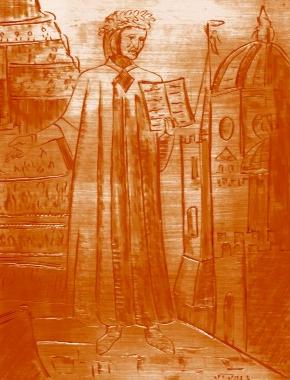
Incisione, Bruno Vivoli
Repubblica di San Procolo, 2001
TABLE OF CONTENTS
SECTION III: IRISH
PSALTERS AND BIBLES : Irish Psalters and Bibles, The CATHACH, THE
BOOK OF KELLS, The Manuscripts, Dr Bernard Meehan,
Trinity College Library, Dublin (English, italiano
forthcoming)|| Irish Psalters and Bibles, The CATHACH, THE
BOOK OF KELLS, The Texts , Revd
Dr Martin McNamara, Woodview, Dublin (English)|| The Irish peregrini in Tuscany, Dr
Maire Herbert, University of Cork (English, italiano)||
Map and
Time Line
Book Fair
Florin
Certosa, Galluzzo, giovedì, 31 maggio 2001/ Thursday, 31 May 2001 9.00-12.00/ 9:00-12:00
IRISH PSALTERS AND
BIBLES:
Presiede/Chair, dottoressa
Antonia Ida Fontana, Direttrice Biblioteca Nazionale, Firenze
IRISH PSALTER AND BIBLES/ I
SALTERI E LE BIBBIE IRLANDESI:
THE MANUSCRIPTS/ I
MANOSCRITTI: THE CATHACH, THE BOOK OF DURROW,
THE BOOK OF KELLS
DR BERNARD MEEHAN, TRINITY
COLLEGE LIBRARY, DUBLIN
{M uch is known about Ireland in the early Christian period. Society was rural, and was organised on lines which were familial and hierarchical. There were large numbers of small kingships. Christianity probably came in the 4th century to the south of the country, and was consolidated by St Patrick in the 5th century. The church was monastic in orientation rather than episcopal. It became part of society, and was closely identified with local dynasties. There are few accounts of Irish martyrs for that reason.
Molto sappiamo sull’Irlanda della cristianità primitiva. La società era di tipo rurale e organizzata su attività familiari e gerarchiche; il Paese era suddiviso in molti piccoli regni. Il cristianesimo si era probabilmente diffuso nel sud del paese nel IV secolo ed era stato consolidato da San Patrizio nel V secolo. La chiesa aveva un orientamento monastico piuttosto che episcopale. Essa divenne parte della società e si identificò strettamente con le dinastie locali. A motivo di ciò esistono poche testimonianze storiche di martiri irlandesi.
While there were eremetical centres like Skellig Michael in Kerry, churches were mostly placed in the heartlands of civilisation, at crossroads like Armagh or on great rivers like Clonmacnoise. While there were no towns as such until the 10th century, developing under Viking influence, the monasteries were centres of economic activity, and have often been described as monastic cities. There are records that on occasions they fought each other. The Irish church was unusual in some of its practices, such as the date on which it observed Easter, and the shape of its clerical tonsure. The vigorous development of the church meant that many books were produced, the vast majority of them not surviving. The eighth-century gospel manuscript the BOOK OF MULLING (Trinity College Dublin MS 60), which is not outstanding artistically, is probably a typical production.
Sebbene esistessero dei centri di eremitaggio come Skellig Michael nel Kerry, le chiese erano prevalentemente situate nelle zone più civilizzate, ai crocevia come Armagh o sui grandi fiumi come Clonmacnoise. Finché non furono edificate vere e proprie città nel X secolo, i monasteri furono il centro della vita economica e per questo sono stati sovente descritti come città monastiche. Dai documenti esistenti, risulta che di quando in quando i monasteri combattevano l’uno contro l’altro. La chiesa irlandese si distingueva per alcune pratiche insolite, come la data in cui osservava la Pasqua, e la forma della sua tonsura ecclesiale. Il rapido sviluppo della Chiesa portò a una vasta produzione di libri, la maggior parte dei quali sono andati distrutti. Il manoscritto del Vangelo dell'VIII secolo, il LIBRO DI MULLING (Trinity College Dublin MS 60), non eccezionale dal punto di vista artistico, è probabilmente una produzione tipica di tale periodo.
In this early Christian period, Ireland produced a number of great art objects which help to define the country in a cultural-historical sense: the great monastic sites themselves - Monasterboice, Clonmacnoise, Kildare, Glendalough; the carved high crosses and round towers which dominate these sites; the products of these monasteries in metalwork, notably the Tara Brooch, the Ardagh chalice, the Derrynaflan hoard. It is known that scholarship, art and calligraphy were widely practised and valued; and that scribes had a high standing. We know the names of a large number of the scribes, where they worked and when they died. A number of famous manuscripts survive, including the BOOK OF KELLS , its contemporary the BOOK OF ARMAGH , its younger relative the BOOK OF DURROW, and, at the beginning of the sequence, the psalter known as the CATHACH.
Nella cristianità primitiva, il gran numero di oggetti d’arte prodotti in Irlanda aiutano a definire il Paese storicamente e culturalmente: gli stessi grandi siti monastici - Monasterboice, Clonmacnoise, Kildare, Glendalough - le grandi croci intarsiate e le torri a base circolare che dominano questi stessi siti; i manufatti in metallo di questi monasteri, in particolare la spilla di Tara, il calice di Ardagh, il tesoro di Derrynaflan. È noto che il sapere, l’arte e la calligrafia erano ampiamente praticate e apprezzate; e che gli amanuensi godevano di alta considerazione. Conosciamo i nomi di un gran numero di amanuensi, sappiamo dove lavorarono e quando morirono. Molti famosi manoscritti sono giunti a noi, fra questi il LIBRO DI DURROW, e all’inizio di questo continuum, il salterio noto come il CATHACH.
We do not however know with any certainty where and when and by whom they were written, and cannot, except in a few cases such as the BOOK OF ARMAGH, positively bring the great site together with the great book together with the great scribe whose name we know from the annals. As a result, there has been controversy over the question of where and when the BOOK OF KELLS and BOOK OF DURROW were written. I am of the view that they originated in the places whose name they bear - Kells in Co Meath and Durrow in Co Offaly. I see them as being in a direct line of descent from the psalter known as the Cathach. But books did and do move around a great deal, and it is difficult to be certain.
Non conosciamo con certezza, tuttavia, né dove, né quando, né da chi vennero redatti e non possiamo, se non in pochi casi come quello del LIBRO DI ARMAGH, abbinare con certezza il grande monastero al grande libro, al grande amanuense il cui nome ci è giunto attraverso gli annali. Di conseguenza, la questione di dove e quando il LIBRO DI KELLS e il LIBRO DI DURROW siano stati scritti resta controversa. A mio avviso essi provengono dai luoghi di cui portano i nomi – Kells nella contea di Meath e Durrow nella contea di Offaly. Ritengo discendano direttamente dal salterio noto come il Cathach. Ma dato che i libri venivano e vengono spostati con molta facilità, è difficile poterlo affermare con certezza.
The decoration of the early Irish manuscripts is made up of a number of elements: dots, diminuendo, interlace and trumpet spirals. Dotting around words appears first in an Irish context in what may be the earliest surviving Irish book, the Gospel book, ' USSHERIANUS PRIMUS' (TCD 55), from the late sixth century or perhaps earlier. This may have been imported into Ireland from Bobbio or another continental centre.
Le decorazioni dei primi manoscritti irlandesi erano composte di vari elementi: puntini, diminuendo, intrecci e spirali campanulate. I puntini intorno alle parole sono apparsi in Irlanda per la prima volta in quello che potrebbe essere il più antico libro irlandese superstite, il libro dei Vangeli, USSHERIANUS PRIMUS (TCD 55) del tardo VI secolo, o addirittura anteriore. Esso potrebbe essere stato introdotto in Irlanda da Bobbio o da un altro centro continentale.
THE CATHACH
In the CATHACH a range of
artistic devices points the way forward to the BOOKS OF KELLS
and DURROW. Any account of the great Irish MSS must include an
introduction to St Colum Cille or Columba. Born in Donegal in
521 or 522, Colum Cille travelled to Scottish Dál Riata around
the year 562 as 'a pilgrim for Christ', along with twelve
companions. His monastic foundation on the island of Iona, off
Mull, became the head of a prosperous confederation of
monastic houses exercising wide influence over ecclesiastical
affairs in Ireland and the north of England. Derry, Swords,
Durrow and Kells (founded by his followers) are among his most
celebrated establishments. Colum Cille was renowned as a
prolific and accomplished scribe. It is recorded that even at
his death, on 9 June 597, he was in the process of
transcribing a psalter.
IL CATHACH
Nel
CATHACH, troviamo una serie di figure ornamentali che anticipano
il LIBRO DI KELLS e il LIBRO DI DURROW. Ogni studio sui grandi
manoscritti irlandesi deve includere una introduzione a San
Colum Cille o Columba. Nato a Donegal nel 521 o 522, Colum Cille
si recò a Dal Riata in Scozia intorno all’anno 562 come
“pellegrino per Cristo”, insieme a dodici compagni. La sua
fondazione monastica sull’isola di Iona, a poca distanza da
Mull, diede origine a una prospera confederazione di centri
monastici che esercitavano una vasta influenza sulle questioni
ecclesiastiche in Irlanda e nel nord dell’Inghilterra. Derry,
Swords, Durrow e Kells (fondate dai suoi seguaci) sono tra le
sue più famose
fondazioni. Colum Cille fu celebre come
amanuense prolifico ed esperto. Si sa che quando venne colto
dalla morte, il 9 giugno 597, stava trascrivendo un salterio.
The earliest surviving MS to be regarded as a relic of St Colum Cille is the Latin psalter known as the CATHACH or 'battler' (Dublin, Royal Irish Academy, MS 12.R.33). It is the earliest surviving manuscript with an unquestioned Irish origin. While much is known about its later history, critical questions remain unresolved over its origins, and in particular whether it should be regarded as a manuscript written and decorated by St Columba or as the work of a copyist undertaken some years after his death on 9 June 597.
Il più antico manoscritto superstite da considerare una reliquia di San Coluom Cille è il salterio latino noto come il CATHACH o “battler” (Dublino, Royal Irish Academy, MS 12.R.33). È il più antico manoscritto superstite di certa origine irlandese. Mentre molto sappiamo della sua storia successiva, restano senza risposta questioni cruciali circa la sua origine e, in particolare, se lo si debba considerare un manoscritto scritto e decorato da San Colum o come il lavoro di un copista iniziato alcuni anni dopo la sua morte avvenuta il 9 giugno 597.
The CATHACH is traditionally believed to be the copy by St Columba - with the help of a miraculous light - of a psalter lent to him by St Finnian. A dispute about the ownership of this copy was resolved by king Diarmait with the judgement ' to every cow her calf and to every book its copy '. This is frequently cited as an early example of copyright law. The dispute continuing, the Psalter is thought to have passed to the O'Donnell family after a battle in 561. It remained in the ownership of the O'Donnells but in the custody of the Mac Robhartaigh family of Ballymagroarty, co Donegal.
Il CATHACH è tradizionalmente considerato la copia realizzata da San Colombo, con l’aiuto di una luce miracolosa, di un salterio prestatogli da San Finnian. La disputa sul diritto di proprietà di questa copia venne risolta da re Diarmait con la sentenza “a ogni mucca il suo vitello e a ogni libro la sua copia.” Questo viene spesso citato come il primo esempio sulla legge del copyright. La disputa si protrasse e il salterio si pensa sia passato alla famiglia O’Donnel dopo una battaglia nel 561. Rimase proprietà degli O’Donnel ma in custodia della famiglia Mac Robhartaigh di Ballymagroarty, nella contea di Donegal.
The CATHACH is now incomplete. There are only 58 folios. Originally, it probably had around 110 folios. Its text runs consecutively from Psalm 30.10 to Psalm 105.13, with a rubric before each psalm. All of the surviving leaves are damaged, to a greater or lesser extent, by contact with the shrine in which the Cathach was encased, as a relic of St Colum Cille, towards the end of the 11th century.
Il CATHACH è oggi incompleto, contiene solo 58 fogli. In origine aveva probabilmente circa 110 fogli. Il suo testo va, senza interruzione, dal Salmo 30.10 ai Salmi 105.13, e ogni salmo è preceduto da una rubrica. Tutti i fogli superstiti sono danneggiati, in misura maggiore o minore, a causa del contatto con il reliquiario in cui il Cathach venne racchiuso, come reliquia di San Colum Cille, verso la fine dell' XI secolo.
In the development of insular forms of script and decoration, the CATHACH is a great landmark. Here we see the use of a number of devices: red dotting around letters; trumpet spirals; 'diminuendo' (whereby the letters at the beginning of a section are formed in decreasing sizes); the fish and the cross, both symbols of Christ.
Nella storia dello sviluppo delle forme insulari di scrittura e decorazione, il CATHACH rappresenta una pietra miliare. Qui osserviamo l’uso di un gran numero di figure ornamentali: i puntini rossi intorno alle lettere; le spirali campanulate; i “diminuendo” (per cui le lettere all’inizio di un capitolo sono composte in misura decrescente); il pesce e la croce, entrambi simboli di Cristo.
THE BOOK OF DURROW
The BOOK OF DURROW is most
commonly dated to the late 7th-century - more than a century
before the BOOK OF KELLS - and, if it WAS written then, its
great distinction is that it is the earliest surviving fully
decorated insular gospel manuscript.
Il LIBRO DI DURROW è comunemente datato alla fine del VII secolo, oltre un secolo prima del LIBRO DI KELLS, e, se fu scritto in tale epoca, la sua straordinarietà consiste nel fatto che è il più antico manoscritto insulare dei Vangeli esistente interamente decorato.
It has some preliminary texts, like the letter of St Jerome to Pope Damasus. It now has 248 folios, measuring c 245 x 145 mm, and is written in a very practised version of what is normally called an Irish majuscule script. There are pages of ornament by an artist who produced some of the most striking images in insular art. In aspects of its background, decoration and preliminary texts - though not its gospels texts - it is closely related to the BOOK OF KELLS. The traditional association of the BOOK OF DURROW is with the monastery of Durrow about four miles north of Tullamore, founded by St Colum Cille. Not a great deal is known about Durrow in the middle ages. This may be simply because its library was burned late in the eleventh century. The Annals of Ulster record for the year 1095 the burning of many churches, among them 'Durrow with its books': one of the many losses hampering our knowledge of early medieval Ireland.
Esso contiene alcuni testi preliminari, come la lettera di San Gerolamo a Papa Damasio. Attualmente consta di 248 fogli che misurano 245 x 145 mm, ed è scritto in una versione abilmente realizzata della cosiddetta scrittura maiuscola irlandese. Contiene pagine di decorazioni opera di un artista che ha prodotto alcune delle più straordinarie immagini nell'arte insulare. Per quanto concerne lo sfondo, la decorazione e i testi preliminari, sebbene non per i testi dei Vangeli, è strettamente imparentato col LIBRO DI KELLS. Il LIBRO DI DURROW viene tradizionalmente associato al monastero di Durrow, situato a circa quattro miglia a nord di Tullamore, fondato da san Colum Cille. Le conoscenze in nostro possesso su Durrow in epoca medievale sono scarse. Questo potrebbe semplicemente essere dovuto al fatto che la sua biblioteca bruciò verso la fine dell' XI secolo. Gli Annali di Ulster riportano, nell’anno 1095, il rogo di molte chiese, fra le quali “Durrow coi suoi libri”: una delle molte perdite che ostacolano la nostra conoscenza dell’Irlanda alto medievale.
Most of the BOOK OF DURROW's decorative techniques were familiar to earlier insular artists. Many of its pages bear a marked resemblance to metalwork and jewellery through Durrow's employment of trumpet and spiral devices, and its mimicking of enamel and glass work. Durrow employed symbols of the evangelists: the Man symbolised St Matthew, the Lion symbolised St Mark, the Calf St Luke and the Eagle was St John's symbol. In a reversion to the pre-Vulgate order of Irenaeus' scheme, St John's gospel in the BOOK OF DURROW is introduced by the Lion, and St Mark's by the Eagle. The gospels are prefaced by a page depicting the symbol of each evangelist, followed by a carpet page, and, facing it, the decorated opening words of the text.La maggior parte delle tecniche decorative del LIBRO DI DURROWsono comuni agli artisti insulari di epoca antecedente. Molte delle pagine del libro presentano una forte somiglianza con la lavorazione dei metalli e l’arte orafa attraverso l’impiego nel LIBRO DI DURROW di elementi ornamentali come la campanula e la tromba, e l’imitazione della lavorazione dello smalto e del vetro. In Durrow furono utilizzati i simboli degli evangelisti: l’Uomo simboleggiava San Matteo, il Leone San Marco, l’Agnello San Luca e l’Aquila San Giovanni. Con un rovesciamento, ritornando all’ordine precedente alla Vulgata dello schema ireneico, il Vangelo di San Giovanni nel LIBRO DI DURROW è introdotto dal Leone, e il Vangelo di San Marco dall’Aquila. Ogni Vangelo è preceduto da una pagina che dipinge il simbolo dell'evangelista, seguita da una pagina tappeto e, sulla pagina a fronte, le parole decorate dell’inizio del testo.
Interlace dominates the carpet pages (that is, pages entirely of abstract decoration) and the symbols pages but is used more sparingly in the initials pages.
Gli intrecci dominano le pagine tappeto (vale a dire, pagine interamente decorate con motivi decorativi astratti) e le pagine dei simboli ma sono meno frequentemente usati nelle pagine iniziali.
THE BOOK OF KELLS
The BOOK OF KELLS is one of a
handful of works of art known everywhere, at least by repute.
It attracts over half a million visitors to Trinity College
every year. It contains a very richly decorated copy of the
four gospels in a Latin text based on the Vulgate edition
(completed by St Jerome in 384 AD) intermixed with readings
from the old latin translation. The gospels are preceded by
prefaces, summaries of the gospel narratives and 'canon
tables' or concordances of gospel passages compiled in the
fourth century by Eusebius of Caesarea. The text is
embellished by the elaboration of significant words and
phrases and by a great range of inventive decorated initials
and interlinear drawings. There are scenes of iconographic
complexity usually interpreted as the arrest and temptation of
Christ, as well as images of Christ, of the Virgin and Child,
and of St Matthew and St John. The evangelists and their
symbols appear throughout the manuscript. It is safe to
suppose that it was produced in a Columban milieu around the
year 800, in other words that it was made by followers of St
Colum. Whether it was made at his principal house on the
island of Iona, or at the monastery of Kells in county Meath,
where the Iona monks fled after their island was attacked by
Vikings in the year 806 - when 68 of the community were killed
- is just one of many uncertainties surrounding its early
history.
Il LIBRO DI KELLS è una delle poche opere d’arte conosciute ovunque, almeno per fama. Ogni anno attrae al Trinity College oltre mezzo milione di visitatori. Esso contiene la copia riccamente decorata dei quattro vangeli nel testo latino basato sulla Vulgata (completata da San Gerolamo nel 384 A.D.) mista a letture dalla vecchia traduzione latina. I Vangeli sono preceduti da prefazioni, sintesi delle narrazioni dei vangeli e dalle “tavole dei canoni” o dalle concordanze dei passaggi dei Vangeli compilate nel IVsecolo da Eusebio di Cesarea. Il testo è abbellito dalla elaboratezza delle parole e delle frasi importanti e da una grande serie di iniziali decorate in modo fantasioso e disegni interlineari. Vi sono scene di complessità iconografica solitamente interpretate come l’arresto e la tentazione di Cristo, così come immagini di Cristo, della Vergine e del Bambino e di San Matteo e San Giovanni. Gli evangelisti e i loro simboli appaiono in tutto il manoscritto. Si può supporre con certezza che sia stato prodotto in un milieu legato a San Columba, intorno all’anno 800, in altre parole che venne realizzato da seguaci di San Colum. Resta incerto, così come altri aspetti che circondano la sua prima storia, se venne prodotto nella sua casa principale sull’isola di Iona o al monastero di Kells nella contea di Meath, dove i monaci di Kells fuggirono dopo l’attacco all’isola da parte dei vichinghi nel 806, durante il quale furono uccisi 68 membri della comunità monastica.
The basic decorative plan was that each gospel should be preceded by symbols of the evangelists, a portrait and an elaboration of the opening words. It is also possible to see certain themes and preoccupations both in the main pages and in the minor decoration.The decoration of most pages mirrors the thematic preoccupations of the major pages in forming part of a scheme which is quite simple in concept. The decoration of the entire manuscript glorifies aspects of Christ's life and message and reflects the principal moments of his life. There are recurring images of his birth, his sacrifice, commemorated in the institution of the eucharist, and his resurrection. His name and face, his properties, attributes and symbols are constantly before us in the fully decorated pages and also in initials and interlinear decoration.L’impianto decorativo fondamentale prevedeva che ciascun Vangelo fosse preceduto dai simboli degli evangelisti, da un ritratto e da una elaborazione delle parole iniziali. È anche possibile notare certi temi e preoccupazioni sia nelle pagine principali che nelle decorazioni minori. La decorazione della maggior parte delle pagine rispecchia le preoccupazioni tematiche delle pagine principali nel costituire la parte di uno schema, la cui concezione è abbastanza semplice. La decorazione dell’intero manoscritto glorifica gli aspetti della vita e del messaggio di Cristo e riflette i momenti principali della sua vita. Vi sono immagini ricorrenti della nascita, del sacrificio, commemorato nell’istituzione dell’eucaristia, e della resurrezione. Il nome, il volto, le caratteristiche, le qualità e i simboli sono costantemente davanti a noi nelle pagine interamente decorate e anche nelle iniziali e nelle decorazioni interlineari.
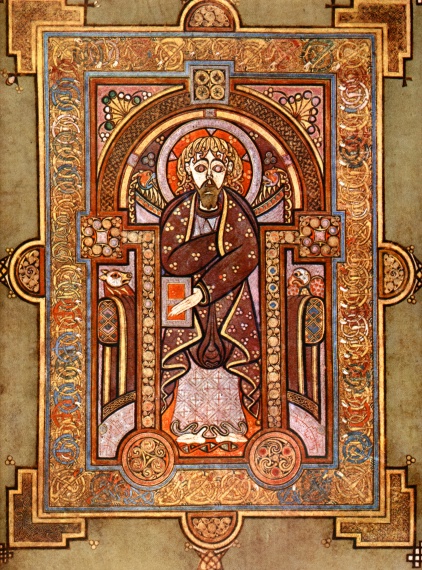
Manuscript 58, Book of Kells, St Matthew's Gospel, fol. 28v
With Permission of Trinity College Library, DublinManoscritto 58, Libro di Kells, Vangelo di S. Matteo, foglio 28v.
Per concessione della Trinity College Library di Dublino.
Pangur Bán: The Scholar and his Cat
{M esse ocus Pangur Bán,
cechtar nathar fria saindan:
bíth a menmasam fri seilgg,
mu memna céin im saincheirdd.
{I and white Felix,
each of us two (keeps) at his specialty:
his mind is set on hunting,
my mind on my special subject.Caraimse fos (ferr cach clu)
oc mu lebran, leir ingnu;
ni foirmtech frimm Pangur Bán:
caraid cesin a maccdán.
I love (it is better than all fame)
to be quiet beside my book, with persistent inquiry.
Not envious of me White Felix;
he loves his childish art.O ru biam (scél cen scís)
innar tegdais, ar n-oendís,
taithiunn, dichrichide clius,
ni fris tarddam ar n-áthius.
When we two are (tale without boredom)
alone in our house,
we have something to which we may apply our skill,
an endless sport.Gnáth, huaraib, ar gressaib gal
glenaid luch inna línsam;
os mé, du-fuit im lín chéin
dliged ndoraid cu ndronchéill.
It is customary at times for a mouse to stick in his net,
as a result of warlike struggles (feats of valor).
For my part, into my net falls
some difficult crux of hard meaning.Fuachaidsem fri frega fál
a rosc, a nglése comlán;
fuachimm chein fri fegi fis
mu rosc reil, cesu imdis.
He directs his bright perfect eye
against an enclosing wall.
Though my (once) clear eye is very weak
I direct it against acuteness of knowledge.Faelidsem cu ndene dul
hi nglen luch inna gerchrub;
hi tucu cheist ndoraid ndil
os me chene am faelid.
He is joyful with swift movement
when a mouse sticks in his sharp claw.
I too am joyful
when I understand a dearly loved difficult question.Cia beimmi a-min nach ré
ni derban cách a chele:
maith la cechtar nár a dán;
subaigthius a óenurán.
Though we are always like this,
neither of us bothers the other:
each of us likes his craft,
rejoicing alone each in his.He fesin as choimsid dáu
in muid du-ngni cach oenláu;
du thabairt doraid du glé
for mu mud cein am messe.
He it is who is master for himself
of the work which he does every day.
I can perform my own task,
directed toward understanding clearly that which is difficult.
British Library Mouse Mat, Reproduced with Permission
THE BIBLE AND THE BOOK -
IRISH PSALTER AND GOSPEL BOOKS: THE TEXTS/
LA BIBBIA E IL LIBRO -
SALTERI E VANGELI IRLANDESI: I TESTI
REV. MARTIN MCNAMARA, MSC,
WOODVIEW, DUBLIN, IRELAND
1. INTRODUCTION
2. IMPORTANCE OF STUDYING
IRISH PSALTER AND GOSPEL TEXTS
Irish Psalter and Gospel texts
were written in Ireland or by Irish scribes and were used in
Ireland and/or by Irish scholars, monastic and lay. In this
they differ from a body of literature on biblical
commentaries, homilies and theology, presented in 1954 by
professor B. Bischoff and later by other scholars as being of
Irish origin, or with Irish affiliations. The matter is today
under discussion. The Latin Psalter and Gospel texts are also
important for Irish vernacular literature, in matter of
orthography (Cannan/Canan of Galilee), and in other ways.
3. MANNER OF APPROACHING THE STUDY
As for "Research Group on Manuscript Evidence": "to apply an integrated, holistic approach to manuscripts and other written works through the ages; to consider them simultaneously s carriers of text, archaeological artefacts, works of art, layers of history, and monuments of culture; to seek to examine, record, and analyse the evidence of these witnesses of history, and monuments of culture, and to set their testimony in context".
4. BACKGROUND TO IRISH
PSALTER AND GOSPEL TEXTS
Christianity in Ireland, with St
Patrick, A.D. 432; but probably earlier.
Notable Contemporaries: Jerome
342-420; Augustine 354-431; Cassian 360-435; Popes, with
increasing emphasis on Rome's position: Celestine 422-432;
Sixtus 432-440; Leo the Great 440-461 (Sermon 82, on Rome's
role; Feast of St Peter and Paul June 29 441)
Columcille (of Iona). d. 597
St Aidan; foundation of
Lindisfarne 635.
Columbanus (Bobbio). Bobbio
founded 613; died 615.
5. LATIN VERSIONS OF THE
PSALTER
Old Latin (Romanum), from
Septuagint (LXX);
Jerome's first revision of the
Old Latin;
Jerome's second revision of the
Old Latin, against Origen's Hexapla, using critical signs of
obelus (÷) and asterisk (*), the obelus (÷…:) marking material
in the LXX and earlier Latin versions not in the Hebrew; the
asterisk (*…:) material not in the LXX, but added (to the
Latin) from the Hebrew. This rendering of Jerome became known
as the GALLICANUM (Vulgate Psalter).
Jerome's translation of the
Psalter direct from the Hebrew text (the HEBRAICUM or Iuxta
Hebraeos), made about 389. This was not accepted as
official Psalter Vulgate in the West.
6. PSALTER TEXTS IN IRELAND
Presumably the first Psalter
Texts to be taken to Ireland were Old Latin. No Irish Old
Latin Psalter text has survived.
The Irish Psalter par excellence
was the Gallicanum, used from the late sixth or early
seventh century (the CATHACH ) onwards. Two Irish texts are
used in the Benedictine critical edition of the Gallicanum
of Jerome (the CATHACH , siglum C, and Double Psalter of St
Ouen (Rouen, Bibl. mun. 24 [A. 41]; siglum I).
Jerome's Hebraicum was
well known in Ireland from a very early age (5th-6th cent.?).
There is in fact an Irish family (sub-group) of the Hebraicum,
represented by the MSS AKI (AMIATINUS , Karlsruhe, Landesbibl.
Aug. XXXVIII) and the Double Psalter of St Ouen (Rouen, Bibl.
mun. 24 (A. 41). The purest representative of the group is I;
A and K are already corrupt. This Irish family is
characterised by certain omissions (single words, phrases) and
other smaller errors. The Hebraicum is well
represented in Irish Psalter MSS.
7. LATIN VERSIONS OF THE
GOSPELS
See below under Gospels
8. COLUMBA OF IONA, ST
FINNIAN AND ST FREDIANO OF LUCCA
Jerome's Revision: The Vulgate
Text in Ireland
A text of the Vulgate seems to have reached
Ireland at an early date. A tradition given by Manus O'Donnell
in his Life of Columba (1532) tells how the young
Colum Cille (520/522-597) visited Finnian (Findéin) of
Druim Finn (Droma Findi; = Dromin, Co. Louth) and
borrowed a book from him which he copied without the owner's
permission. This led to the famed judgment of Diarmuid O
Cerbal, King of Erin at Tara, on the matter: " To every cow her young cow (le gach boin a
boinin), that is her calf, and to every book its transcript"
(le gach lebhur a leabran).
Finnian of Dromin may have been the Finnian of Moville, one of
Columcille's teachers. Although Manus Ó Donnell says that the
book in question was the Psalter known as the CATHACH
, it is possible that it was a copy of the Four Gospels
recently brought from Italy to Ireland by, or for, Finnian of
Moville, who died in 579 or 580, under whom Columcille is said
to have studied as a youth. (Columba went to Iona in 563 or
565.)
There is a tradition that Finnian went to Rome and brought back to Ireland a copy of the Gospels, presumably of Jerome's new (Vulgate) revision. There is confusion among Irish hagiographers as to the identify of the persons variously named Vinnio, Finnio, Finnian, Findbar. Colum Cille's tutor Finnio (Finnian) has been identified with Finnian of Druim-Finn, and later with Frediano, bishop of Lucca in Italy, a historical personage mentioned and praised by St Gregory the Great. This identification has led to the introduction into the Life of Frediano of Lucca, and thereby preserving, anecdotes from the Life of the Irishman Finnian. despite the confusion in the evidence and the uncertainties, modern scholars accept as possible that Finnian (of Moville) may have introduced into Ireland one of the first copies of Jerome's revision of the Gospels, later to be known as the Vulgate.
Giovanni Villani, Cronica I.xlix, 'La citta` di Lucca ebbe in prime nome Fridia, e chi dice Aringa; ma perche` prima si converti` alla vera fede di Cristo che citta` di Toscana, e prima ricevette vescovo, cio` fu Santo Fridiano, . . . e per lo detto Santo prima fu luce di Fede, si` fu rimosse il primo nome e chiamata Luce, e oggi per lo coretto vulgare si chiama Lucca'.
Giovanni Villani, Chronicle, XIV Century:
'The city of Lucca was first called Fridia, which means
'herring', but because it was the first city in Tuscany to
convert to the true faith of Christ, and the first to receive
the bishop, who was St Fridiano . . . and through this said
saint the first to have the light of faith, its earlier name
was done away with and it was called 'Light', and today in
common parlance is called Lucca'.
CONSIDERATION OF SELECTED
IRISH PSALTER TEXTS
WITH ILLUSTRATIONS BY
TRANSPARENCIES (OVERHEAD PROJECTOR)
1. The Springmount Bog tablets
2. The CATHACH of St Columba
i. The purpose of the obeli and the asterisks in the CATHACH; evidence of correction of a Gallican against a Hebraicum text, and against a specifically Irish Hebraicum text. Consequences re dating: a date ca. 600 too early?3. The Pseudo-Bede Psalm headings; the PSALTER OF CHARLEMAGNE (Ms Paris, Bibl. Nat. lat. 13159); the gloss on the Psalms in MS Vatican Pal. lat. 68 and relationships with Northumbria.
ii. The Psalm Headings in the CATHACH; in red; Christological; purpose; relation of many to the Glosa Psalmorum ex traditione seniorum; ca. 600; South-west France. Bearing on dating of the CATHACH?
4. The Double Psalter of St Ouen (#18)
5. The Psalter of Caimin (# 25)
6. The Southampton Psalter (#21)
7. Greco-Latin Psalter; Greek Psalter of Sedulius
Scottus (##13-15 of list).
EARLY IRISH GOSPELS
1. LATIN VERSIONS OF THE
GOSPELS
The Bible was being translated
into Latin from ca. A.D. 160 onwards. We have three stages of
Latin Gospels: the earlier Old Latin; Jerome's revision
against the Greek (384), made at Pope Damasus's request (which
became to accepted text of the West – the Vulgate; later
admixtures of the Old Latin and Vulgate (Mixed Gospel Texts).
i. OLD LATIN. We have two forms of the Old Latin Gospels: the African (Afra) and the European.
TheAFRICAN TEXT is preserved in the two MSS:EUROPEAN TYPE. For this about 18 manuscripts.
(a) CODEX BOBIENSIS (Turin, Biblioteca Naz. G. VIII [1163]), s. IV; written in Africa. It was preserved in the monastery of Bobbio, and was believed to have been carried on his person by St Columbanus;
(b) CODEX PALATINUS (Trent, Museo Nazionale; with a page in London, BL and in Dublin, TCD).
The core group in the MSS:This core group is related to Ambrose, Ambrosiaster, and especially in Luke to Lucifer. It was the model that lay behind Jerome in his revision for Pope Damasus (the Vulgate Gospels).
b ( VERONENSIS; end of 5th cent.; probably Verona),
ff2 ( CORBIENSIS ; 5th cent.; Italy);
i ( VINDOBONENSIS; end of 5th cent.; Italy),
all representing a "progressive" Italian text from about 350-380.
Attached to this core group is the GALLIC-IRISH GROUP comprised of the texts:
h (VL 12; CLAROMONTANUS ; Vatican Library. Vat. lat. 7223; end of 5th cent.; Italy);-------
the Irish CODEX USSERIANUS (r);
and the closely-related ? (VL 24; Xs; Milan; Bibl. Ambrosiana M. 12 sup.; palimpsest; pericope from a Gallican Sacramentary; South of France, ca. 700);
p (VL 20; fragment: St Gall, Stiftsbibliothek 1395, p. 430-433; 8th cent.; Ireland; CLA VII 989);
the European layer in ? (26; St. Paul in Kärnten, Stiftsbibl. 225.3.19 [XXV.a.1], s. VII; fragment with only Luke 1:64-2:51);
and the Old Latin layer in g1 (7; Fischer Pg; Vulgate G; Sangermanensis; Paris BNF lat. 11553; ca 810 [Nestle-Aland 26 s. VIII], Saint-Germain-des Prés).
(a) the Irish CODEX USSERIANUS (r; VL 14): All four Gospels, in order: Mat, Jn, Luke, Mark.
(b) the Old Latin layer in g1(VL 7; Fischer Pg; Vulgate G; Sangermanensis; Paris BNF lat. 11553; ca 810 [Nestle-Aland26 s. VIII], Saint-Germain-des Prés). Gospel of Matthew only; entire; with Vulgate influences (overlay). In Mat identical with lemmata of Hilary, in his Comm. on Matthew; in John identical with text of John 13:3-17 (VL 24; ?: Milan, Bibl. Ambrosiana M. 12 sup. pp. 119-122).
(c) Vat. lat. 7223 (h; VL 12 CLAROMONTANUS ; end of 5th cent.; Italy): Mat 3:15-14:33; 18:12-28:20.
(c) p (VL 20; fragment: St Gall, Stiftsbibliothek 1395, p. 430-433; 8th cent.; Ireland; CLA VII 989),
(d) the European layer in ? (26; St. Paul in Kärnten, Stiftsbibl. 225.3.19 [XXV.a.1], s. VII; fragment with only Luke 1:64-2:51)
ii. JEROME'S VULGATE
REVISION
iii. MIXED TEXTS OF VULGATE/OLD LATIN (Old Latin/Vulgate).
2. IRISH LATIN GOSPELS
i.
EXTERNALS: GOSPEL SATCHELS
Small portable Gospel books would have been
carried about in book satchels. In Adomnan's Life of
Columba (2,8) we read of a young man who fell into the
river Boyne and was drowned. But just as when he fell he had
books enclosed in a skin satchel (in
pellicio … sacculo) under his
arm. We have seen about the note in the CODEX BOBIENSIS that
Columbanus used to carry this codex about with him in his
satchel ( pera). In Irish literature such a book satchel was
called a tíag (from the Latin theca ). We read of monks taking
the head of John the Baptist in their book-satchel (tíag) to carry it
with them to their own country (LB, PH 925; also SR 5868;
Trip. 556.9: tíag libur ; also
84.17). See also J. Wordsworth, Introd. to ed. k, p.
xx. Books were so carried around, and also hung on the walls
in the library. One is mentioned often in the Irish Vision
of MacConglinne (to carry his Psalter; and some food!)
(ed. K. H. Jackson 1990, lines; ed. K. Meyer, 1892, page and
line): ed. Jackson, lines 101, 107, 130, 137, 253, 255 (2x;+
note), 283, 706, 924.
We now know of three items that can be described as ancient Irish book-satchels or budgets: those now associated with the Breac Modeóic reliquary (National Museum of Ireland), with the BOOK OF ARMAGH (TCD) and with an Irish missal which belongs to Corpus Christi College, Oxford, now deposited in Bodleian Library, Oxford (shelf-number: CCC 282).a) The Breac Moedóic is a house-shaped reliquary, which for a long time was contained with the satchel in question. The satchel, however, can be presumed to have been intended for a valuable manuscript. John Waterer believes the satchel dates from the early Irish Christian period, between the 7th and 9th or 10th centuries.
b) The Corpus Christi Missal satchel would appear to be older than the missal itself, which is dated between 1120 and 1130. Waterer believes this satchel is as old as the of the Breac Moedóic reliquary.
c) The book-satchel of the BOOK OF ARMAGH (both in Trinity College, Dublin), seems to have been designed originally for a larger manuscript than the BOOK OF ARMAGH , written c. 809. The original internal dimensions of the satchel would probably have accommodated a book of about 0.305 m. (12 in.) by 0.255 m. (10 in._ by 0.40 m. (1½ in.). The BOOK OF ARMAGH, without its modern binding, 0.19 m. (7½ in.) by 0.125 m. (5 in.) by 0.40 m. (1 in.). Waterer thinks that the satchel for of the book is later than the BOOK OF ARMAGH (written ca. 809). In his view an 11th- or 12th-century date seems a reasonable conjecture.
These satchels are all leather work. Waterer observes that, whatever their actual age, they are exemplars of the very high standards of artistry and skill which the Irish leather-workers unquestionably attained during the early Christian period.
ii. Irish Pocket Gospels (as
listed by McGurk)
P. McGurk gives the following list of eight Irish Pocket Gospels:
Bern, Stadtbibliothek [now: Burgerbibl. ] 671 CORNISH GOSPELS IXIn his work on Latin Gospel Books from A. D. 400 to A. D. 800 he describes the six of these that fall within this period, and speaks of the group as follows:
Dublin, Royal Irish Academy D.II.3 STOWE ST JOHN VIII-IX (fol. 1-11)
Dublin, Trinity College 59 DIMMA GOSPELS VIII-IX
Dublin, Trinity College 60 MULLING GOSPELS VII(>VIIIend)
Dublin, Trinity College 60 (fol. 95-98) Mulling Fragment VII(>VIIIend)
Fulda, Landesbibliothek Bonif. 3 CADMUG GOSPELS VIII
London, British Library Add. 40618 IRISH GOSPELS VIII-IX
London, Lambeth Palace MACDURNAN GOSPELS IX
The Irish pocket Gospel book has been described elsewhere [with reference to his earlier essay]. Even if none of its representatives […] can be dated with assurance to an early period, the group as a whole is so obviously eccentric and Irish in its connections as to make certain that Ireland was the home of the particular tradition of book making. Diminutive in format, containing the four Gospels with portraits of the evangelists or their symbols, but with no prefaces of any kind, arranging each Gospels on a separate set of bizarrely sized quires, these Irish books are distinguished by their apparent desire to save space and by the extent of their departure from the scribal tradition of that common classical measure, the uncial or half uncial book of the 4th, 5th and 6th centuries. The restriction of their contents to a text of the Gospels is a feature, which they share with many early uncial books, but which sets them apart from all contemporary Merovingian and Carolingian, Italian and Anglo-Saxon Gospels. It is interesting to see. when a list of large books dating from the 7th or 8th centuries, which similarly limited their contents, was drawn up, that these books were either Irish or had connections with centres influenced by Ireland : they came from Ireland or Brittany, from St. Gall or Bobbio, from early Northumbria or Llandaff. The large books shared with the pocket Gospels many scribal traits, specifically Irish types of texts, and in some cases, staccato colophons: the Mac Regol Gospels from Oxford and the St. Chad Gospels from Lichfield end their texts with the same words as the small Mulling or Cadmug Gospels.With regard to the function served by these small Irish pocket Gospels, McGurk thinks that they may have been intended as gifts, for instance from master to pupil, or from pupil to master, as tokens of union, or as relics. The monks may have taken them around with them in their satchels. He give some illustrative instances from the Lives of Irish saints. The monks of Laisren copied the Gospels for Laisren with miraculous speed. The life of Finian of Clonard says that of the many who went to his school "none of the 3000 went from him without a backall ( bachall ) or without a gospel or without some well known sign so that round these they built their churches and their cathedrals afterwards". Similarly the story of St Senan, and/or St Colum Cille taking a Gospel from St Martin of Tours, or from the breast of the dead Saint Martin.
ii. The Old Latin. USSERIANUS PRIMUS , and sections
of St Gall 60 (John) and apparently in St Gall 51 (Mat)
iii. The Vulgate. Sole Irish
text of true Vulgate is the BOOK OF DURROW
iv. Irish Mixed Texts. Most
Irish texts
Consideration of selected
Irish Gospel texts
with illustrations by
transparencies (overhead projector)
1. CODEX USSERIANUS PRIMUS (TCD 55 [A.IV.15]; Old Latin)
i. Views on its date and place of origin: 7th, 6th, even 5th cent. date; Ireland or Continent? D. Dumville, 1999, p. 39: "There seems little here, therefore, to inhibit a fifth-century date and Continental origin for TCD MS 55".Speaking of early Christian Latin and the origins of liturgical Latin, Christine Mohrmann, for reasons best known to herself notes that it has been pointed out that the Greek Christians did not scruple to adopt the word swthr to denote Christ as Saviour, although this word played a great role in the pagan religious world, notable in the cult of Aesculapius. The Latin world on the contrary refused to adopt the Latin equivalentconservatorbecause it retained a pagan significance. They preferred to take refuge in a neologism,salvator, derived from salvare , equally of Christian coinage, which rendered the Greek swzein. This was not quite the case, at least as far as the Irish-Gallic Old Latin text is concerned. The term conseruator is used in Luke 2:11 in the words of the angels to the shepherds. Here the Vulgate has:
ii. The biblical text of USSERIANUS . Recall the material available for comparison, in the Gallic-Irish family of Old Latin:
Matthew: g1 (San Germanensis; s. VIII; OL for Matthew only ); Vat. lat. 7223 (h; VL 12 CLAROMONTANUS ; end of 5th cent.; Italy): Mat 3:15-14:33; 18:12-28:20. In g1 we have Matthew entire with Vulgate influences (overlay). The prevailing view is that in Mat. this OL text is identical with the lemmata of Hilary of Poitiers ( A.D. 315-367), in his Commentary on Matthew. A revision of this view seems called for.
John: MS Milan, Bibl. Ambrosiana M. 12 sup. pp. 119-122 (r; VL 24) -- a fragment only with text of John 13:3-17; also (c) p (VL 20; fragment: St Gall, Stiftsbibliothek 1395, p. 430-433; 8th cent.; Ireland; CLA VII 989), with John 11:14-44.
Mark: ? Apparently no corresponding text to USSERIANUS.
Luke: The only other text from the Gallic-Irish family is b (VL 26), the European layer in the MS St. Paul in Kärnten, Stiftsbibl. 225.3.19 [XXV.a.1], s. VII; fragment with only Luke 1:64-2:51.
Rare reading in USSERIANUS Luke 2:11: Christ conseruatorsalutis
CATACHESIS CELTICA (Vatican, Reg. Lt. 49; s. X; probably from
Brittany; ed, in part, A. Wilmart [AW], Analecta
Reginensia .
Context: in homily/catechesis
for Christmas Day Mass
2:11natus est
uobis hodiae conseruator salutis (MS:saluasti) qui est Christus
Dominus in ciuitate Dauid quae dicitur Bethlem (AW 93);
natus est uobis hodiae conseruator salutis
qui est Christus(fol. 40va);
conseruatorsalutis(AW 103, 126);
in ciuitate Dauid quae dicitur Bethlem (AW 97,88); Bethlem (AW 102, 141);
Vg: quia natus
est uobis hodie saluator qui est Christus Dominus;
--conseruator salutis(for Vg
saluator), VL, r (co.seruator salutis qui est xps ),
b (conseruator salutis qui est xps);
Reference Bible (ca. A.D. 750), MS. Paris BN lat. 11561 (fol. 207rb) (on Apoc 5:1), natus est nobis hodie conseruatur salutis nostrae reliqua ; (no comment on Luke 2:11 in Ref. Bib.).
Vienna Commentary In Luc. (probably from circles of the Irish scholar of Virgilius of Salzburg; 8th cent.); on Lk 2:11, (Cod. Vind. lat. 997), ed. J. Kelly in CCL 108C, p. 15, with biblical text: qui est Christus Domini(p. 15, 83); :" quia natus est nobis hodie conseruator salutis (p. 15, 83-84); (no lemma in ciuitate Dauid).
2:11 in ciuitate Dauid quae dicitur Bethlem ; Vg: in ciu. Dauid ; + quae dicitur B . =VL, b; quae uocatur BethlemL;
Likewise in the VERONA CATECHESIS (Homiliarium Veronense, ed. L. T. Martin, CCCM 186 = Scriptores Celtigenae 4), Brepols, 2000. MS:Verona, Biblioteca Capitolare Cod. LXVII (64), fol. 33r-81v (probably early 9th cent.), in a homily on Luke 2 (Christmas Mass), with lemmata: natus est uobus hodie conseruatorsalutis qui est christus domini in ciuitate dauid , and gloss on conseruator salutis as follows: "qui ab initio seculi salutem hominis in sua prescientia conseruauit…(ed. Martin, p. 18). This homily may depend on the Vienna commentary on Luke.
2. The Glosses to the ECHTERNACH GOSPELS (ca. 700)
3. Four Gospels in St Gall, Stiftsbibliothek 51 (s. VIII)
i. Description of the MS. Written in Ireland.Alius autem[written in full, not with Irish symbol as is usual in St Gall 51] accepta lancea pupungit latus eius et exit aqua et sanguis . ("Another, however, having taken a lance pierced his side and water and blood came out")
ii. The Interpolation in Irish Gospels from Jn 19:34 in Mat 27:46 and from Mat 27:51 (Mark 15:38) at John 19:30.
For the Gospels of Matthew and John in St Gall 51 and other Irish texts we may note interpolations in the crucifixion scene. Especially significant for our purpose is the addition in the Irish textual tradition at Mat 27:49 (McNamara 1990, 25). In the Gospel scene the dying Jesus cries out (27:46): Heli heli lema sabacthani... Some of the bystanders said: heliam uocat iste. And immediately one of them ran, took a sponge, filled it with vinegar, put it on reed and gave him to drink. (49)Ceteri uero dicebant sine uideamus an ueniat Elias liberans eum(there are variant readings to verse). Here the Irish tradition has an interpolation from John 19:34, found in St Gall 51 as follows:
This interpolation in Matthew is also found in the following Latin Gospel texts, almost all of which are Irish: the texts listed in the paragraph above; in addition to these (among the texts thus far examined: DEEpmhLQR) we have CODEX USSERIANUS SECUNDUS, Irish (CLA 271) (TCD 56, Ireland, s. VIII-IX); the BOOK OF MULLING (CLA 276); BL Additional 40618, Ireland, 9th century, CLA 179); BL Harley 1023, Irish, 10th century [my list gives |Harley 1023 s. xii; L&S 482) ; + TCD DIMMA s. VIII2; Oxford, CCC 122, L&S 528, s. 12med (after 1140?), BL Harley 1802 (MAEL BRIGTE , 1138) + gat (BnF nouv. acq. lat. 1587; ca, 800; Bretagne; Bt) ; BL Royal 1 E VI + Canterbury, Cathedral Library Additional 16 (end of 8th century; Kent; CLA 214);. Thus, in Latin Gospel texts, this interpolation is transmitted almost exclusively in Irish Gospel texts. The interpolated passage is a variant of the Vetus Latina text of John 19:34, with the inversion aqua et sanguis for sanguis et aqua as in the African text ( e ) of the Vetus Latina. (John 19:34):The Greek interpolated text for John 19:34 reads:
The interpolation itself, however, is a very old one in Gospel texts. It is found in some earlier Greek Gospel books, such as CODEX SINAITICUS (London BL Add. 43725; a), CODEX VATICANUS (Vat. graec. 1209; B), CODEX EPHRAIM rescriptus (Paris, B. N. grec 9; C); Greek minuscule 1010 (12th cent.), in manuscripts of the Syro-Palestinian translation, in some of the Ethiopic translations, and in John Chrysostom (according to Severus, AD 538) [For John Chrysostom see "The Instructions of St John Chrysostom to the Catechumens", Cat. 3:13-19;SC 50, 174-177; in the Divine Office, Good Friday, Second Reading; "There came out … water and blood" twice in this text; thus twice in English translation. The Latin has (from SC as above) : exinde aqua fluxit et sanguis", but in direct citation a little later has: "De latere sanguis et aqua "]. A note in a Greek BL Harley MS says that it comes from Tatian's Diatessaron , which is not proven. B. Metzger (A Textual Commentary on the Greek New Testament, United Bible Societies, 1971, p. 71, on this interpolation: "It is probable that the Johannine passage was written by some reader in the margin of Matthew from memory (there are several minor differences such as the sequence of "water and blood"), and a later copyist awkwardly introduced it into the text". This may be true, but does not explain why it was inserted into the margins in the first instance.

We have an extremely significant interpolation (chiefly from Matthew 27:51 or Mark 15:38) at John 19:30, again at the account of the death of Christ, added after the words 'He handed over the spirit':With regard to these interpolated passages in the crucifixion scenes in the Gospel of Mathew and John we may legitimately ask whether they have been preserved by textual transmission alone, or whether their presence is due to the prominence of the crucifixion scene in Irish devotion.
19:30 (tradidit spiritum ). Cum ergo expirasset uelum templi scisum est a summo usque deorsum. ( Iudei ergo...). ('When, then, he had breathed his last, the veil of the Temple was rent from the top right down to the bottom')This addition is known otherwise in Latin only in Irish Gospel texts: in the Vulgate texts DREpmg BL Harley 1023 Harley 1802 ( GOSPELS OF MAEL BRIGTE, AD 1138), CADMUG GOSPELS (Fulda). It is also found in some late (12th and 14th century) Greek minuscule texts, although it occurs as well in earlier Syriac (Syrher) and Syro-Palestinian translations; (see the apparatus to John 19:30 in Merk 1948 and Tischendorf 1872).
iii. The Crucifixion Scene (with Longinus and Stephaton) in St Gall 51 and Irish tradition.We may also note the relevant section on the Crucifixion scene in the POEMS OF BLATHMAC (ca. 750; contemporary with St Gall 51):
He speaks of the conception of Christ, of his public life, his passion and crucifixion, of the events at Calvary, in which context he describes the piercing of Christ's said as follows:4. Gospel of John in St Gall, Stiftsbibliothek 60 (s. VIII)(q. 55) When they thought that Jesus could be approached, Longinus then came to wound him with the spear (dïa guin cosind láigin).
(q. 56) The king's son of the seven holy heavens, when his heart was pierced (o fu-rócbath a chride ) wine was spilled upon the pathways (do-rórtad fín fu roenu; i.e. the declivities of his body?), the blood of Christ (flowing) through his gleaming sides.
(q. 57) The flowing blood from the side of the dear Lord baptized the head of Adam, for the shaft of the cross of Christ had aimed at his mouth.
(58) By the same blood -- it was a fair occasion! -- he instantly cured the fully blind man (is trait ron-ícc in n-ógdall ) as he openly with his two hands was plying the lance ( ossé díb dornnaib co glé/ oc imbeirt inna láigne).
(After Carney 1964, as changed by Dooley 1997)
[See also 'Dream of the Rood' on the Ruthwell Cross ]
5. The GOSPELS OF MAEL BRIGTE (British Library Harley 1802; AD 1138)
A Glossed Gospel Book
We have one glossed Gospel Book: the Gospels in MS
BL Harley 1802, written in Armagh in 1138 by the scribe
Máel-Brigte húa Máel-Úanaigh. It is glossed heavily,
especially in the Gospel of Matthew. It was thought by Hans
Glunz, The History of the Vulgate in England from Alcuin to
Bacon, Cambridge, 1933, that the glosses represented the new
learning, of the Glossa Ordinaria type, introduced into
Ireland through Armagh. However, Gene Rittmueller has shown
that the glosses in Matthew are derived from Hiberno-Latin
commentaries, such the Liber questionum in euangeliis, which
appear to have been used, if not composed, in Ireland in the
eight and ninth centuries.
The Glosses contain Apocryphal
material (in Irish and Latin) on Infancy Gospels, on Christ,
the Apostles, the Baptist (see M. McNamara, The Apocrypha
in the Irish Church, Dublin, 1975 (1984), index of MSS
under, London BL Harley 1802 (p. 148).
Exegetical Glosses from earlier Hiberno-Latin commentaries.
A text under the title "Epistle according to the Hebrews" (fol. 11r) on Mat 2:11 on the Magi: intrantes domum. The gloss reads: legitur in euangelio secundum ebreos quod uenit Ioseph foras ex diuersorio antequam intrarent domum et admirans eos dixit ad Semeon filium suum quod peregrini essent cognoscens ab habitu. A similar text, given as drawn from the same source, is cited also by Sedulius Scottus (ca. 850) in his commentary on Matthew. It may be that the earlier work under thus name continued to circulate in 12th century Ireland. The text is also found in the Latin Infancy Gospels (published by M. R. James, 1926), in Irish translation in the Leabhar Breac and other Irish MSS.
6. Bilingual Greek-Latin
Gospels
Appendix I. Irish psalter texts A.D. 600-1200
See M. McNamara, "Psalter Text and Psalter Study in
the Early Irish Church (A.D. 600-1200), PRIA 73 C (1973),
201-298; reproduced in M. McNamara, The Psalms in the
Early Irish Church (Sheffield Academic Press, 1990).
Additions in review by P. Ó Néill, Proceedings of the
Irish Biblical Association 23 (2000), 98-102, at
101-102.
David N. Dumville, A
Palaeographer's Review: The Insular System of Scripts in the
Early Middle Ages. Volume One (Kansai University
Institute of Oriental and Occidental Studies. Sources and
Materials Series 20-1). Kansai University Press: Suita, Osaka
[Japan], 1999.
1. THE CATHACH OF ST. COLUMBA (6TH-7TH CENTURY).
MS: Dublin, Royal Irish Academy
(once s.n; now RIA 12.R.33).
Edition: H. J. Lawlor, 'The
Cathach of St. Columba', PRIA 33 C (1916), pp. 241-443
(with six plates; text, with detailed description and study of
the MS itself and of questions connected with it); Liber
Psalmorum (full collation of the MS made from
photographs supplied by the RIA for the critical edition of
Jerome's Vulgate Psalter).
Studies: Lawlor, 'The Cathach'
(with an appendix on 'The Shrine of the Cathach' by E. C. R.
Armstrong, pp. 390-396; and Appendix II: W. M. Lindsay,
'Palaeographical Notes', pp. 397-403); E. A. Lowe, CLA II, no.
266; H. de Sainte-Marie, Psalterium iuxta Hebraeos,
pp. xxiii-xxiv; F. Henry, Irish Art I, pp. 58-61; F.
Henry, 'Les débuts de la miniature irlandaise' Gazette des
Beaux Arts 1950, p. 5; Carl Nordenfalk, 'Before the Book
of Durrow', Acta Archaeologica 18 (1947), pp. 141-174,
esp. 151-159 (a study of the decoration); Kenney, Sources, pp.
629-30 (no. 454); M. Esposito, 'The Cathach of St. Columba',
County Louth Archaeological Journal 4 (1916), pp.
80-83; ); David N. Dumville, A Palaeographer's Review: The
Insular System of Scripts in the Early Middle Ages.
Volume One (Kansai University Institute of Oriental and
Occidental Studies. Sources and Materials Series 20-1). Kansai
University Press: Suita, Osaka [Japan], 1999, pp. 19-29.
2. WAX TABLETS FROM SPRINGMOUNT BOG (7TH CENT.)
(APPENDIX I) MS: Dublin. National Museum of Ireland; No. S.A.
1914: 2.
Editions: E. C. R. Armstrong and
R. A. S. Macalister, 'Wooden Book with leaves indented and
waxed found near Springmount Bog, Co. Antrim, JRSAI 50
(1920), pp. 160-166; new edition below, Appendix I, by Dr.
Maurice Sheehy.
Studies: Armstrong and
Macalister, 'Wooden Book'; F. Henry, Irish Art I, p.
58; J. N. Hillgarth, 'Visigothic Spain and Early Christian
Ireland', PRIA 62 (1962) p. 183 note 78, p. 184; D. H. Wright,
'The Tablets from Springmount Bog, a Key to Early Irish
Palaeography', The American Journal of Archaeology 67
(1963), p. 219 (summary of a paper presented to the
Sixty-fourth General meeting of the Archaeological Institute
of America at Baltimore, Dec. 1962); D. N. Dumville, A
Palaeographer's Review , pp. 31-35..
3. PSALM HEADINGS
A. The Columba Series of Psalm
Headings
MSS, Editions and Studies: P.
Salmon, Les "Tituli Psalmorum" des manuscrits latins
(Collectanea Biblica Latina 12; Rome: Abbaye de Saint-Jerôme;
Città del Vaticano: Libreria Vaticana, 1959), pp. 47-74; H. J.
Lawlor, 'The Cathach of St. Columba', PRIA 33 C
(1916), pp. 413-436; M. McNamara, "Some Affiliations of the St
Columba Series of Psalm Headings: A Preliminary Study", Proceedings
of the Irish Biblical Association 21 (1998), 87-111; 22
(1999), 91-123; reproduced in The Psalms in the Early
Irish Church , pp. 302-352.
B. The Theodorean Psalm Headings
MSS and Edition: Willem
Bloemendaal, The Headings of the Psalms in the East Syrian
Church (Leiden: Brill, 1960) (critical edition of Syriac
titles without translation). Studies: W. Bloemendaal, The
Headings , pp. 1-31; R. L. Ramsay, 'Theodore of
Mopsuestia and St. Columba on the Psalms', ZCP 8
(1912), pp. 421-426; R. L. Ramsay, 'Theodore of Mopsuestia in
England and Ireland', ZCP 8 (1912), pp. 452-465; R.
Devreesse, Essai sur Théodore de Mopsueste (Studi e
Testi 141; Città del Vaticana: Biblioteca Apostolica Vaticana,
1948); R. Devreesse, Le commentaire de Théodore de
Mopsueste sur les Psaumes (I-LXXX) Studi e Testi 93;
Città del Vaticano: Biblioteca Apostolica Vaticana, 1939), p.
xxvii.
C. The Work 'De Titulis Psalmorum' attributed to
Bede
MSS: See F. Stegmüller, Repertorium,
vol. II, no. 1665 (pp. 189f).
Edition: Migne, PL, vol.
93, cols. 477-1098.
Studies: H. Weisweiller, 'Die
handschriftlichen Vorlagen zum Erstdruck von Pseudo-Beda, In
Psalmorum Librum Exegesis', Biblica 18 (1937), pp. 197-204; P.
Salmon, Les "Tituli Psalmorum" (no. 3A above), pp.
4748; R. L. Ramsay, 'Theodore of Mopsuestia in England and
Ireland', pp. 453-458; J. W. Bright and R. L. Ramsay, 'Notes
on the "Introductions" of the West-Saxon Psalms', JTS
13 (1912), pp. 520-558; see Stegmüller, loc. cit.; see now
Bonifatius Fischer, 'Bedae de titulis psalmorum liber', in Festschrift
Bernhard Bischoff (Stuttgart: Hiersemann, 1971), pp.
90-110.
3A. The So-Called PSALTER OF CHARLEMAGNE (795-800)
MS. Paris, Bibl. Nat. lat.
13159.
Edition: (of introductory
material to Pss 40-151) Kurt Ceulemans, Scotti (?) anonymi
Tituli Psalmorum in Psalterio Caroli Magni traditi (=cod.
Paris. NB lat. 13159). Argumenta, opschriften en
woordverklaringen bij psalmen 40-151).I. Inleidung,
kritische tekstuitgave en vertaaling; II.Tekskritische
aantekeningen en inhoudelijke commentar (Upublished Licentiate
dissertation in Classics, Latin and Greek; Katholieke
Universiteit Leuven. Faculteit Letteren; (Director Prof. Dr.
L. De Coninck), Leuven, 1997 .
Studies: M. McNamara, in The
Psalms in the Early Irish Church , pp. 156-164.
4. CATENA ON THE PSALMS
OF CODEX PALATINO-VATICANUS 68 (8TH CENT.)
MS: Vatican, Pal. Lat. 68, fols.
1-46 (Pss. 39: 11-151).
Editions (partial and
facsimiles): W. M. Lindsay, Early Irish Minuscule Script (Oxford:
James Parker & Co., 1910), pl. 12 (fol. 46); E. A. Lowe, CLA
I, no. 78 (facs.; portion of fol. 27v); below Appendix II
(fols. 1; 46r); M. Sheehy, in PRIA 73 C (1973)
(Appendix III). Complete Edition: M. McNamara (ed.), Glossa
in Psalmos. The Hiberno-Latin Gloss on the Psalms of Codex
Palatinus Latinus 68 (Psalms 39:11-151). Critical
edition of the text together with Introduction and Source
Analysis (Città del Vaticano: Biblioteca Apostolica Vaticana,
1986); introduction to the volume reproduced in M. McNamara, The
Psalms
in
the Early Irish Church , pp. 165-238.
Studies: B. Bischoff,
'Wendepunkte . . .', SE, p. 232 = MS I, p. 238; Eng. Trans,
'Turning Points', p. 105. For further studies and editions of
glosses see Kenney, Sources, p. 637 (no. 465);
Lindsay, Early Irish Minuscule Script, pp. 67-70
(study of abbreviations).
5. THE ABBREVIATED PSALTER OF THE BOOK OF CERNE (8th
cent.)
MS: Cambridge University
Library, Ll. 1. 10, fols. 87b-98a; Headed: ' Hoc argumentum
forsarii (i.e. versarii) oedhelwald episcopus decerpsit .'
Begins: ' Beatus uir qui non abit . . . ' (Ps. 1:1).
Edition: A. B. Kuypers, The
Prayer Book of Aedeluald commonly called the Book of Cerne
(Cambridge: University Press, 1902), pp. 174-198.
Studies (of the book in
general): J. Kenney, Sources, pp. 720-722 (no. 578);
F. Henry, Irish Art II,
pp. 60-63.
6. TURIN FRAGMENTS OF THE LATIN TRANSLATION OF
THEODORE'S COMMENTARY ON THE PSALMS (8th-9th cent.)
MS: Turin, Biblioteca Nazionale,
MS F. IV.I, fasc. 5-6.
Edition: R. Devreesse, Le
commentaire, pp. 85-111, 112-259.
Studies: R. Devreesse, Le
commentaire, pp. xxiii-xxiv.; R. Devreesse, 'Le
commentaire de Théodore de Mopsueste sur les, psaumes', Revue
Biblique 37 (1928), pp. 340-366; 38 (1929), pp. 35-62;
Kenney, Sources , pp. 665 (no. 515); Lowe, CLA,
IV, no. 452.
7. THE MILAN COMMENTARY, AMB.
C 301 Inf (8th-9th cent.)
MS: Milan, The Ambrosian
Library, MS C 301 inf. (146 folios).
Editions: G. I. Il codice
irlandese della Ambrosiana (= Archivio glottologico
italiano vol. 5; Rome, Loescher, 1878, pp. 1-160 (a careful
diplomatic edition of the text and glosses); R. I. Best, The
Commentary on the Psalms with glosses in Old Irish preserved
in the Ambrosian Library , Collotype facsimile with
introduction (Dublin and London: The Royal Irish Academy,
1936) (with an excellent introduction); Thes. Pal. 1,
pp. 7-483 (text and English translation of the glosses
together with their Latin context). R. Devreesse, Le
commentaire (contains the genuine Theodorean material
found on fols. 4-13 and 14-39; with valuable introduction).
Studies: R. L. Ramsay, 'Theodore
of Mopsuestia and St. Columban on the Psalms' and 'Theodore of
Mopsuestia in England and Ireland', ZCP 8 (1912), pp.
421-497; A. Vaccari, 'Nuova opera di Giuliano Eclanese:
Commento ai Salmi', La civiltà cattolica 67 (1916,
vol. 1), pp. 578-593; A. Vaccari, 'Il salterio ascoliano e
Giuliano eclanese', Biblica 4 (1923), pp. 337-355); A.
Vaccari, 'Note lessicali', Archivium Latinitatis Medii
Aevi (Bulletin du Cange), 1 (Paris 1924), p. 185; G.
Morin, 'Le "Liber S. Columbani in Psalmos" et le Ms. Ambros.
C. 301 inf. . .', Revue Bénédictine 38 (1926), pp.
164-177; R. Devreesse, 'Chaines éxégetiques grecques',
Supplément to Dictionnaire de la Bible, vol. 1 (Paris:
Letouzey, published 1928), col. 1131; R. Devreesse, Le
commentaire, pp. xxi-xxvi; Lowe, CLA III, no.
326; further studies in Kenney, Sources, pp. 200-203
(no. 47).
[Also discussed
in Herbert.]
8. THE BREVIARIUM IN PSALMOS OF PSEUDO-JEROME
MSS: In F. Stegmüller, Repertorium
III, p. 60 (no. 3333); the oldest of the MSS are from the
ninth century.
Edition: PL vol. 26 [ed.
1884], cols. 871-1346; ed. 1845, cols. 821-1370.
Studies: E. Dekkers, Clavis
patrum latinorum (Sacris Erudiri 3, 1951), p. 110; 2nd
ed., 1961, p. 143 (no. 629); 3rd ed. (Turnhout: Brepols,1995),
p. 218 (no. 629); ed G. Morin, in the preface to his edition
of Jerome's Commentarioli in psalmos (pp. iii-iv)
reprinted in CCSL 72 (Turnhout: Brepols, 1959), p.
166.
9. ECLOGAE TRACTATORUM IN PSALTERIUM (ca. A.D. 800)
(Appendix III)
MSS: St. Gall, Stiftsbibl. 261,
pp. 147-274, saec. IX1 (see A. Bruckner, Scriptoria Medii
Aevi Helvetica, vol. III (Genf: Roto-Sadag, 1938, 88);
in this MS the Eclogae are preceded by excerpts from Jerome,
Eucherius and others on the Psalms: Jerome, Epp. 30 and 26);
Munich, Clm 14715, fols. Ir-56v, saec. IX2 (on this Munich MS
see B. Bischoff, Die südostdeutschen Schreibschulen und
Bibliotheken in der Karolingerzeit (1st ed. Leipzig,
1940; 2nd ed. Wiesbaden, 1960; 3rd ed., Wiesbaden: Otto
Harrassowitz, 1974), vol. 1, p. 253). The first and last
folios of this MS are missing; fol. 1 begins towards the end
of the prologue = St. Gall p. 156 (the exposition of Ps. 1
begins on fol. 2v).
(prol.) Inc.: Prophetia est
aspiratio divina, que eventus rerum ... Expl.: ... ex
brevitate sermonum longumque sensum habent .
(Ps. 1: 1) Inc: 'Beatus vir'.
Moralis psalmus est ...
Expl.: ... Sic multis
divisionibus per mare huius seculi transitur ad dominum.
Edition: Appendix III PRIA 73 C
(1973) (reproduced in Psalms in the Early Irish Church)
(fols. 1-3; 21, 36 of Clm 14715: part of prologue, and
exposition on Pss. 1: 1-2: 1; 35-40; 67: 28-70: 15). Studies:
B. Bischoff, 'Wendepunkte',Sacris Erudiri, p. 233 = MS.
1 p. 238-39; 'Turning-Points', p. 106.
10. INTRODUCTION TO THE PSALTER IN THE ' REFERENCE
BIBLE' (ca. A.D. 800) (Appendix IV)
MSS: Munich, Clm 14276, fols.
94v-99r (saec. IX, in.; cf. B. Bischoff, Die
südostdeutschen Schreibschulen , 1, p. 194; Paris, Bibl.
Nat. Lat., 11561 (saec. IX med.-2).
Edition: Appendix IV PRIA 73 c
(1973); reproduced in The Psalms in the Early Irish Church;
(fols. 94v---99r of Munich MS).
Study: B. Bischoff, 'Wendepunkte
. . .', Sacris Erudiri pp. 226-227 = MS I, p. 233;
'Turning-Points', p. 100.
11. TREATISE ON THE PSALTER IN OLD IRISH (A.D.
800-850)
MSS: Oxford, Bodleian Library,
Rawl. B. 512, fols. 45-47 (15th cent.);
British Museum, Harley 5280,
fols. 21-24 (16th cent.).
Begins: 'Is hé
titul fil i n-dreich ind libuir se . . .'; ends (imperfect): ' . . . Ab eo didiu, fiad immthiag . . .'.
Edition: Kuno Meyer, Hibernica
Minora,
being
a
fragment
of
an
Old-Irish
Treatise on the Psalter, with translation, notes and
Glossary, and an Appendix containing extracts hitherto
unpublished from 3,18 Rawlinson B. 512 in the Bodleian
Library. Edited with a Facsimile (Anecdota Oxoniensia,
Mediaeval and Modern Series, part VIII; Oxford: Clarendon
Press, 1894).
Studies: Heinrich Zimmer,
'Anzeige der Hibernica Minora', Göttingische Gelehrte
Anzeigen, 1896, pp. 376-409 (with valuable comments); K.
Meyer, 'Erschienene Schriften', ZCP 1 (1897), p.
496-97 (observations on some of Zimmer's comments); R. L.
Ramsay, 'Theodore of Mopssuestia in England and Ireland', ZCP
8 (1912), esp. pp. 465-474 (on Theodorean material in the
Treatise etc); Robin Flower, A Catalogue of Irish
Manuscripts in the British Museum, vol. 2 (London, 1926;
repr. under title Catalogue of Irish Manuscripts in the
British Library [formerly British Museum] , Dublin
Institute for Advanced Studies, 1992), pp. 302-303; P. Ó
Néille, 'The Old-Irish Treatise on the Psalter and its
Hiberno-Latin Background', Ériu 30 (1979), 148-164.
12. COPY OF COMMENTARY ON THE PSALMS BY CASSIODORUS
(A.D. 800-850)
MS: Laon, Bibliothèque
municipale 26 (with Irish glosses).
Edition of Irish glosses: K.
Meyer, 'Neu aufgefundene altirische Glossen', ZCP 8
(1912), pp 175-176; edition of Cassiodorus's commentary: M.
Adriaen, Magni Aurelii Cassiodori expositio psalmorum (CCSL
97-98; Turnhout: Brepols, 1958) (critical edition with
introduction).
Studies: M. Adriaen, Magni
Aurelii Cassiodori (on Cassiodorus and his commentary);
Kenney, Sources, p. 666 (no. 517). See also no. 3C above.
12A FRAGMENTARY PSALTER OF CODEX PARIS, BIBL. NAT.
FR. 2452 (early 9th cent.)
MS: Paris, Bibl. Nat. Fr. 2452,
fol. 75-84.
In these folios we have
fragments of an Irish text of the Hebraicum (on which
see no. 18 and V, 4 below). The fragments are from a
manuscript written in the early ninth century and thus
represent the oldest Irish text of the Hebraicum we
know. I know of these fragments only from a reference by B.
Fischer, 'Bedae de titulis psalmorum liber', Festschrift
Bernhard Bischoff (see no. 3C above), p. 110, who in
turn was informed of their existence by David H. Wright. I am
not aware that any study has been made of them. They deserve
examination to determine their precise relation to the Irish Hebraicum
family.
13. THE BASEL GRECO-LATIN PSALTER (second half of
9th cent.)
MS: Basel,
Universitätsbibliothek MS A. vii. 3.
Editions (in facsimile): Psalterium
Graeco-Latinum. Codex Basiliensis A. VII. 3 (Umbrae
Codicum Occidentalium, V), (Amsterdam, n 1960), with
introduction in German, pp. V-XXII, by Ludwig Bieler; Aug.
Baumeister, Denkmäler des klassischen Altertums, vol.
2, (Munich: R. Oldenberg [and Leipzig?], 1887), pp. 1132-33
(fol. 23r with Pss. 29:10c-30:6b; with palaeographical
observations on Greek text); A. Bruckner, Scriptoria Medii
Aevi Helvetica , vol. III (Genf: Roto-Sadag, 1938),
table XIV (fol. 23r); J. Smits van Waesberghe, Muziekgeschiedenis
der Middeleeuwen , vol. II (Tilburg, n 1942), App. 15
and 18 (fols. 23r and 58r, this latter with Pss. 72: 17a-73:
2b).
Studies: L. Bieler, Psalterium
Graeco-Latinum, introduction (a detailed examination of
the MS from points of view of palaeography, text, etc.; with
further bibliography on p. xxii); A. Rahlfs, Verzeichnis
der griechischen Handschriften des Alten Testaments (Berlin:
Weidemann, 1914), p. 25 (our MS is given the no. 156 among
Greek texts); H. J. Frede, Altlateinische
Paulus-Handschriften (Aus der Geschichte der
lateinischen Bibel 4; Freiburg: Herder, 1964), pp. 50-77 ('Der
Codex Boernerianus'); 78-79 (Greek studies at St. Gall);
67-69, 73-75 (our MS); A. Bruckner, Scriptoria Medii Aevi
Helvetica, vol. III, pp. 27-29, 31; S. Berger, Histoire
de la Vulgate (Paris: Librairie Hachette, 1893; repr.
New York: Burt Frankler, 1961), pp. 115-116,376;M. Esposito in
PRIA 28 C (1910), pp. 69f.; Kenney, Sources,
no. 364 (pp. 557f); M. Lindsay, Early Irish Minuscule
Script, pp. 47-50 (on the abbreviations in the Latin
text); B. Bischoff, 'Das griechische Element in der
abendländischen Bildung des Mittelalters', in Byzantinische
Zeitschrift 44 (1951) 27-55, esp. p. 42 (reproduced in Mittelalterliche
Studien, vol. 2, Stuttgart: Hiersemann, 1967, pp.
246-275 (see esp. p. 260); B. Bischoff, 'The Study of Foreign
Languages in the Middle Ages', in Speculum 36 (1961),
209-224 (reproduced in Mittelalterliche Studien , vol.
2, pp. 227-245, esp. 231-235).
14. THE GREEK PSALTER OF
SEDULIUS SCOTTUS (9th cent.)
MSS: Paris, Bibliothèque de
l'Arsenal 8407 (no. 2 of Greek series); fols.1 -55; this MS
earlier belonged to the monastery of St. Nicholas-du-Pré at
Verdun.
Editions (partial and in
facsimile): Bernard de Montfaucon O.S.B., Palaeographia
graeca, vol. 3, (Paris, 1708, pp. 7, 235-36 (Pss.
101-102); H. Omont, 'Inventaire sommaire des manuscrits
grecs', Mélanges Charles Graux (Paris, 1884), p. 313
(fol. 55, with Pss. 149: 3-Ps. 151 and colophon).
Studies: Victor Gardthausen, Griechische
Paläographie (1st ed., Leipzign 1879), p. 427; (2nd ed.,
vol. 2, Leipzig: 1913), pp. 257-262 (pp. 257-262: Greek in
West; 258-260: medieval Greek MSS and bilingual Psalters; p.
258: the Arsenal MS); Henri d'Arbois de Jubainville, Introduction
a 1'étude de la littérature celtique (Paris, 1883), p.
380, n. 2; L. Traube, O Roma nobilis (Munichn, 1891),
pp. 344f, 359 (pp. 338-363 are on Sedulius and his circle; on
their knowledge of Greek and on MSS written by them); S.
Berger, Histoire de la Vulgate , pp. 116, 411; Kenney,
Sources, p. 557; Gerard Murphy, 'Scotti Peregrini', Studies
17 (1928), pp. 39-50, 229-244; M. Eposito, 'The Knowledge of
Greek in Ireland during the Middle Ages', Studies 1
(1912), pp. 665-83 (at 677); M. Esposito, 'A Bibliography of
the Latin Writers of Mediaeval Ireland', Studies 2
(1913), pp. 495-521 (at 505; further works on Sedulius).
15. LETTER OF A SCOT ON TRANSLATION OF PSALTER FROM
GREEK (9th cent.)
MSS: Munich, Staatsbibliothek
343 (9th cent.), fols. 1v-9v; Cod. Vatican 82
(9th-10th cent.), fols. 2v-12v;
Cod. Vatican 83 (9th cent.), fols. 1-9v.
Editions: Ant. Fran. Vezzosi, Ios.
Mariae Thomasii Opera Omnia , vol. 2 (Rome, 1747), pp.
xx-xxvi (from Vatican 82 and Munich 343); E. Dümmler, in Monumenta
Germaniae historica, Epistolae, vol. VI (Berlin, 1902),
pp. 201-205 (from all three MSS). Studies: G. Morin, 'Une
revision du psautier sur le texte grec par un anonyme du
neuvième siècle', in Revue Bénédictine 10 (1893)
193-197; S. Hellmann, Sedulius Scottus (Munich, 1906),
p. 95, n. 2; M. Manitius, Geschichte der lateinischen
Literatur des Mittelalters , vol. 1 (Munich, Beck'sche
Verlagsbuchandlung, 1911), pp. 317-18; Kenney, Sources,
p. 569 (no. 376); R. Hayes, Manuscript Sources for the
History of Irish Civilisation (Boston: G. K. Hall &
Co., 1965), vol. 4 (sub 'Sedulius'), p. 397; M. Esposito,
Notes on Mediaeval Hiberno-Latin and Hiberno-French
Literature', in Hermathena 16 (1910), pp. 58-72 (64).
16. PSALTER OF CODEX BM VITELIUS F. xi (about A.D.
920.
MS: British Musuem, MS Cotton
Vittellius F. XI, 59 fols.
Studies: J. O. Westwood, 'On the
particularities exhibited by the Miniatures and Ornamentation
of Ancient Irish Illuminated Manuscripts', Archaeological
Journal 7 (1850), pp. 17-25; L. Gougaud, 'Répertoire des
fac-similés des manuscrits irlandais', Revue Celtique 35
(1914), pp. 423-24; J. Romilly Allen, 'On some Points of
Resemblance between the Art of the Early Sculptured Stones of
Scotland and Ireland', in PSAS 31 (1897), pp. 326ffn;
F. Henry, 'Remarks on the Decoration of Three Irish Psalters',
in PRIA 61 C (1960), pp. 23-40; F. Henry, Irish
Art II, pp. 106-108; Anne O'Sullivan, 'The Colophon of
the Cotton Psalter (Vitellius F. XI)', in JRSAI 96
(1966), pp. 179-80; Facsimiles of the National Monuments
of Ireland, part II, (London, 1878), p. 24, pl. XLVIII
(fol. 29v, 38v; Pss. 84, 85, 101); M. McNamara, The Psalms
in the Early Irish Church , p. 151-154.
17. AIRBERTACH MAC COISSE'S VERSE RENDITION OF THE
INTRODUCTION OF THE OLD-IRISH TREATISE (A.D. 982).
MS: Oxford, Bodleian Library,
Rawlinson B. 502, fol. 46a-b (12th cent.).
Edition: K. Meyer, 'Erschienene
Schriften', in ZCP 1 (1897), pp. 496-97 (of small
portions only; without translation); K. Meyer, 'Mitteilungen
aud irischen Handschriften. Aus Rawlinson B. 502 fo. 46a'.,
ZCP 3 (1901), pp. 20-23 (complete text; without translation).
Facsimile Edition: K. Meyer, Rawlinson B. 50.A Collection
of Pieces in Prose and Verse in the Irish Language
(Oxford, 1909) (cf. p. vi). New edition by P. Ó Néill,
'Airbertach Mac Cosse's Poem on the Psalter'. Éigse 17
(1977), 19-46.
Studies: R. L. Ramsay, 'Theodore
of Mopsuestia in England and Ireland', in ZCP 8
(1912), pp. 474-476 (with translation of four quatrains by
Eleanor Hull); F. Henry, Irish Art III, p. 48 (on the
artistic associations of Rawl. 502 with Clonmacnois), Kenney,
Sources, p. 682; Thomas Olden, 'On the Geography of Ros
Ailithir', Proceedings of the Royal Irish Academy ,
2nd ser., 16 (1854-1888; paper read Jan 22 1883), pp. 219-52
(on Mac Coisse's geographical text from same MS).
18. THE DOUBLE PSALTER OF ST. OUEN (10th cent.)
MS: Rouen, Bibliothèque
municipale 24 (A.41).
Editions: Liber Psalmorum
(complete collation for the critical edition of the Gallicanum
of St. Jerome); H. de Sainte-Marie, Psalterium iuxta
Hebraeos (complete collation of text of Hebraicum
for the critical edition of Jerome's rendering from the
Hebrew). For both texts our MS is signed I.
Edition of Commentary on Pss
1:1-16:1: L. De Coninck, Incerti auctoris expositio
psalmorum I:1-XVI:11A iuxta litteram, uitgegeven door de
faculteit Letteren en Wijsbegeerte K. U. Leuven Campus
Kortrijk, part 57-8 (Kortrijk, 1989).
Studies: Liber Psalmorum,
p. ix; H. de Sainte-Marie, Psalterium iuxta Hebraeos,
pp. viii, xxiiff.; Kenney, Sources, p. 650; L. Bieler
and G. MacNiocaill, 'Fragment of an Irish Double Psalter with
Glosses in the Library of Trinity College, Dublin', Celtica
5 (1960), pp. 25-39; F. Henry, 'Remarks on the Decoration
of Three Irish Psalters', PRIA 61 C (1960-1961), pp.
23-40 (at 37-40); F. Henry, Irish Art II, pp. 59, 106;
L. De Coninck, 'The Composite Literal Gloss of the Double
Psalter of St. Ouen and the Contents of MS. Vat. Pal. lat.
68', in T. O'Loughlin (ed.), The Scriptures in Medieval
Ireland: Proceedings of the 1993 Conference of the Society
for Hiberno-Latin Studies on Early Irish Exegesis and
Homiletics (Instrumenta Patristica 31; Steenbrugge:
Abbatia St Petri-Turnhout: Brepols, 1999), pp. 81-93.
19. FRAGMENT OF SISTER CODEX OF ST. OUEN PSALTER
(10th cent.)
MS: Dublin, Trinity College, M.S
1337 (H. 3. 18), fols. 2*-3*.
Edition and Study: L. Bieler and
G. MacNiocaill, 'Fragment', Celtica 5 (1960), pp.
28-39 (with photo of fols. 2*v-3*r).
20. PSALTER OF CODEX VAT. LAT. 12910 (11th cent.)
MS: Vatican Latin, 12910.
This is a fragmentary text of an
Irish Psalter, a number of the original folios being lost;
e.g. the text passes from Ps. 5: 5 on fol. 2v to 17: 36C on
fol. 3r. The biblical text is Gallican, of a type that can be
determined only by a complete collation. A collation of Pss.
2: 1-5: 5 and 17: 36-48 (fols. 1v-3r) with the critical
edition shows that while it does on occasion agree with the
Irish family of Gallican texts (5: 5 -- non volens deus), in a
number of instances it agrees with others (e.g. the Alcuin
recension) against the Irish family. A complete collation of
the MS is called for (Since the foregoing passage was written
the Psalter has been studied in detail by L. Bieler in 'A
Gallican Psalter in Irish script, Vaticanus Lat. 12910', in P.
Gambert and H. J. M. de Haan (eds.), Essays presented to
G. I. Lieftinck. Litterae Textuales, II. Texts and
Manuscripts (4 vols.; Amsterdam: van Gend, 1972), pp.
7-15,. with photostat of fols. 26v-27r). This article by L,
Bieler, "A Gallican Psalter", etc. has been reprinted in R.
Sharpe, Ireland and the Culture of Early Medieval Europe,
Variorum Reprints, CS 263 (1987).
21. THE SOUTHAMPTON PSALTER (beginning of 11th
cent.)
MS: Cambridge, St. John's
College, MS C.9.
Edition (of glosses): Thes.
Pal. 1 (1901), pp. xiv, 4-6 (of Irish glosses); R. L.
Ramsay, 'Theodore of Mopsuestia in England and Ireland', ZCP
8 (1912), pp. 471-74 (of Latin glosses on Ps. 1 and some
others). Facsimiles: F. Henry, Irish Art II, plates
M, N, O; see also L. Gougaud, in, RC 35 (1914), p.
416.
Studies: R. L. Ramsay, 'Theodore
of Mopsuestia in England and Ireland', ZCP 8 (1912),
pp. 471-474 (on the Latin glosses and their relationships); F.
Henry, 'Remarks', PRIA 61 C (1959-1961; paper
published 1960), pp. 23-40 (33-36); F. Henry, Irish Art
II, pp. 106-108 (on decoration and the Psalter's relationship
to Vitellius F. XI and to Psalter of St. Ouen); see further
Kenney, Sources, pp. 645-46 (no. 476); E. H.
Zimmermann, Vorkarolingische Miniaturen (Berlin,
1916), 111, pls. 212-213; P. Ó Néill, 'Some Remarks on the
Edition of the Glosses of the Southampton Psalter Irish
Glosses in Thesaurus Palaeohibernicus, with further Addenda
and Corrigenda', Ériu 44 (191193), 99-103.
22. THE EDINBURGH PSALTER (about A.D. 1025)
MS: Edinburgh, University
Library, MS 56 (142 folios).
Edition (in facsimile): Celtic
Psalter, Edinburgh University Library Ms 56,
introduction by C. P. Finlayson (Umbrae Codicum Occidentalium
VII; Amsterdam: North-Holland Publishing Company, 1962).
Studies: C. P. Finlayson, Celtic
Psalter, pp. v-xxxii (physical description,
hand-writing, decoration, text, later additions, provenance);
F. Henry, Irish Art II, pp. 58-59, 106; F. Henry, Irish
Art III, p. 120.
23. THE PSALTER OF RICEMARCH (soon after A.D. 1055)
MS: Dublin, Trinity College, MS
50 (A. 4. 20).
Edition: H. J. Lawlor, The
Psalter and Martyrology of Ricemarch , 2 vols. (London:
Henry Bradshaw Society, 1914).
Studies: Lawlor, The Psalter
and Martyrology; J. O. Westwood, 'Notice on a manuscript
of the Latin Psalter written by John, brother of Rhyddmarch',
in Archaeologia Cambrensis 1 (1846), pp. 117-125; H.
de Sainte-Marie, S. Hieronymi Psalterium iuxta Hebraeos
(Rome-Città del Vaticano, 1954), p. xli; F. Henry, Irish Art
II, p. 108; F. Henry, Irish Art III, pp. 3, 56, 121;
N. K. Chadwick, 'Intellectual Life in West Wales in the Last
Days of the Celtic Church' in Studies in the Early British
Church (Cambridge: University Press,?1958), pp. 121-82
(126-127,165-171).
24. ABBREVIATED PSALTER OF THE IRISH LIBER HYMNORUM
(late 11th cent.)
MS: Dublin, Trinity College, (MS
1441 E. 4.2), fols. 22b-31a. Headed: 'Incipiunt MCLXV.
orationes quas beatus papa Grigorius ... congregauit . . .'..
Begins: Deus in adiutorium . . . 'Exsurge domine, saluum me
fac deus meus' (Ps. 3: 7). Ends: '. . . Et eripe me de manu
filiorum alienorum' (Ps. 144: 11).
Edition: J. H. Bernard and R.
Atkinson, The Irish Liber Hymnorum , 2 vols. (Henry
Bradshaw Society, vols. 13 and 14; London, 1898), vol. 1, pp.
144-156 (text); vol. II, pp. 216-218 (notes).
Studies: F. Henry, Irish Art
III, pp. 56-59; see also Kenney, Sources, pp.716-718
(both on the Liber Hymnorum).
25. THE SO-CALLED PSALTER OF ST. CAIMIN (about A.D.
1100)
MS: Franciscan Library,
Killiney, Co. Dublin, MS A.I; 6 fols.
Studies: Mario Esposito, 'On the
So-called Psalter of Saint Caimin', in PRIA 32 C
(1913), pp. 78-88 (with 1 plate: fol. 3b, p. 6); Kenney, Sources,
pp. 646-47; Stokes and Strachan, Thes. Pal. , vol. i,
pp. xiv, 6 (edition of Irish glosses); F. Henry and G. L.
Marsh-Micheli, 'A Century of Irish Illumination (1070-1170)',
in PRIA 62 C (1962), pp. 101-164 (esp. 117-19); F.
Henry, Irish Art III, pp. 41, 48, 50.
Note remark of P. Ó Neill on Psalms¸ p. 79 in PIBA 23 (2000), 102: '"The language of the Irish glosses … point[s] to about 1100 C.E." I see no linguistic evidence for such a late date; in fact, some of the glosses, e.g. rechto, in mar , point to a much earlier date; perhaps they were copied'.
26. THE PSALTER OF MS COTTON GALBA A.V. (12th cent.)
MS: British Museum, Codex Galba
A.V. (35 folios).
Studies: Facsimiles of the
National Manuscripts of Ireland, part II, London, 1878,
p. xxiv (description), pl. XLIX; F. Henry and G. L.
Marsh-Micheli, 'A Century of Irish Illumination (1070-170)',
PRIA 62 C (1962), pp. 101-64 (at 141-143) (plate XXIII); F.
Henry, Irish Art, Ill, p. 47; Kenney, Sources,
p. 647; Thomas Smith, Catalogus Librorum manuscriptorum
Bibliothecae Cottonianae (Oxford, 1696); p. 61 (brief
description); M. McNamara, The Psalms in the Early Irish
Church, 151-156.
27. THE COUPAR-ANGUS PSALTER (about A.D. 1170)
MS: Vatican, Pal. Lat. 65, fols.
197.
Editions and facsimiles: Liber
Psalmorum; (siglum: V, complete collation); F. Ehrle and
F. Liebart, Specimena Codicum Latinorum Vaticanorum
(Bonn, 1912), pl. XXIV; J. B. Cardinal Pitra, H. Stephenson
and I. B. de Rossi, Codices Palatini Latini Bibliothecae
Vaticanae, vol. 1 (Rome, 1886), p. 11; Codices e
Vaticanis selecti phototypice expressi, series minor,
vol. 1 (Rome: 1912).
Studies: Liber Psalmorum,
p. x; H. M. Bannister, 'Specimen pages of Two Manuscripts of
the Abbey of Coupar-Angus in Scotland' (in Codices e
Vaticanis selecti, see above); H. M. Bannister, 'Irish
Psalters' in JTS 12 (1910-1911), pp.280-284; H. M.
Bannister, 'Abbreviations &c in MS Vatican-Palat.-Lat.
65', in ZCP 8 (1912), pp. 246-258 (on abbreviations
and date of MS); F. Henry and G. L. Marsh-Micheli, 'A Century
of Irish Illumination', pp. 157-159 pl. XXXIII and XXXIV; F.
Henry, Irish Art III, pp. 47-48; Dom D. de Bruyne, in
Revue Bénédictine 41 (1929), pp. 297-324.
28. THE PSALTER OF CORMAC (A.D. 1150-1200)
MS: British Museum, Additional
MS 36929 (fols. 197).
Editions (of individual folios,
in facsimile): F. Henry and G. L. Marsh-Micheli, 'A Century of
Irish Illumination', pl. XXXVIII (Ps. 1, Part); pl. XX= (Ps.
51, part); pl. XL (Ps. 101, Part); pl. XLI (fols. 31v-32r;
Pss. 30: 25-32: 2); F. Henry, Irish Art III, pl. 14
(fol. 60, Ps. 51: 3-4); pl. 15 (fol. 122, Ps. 101: 4); plates
A + B (between pp. 56-57, fols. 5b-6a, Pss. 6: 2-7: 6).
Studies: Catalogue of
Additions to the Manuscripts in the British Museum in the
Years 1800-1905 (London, 1907, pp. 259-260; H. M.
Bannister, 'Irish Psalters', in JTS 12 (1910-1911), p.
282; E. H. Zimmermann, Vorkarolingische Miniaturen, Text (Berlinn,
1916), p. 109, pl. 216a; F. Henry and G. L. Marsh-Micheli, 'A
Century of Irish Illumination', pp. 161-164.
29. COLUMBANUS' COMMENTARY ON THE PSALMS
Studies: See Kenney, Sources,
pp. 200-201 (no. 47); to which add: Dom G. Morin, 'Le "Liber
S. Columbani in Psalmos" et le Ms. Ambros. C. 301 inf. . .', Revue
Bénédictine 38 (1926), pp. 164-177 (see no. 7 above);
Michele Tosi, 'Il commentario di S. Colombano sui salmi', Columba
(Bobbio)
1 (1964), pp. 3-14; G. S. M.
Walker, S. Columbani Opera (SLH 3; Dublin, 1957, p.
Ixiv f.; G. F. Rossi, C.M., , 'Il commentario di S. Colombano
ai Salmi ritrovato a Bobbio in un codice della fine del secolo
XII', in Divus Thomas 67 (1964), pp. 89-93; F.
Nuvolone, 'Le commentaire de S. Columban sur les psaumes
rentre-t.il définitivement dans l'ombre?' Freiburger
Zeitschrift für Philosophie und Theologie 26 (1979),
211-219.
30. MARIANUS SCOTTUS (died 1080) AND THE PSALTER
Literature: See F. Stegmüller, Repertorium
biblicum medii aevi , vol. III (Madrid, 1951), no. 5454
(p. 535); Kenney, Sources, pp. 616-618 (no. 444); the
Bollandists' Acta Sanctorum, Feb. II, npp. 361-372.
31. IRISH PSALTERS AND PSALTER COMMENTARIES IN
MEDIEVAL CONTINENTAL LIBRARIES
Editions of Catalogues: G.
Becker, Catalogi bibliothecarum antiqui (Bonn, 1885);
Th. Gottlieb, Über mittelalterliche Bibliothekwesen
(Leipzig, 1890). See further Kenney,Sources, pp. 620f
(no. 449); G. Murphy, 'Scotti Peregrini', in Studies
17 (1928), pp. 39-50, 229-224 (for these wandering scholars in
general; pp. 49-50 for their scribal activity).

A later find is the
Bog Psalter, 2006.
Appendix II: Irish Gospel books and related texts
We now know of twenty-seven Gospel texts or fragments of texts, written in Ireland or by Irish scribes abroad in Irish centres. These I list here, together with such texts closely related to Irish tradition as the Echternach Gospels (no.8 below) and the Gospels of St Gatien (no. 22 below).
See M. McNamara, Studies on Texts of Early Irish Latin Gospels (A.D. 600-1200) (Instrumenta Patristica 20) (Steenbrugge: Abbatia S. Petri; Dordrecht: Kluwer Academic Publishers, 1990).
Abbreviations used: CLA=E.A. Lowe, Codices Latini Antiquiores; LGB= Patrick McGurk, Latin Gospel Books from A.D. 400 to A.D. 800; L&S = M. Lapidge and R. Sharpe, A Bibliography of Celtic-Latin Literature 400-1200; TCD=Trinity College, Dublin.
1 TCD 55(A.IV.15). Evangelia. CODEX USSERIANUS
PRIMUS (r1). (Sequence: Mat, Jn, Lk, Mark); CLA II,267; LGB
83; L&S 515. s. VII.
Edition: T. K. Abbott, Euangeliorum
uersio antehieronymiana ex codice Usseriani, 2 vols.,
Dublin, 1884.
Collation: In Jülicher-Aland,
Itala
Studies: B. M. Metzger, The
Early Versions, p. 300; David N. Dumville, A
Palaeographer's Review: The Insular System of Scripts in the
Early Middle Ages. Volume One (Kansai University
Institute of Oriental and Occidental Studies. Sources and
Materials Series 20-1). Kansai University Press: Suita, Osaka
[Japan], 1999, 35-40; P. Ó Neill, 'The Earliest dry-point
glosses in Codex Usserianus Primus', in 'A Miracle of
Learning': Studies in Manuscripts and Irish Learning ,
T. Barnard, D. Ó Cróinín & K. Simms (eds.) (Aldershot,
1998), pp. 1-28; P. Ó Néill, "The Dry-Point Glosses in Codex
Usserianus Primus: Addenda and Corrigenda', Peritia 14
(2000), 430-431.
2 TCD 60(A.I.5). Evangelia. "THE BOOK OF MULLING".
CLA II.276; LGB 89; L&S 518. s. VIII2
Unptd. But commentary (?) and
part publication: H. J. Lawlor, Chapters on the Book of
Mulling (Edinburgh, 1897).
Studies: Peter J. Doyle, "A
Study of the Text of St. Matthew's Gospel in the Book of
Mulling and of the Palaeography of the Whole Manuscript"
(Unpublished Ph.D. Dissertation, National University of
Ireland [University College Dublin], 1967); Peter J. Doyle,
"The Text of St. Luke's Gospel in the Book of Mulling", PRIA
73 C (1973), pp. 177-200.
Collation: H. C. Hoskier, Concerning
the Genesis of the Versions of the New Testament (Gospels),
vol. 2: Appendices (London: B. Quaritch, 1911). Appendix III:
Book of Mulling. Introduction and Collation of St. Luke
ix.57--xxiv. fin, pp. 278-357; Introduction and Collation of
St. Luke i.1--iv.5, pp. 357-377.
3 TCD 60(A.IV.5), fol. 95-98: Mulling Fragments (with Mat 26:42-27:35; Mk 1:1-4:8; 5:18-6:35). CLA II.273. s. VII
4 St Gall, Stiftsbibliothek 47 and 1395 (pp. 430-433). Fragments of a liturgical text, with Missa pro defunctis, and Gospel reading from John 11:14-44 (MS. 47 with John 11:19,20,29,30,37-38). CLA VII.989 + B. Bischoff, in Miscellanea Mercati I (Studi e Testi 121, Vatican, 1946), pp. 425-426; L&S 792
5 TCD 56(A,IV.6). Evangelia. CODEX USSERIANUS
SECUNDUS ("The Garland of Howth") (r2). CLA II.272; LGB 85;
L&S 523 VIII-IX
Studies: B. M. Metzger, The
Early Versions, p. 300.
Edition: T. K. Abbott, Euangeliorum
uersio antehieronymiana ex codice Usseriani, 2 vols.,
Dublin, 1884; vol. 2, pp. 819-63; H. C. Hoskier, The Text
of Codex Usserianus Secundus (London, 1919).
6 Cambridge (Mass.), Harvard University, Houghton
Library MS Typ 620 (siglum ?) (purchased from Bernard
Rosenthal, San Francisco). Luke 16:27-17:26.
Described by B. Bischoff and V.
Brown in "Addenda to Codices Latini Antiquiores", in Medieval
Studies 47 (1985), 323-324, and pl. 3b. Evangelia
Antehieronymiana. Irish minuscule. In text and script very
close to USSERIANUS SECUNDUS; -- -also B. M. Metzer, The
Early Versions (1977), p. 461 (gives extent as Luke
16:27-17:8; 18:11-16, 18-26); B. Fischer, "Das Neue
Testament", (see p. 30 [=196], n. 87; VIII2 (or s. VIII-IX)
Edition: K. Aland, in
Jülicher-Aland, Itala. Lucas, ed. 2.
7 TCD 57(A.IV.5). Evangelia: The BOOK OF DURROW. CLA
II.273; LGB 86; L&S 516. ca. 700.
Edition: A. A. Luce, G. O.
Simms, P. Meter and L. Bieler, Euangeliorum Quattuor Codex
Durmachensis. 2 vols. (Olten, Lausanne, Freiburg, 1960)
[facsimile].
8 TCD 58(A.I.6). Evangelia: The BOOK OF KELLS (Q).
CLA II.274; LGB 87. ca. 800.
Collation: For critical edition
on Vulgate in Wordsworth and White
Edition: E. H. Alton and P.
Meyer, Euangeliorum Quattuor Codex Cenannensis , 3
vols. (Bern, 1951) [facsimile]; The Book of Kells. MS 58
Trinity College Library Dublin. Facsimile edition, with
commentary. Commentary edited by P. Cox (Lucern: Fine Arts
Facsimile Publications of Switzerland. Facsimile Verlag
Luzern, 1990) (P. McGurk, "The Texts at the Opening of the
Book", pp. 37-58; "The Gospel Text, pp. 59-152, including full
collation, 71-152).
9 Fulda, Landesbibliothek Bonifatius 3. Evangelia: CADMUG GOSPELS. CLA VIII.1198; LGB 68; VIII (ante 754)
10 Milan, Bibl. Ambrosiana I.61 sup. Evangelia. CLA
III.350; LGB 96.VIII.
Collation: Matthew: M. McNamara,
'Non-Vulgate Readings of Codex Amb I.61 suo.: I. The Gospel of
Matthew', Sacris Erudiri 33 (1992), 183-257.
11 St Gall, Stiftsbibliothek 1394 (pp. 101-104). Evangelia (frag.: Lk 1:12-32; 2:43-3:9). Two folios forming a bifolium. CLA VII.980; LGB 121. VIII.
12 Turin, Biblioteca Nazionale O.IV.20. Evangelia (frag.). Partly palimpsest. CLA IV.466; LGB 107. VIII.
13 St Gall, Stiftsbibliothek 51. Evangelia. CLA VII.901; LGB 117. VIII2.
14 TCD 59(A.IV.23). Evangelia. BOOK OF DIMMA . CLA
II.275; LGB 88. VIII2.
Collation: H. C. Hoskier, Concering
the
Genesis
of
the
Versions
of
the
New Testament (Gospels), vol. 2: Appendices (London: B.
Quaritch, 1911). Appendix II: Book of Dimma. Introduction and
Collation of St. John, pp. 95-176; Introduction and Collation
of St. Matthew, pp. 176-276.
15 Oxford, Bodleian Rawlinson G. 167 (14890). Gospels. Imperfect (Luke 1:1-24:47; John 1:14-6:53; 7:1-21:16). CLA II.276; LGB 35. VIII or VIII-IX
16 London, British Library Additional 40618. Gospels.. Imperfect. Beg. Mat 21:32; ends Jn 21:16.CLA II.179; LGB 20. VIII-IX.
17 Würzburg, Universitätsbibliothek M.p.th.f.61. St Matthew's Gospel. CLA IX.1415; LGB 79. VIII-IX.
18 Dublin, Royal Irish Academy D.II.3, fol. 1-11. Excerpts from John's Gospel. CLA II.267; LGB 82. VIII-IX.
19 Dublin, Royal Irish Academy 24.Q.23. Evangelia. The manuscript of the "Domnach Airgid". CLA II.269; LGB 83. VIII-IX.
20 St Gall, Stiftsbibliothek 60. St John's Gospel.
CLA VII. 902; LGB 118. VIII-IX.
Study and partial Edition: J.
Mizzi, 'The Old-Latin Element in Jn. I, 29-III, 26 of Cod.
Sangallensis 60', Sacris Erudiri 28 (1978-1979), 33-62
(with edition of the Old Latin text in Jn 1:29-3:26).
21 TCD 52. Novum Testamentum. Patriciana.
Martiniana. The BOOK OF ARMAGH. CLA II.270; L&S 926. ca.
809.
Edition: J. Gwynn, Liber
Ardmachanus. The Book of Armagh (Dublin, 1913)
Collation: For critical edition
on Vulgate in Wordsworth and White
22 Oxford, Bodleian Library, Auct. D.2.19(3946).
Evangelia. MAC REGOL GOSPELS ( CODEX RUSHWORTHIANUS). (R). CLA
II,231; LGB 33; L&S 527. ante 822.
Collation: For critical edition
on Vulgate in Wordsworth and White
Edition: J. Stevenson and G.
Waring, The Lindisfarne and Rushworth Gospels. 4
vols., Surtees Society 28, 39, 43, 48 (Durham, 1854, 1861,
1864, 1865). (Lindisfarne in text; variants from Rushworth in
footnotes.); Ed. microform: Macregol or Rushworth Gospels,
microform. University of Toronto Press.
23 St Gall, Stiftsbibliothek 48. Evangelia. Greek
with Latin interlinear translation. Kenney, Sources,
p. 558 (no. 364v); cf. L&S 740 IX
Edition H. C. M. Rettig, Antiquissimus
quatuor Evangeliorum canonicorum Cidex Sangallensis
Graeco-Latinus interlinearis nunquam adhuc collatus ,
Zürich (=Turici], Sumtibus Friderici Schilthess, 1836.
Studies: Add J. Rendel Harris, The
Codex Sangallensis (D). A Study in the Text of the Old Latin
Gospels (London: C. J. Clay and Sons, 1891).
24 London, Lambeth Palace Library 1370. Evangelia: MAC DURNAN GOSPELS. Kenney, Sources , pp. 644f. (no. 475); L&S 528. IXex
25 Oxford, Corpus Christi College 122. Evangelia. Imperfect (John 1:1-33; 7:33-18:20 missing). Kenney, Sources, pp. 647-48 (no. 481). XII; after 1140?
26 London, British Library, Harley 1023. Evangelia.
Imperfect. Kenney, Sources, p. 648 (no. 482); L&S
530. XII
Edition: E.S. Buchanan, The
Four Gospels from the Irish Codex Harleianus (Sacred
Latin Texts 3) (London: Heath Cranton & Ouseley, 1914).
27 London, British Library, Harl 1802. Evangelia:
GOSPELS OF MAEL-BRIGTE. Kenney, Sources , p. 648 (no.
483). AD 1138
Studies: H. Glunz, 'The Gospel
Glosses in the Harleian MS 1802 (about 1140, from Armagh', in
History of the Vulgate in England from Alcuin to Roger
Bacon, Cambridge, 1933, pp. 328-341; J. Rittmueller, The
Leabhar Breac Latin and Middle-Irish Homily 'In Cena Domini'
[Mat 26:17-29]: An Edition and Source Analysis
(Ph. D. Dissertation, Harvard University, 1984; published Ann
Arbor: University Microfilms International, 1989): chapter
five: 'The Sources of In Cena Domini, Part I: The
Gospel Commentary of Máel Brigte ua Máeluanaig and its
Hiberno-Latin Background', pp. 254-305; in expanded form in Peritia
2 (1983), 1851-214.
GOSPEL TEXTS CONNECTED
WITH IRISH TRADITION
WRITTEN OUTSIDE OF IRELAND
1 LICHFIELD GOSPELS, OR ST CHAD'S
GOSPEL , Lichfield Cathedral, s.n. Evangelia (L).
Written in England, in centre near Welsh border, following
Irish calligraphic traditions. Imperfect (ends Luke 3:9). CLA
II,159; LGB 16; L&S 156; J.J.G. Alexander, Insular
Manuscripts, no. 21. ca. VIII2 (Fischer VIII1)
Collation: For critical edition
on Vulgate in Wordsworth and White
Edition J. G. Evans and J. Rhys,
The Text of the Book of Llan Dâv (London, 1893), pp.
xliii-xlvii (this only for the additions; see book itself); L.
J. Hopkin-James, The Celtic Gospels. Their Story and their
Text (Oxford University Press; London: Humphrey
Milford, 11934). Edition of the Synoptics (Gospels of Mt, Mk
and Luke) with the text of Teilo=Chad [=L] as base text, as
far as Luke 3:9, where L ends; has Hereford Cathedral Library
P.I,2 for rest of Luke; others in Apparatus.
2 HEREFORD , Cathedral Library P.I.2. Evangelia. All four gospels. Text related to LICHFIELD GOSPELS MS as original to copy, or as sister codex. Written in England near Welsh border? CLA II.157; LGB 16; Alexander, Insular Manuscripts, no. 38. VIII (Fischer, VIII2)
3 London, British Library, Egerton 609. (E). From
Tours monastery. Written apparently in Brittany. IX.
Collation: For critical edition
on Vulgate in Wordsworth and White
4. AUGSBURG GOSPELS, MS Augsburg, Universitätsbibl.,
olim Harburg/Maihingen Gospels, MS Fürstlich
Oettingen-Wallerstein'sche Bibl. I.2.4o2; CLA VIII. 1216; LGB
*72.
See D. Ó Cróinín, in St
Cuthbert, The Boydell Press, 1989, 189-201.
5 Paris, Bibl. Nat. nouv. acq. lat. 1587. Evangelia:
GOSPELS OF ST GATIEN. From monastery of St Gatien, Tours.
(Written in Brittany? From Insular or Irish original?). CLA V.
684; LGB 63; L&S 960 VIII-IX
Edition: J. M. Heer, Euangelium
Gatianum. Quatttuor Euangelia latine translata ex codice
Monasterii Gatiani Turonensis (Freiburg im Breisgau:
Herder, 1910).
6 Cambridge University Library I,I,6,32; THE BOOK OF
DEER; Kenney, p. 656 (no. 502); L&S 1032. Portions of Mt,
Mk, Lk; John completes. IX-X
Edition: John Stuart, The
Book of Deer (Spalding Club: Edinburgh, 1869) (Vulgate,
with many old and peculiar readings: Kenney)
7 Paris, Bibl, Nat. lat. 9389. Evangelia. THE
ECHTERNACH GOSPELS. (Written at Echternach? Lindisfarne? In
Ireland -- Rathmelsigi?). CLA V.587; LGB 59 ca. 700.
Edition of marginal glosses: M.
McNamara, 'Echternach Marginalia and the Irish Gospel Text',
in Studies on Texts of Early Irish Latin Gospels , pp.
35-101
Pranzo/ Lunch 13,00/1:00 p.m.
IL MONACHESIMO E IL LIBRO IN
EUROPA I : presiede, dott.ssa Giovanna Lazzi, Direttrice,
Biblioteca Riccardiana
MONASTICISM AND THE BOOK IN
EUROPE I: Chair, dott.ssa Giovanna Lazzi, Director,
Riccardian Library
Giovanni Villani, Cronica I.lix. 'Troviamo che la nostra citta` di Firenze si resse sotto la guardia dello imperio de Romani intorno di 350 anni, dappoiche` prima fu fondata, tenendo legge pagana e coltivando gl'idoli, contuttoche` assai v'avesse le cristiani per lo modo ch'e` detto, ma dimoravano nascosi in diversi romitaggi e caverne di fuori dalla citta, e quelli ch'erano dentro non si palesavano christiani per la tema delle persecuzioni che gl'imperadori di Roma, e de' loro vicari e ministri facevano a' cristiani, infino al tempo del grande Costantino filiuolo di Costantino imperadore, e d'Elena sua moglie figliuola del re di Brettagna, il quale fu il primo imperadore cristiano` . . .'
Giovanni Villani, Chronicle, XIV century: 'We find that our city of Florence remained under the imperium of the Romans for 350 years, from when it was first founded, observing pagan laws and worshipping idols, although there were Christians there as said before, but having to dwell in hiding in hermitages and caves outside of the city, or those within could not show themselves as Christians for fear of persecution that the Roman Emperors and their vicars and ministers wrought against the Christians, until the time of Constantine the Great, son of the Emperor Constan[tinu]s, and of Helen his wife, daughter of the King of Britain . . . '
IN IRELAND: THE LEGACY OF THE IRISH PEREGRINI IN TUSCANY
IN IRLANDA: IL RETAGGIO DEI PEREGRINI IN TOSCANA
PROFESSOR MAIRE HERBERT, UNIVERSITY OF CORK, IRELAND
{T he Irish who travelled as peregrini to continental Europe left traces of their presence in their copies of the scriptures and their books on liturgy, exegesis and Latin grammar, often glossed in their native language. Another indicator of their presence is that they continued to commemorate their native Irish saints in their new locations. In this introduction to the legacy of Irish peregrini in northern Italy I hope to take account of these two aspects of their contribution, briefly surveying some surviving manuscripts and texts, and discussing the cultivation of the cult of St Brigit, which has particular links with this city.
Gli irlandesi che viaggiarono come peregrini nell'Europa continentale lasciarono tracce della loro presenza nelle loro copie delle Scritture e nei libri liturgici. Nei libri di esegesi così come nei libri di grammatica latina, sovente forniti di glosse nella loro lingua nativa. Un altro indice della loro presenza è dato dal fatto che nelle nuove sedi essi continuarono a ricordare la memoria dei loro santi nativi. I loro santi irlandesi. In questa introduzione al retaggio dei peregrini irlandesi nell'Italia del Nord mio intento è considerare questi due aspetti del loro contributo tramite la breve disanima di alcuni manoscritti e testi giunti fino a noi, e dello zelo con cui mantennero vivo il culto di Santa Brigida che ha vincoli particolari con questa città.
I begin with the information in a charter of the year 850 which records that Donatus, Bishop of Fiesole [†876], granted to Bobbio a church at Piacenza, dedicated to St Brigit, on condition that it should offer hospitality to any of his fellow-Irishmen who came as peregrini. This single record encompasses many important aspects of the legacy of Irish monks in Northern Italy in the period between the seventh and the tenth centuries. The history begins with Columbanus, who left his Irish homeland about the year 590, and after a chequered career in Francia spent the final years of his life in the region of the Appenines, in Bobbio, where he died on 23 November 615. Columbanus was a pioneer of the first wave of Irish migration to continental Europe. This migration was in essence an ascetic discipline. A seventh-century Irish homilist reflects the contemporary ideal of “white martyrdom”, renunciation of everything held dear in lieu of the blood sacrifice of the early Christians.
Inizio con l'annotazione in un documento dell'850 che attesta come Donato, Vescovo di Fiesole, cedette a Bobbio una chiesa a Piacenza dedicata a Santa Brigida a condizione che si offrisse ospitalità ad ogni compatriota irlandese che vi giungesse come pellegrino. Questo singolo documento racchiude molti importanti aspetti del retaggio dei monaci irlandesi nell'Italia del Nord nel periodo compreso tra il VII e il X secolo. La storia inizia con Colombano che lascia la natia terra irlandese intorno al 590 e dopo una carriera fatta di alterne vicende in Francia trascorre gli ultimi anni della sua vita nella regione degli Appennini, precisamente a Bobbio, dove muore il 23 novembre del 615. Colombano fu il pioniere della prima ondata di emigrazione irlandese nell'Europa continentale. Questa emigrazione era fondamentalmente una disciplina ascetica. Un omelista irlandese del VII secolo rispecchia l'ideale del "martirio bianco" del tempo: la rinuncia ad ogni cosa tenuta cara di contro al sacrificio di sangue dei primi Cristiani.
The Cambray Homily{T his is the white martyrdom to man, when he separates for sake of God from everything he loves, although he suffer fasting or labour thereat.
This is the green martyrdom to him, when by means of them (fasting and labour) he separates from his desires, or suffers toil in penance and repentance.
This is the red martyrdom to him, endurance of a cross or destruction for Christ's sake, as has happened to the apostles in the persecution of the wicked and in teaching the law of God.
L'Omelia di Cambray{Questo è il martirio bianco per l'uomo: quando per amore di Dio egli si separa da tutto ciò che ama, pur patendo poi digiuno e fatica.
Questo è il martirio verde per lui: quando per mezzo di digiuno e fatica si distacca dai desideri, patisce tribolazioni per penitenza e contrizione.
Questo è il martirio rosso per lui: sopportazione di una croce o annientamento per amore di Cristo, così come per i discepoli nelle persecuzioni dei malvagi nel loro insegnamento della legge di Dio.
Il primo monachesimo irlandese, tuttavia, coniugava ascetismo e sollecitudine verso gli altri. Così gli ecclesiastici nel lasciare l'Irlanda per vivere come peregrini si dedicavano all'attività missionaria, alla cura pastorale, alla predicazione o all'insegnamento. Accanto a coloro i quali optavano per un esilio permanente vi erano quelli che facevano pellegrinaggi ai grandi luoghi sacri della cristianità, a Roma in particolare.
Then, in the aftermath of the Viking raids which began at the end of the eighth century we find migration of another kind from Ireland, the enforced migration of scholars and teachers fleeing the disruption of monastic life and seeking a safe haven for scholarship abroad. Our bishop of Fiesole, Donatus, probably belonged to the latter category. He seems to have come to Italy as a student or associate of another Irish scholar, Dungal, who was initially attached to the Carolingian court in the early years of the ninth century, and subsequently was a renowned teacher at Pavia. It would appear that these ninth-century scholarly exiles in northern Italy consciously associated themselves with the tradition of their Irish predecessors. Dungal seems to have retired to Bobbio in the 830s and he bestowed a collection of his books on the monastery library. Donatus, as we have already noted, made a grant to Bobbio for the benefit of Irish peregrini. Moreover, the vita of Donatus depicts his decision to depart from Ireland in terms similar to those of the Vita Columbani, citing the inspiration of the Gospel, and similarly quoting God’s command to Abraham , “Exi de terra tua ”. Thus, however different their circumstances actually were, the later Irish exiles evidently viewed themselves as inheritors of the legacy of Columbanus, and sought by their own associations with Bobbio to reinforce connections between past, present, and future Irish peregrini in Northern Italy.
Successivamente, a seguito delle incursioni vichinghe, che ebbero inizio alla fine dell'VIII secolo, troviamo un'emigrazione irlandese di carattere diverso, vale a dire la forzata emigrazione di studiosi e maestri che fuggivano dallo sfacelo della vita monastica e cercavano all'estero un sicuro rifugio per il sapere. Il nostro Vescovo di Fiesole, Donato, apparteneva verosimilmente alla seconda categoria. Sembra fosse giunto in Italia come studente o compagno di un altro studioso irlandese, di nome Dungal, che in principio, nei primi anni del secolo IX fu alla Corte carolingia, ed in seguito fu illustre maestro a Pavia. Sembrerebbe che questi esuli eruditi del secolo IX nell'Italia del Nord condividessero la tradizione dei loro predecessori irlandesi. Dungal pare essersi ritirato a Bobbio negli anni fra l'830 e l'840 donando una collezione di libri alla biblioteca del monastero. Donato, come abbiamo già osservato, fece una donazione a Bobbio a beneficio dei pellegrini irlandesi. Oltre a ciò, la vita di Donato descrive la sua decisione di lasciare l'Irlanda in termini analoghi a quelli della vita di Colombano, facendo riferimento all'ispirazione del Vangelo, ed ugualmente citando il comando di Dio ad Abramo " Exi de terra tua". Cosi, quantunque in realtà le condizioni della loro situazione fossero differenti, gli esuli irlandesi di epoca più tarda si considerarono, evidentemente, eredi del retaggio di Colombano e cercarono, tramite i loro contatti con Bobbio, di rafforzare nell'Italia del Nord i legami tra i pellegrini irlandesi. I pellegrini del passato, del presente e del futuro.
Columbanus and his fellow monks had brought with them from Ireland a firm commitment to the scriptures, to writing and study, and to their native saints. Jonas, biographer of Columbanus, relates that the saint, while still a young man in Ireland, was able to expound the Psalms in clear language, and to compose texts to be sung or used in teaching. Though the gospel-book now in Turin which was traditionally identified as that of Columbanus has been shown to belong to a later date, nevertheless, the belief that the saint carried the scriptures constantly on his person accords with what we know of their centrality in his life and writings. A brief survey of surviving Bobbio manuscripts, those brought from Ireland and those written and glossed by Irishmen while they were on continental Europe, reflects continuity of the founder’s outlook and activity in northern Italy in the centuries after his death. Books from the library of Bobbio include the famous ANTIPHONARY OF BANGOR, a late seventh-century liturgical book brought from the northern Irish monastery where Columbanus had received his monastic training.
Colombano ed i monaci suoi compagni avevano portato con sé dall'Irlanda un saldo attaccamento alle Scritture, alla scrittura e allo studio, come pure ai loro santi nativi. Jonas, biografo di Colombano, racconta che il santo fin da giovane quando in Irlanda era capace di spiegare i Salmi in un linguaggio chiaro e di comporre testi destinati al canto o usati per l'insegnamento. Sebbene il libro dei Vangeli, ora conservato a Torino, tradizionalmente identificato come quello di Colombano, sia stato dimostrato come appartenente ad epoca più tarda, la credenza, tuttavia, che il santo portasse le Scritture sempre con sé si accorda con quello che noi sappiamo riguardo alla loro centralità nella sua vita e nei suoi scritti. Un breve esame dei manoscritti che si sono conservati a Bobbio, quelli portati dall'Irlanda e quelli scritti e glossati da irlandesi quando si trovavano nell'Europa continentale, riflette la continuità della visione del fondatore e dell'attività nell'Italia del Nord nei secoli successivi alla sua morte. I libri della biblioteca di Bobbio comprendono il famoso ANTIFONARIO DI BANGOR, un libro liturgico del tardo VII secolo portato dal monastero nel Nord dell'Irlanda, dove Colombano ricevette la sua formazione monastica.
ANTIPHONARIUM BENCHORENSE, Bibl. Ambr. C.5.inf.
There survives also a commentary on the Psalms with extensive glosses in Old Irish, dated to the ninth century, similarly dated and glossed portions of commentaries on Matthew and Mark, and a fragment of the second epistle of St Peter [Milan Commentary, Codex Ambrosianus C301 inf, McNamara] . Writings of Columbanus, letters and sermons, were also preserved in Bobbio. As for saintly devotion, the native district of Columbanus in Ireland was Leinster, where Brigit’s cult had its main centre at Kildare. Thus, while there is no direct evidence, it seems to me likely that the founder of Bobbio played a part in the introduction of Brigit’s cult into the region. We shall return to this later.
Là si conserva anche un commento ai Salmi con ampie glosse in irlandese antico, datato al IX secolo, parti di commenti a Matteo e Marco - analogamente datate e glossate - e un frammento della seconda lettera di San Pietro. A Bobbio sono anche custoditi scritti, lettere e sermoni di Colombano. Per quanto concerne la devozione verso il santo, la regione nativa di Colombano in Irlanda era Leinster, dove il culto di Brigida aveva il suo centro principale a Kildare. Sebbene non vi sia, dunque, alcuna prova diretta, pare molto probabile che il fondatore di Bobbio ebbe parte nell'introduzione del culto di Brigida nella regione. Ritorneremo su questo punto più avanti.
Among the texts of the Irish peregrini in Italy the ANTIPHONARY OF BANGOR has particular importance. It demonstrates the liturgical use of Bible texts in the monastic office of the home monastery of Columbanus in Ireland about a century after his death. The contents of the manuscript, canticles, hymns, antiphons and collects, indicate it was compiled for use by whoever presided over the monastic office. Moreover, the manuscript is apparently designed to be portable, suggesting that communication and liturgical interaction was being maintained between Bangor and Bobbio at the end of the seventh century. The ANTIPHONARY may perhaps represent a contemporary recension of the Bangor liturgy brought to Italy, and it includes a hymn shown to be a composition of Columbanus himself prior to his departure from Ireland.
Tra i testi dei peregrini
irlandesi in Italia una
importanza particolare riveste l'ANTIFONARIO DI BANGOR. Esso attesta l'uso
liturgico di testi biblici nell'ufficio monastico del
monastero d'origine di Colombano in Irlanda circa un secolo
dopo la sua morte. Il contenuto del manoscritto, cantici,
inni, antifone e collette indica che fu compilato per l'uso di
chi doveva presiedere l'ufficio monastico. Il manoscritto,
inoltre, sembra sia stato concepito per essere facilmente
trasportabile, facendo intuire che alla fine del VII secolo la
comunicazione e l'interazione liturgica tra Bangor e Bobbio
continuava ad essere mantenuta. L'ANTIFONARIO può forse
rappresentare un testo coevo riveduto della liturgia di Bangor
portata in Italia. Esso include anche un inno che è stato
identificato come un componimento di Colombano stesso di epoca
antecedente alla sua partenza dall'Irlanda.
{P recamur patrem regem omnipotentem
et Iesum Christum sanctum quoque spiritum
Deum in una perfectum substancia
trinum persona, unum in essentia
. . .
Surdi sanantur caeci atque leprosi
funere truso suscitantur mortui
Totidem panes quinque dividit virum
saturaturis proculdubio milibus
. . .
Rogo quam tantis talibusque donariis
vicem condigne possumus rependere?
Solum oramus hoc idemque maximum:
nostri aeterne misere domine. Alleluia
This hymn, Precamur Patrem , seems to have been particularly designed for recitation in the liturgy of Holy Saturday, stressing as it does the imagery of Christ as light overcoming darkness. Yet the focus extends more broadly to the life of Christ, recounted concisely as consecutive narrative from Nativity to Resurrection. The poetic recital of the New Testament account of the life of Christ is similarly attested in eighth-century Irish vernacular verse attributed to a poet called Blathmac, preserved in a seventeenth- century manuscript in the National Library of Ireland. This poem opens with the crucifixion, as the poet associates himself with Mary in lamenting her son. Like Columbanus, however, this poet also recalls Christ in his entire human existence and, more copiously than Columbanus, Blathmac narrates in verse the scriptural story from Christ’s birth to resurrection.
Questo inno Precamur Patrem sembra sia stato concepito in particolare per essere recitato nella liturgia del Sabato Santo, dal momento che pone in rilievo l'immagine di Cristo come luce che sconfigge le tenebre. Il punto focale, tuttavia, si estende più ampiamente alla vita di Cristo raccontata concisamente e in modo consecutivo dalla Natività alla Resurrezione. Il racconto poetico di quanto il Nuovo Testamento narra della vita di Cristo è analogamente attestato in versi irlandesi in volgare del secolo VIII, attribuiti ad un poeta di nome Blathmac preservati in un manoscritto del secolo XVIII conservato alla Biblioteca Nazionale d'Irlanda. Questo componimento sia apre con la crocifissione e il poeta si unisce a Maria che compiange suo figlio. Così come Colombano, tuttavia, questo poeta ricorda Cristo anche nell'intero corso dell'esistenza umana e più estesamente di Colombano. lathmac rende in versi i contenuti della Sacra Scrittura dalla nascita di Cristo fino alla sua resurrezione.
National Library of Ireland MS G 50: BLATHMAC'S POEMS
{C ome to me, loving Mary, that I may keen with you your very dear one. Alas, that your son should go to the cross, he who was a great diadem, a beautiful hero.Biblioteca Nazionale d'Irlanda MS G 50: I CARMI DI BLATHMAC
Your people seized your son; Mary, they flogged him. There struck him the green reed and fists across ruddy cheeks.
That I be in this world till old with the Lord who rules starry Heaven, and that thereafter there be a welcome for me into the eternal ever-enduring kingdom.
At the angry coming of your son with his cross on his reddened back, that at that time you save any friend who shall have keened him.
{ Vieni a me, devota Maria, che io possa con te dolermi per il tuo diletto.
Quale dolore che il figlio tuo dovesse esser crocifisso, lui che fu diadema meraviglioso, splendido eroe.
La tua stirpe arrestò il figlio tuo, oh Maria, lo flagellò. Ecco, lo colpirono la verde canna, i pugni sulle guance sanguinanti.
Che io possa essere in questo mondo fino alla vecchiaia con il Signore che governa il Cielo stellato, per essere poi accolto nel regno dell'eternità.
Con la venuta dcl figlio tuo colmo di sdegno, la croce sulle spalle sanguinanti, avresti tu allora salvato ogni amico che lo avesse compianto.
It seems to me that the works of these two Irish monks mutually illuminate and complement each other. Both transmute into Christian terms the native Irish poetic obligation of praise for a lord or patron through recalling this person’s deeds. Both of our writers are concerned also with the reciprocity involved in the relationship between patron and poet. Columbanus, expressing the impossibility of adequate poetic response, wishes his poem to be regarded as a prayer for mercy. The vernacular poet, Blathmac, addressing himself to Mary, requests that his poem for Christ gain him long life and heaven, and gain salvation also for all who recite his work. Columbanus’s composition for public monastic use in Bangor and Bobbio, together with the Irish vernacular work for private devotion share a spirituality which is founded on gospel values, and integrated into a native tradition of celebration through narrative recollection.
Mi sembra che le opere di questi due monaci irlandesi si illuminino e integrino a vicenda. Entrambi convertono in termini cristiani il nativo debito poetico irlandese di lode per un signore o protettore ricordandone le opere. Entrambi i nostri scrittori si preoccupano della reciprocità coinvolta nel rapporto fra protettore e poeta. Colombano, esprimendo l'impossibilità di un'adeguata replica poetica, vuole che il suo componimento sia considerato una preghiera per impetrare misericordia. Il poeta in volgare, Blathmac, rivolgendosi a Maria, chiede che il suo componimento per Cristo gli ottenga lunga vita e il paradiso, e la salvezza a tutti coloro che lo reciteranno. Sia il componimento di Colombano per l'uso monastico comunitario a Bangor e Bobbio, sia il testo irlandese in volgare per la devozione privata, condividono una spiritualità fondata sui valori del Vangelo, ed integrata nella tradizione natia della celebrazione attraverso il ricordo narrativo.
It is salutory to bear in mind that we would know a great deal less about such matters, and about Irish Bible texts, litugy, exegesis - even about the early Irish language itself, were it not for the preservation in continental monasteries like Bobbio of manuscripts brought from Ireland. Of course the traffic was not entirely in one direction. The vivid pictorial quality of the verses on Christ’s life in the BLATHMAC POEMS has been seen as suggesting that the poet may have been been influenced by the visual representation of Biblical narrative in frescos decorating Roman churches such as Santa Maria Antiqua. While we have no direct evidence in this particular instance, we do know that travel to and from Rome by Irish ecclesiastics is likely to have brought texts, relics, and artistic works to Ireland. Contact with Rome became particularly important during the seventh-century controversy about the date of Easter within the Irish church. In fact, the Irish churchmen who favoured unity of observance with the universal church came to be known as (or to style themselves as) ‘Romani’. Irish hagiographers from the eighth century attributed contacts with Rome to their saints in order to stress their participation in the unity of Christendom. In the eighth-century text of a Life of Brigit the saint is granted a vision of Masses being celebrated in Rome at the tombs of Peter and Paul, and she asks that the order of this Mass and of ‘the universal rule’ be brought to her. Then, after a time, she declares that she has discerned that certain things had been changed in the mass in Rome since her messengers returned, so she sent them back for the newer version. In hagiographical terms, what Brigit’s monastic followers in Ireland were affirming was the fact of their own contemporary contact with Rome, and with its most recent liturgical usage.
È bene tenere presente che molto meno sapremmo riguardo a queste cose e ai testi biblici irlandesi, liturgici ed esegetici - persino per quanto concerne l'irlandese primitivo - se nei monasteri continentali come Bobbio non si fossero conservati dei manoscritti portati dall'Irlanda. La circolazione, naturalmente, non avveniva esclusivamente in un'unica direzione. La vivida qualità pittorica dei versi sulla vita di Cristo, nei componimenti di Blathmac, ha fatto supporre che il poeta avesse subito l'influsso della rappresentazione figurativa della narrazione biblica negli affreschi che decorano le chiese romane, ad esempio Santa Maria Antiqua. Mentre in questo caso particolare non abbiamo alcuna prova diretta, sappiamo con certezza che il viaggio per e da Roma di ecclesiastici irlandesi deve avere portato in Irlanda molto probabilmente testi, reliquie ed opere d'arte. Particolarmente importante divenne il contatto con Roma durante la controversia del VII secolo sulla datazione della Pasqua nella Chiesa irlandese. Di fatto, gli ecclesiastici irlandesi che favorirono unità di osservanza con la Chiesa universale arrivarono ad essere conosciuti come (o a riferirsi a se stessi come) "Romani". Gli agiografi irlandesi a partire dal secolo VIII attribuirono ai loro santi contatti con Roma per porre in rilievo la parte da loro stessi giocata nell'unità della Cristianità. Nel testo dell'VIII secolo di una vita di Brigida alla santa è attribuita una visione delle messe che vengono celebrate a Roma sulle tombe di Pietro e Paolo. Ella chiede che le sia portata quella formula liturgica e quella "della norma universale". Dopo qualche tempo, dunque, dichiara di aver percepito che alcune cose nella liturgia della messa erano state mutate a Roma dopo il ritorno dei suoi messi. Pertanto, per ottenere la versione più recente li invia nuovamemte a Roma. In termini agiografici, ciò che i seguaci monastici di Brigida in Irlanda andavano affermando era il proprio contatto con Roma e con le sue più recenti consuetudini liturgiche.
We may suggest, then, that the establishment of Brigit’s cult in Italy was a process which proceeded in parallel with the various types of Irish peregrinatio during the period between the seventh and the tenth centuries. The connection which I have already suggested between the mission of Columbanus and the introduction of Brigit’s cult finds support in the fact that around St Gallen Brigit is commemorated in association with the local patron who came to the area in the company of Columbanus. Thereafter Brigit’s monastic followers in seventh and eighth-century Ireland stressed their own communication with Rome, and these traditions persisted. In fact, we find a foundation-legend for Brigit’s church at Piacenza in an eleventh-century Irish hymn-preface. This relates that three members of the saint’s household, en route for Rome, reached ‘Blasantia’, where they were saved from an attempt to poison them by recitation of a eulogy of Brigit, who miraculously appeared in their midst. The saint’s reappearance converted the potential murderer, who granted his own dwelling, or the whole of the city of ‘Blasantia’, to Brigit. The legend supports an association between the Roman contacts of Brigit’s community in Ireland in the seventh and eighth centuries and the establishment of Brigidine sites on the route to Rome. In the ninth century, then, the third kind of Irish traveller, the scholar, bishop Donatus of Fiesole, made his particular contribution to the promotion of the cult of Brigit, as he affirmed her role as patroness of visiting pilgrims in Piacenza, and produced a new verse Life of Brigit.
Possiamo sostenere, dunque, che lo stabilirsi del culto di Brigida in Italia fu un processo che procedeva in parallelo con i diversi tipi di "peregrinatio" irlandese durante il periodo compreso tra il VII il X secolo. Il nesso che ho già suggerito tra la missione di Colombano e l'introduzione del culto di Brigida trova sostegno nel fatto che dintorno a San Gallen la memoria di Brigida è in stretta relazione con il protettore locale che giunge in quest'aria in compagnia di Colombano. Successivamente i seguaci monastici di Brigida nell'Irlanda del VII e dell'VIII secolo misero in rilievo il loro rapporto con Roma. Queste tradizioni perdurarono. Ritroviamo, infatti, una leggenda in relazione alla fondazione della chiesa di Brigida a Piacenza in una prefazione irlandese in forma di inno dell secolo X. Questa narra che tre membri della famiglia della santa in cammino alla volta di Roma raggiunsero "Blasantia", dove si salvarono da un tentativo di avvelenamento tramite la recita di una eulogia di Brigida che miracolosamente apparve in mezzo a loro. L'apparizione della santa convertì il potenziale assassino, che concesse la propria dimora o l'intera città di "Blasantia" a Brigida. La leggenda conferma l'esistenza di una connessione tra i contatti romani della comunità di Brigida in Irlanda nel VII e nell'VIII secolo, e lo stabilirsi del culto di Brigida nei luoghi toccati sulla via di pellegrinaggio a Roma. Nel IX secolo, dunque, il terzo tipo di viaggiatore irlandese, lo studioso, il Vescovo Donato di Fiesole, diede il suo particolare contributo per promuovere il culto di Brigida come patrona dei pellegrini che visitavano Piacenza e scrisse una nuova vita di Brigida in versi.
Brigit had been commemorated in Ireland by Latin prose vitae from the seventh century onward, but the texts which survive are known only through the fact that numerous manuscript copies were made in continental Europe. Indeed, the Life of Brigit is probably the most-copied of all the vitae of early medieval women saints in Europe, yet no copy of the early vitae survived in Ireland. It is to the peregrini that we owe our knowledge of these most important records of Irish hagiography. While we have no very early Italian manuscript copy of a seventh-century vita of Brigit, we do have evidence that these vitae were in circulation among the Irish in Italy. A poem by an Irishman called Colman, said to have been composed in Rome, recalls one of the best-known of Brigit’s miracles, the incident of the cloak on the sunbeam , a story interesting also for the fact that it seems to be modelled on an apocryphal story about the infant Christ playing on a sunbeam as if it were a solid wooden beam. Colman ends his verses on Brigit by stating that he leaves to others the narration of the saint’s many other uirtutes .
Dal VII secolo in poi in Irlanda era stata ricordata la memoria della santa con vitae in prosa latina, ma i testi superstiti sono conosciuti solo in quanto numerose copie manoscritte furono realizzate nell'Europa continentale. La vita di Brigida è infatti probabilmente la più copiata di tutte le vitae di donne sante di epoca alto medievale in Europa. Nessuna copia delle primitive vitae, tuttavia, sopravvisse in Irlanda. Dobbiamo ai peregrini la nostra conoscenza di questi documenti molto importanti dell'agiografia irlandese. Mentre non abbiamo alcuna antichissima copia manoscritta italiana di una vita di Brigida del VII secolo, abbiamo prova invece che queste vitae circolavano tra gli irlandesi in Italia. Un componimento poetico di un irlandese di nome Colman, che si riteneva fosse stato composto a Roma, ricorda uno dei più conosciuti miracoli di Brigida, l'episodio del mantello sul raggio di sole, una storia interessante anche per il fatto che sembra sia modellata su un racconto apocrifo di Gesù bambino che gioca su un raggio di sole come fosse una solida trave di legno. Colman termina i suoi versi su Brigida asserendo che lascia ad altri la narrazione delle molte altre virtutes della santa.
Canon Tony Barnard , Lichfield Cathedral, reminds us of a similar story in connection with St Chad and King Wulfhere, who saw the saint, finishing his prayer, hang his robe on a sunbeam. The king tries the same but it falls to the ground. He converts to Christianity.
Canon Tony Barnard, ecclesiastico anglicano della cattedrale di Lichfield, ci rammenta una storia analoga in relazione a san Chad e al re Wulfhere. Re Wulfhere vide il santo che dopo aver finito di pregare appende il suo mantello su un raggio di sole. Tenta di fare la stessa cosa ma il suo mantello cade a terra. E così egli si converte alla cristianità.
Versus Colmani episcopi de sancta Brigida{Q uodam forte die caelo dum turbidus imber,
Dum subito gelidi glomerantur ab aethere nimbi
Nubibus et largos dum fundit Aquarius amnes,
Carpsit iter medii properans per pascua campi,
Intravitque domum madida cum veste puella,
Quam veteres Brigitam dudum dixere parentes.
Interea sacre motat dum tegmina vestis
Humida nec mediis posset suspendere tectis.
Venit ab exigua lapsus tum forte fenestra
Luciflui radius vibranti lumine solis,
Lustravitque domum sacraque in veste refulsit.
Tunc unus numero mixti sine nomine vulgi
Egregiam tali delusit fraude puellam,
Nam teretes radios ceu fortia robora monstrat
Et trabibus suasit tremulis expandere vestem.
Ille dolos versat, pure sed pectore virgo
Credidit et radiis vestem vibrantibus aptans
Expandit medio stillantia pallia tecto.
Aere quae in vacuo divino numine fulta
Pendebat radiis, visu mirabile, vestis,
Nec rutilos solis radios pendentia rumpunt
Pallia dum toto stillarent humida libo,
Sed valido madidus ceu fune pependit amictus.
Obstupuere omnes famamque spargere certant,
Virginis extollunt nomen Christumque fatentur,
Non solum minimis vestem qui fulsit athomis
Cunctam sed proprio sustentat numine molem,
Principio totum patris qui viribus orbem
Condidit ex hihilo, semper cui sidera parent,
Cui virtus aeterna dei, qui dextera patris,
Creditur ingenito genitum de lumine lumen.
Haec pausa ex multis discant me vate legentes
Eximio Christi gessit que munera virgo
Cetera nunc aliis post me scribenda relinquo.
Bishop Donatus of Fiesole [876], the fellow-countryman of Colman, seems to have taken up the challenge.
Il Vescovo Donato di Fiesole, il compatriota di Colman pare abbia raccolto la sfida.
Uita Metrica Sanctae Brigidae
Has ego Donatus uirtutes sanguine Scottus[Manuscritti: Rome, Bibl. Vaticana, Barberini 586; Monte Cassino 232; Firenze, Bibl. Laurenziana, Mugellanus de Nemore 13; Pistoia, Archivio Vescovile I; Roma, Bibl. Universitaria Alessandrina 91.]
Bricte descripsi, presul et exiguus
Uirginis; indocto carptim sermone repertas
Pangere presumpsi carmine dactilico.{C hriste Dei uirtus splendor, sapientia Patris
In Genitore manens, genitus sine tempore et ante
Saecula; qui nostram natus de uirgine formam
Sumpsit, nutritus, lactatus ab ubere matris;
Qui sancto nostras mundans baptismate culpas,
Et noua progenies caelo perduciter alto;Tu quoque, qui tantas pro nobis sumere poenas
Dignatus miseris caelestia regna dedisti
Da mihi precelsas Paradisi scandere scalas,
Fac bene pulsanti portas mihi pandere uitae.
Non mihi pes ueniat tumidus, non hostis auarus,
Necne externa manus me tangat, praemia tollat;
Sed me, Christe, tuum miserum nunc suscipe seruum,
Ut merear pauidus conuiuas uiscere claros,
Quo tecum gaudent uideam conuiuia sancti,
Quo cum Patre manens regnas per saecula semper,
Spiritus et sanctus pariter, Deus impare, gaudet.Martyribus Christi pendentia uiscera gentesFinibus occiduis describitur optime tellus,
Dentibus infestum tradebant saepe leonum
Corpora sanguineis ursorum morsibus aptant:
Ungula heu carnes detraxit ferrea costis.
Nomine et antiquis Scottis scripta libris.
Diues opum, argenti, gemmarum, uestis et auri:
Commoda corporibus aere, putre solo,
Melle fluit pulchris et lacte Scotia campis,
Uestibus atque armis, frugibus, arte, uiris.
Ursorum rabies nulla est ibi, seua leonum
Semina nec umquam Scotica terra tulit.
Nulla uenena nocent nec serpens serpit in erba
Nec conquesta canit garrula rana lacu.
In qua Scottorum gentes habitare merentur:
Inclita gens hominum milite, pade, fide.
De qua nata fuit quondam sanctissima uirgo
Brigida, Scottorum gloria, nomen, honor.
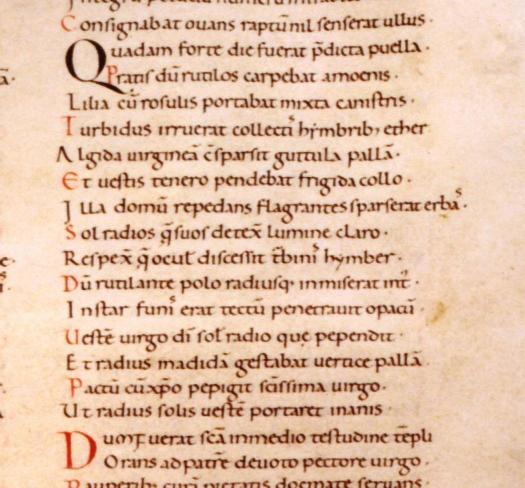
The Laurentian Library manuscript open to the miracle story of St Brigit hanging her cloak on a sunbeam to dry.
Lorica di san Patrizio (385-461)
{ Io sorgo quest'oggi con la
forza del Cielo
i raggi del sole,
la luminosità della luna,
il bagliore del fuoco,
la velocità del lampo,
la velocità del vento,
la profondità del mare,
la stabilità della terra,
la solidità della roccia.
{ Io sorgo quest'oggi con la
possanza di Dio,
la potenza di Dio mi conforti,
la saggezza di Dio mi guidi,
l'occhio di Dio vigili innanzi a
me,
l'orecchio di Dio mi ascolti,
la parola di Dio parli per me,
la mano di Dio mi conduca,
le vie di Dio siano innanzi a
me,
lo scudo di Dio mi protegga,
le schiere celesti mi salvino
dai lacci del diavolo,
dalle tentazioni a peccare,
da tutti coloro che mi vogliono
male,
quelli vicini e lontani,
Quando da solo e con gli altri.
{ Possa Cristo proteggermi
quest'oggi
dal veleno e dal fuoco,
dall'annegare e dall'esser
ferito,
così ch'io possa compiere la mia
missione
e dare frutto in abbondanza.
Cristo dietro e innanzi a me,
Cristo dietro e sopra di me,
Cristo con me ed in me,
Cristo vicino a me e unito a me,
Cristo alla mia destra, e alla
mia sinistra,
Cristo quando vado a dormire la
sera,
Cristo quando mi alzo al
mattino,
Cristo nel cuore di ogni uomo
che mi pensa,
Cristo sulla bocca di tutti
quelli che parlano di me,
Cristo in ogni occhio che mi
vede,
Cristo in ogni orecchio che mi
ascolta.
{ Io sorgo con la potenza della
Trinità,
con la fede nella Trinità,
con la fede nell'unità,
del Creatore del cielo e della
terra.
The metrical Life of Brigit ascribed to Donatus survives in four main copies, all apparently of Tuscan provenance. The text shows close but not direct relationship with the so-called Vita Prima of Brigit, itself identified as an eighth-century amalgamation of three seventh-century vitae. We may suppose that both works drew independently on the same material. Why did Donatus produce yet another vita of Brigit when vitae from Ireland were evidently in circulation? The work of Donatus shows that he is focusing in particular on a continental readership rather on the Irish emigrees familiar with the saint. Donatus substitutes a hagiographical form which came into vogue in Carolingian circles, that of a Latin hexameter epic, for the existing Hibernicized Latin prose narratives which were influenced by vernacular Irish storytelling. Clearly, in proclaiming Brigit’s deeds to Tuscan ecclesiastics, Donatus sought that the medium of his work should invite reception and that form should not distract from content.
La vita di Brigida in forma metrica attribuita a Donato sopravvive in quattro copie principali tutte a quanto pare di provenienza toscana. Il testo mostra una stretta relazione, anche se non diretta, con la cosìddetta Vita Prima di Brigida, essa stessa riconosciuta come una fusione dell'VIII secolo di tre vitae del VII. Possiamo supporre che entrambe le opere attinsero indipendentemente dallo stesso materiale. Perché mai Donato scrisse ancora un'altra vita anche se evidentemente circolavano vitae della santa provenienti dall'Irlanda? L'opera di Donato attesta come egli si concentri in particolare sui lettori dell'Europa continentale piuttosto che non sugli emigrati irlandesi che avevano familiarità con la santa. Donato sostituisce una forma agiografica divenuta di moda nei circoli carolingi, quella cioè di un'epica latina in esametri, con le allora comuni narrazioni in prosa latina commiste a tipiche espressioni irlandesi che subirono l'influsso dellle storie irlandesi in volgare. Nell'esaltare le opere di Brigida agli ecclesiastici toscani, l'aspirazione di Donato fu, chiaramente, quella che la sua opera invitasse all'accoglienza, e la forma non distraesse dal contenuto.
We learn more of the writer’s outlook from his prologues. Two hymns on Christ and the saints set Donatus’s account of Brigit in context. In the first hymn we find praise of Christ through brief recall of his deeds for mankind, especially his death and resurrection, and at the end is the poet’s own request for mercy and eternal salvation. The adoption of this poetic mode suggests that Donatus viewed his work in a manner similar to that which we noted earlier in the verse of Columbanus and of Blathmac, and thus within a framework of reciprocal relations between poet and patron. Donatus the bishop is also concerned with proper protocol, as he accords Christ pride of place as his primary patron, then he proceeds to extol the saints from the martyrs onward, and follows with praise of Brigit in particular. Before recounting Brigit’s deeds, moreover, Donatus includes verses in praise of Ireland, native land of the saint and his own native land. We may view this as Donatus the exile looking back on his homeland as a kind of Biblical paradise. Yet the placement of these verses in his hagiographical text suggests that somewhat more was in question, that Donatus wished to link Brigit’s Irishness with her sanctity. Proclaiming to a Tuscan audience that Brigit’s deeds merited recognition in the universal canon of sanctity, at the same time he proclaims that this great saint was his compatriot.
Apprendiamo molto più del punto di vista dell'autore dai suoi prologhi. Due inni su Cristo e sui santi contestualizzano il racconto di Donato su Brigida. Nel primo inno troviamo una lode a Cristo per mezzo di una breve rievocazione di quello che egli ha fatto per l'umanità, in particolare con la sua morte e resurrezione ed alla fine vi è la supplica dello stesso poeta per impetrare misericordia e la salvezza eterna. L'adozione di questa forma poetica suggerisce che Donato considerava la sua opera in modo analogo a quello da noi precedentemente osservato nei versi di Colombano e di Blathmac, e, dunque, entro una cornice di reciprocità relazionale tra poeta e protettore. Il Vescovo Donato mostra di preoccuparsi anche dell'appropriato protocollo, dal momento che accorda a Cristo il posto di suo protettore privilegiato, procede poi a celebrare i santi e i martiri, e continua con la lode di Brigida in particolare. Donato, inoltre, prima di narrare le opere di Brigida, include dei versi in lode dell'Irlanda, terra natia della santa e sua propria. Questo ci induce a pensare all'esule Donato come a colui che ricorda la madre patria come una sorta di paradiso biblico. La collocazione di questi versi nel suo testo agiografico suggerisce, tuttavia, che Donato voleva indulgere su qualcosa di più importante in quanto desiderava collegare l'irlandità di Brigida alla sua santità. Dichiarando ad un pubblico toscano che le opere di Brigida meritassero il riconoscimento nel canone universale della santità egli annuncia, al contempo, che questa grande santa era sua compatriota.
Once he had asserted the fact of Brigit’s Irishness, Donatus dispenses with the detail, abbreviating biographical data in his source-texts. He is more concerned with establishing the saint’s favour with God than with setting out a chronological career. Brigit is called ‘ uirgo Dei’ or ‘ sancta Dei’, and it is emphasized that divine power was manifested in the deeds which she was enabled to do. Miracles of assistance predominate. The sick and disabled are cured, lepers are healed, food is miraculously multiplied, water is changed into beer or milk, lost or broken objects are restored. Brigit is a saint who protects and provides, who restores health, guides the lost, and gives abundantly. Furthermore, Brigit is shown as being eminently approachable. She is not cloistered, and she travels through the countryside, encountering and assisting people from every echelon in society. Her deeds proclaim the virtues of humility and charity, and the few instances of punishment through her power arise through sins against these virtues. Donatus, in his pastoral role, presents Brigit as a saint who interacted with kings and bishops, but who had especial care for the poor and afflicted. She is a patron worthy of the regard of the whole community.
Asserito il fatto
dell'irlandità di Brigida, Donato tralascia i particolari,
abbreviando i dati biografici presenti nelle sue fonti. È più
interessato a dimostrare lo stato di grazia della santa con
Dio che non ad esporre un percorso cronologico. Brigida è
chiamata
" virgo Dei " o "sancta Dei", ed è enfatizzata la potenza
divina che manifestatasi nelle opere che a lei fu concesso di
compiere. I miracoli di assistenza predominano. I malati ed i
disabili sono guariti, i lebbrosi sanati, il cibo è
miracolosamente moltiplicato, l'acqua trasformata in birra o
latte, gli oggetti smarriti restituiti, gli oggetti rotti
restaurati. Brigida è la santa che offre la sua protezione,
che riesce a provvedere ai bisogni, che risana, che guida i
dispersi e dona generosamente. La descrizione di Brigida,
inoltre, la mostra come molto aperta. Non è segregata in
clausura, vaga per la campagna incontrando e assistendo gente
di ogni condizione sociale. Le sue opere proclamano le virtù
dell'umiltà e della carità ed i pochi esempi di punizione in
cui ha esercitato la sua autorità derivano dai peccati contro
queste virtù. Donato, nel suo ruolo pastorale, presenta
Brigida come una santa capace di interagire con re e vescovi,
ma con una sollecitudine particolare verso i poveri e gli
afflitti. La patrona a cui l'intera comunità deve rendere
omaggio.
The epitaph of Donatus emphasizes the prominent role which he played in public life in northern Italy as a scholar and as an ecclesiastical magnate who interacted with secular powers.
L'epitaffio di Donato enfatizza il ruolo preminente che egli ebbe nella vita pubblica nell'Italia del Nord come studioso e come autorevole personalità ecclesiastica capace di interagire con il potere secolare.
{H ic ego Donatus, Scotorum sanguine cretus,
solus in hoc tumulo, pulvere, verme, voror.
Regibus Italicis servivi pluribus annis,
Lothario magno, Ludovicoque bono,
Octenis lustris septenis insuper annis,
post Fesulana praesul in urbe fui.
Grammata discipulis dictabam scripta libellis;
schemmata metrorum, dicta beata senum.
Posco, viator, adis quisquis pro munere Christi,
te, modo, non pigeat cernere busta mea,
atque precare Deum, regit qui culmina caeli,
ut mihi concedat regna beata sua.
Yet his devotion to Brigit implies concern with the weak in society as well as with the strong. Brigit was a role-model in helping and protecting all who sought her assistance, especially the most needy in the community. Historical sources testify that in his episcopal role Donatus attended royal courts and church councils, and acted as feudal lord in the city. Was there a contradiction, then, between his public role and his position as a follower of Brigit, saint of humility and charity? Beyond the city is the rural hermitage of Santa Brigida, very probably dedicated by Donatus to his patron saint. The hermitage under Brigit’s patronage may well have constituted for Donatus a place of ascetic retreat, known in Irish as di/sert, literally ‘desert’, away from the obligations of episcopacy and power, where he might pray and contemplate. Following the example of Martin of Tours, one of the saints most venerated in the early Irish church, Donatus may have sought to balance the episcopal and monastic roles, the pastoral and the ascetic. City and hermitage thus may be seen as contrasting yet complementary dwellings, the one serving public obligation and interaction with the powerful, the other, offering private meditation and interaction with the poor and needy of the countryside.
La sua devozione a Brigida implica, tuttavia, il suo prendersi cura dei deboli e dei potenti. Brigida era un modello da imitare nell'aiuto e nella protezione che offriva a tutti coloro i quali accorrevano a lei per ricevere soccorso, in particolare i più bisognosi della comunità. Fonti storiche attestano che nel suo ruolo episcopale Donato frequentò corti regie e concili ecclesiastici e fu signore feudale della città. Vi era, dunque, contrapposizione tra il suo ruolo pubblico e il suo essere un seguace di Brigida, la santa dell'umiltà e della carità? Al di là della città vi è l'eremo rurale di Santa Brigida, da Donato molto probabilmente dedicato alla sua santa protettrice. L'eremitaggio sotto la protezione di Brigida può aver rappresentato per Donato un luogo di ritiro ascetico, conosciuto in irlandese come di/sert, letteralmente "deserto", lontano dagli obblighi dell'episcopato e del potere, dove poteva raccogliersi per pregare e meditare. Seguendo l'esempio di Martino di Tours, uno dei santi più venerati nella Chiesa irlandese primitiva, Donato può aver cercato di armonizzare il ruolo monastico e quello episcopale, il pastorale e quello ascetico. La città e l'eremitaggio possono essere così visti come dimore contrapposte e, tuttavia, complementari, l'una essendo al servizio degli obblighi pubblici e dei contatti con i potenti, l'altra offrendo la meditazione privata e l'interazione con i poveri ed i bisognosi della campagna.
In parallel, Donatus’s own commemoration of Brigit linked Irish tradition with Carolingian scholarship, as the narration of the saint’s deeds in epic hexameters performed the service of poetic praise for patron in expectation of a spiritual reward. Donatus’s composition implies the view that while Brigit belonged to Ireland she belonged also to the wider world and to Tuscany itself. The fact that Tuscany preserved manuscripts of Brigit’s Vita and the name of Santa Brigida must surely be attributed to the actions of Donatus, and ultimately to his conviction that the deeds of Brigit were not merely matters of history or clerical concerns, but served as a universal inspiration for all time.
In parallelo, la stessa celebrazione di Brigida da parte di Donato coniugava tradizione irlandese e cultura carolingia, dal momento che la narrazione delle opere della santa in esametri epici adempiva l'ufficio della lode poetica per un protettore in attesa di una ricompensa spirituale. Il componimento di Donato implica l'idea che Brigida appartenesse all'Irlanda, ma, al contempo, apparteneva anche al più vasto mondo e alla stessa Toscana. Il fatto che la Toscana preservasse manoscritti della Vita di Brigida e ne conservasse il nome è da attribuire con certezza all'operato di Donato, e fondamentalmente alla sua convinzione che le opere di Brigida non fossero semplicemente una questione di storia o una questione legata a preoccupazioni clericali, ma, piuttosto, servissero come ispirazione universale per tutti i tempi.
Moreover, our earliest documentary reference to Brigit, in a vernacular Irish text dated about 600 AD says of her “She will be another Mary, mother of the great Lord ”. Devotion to Brigit was, therefore, associated with Marian devotion. A vernacular text on the Life of Brigit dated c. 900 AD depicts a prophecy of Brigit’s coming to her Irish site of Kildare thus: “ This site is open to heaven ...; and today a girl for whom it has been prepared by God will come to us like Mary”. The close geographical association between Santa Brigida and Marian sites in Tuscany such as Santuario Madonna delle Grazie al Sasso thus mirrors a connection between Brigit and Mary which extends back to the beginnings of Christianity in Ireland.
Il nostro più antico riferimento documentario a
Brigida, inoltre, in un testo irlandese in volgare, datato
intorno al 600 d. C., dice di lei:
"Ella sarà un'altra Maria, madre dell'altissimo". La devozione
a Brigida fu, dunque, associata alla devozione mariana. Un
testo in volgare sulla vita di Brigida, datato intorno
al 900 d. C., riporta una profezia della venuta di Brigida al
suo sito irlandese di Kildare: "questo luogo è aperto al cielo
...; ed oggi una fanciulla per la quale esso è stato preparato
da Dio giungerà a noi come Maria". Gli stretti contatti
geografici tra Santa Brigida ed i luoghi mariani in Toscana,
quali il Sacro Convento di Monte Senario e il Santuario della
Madonna delle Grazie al Sasso, rispecchiano una collegamento
tra Brigida e Maria che si estende indietro nel tempo fino
alla cristianità primitiva in Irlanda.

Santuario della Madonna delle Grazie al Sasso, built
over the hermitage of Sant'Andrea
of Ireland. In the valley below
is the cave of his sister St Brigit of Ireland's hermitage.
The continuing veneration of Santa Brigida, moreover, indicates that the site served as a place of retreat and meditation even after the time of Donatus. That it was particularly linked with female devotion is suggested by an episode in the thirteenth-century Life of St Andrew, identified as a disciple of Donatus in Ireland, and subsequently his Archdeacon in Fiesole.
L'ininterrotta venerazione di Santa Brigida, inoltre, indica che il sito serviva come luogo di ritiro e di meditazione anche dopo il tempo di Donato. Che fosse particolarmente collegato con la devozione di genere femminile è suggerito da un episodio presente nella Vita di Sant'Andrea del secolo XIII. Sant'Andrea è identificato come discepolo di Donato in Irlanda e successivamente suo Arcidiacono a Fiesole.

Hermitage first of Sant'Andrea of Ireland, then of
San Bernardino of Florence, at the Santuario della Madonna
delle
Grazie al Sasso, Santa Brigida
It is related that God took pity on Andrew as he lay in his final illness far from his homeland, and angels were sent to bring his sister, Brigit, from Ireland to comfort him at his life’s end. After Andrew’s death, the Life recounts that his sister remained in the area, living a life of prayer in the hermitage now known as Santa Brigida. The hagiographical episode may be based on an episode in the Life of Donatus himself, which recounts how the saint was consoled and healed by a vision of his patron saint, Brigit. The thirteenth-century story in the Life of Andrew seems to be an adaptation which makes the sixth-century Irish saint into a more accessible and immediate figure, who was physically as well as spiritually present in the Tuscan countryside. The significance of the story is that it witnesses in an important way to contemporary devotion, and to the fact that the secluded site of Santa Brigida was known as the retreat of a female saint. Thus, the legacy of Brigit, patron and guide of the first Irish pilgrims to Italy, took root and survived, in various forms, and through the centuries. The saint’s legacy in Tuscany associates female sanctity and intercession with a holy place which continues to inspire the practices of prayer and contemplation.
Si racconta che Dio ebbe compassione di Andrea quando lontano dalla patria soffriva sul suo giaciglio durante la sua ultima malattia. Dio gli inviò degli angeli per condurre a lui dall'Irlanda la sorella Brigida affinché lo confortasse alla fine della vita. Dopo la morte di Andrea la Vita racconta che sua sorella rimase in quell'area, e condusse una vita di preghiera nell'eremitaggio ora conosciuto come Santa Brigida. L'episodio agiografico può essere basato su un episodio che ritroviamo nella Vita di Donato stesso, che racconta come il santo fu confortato e curato da una visione di santa Brigida, sua santa protettrice. Il racconto del secolo XIII nella Vita di Andrea pare sia un adattamento, che descrive il santo irlandese del secolo VI come aperto e pieno di sollecitudine. Fisicamente e spiritualmente presente nella campagna toscana. L'importanza della storia sta nel suo dare essenzialmente testimonianza della devozione del tempo e del fatto che il luogo solitario di Santa Brigida, era conosciuto come l'eremo di una donna santa. Così l'eredità di Brigida, protettrice e guida dei primi pellegrini irlandesi, si radicò e sopravvisse in varie forme e attraverso i secoli. L'eredità della santa in Toscana associa la santità e l'intercessione femminile con un luogo santo che continua ad ispirare la pratica della preghiera e della contemplazione.
2 July 1484, the Virgin appeared to two Ricovera sister shepherdesses at Sasso, on the site of St Andrew's hermitage, telling the young girls to tell Florence, the Clergy and the People, to return to reading and meditating on the Gospel, accepting the Word of God with the same readiness of mind and heart as she had accepted the Word at the Annunciation.
Il 2 luglio 1484 la Madonna apparve a due pastorelle, le sorelline Ricovera, presso l'eremitaggio di sant'Andrea al Sasso, chiedendo alle due fanciulle 'di annunciare a Firenze, al Clero e al Popolo che la loro Madre Celeste invitava tutti a leggere e a meditare il Vangelo, accogliendo la Parola di Dio con la stessa sollecitudine della mente e del cuore con la quale Ella stessa accolse la Parola al momento dell'Annunciazione'.
BIBLIOGRAPHY/BIBLIOGRAFIA
Sancti Columbani Opera ed. G.S.M. Walker
(Dublin, 1957, repr. 1970).
Michael Lapidge, “Precamur
Patrem: An Easter Hymn By Columbanus?” in Columbanus:
Studies on the Latin Writings, ed. M. Lapidge
(Woodbridge, 1997).
The Antiphonary of Bangor
ed. F. E. Warren (2 vols, London, 1893).
Michael Curran, The
Antiphonary of Bangor (Dublin, 1984).
Jonas, Vita Columbani
Abbatis disciplinorumque eius ed. B. Krusch, MGH Srm 4
(Hannover & Leipzig 1902); also ed. M. Tosi with Italian
translation by E. Cremona & M. Paramidani (Piacenza,
1965).
The Poems of Blathmac son of
Cu Brettan ed. J. Carney (Dublin, 1964).
Uita Metrica Sanctae Brigidae
ed. D.N. Kissane, Proceedings of the Royal Irish Academy
77C (1977).
Uita Sancti Donati publ.
Acta Sanctorum ..Octobris XXII (Paris, 1869), 655-662.
Margaret Stokes, Six Months
in the Appenines: A Pilgrimage in Search of the Vestiges of
the Irish Saints in Italy (London, 1892).
Fra. Anselmo Tommasini, Irish
Saints
in Italy (tr. with additional material by Fr G. Cleary,
(orig. publ. Milan, 1932, English version, London, 1937).
Dom Louis Gougaud, Gaelic
Pioneers of Christianity (Dublin, 1923).
Simon Young, “Brigid of Kildare
in Early Medieval Tuscany”, Studia Hibernica 30
(1998-99), 251-55
Simon Young, “Donatus of Fiesole
829-76, and the Cult of St Brigit in Italy”, Cambrian
Medieval Celtic Studies 35 (1998), 13-26.
Techt do Ròim,Irish poem in a Sedulius manuscript (Codex Boernerianus, MS Dresd. A154b, Greek Text of 13 Pauline Epistle with Latin interlinear, Sedulius and Circle )
mòr saìtho, becc torbai;
In Rì con-daigi i foss,
manim bera latt nì fhogbaiWho pilgrims to Rome,
labours much, yet little gains.
Your King is there only
if he travelled with you.Pellegrino a Roma,
molta fatica, poca ricompensa;
se Cristo non viaggia
con te non lo troverai.
Poema irlandese a margine di un manoscritto di
Sedulio (Codex Boernerianus, MS Dresd. A154b, testo greco di
13 epistole di san Paolo con interlineare latina)

Julia Bolton Holloway, Bernard Meehan, Maire
Herbert, Rev. Martin McNamara, at the Certosa, Florence

Rev. Martin McNamara, [ ], Liesel
Nolan, David Moreno, Nora Serrano, [ ], Santa Brigida,
Luciana Cupo Csaki, Julia Bolton Holloway, Maire Herbert,
Angela Franco at St Bridget's Cave, Santa Brigida
GO TO PART IV OF THE CITY AND THE BOOK CONGRESS: IV, THE BIBLE IN ENGLAND AND ICELAND
VA ALLA PARTE IV DEL CONVEGNO, LA CITTA` E IL LIBRO: IV, LA BIBBIA IN INGHILTERRA E ISLANDA
 City and Book Websites
Si ringraziano per la collaborazione
Lapo Mazzei, Carlo Steinhauslin


 Rotary Club Bisenzio - Firenze
 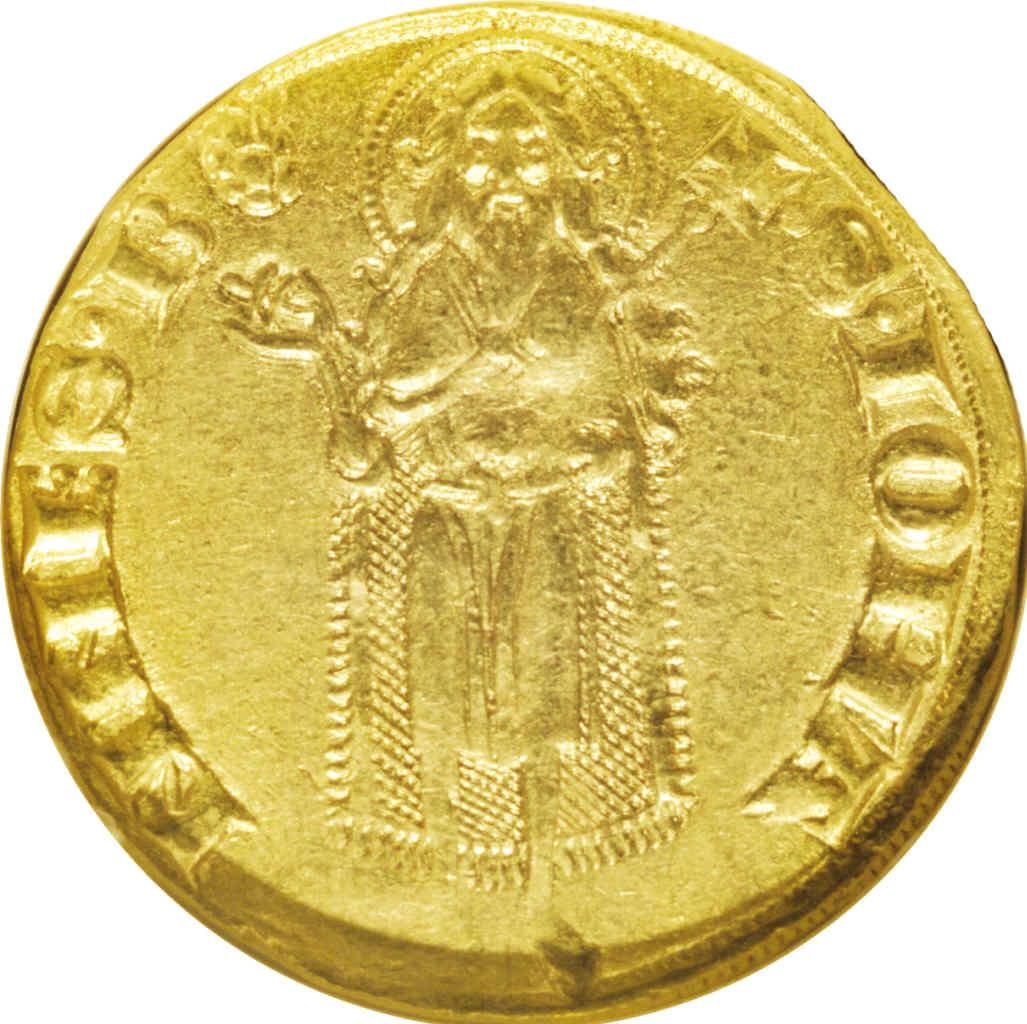 |
To donate to the restoration by Roma of Florence's
formerly abandoned English Cemetery and to its Library
click on our Aureo Anello Associazione's
PayPal button: THANKYOU! |