nna
Jameson prefaced her Loves of the Poets with a
quotation from Madame de Staël:
nna
Jameson prefaced her Loves of the Poets with a
quotation from Madame de Staël:
Elizabeth Barrett Browning || Madame de Staël || Anna Jameson || Theodosia
Garrow Trollope || Isa Blagden || Mary Somerville || Jessie White Mario || Anita Garibaldi || Cristina Trivulzio, Principessa Belgioioso || Sarah Parker Remond
|| Harriet Beecher Stowe || Rosa Madiai || Margaret
Fuller || Harriet Hosmer || Félicie de Fauveau
|| Lily Wilson || Cristina Rossetti
nna
Jameson prefaced her Loves of the Poets with a
quotation from Madame de Staël:
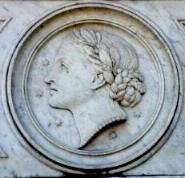
Lord
Leighton's cameo on Elizabeth Barrett
Browning's Tomb of a Poetess with laurel
garland.
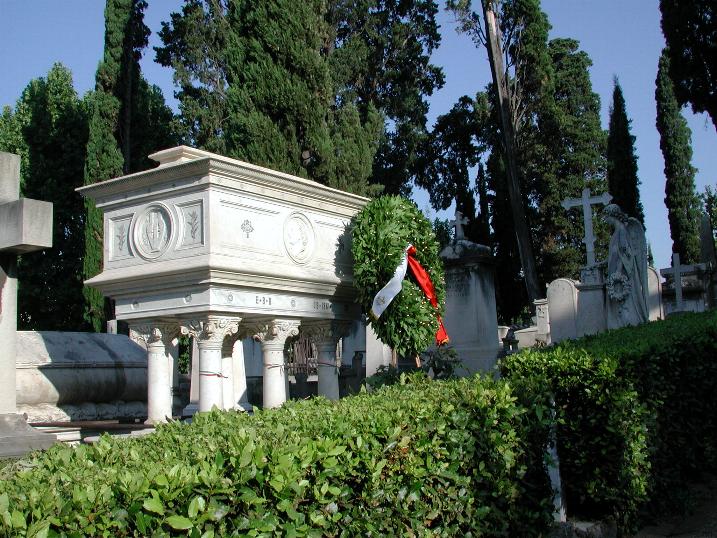
The laurel wreath laid by the Comune of
Florence on Elizabeth Barrett Browning's tomb by Lord Leighton
on her 200th anniversary, 2006
 lizabeth
Barrett and Robert Browning eloped together from her Wimpole
Street sickroom in 1846 and came to Casa Guidi in 1847.
Their first glimpse of their new home would have been of its
frescoed walls, then covered with laurel garlands. It was at
Casa Guidi that Elizabeth gave birth to her child, in 1849,
celebrating that event while mourning the Austrian takeover
of Tuscany and the downfall of the Mazzini Republic of Rome
to the French in that same year in her political poem, Casa
Guidi Windows, and it was here in 1850, that she was
proposed for Poet Laureate, and here where she wrote her
epic poem, Aurora Leigh, whose heroine crowns
herself one June day with ivy and not with laurel.
lizabeth
Barrett and Robert Browning eloped together from her Wimpole
Street sickroom in 1846 and came to Casa Guidi in 1847.
Their first glimpse of their new home would have been of its
frescoed walls, then covered with laurel garlands. It was at
Casa Guidi that Elizabeth gave birth to her child, in 1849,
celebrating that event while mourning the Austrian takeover
of Tuscany and the downfall of the Mazzini Republic of Rome
to the French in that same year in her political poem, Casa
Guidi Windows, and it was here in 1850, that she was
proposed for Poet Laureate, and here where she wrote her
epic poem, Aurora Leigh, whose heroine crowns
herself one June day with ivy and not with laurel.
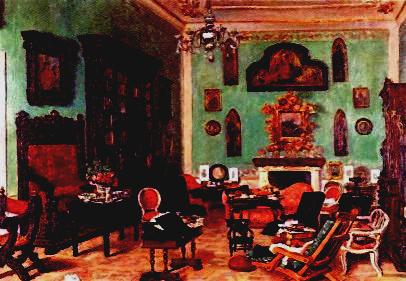
It was in this room that Elizabeth read novels and wrote poems, her favourites being Madame de Staël's novel, Corinne ou Italy and those of George Sand. She had as a child studied Hebrew and Greek, and knew the poetry of Homer, Sophocles and Lord Byron intimately, their pictures and their books being her cherished possessions. It was to this room that many other women came, women like the Americans Margaret Fuller, Kate Field, Harriet Hosmer, Harrier Beecher Stowe, and the Englishwomen Anna Jameson, Jessie White Mario, Frances Trollope and Isa Blagden, but not George Sand or George Eliot or Anita Garibaldi or the Princess Belgioioso.
None of these women could attend university. But they could and did write, or sculpt, or heal the sick, or advise nations on freedom. They share a passionate hatred of the abuse of children, of slavery, of the oppression of nations, all as paradigms of their own exploitation as women. In the nineteenth-century they banded together, especially espousing the cause of the Italian Risorgimento. In this essay I shall give portraits of these women, just as much as did Elizabeth Barrett Browning herself adorn its walls, decked with the colours of Beatrice's garb and Italy's then-forbidden flag, with engravings and paintings of poets she loved, and in the same way as would later Lytton Strachey write Eminent Victorians and Virginia Woolf, The Common Reader, and as had Anna Jameson and even Plutarch before them written biographical sketches of great women and men. These women can be her laurel and her ivy, her Casa Guidi Windows opened to the world.
In an earlier lecture at the British Institute I discussed in detail
Elizabeth and Robert's family backgrounds as deeply implicated
in slavery in the West Indies. Elizabeth Barrett Moulton Barrett
was of slave as well as slave-owning stock (her aunt is the
famous Pinkie, born in Jamaica, and dying sooner after this
painting was finished, and this is Pinkie's brother, Edward
Barrett Moulton Barrett, owner of countless slaves). And
likewise was Robert, who was also celebrating, in his Bells
and Pomegranates his partly Jewish ancestry. We are
dealing with Citizens of the Globe, not merely of Italy or of
England or of America.
 et me begin with Madame
de Staël (1766-1817), the author of
the novel, Corinne
ou Italie (1804),
which profoundly influenced Elizabeth Barrett Browning,
Anna Jameson, Harriet Beecher Stowe and Margaret Fuller.
Anne Louise Germaine was the daughter of Suzanne Curchod
and supposedly Jacques Necker, the Swiss banker who became
France's Minister of Finance in 1776 and 1789. But more
likely Edward Gibbon, author of the Decline and Fall of the Roman
Empire, and who had
loved Suzanne Curchod for many years, was her real father.
Gibbon, two years before she married, described her to a
friend: "Mlle. Necker,
one of the greatest heiresses of Europe, is now about
eighteen, wild, vain, but good-natured, and with a much
larger provision of wit than of beauty." Her husband
was to be Eric Magnus, Baron de Staël-Holstein,
Sweden's ambassador to Paris.
et me begin with Madame
de Staël (1766-1817), the author of
the novel, Corinne
ou Italie (1804),
which profoundly influenced Elizabeth Barrett Browning,
Anna Jameson, Harriet Beecher Stowe and Margaret Fuller.
Anne Louise Germaine was the daughter of Suzanne Curchod
and supposedly Jacques Necker, the Swiss banker who became
France's Minister of Finance in 1776 and 1789. But more
likely Edward Gibbon, author of the Decline and Fall of the Roman
Empire, and who had
loved Suzanne Curchod for many years, was her real father.
Gibbon, two years before she married, described her to a
friend: "Mlle. Necker,
one of the greatest heiresses of Europe, is now about
eighteen, wild, vain, but good-natured, and with a much
larger provision of wit than of beauty." Her husband
was to be Eric Magnus, Baron de Staël-Holstein,
Sweden's ambassador to Paris.
De Goncourt described her political role:
Napoleon: Madame, in what chapter of the work you are now about to publish shall we read this brilliant passage?'
She next visited England where she was treated with the highest consideration and above all enjoyed the friendship of Lord Byron.
In 1816, she wrote "There is a nation which will one day be very great--the Americans." Only slavery she felt, marred its perfection. "What is more honourable for mankind than this new world which has established itself without the prejudices of the old?--this new world where religion exists in all its fervor without needing the support of the state to maintain it, where the law commands by the respect it inspires although no military power backs it up." In a letter to Thomas Jefferson she wrote, "If you succeeded in doing away with slavery in the South, there would be at least one government in the world as perfect as human reason can conceive it."
Twice she published novels, Delphine first, then Corinne ou Italie. Corinne is an intensely political book. In it a young Scottish nobleman, Oswald, Lord Nevil, finds his childhood friend become an Italian patriot. He witnesses her being crowned with laurel, made Poet Laureate, while dressed as the Sibyl, on the Capitol in Rome and hears her utter political prophetic verses. Perhaps, in this scene on the Capitol, Madame de Staël/Corinne was playing with her biological father's conception of his great work, The Decline and Fall of Rome. In her chef-d'oeuvre, she metamorphoses that into the Renaissance, the Risorgimento, of Italy.
But, instead of marrying Corinne, Lord
Nevil weds a pallid proper young girl--and Corinne dies of a
broken heart. This novel was read and admired by Victorian
generations. Though unbeautiful, Madame de Staël had herself
portrayed as enacting the role of Corinne, by the woman portrait
painter, Madame Vigée Le Brun.
 nna
Jameson had come to Italy for the first time in 1821, a
buxom twenty-five year old with a head of reddish-blond hair
(just the colour of Poetry in Carlo Dolci's painting, Ruskin
noted). She was the eldest daughter of an Irish miniature
painter of considerable talent, Denis Murphy, Lady Byron in
1841 writing a poem 'On a Portrait of Mrs. Jameson by her
Father'. At first she earned her sustenance as a governess,
observing that "the occupation of governess is sought merely
through necessity, as the only means by which a woman not
born in the servile classes can earn the means of
subsistence".
nna
Jameson had come to Italy for the first time in 1821, a
buxom twenty-five year old with a head of reddish-blond hair
(just the colour of Poetry in Carlo Dolci's painting, Ruskin
noted). She was the eldest daughter of an Irish miniature
painter of considerable talent, Denis Murphy, Lady Byron in
1841 writing a poem 'On a Portrait of Mrs. Jameson by her
Father'. At first she earned her sustenance as a governess,
observing that "the occupation of governess is sought merely
through necessity, as the only means by which a woman not
born in the servile classes can earn the means of
subsistence".
In moments when she was alone, or if her employers went out to some reception to which she was not invited, Anna Murphy immediately opened two diaries. In the second, she has herself die of a broken heart, the work being published as a governess novel with the title, The Diary of an Enuyée, modeled upon de Staël's Corinne ou Italie, but which is also filled with art historical observations. Mrs. Fanny Kemble said, "While under the immediate spell of her fascinating book, it was of course very delightful to me to make Mrs. Jameson's acquaintance, which I did. . . The Ennuyée , one is given to understand, dies, and it was a little vexatious to behold her sitting on a sofa in a very becoming state of blooming plumpitude".
The Frontispiece is of Beatrice Cenci.
In reality, rather than dying of Victorian tuberculosis, Anna Murphy married.
But the marriage failed, and the alcoholic Mr. Jameson went off to Canada.
Because of the failed marriage, Anna could no longer even return to being a governess. She therefore wrote further books: The Memoirs of the Loves of the Poets by the Author of the "Diary of an Ennuyëe, 1829, in two volumes; Memoirs of Celebrated Female Sovereigns, 1831; Memoirs of the Beauties of the Court of Charles II, 1831; Characteristics of Shakespeare's Women. Anna Jameson had a warm temperament, her friends including Ottilie von Goethe, Lady Byron, Elizabeth Barrett Browning and her own niece Geraldine Bate, who married and became Geraldine MacPherson. This is Anna Jameson describing the Coronation of Queen Victoria, whom she knew well:
Anna Jameson, with her young niece, helped the eloping Elizabeth Barrett, who was seriously ill, and Robert Robert Browning, who was robust, in Paris and Pisa while on her way to Rome and working on her masterpiece, Sacred and Legendary Art. The couple seemed to have walked out of the pages of her volumes, The Loves of the Poets .
In 1857 Anna Jameson lived around the
corner from Casa Guidi in Via Maggio; like Elizabeth, she was to
die, in 1860, without seeing Italian liberation succeed.
 heodosia
Garrow and Elizabeth Barrett Browning already knew each from
Torquay in Devon where Elizabeth had been sent because of
her tuberculosis, an illness she shared with Theodosia. Like
Elizabeth, she was small and exotic, her own background
being part East Indian, part Jewish, and from this she is
partly the model for Nathaniel Hawthorne's Miriam in The Marble Faun. Both Theodosia and Elizabeth
were to come to Florence where Theodosia met and married
Thomas Adolphus Trollope, bearing him the child Bice, Pen's
playmate, translating Niccolini's plays, supporting the
Risorgimento, until her own early death.
heodosia
Garrow and Elizabeth Barrett Browning already knew each from
Torquay in Devon where Elizabeth had been sent because of
her tuberculosis, an illness she shared with Theodosia. Like
Elizabeth, she was small and exotic, her own background
being part East Indian, part Jewish, and from this she is
partly the model for Nathaniel Hawthorne's Miriam in The Marble Faun. Both Theodosia and Elizabeth
were to come to Florence where Theodosia met and married
Thomas Adolphus Trollope, bearing him the child Bice, Pen's
playmate, translating Niccolini's plays, supporting the
Risorgimento, until her own early death.
lizabeth
set her epic poem's most important Dantesque-scene at
Bellosguardo. She knew of it because of her friend, Isa
Blagden . Isa is likewise the model for Miriam in
Nathaniel Hawthorne's Romance, The Marble Faun.
Alfred Austin said of her: "The news, 'Isa is coming,'
invariably thrillled with an almost childlike delight a
certain Florentine circle." "She gloried in the gorgeous
apparel of the external world, just as--many will
remember--she delighted in bright textures and vivid colours
for feminine adornment." Kate Field said:
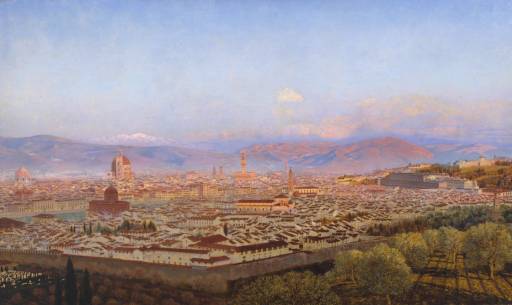
Henry James talked with her one morning at Bellosguardo:
 essie White ' is
a great woman to whom we Italians owe a lot' Giosué
Carducci said. She had met Garibaldi in London in 1854,
when he was more or less engaged to be married to an
Englishwoman. As this lady's friend she had come to Italy
to rejoin the General. Garibaldi valued her masculine
energy and her gifts as a medically trained nurse. She was
a most fervent disciple of Mazzini who held her in high
esteem. Even before meeting him Miss White had been fired
with his theories, and once she had met him, she threw
herself into the cause with such passion that the apostle
himself was frightened. 'Good and devoted as she is, Jessie
infuriates me. She talks like a soldier; she insults
everyone; she uses a dictatorial manner which is more
imperious than Garibaldi's own.'
essie White ' is
a great woman to whom we Italians owe a lot' Giosué
Carducci said. She had met Garibaldi in London in 1854,
when he was more or less engaged to be married to an
Englishwoman. As this lady's friend she had come to Italy
to rejoin the General. Garibaldi valued her masculine
energy and her gifts as a medically trained nurse. She was
a most fervent disciple of Mazzini who held her in high
esteem. Even before meeting him Miss White had been fired
with his theories, and once she had met him, she threw
herself into the cause with such passion that the apostle
himself was frightened. 'Good and devoted as she is, Jessie
infuriates me. She talks like a soldier; she insults
everyone; she uses a dictatorial manner which is more
imperious than Garibaldi's own.'
Jessie White arrived in Genoa in 1857 to take part in the Mazzinian rising for which she had collected considerable funds, but she was promptly arrested and kept in jail for four months. In prison she made the acquaintance of Alberto Mario, an exceedingly handsome young patriot who shared her views. From that moment, the heart of Jessie White nursed not only a fraternal friendship for Garibaldi and a disciple's cult for Mazzini, but a flaming woman's passion for Mario, whose wife she soon became, and with whom she pursued her devoted service to the cause of her adopted country. After 1860, along with her husband, she followed Garibaldi on the field of battle in all his campaigns, and was always in the thick of the fight as an heroic nurse. Miss Henrietta Corkran gave a portrait of Jessie White:
Though they were friends, inevitably things moved towards open disagreement between the invalid Elizabeth Barrett Browning and the robust Jessie White Mario. In fact when Mrs Mario went to America to give a series of propaganda talks and used the name of the Brownings as a recommendation for the cause they were horrified lest they be taken as patrons of revolutionary ideas, and they issued a denial in an American newspaper. Polemical correspondence ensued in the columns of the Athenaeum, which ended with a letter from the Browning stating that ' despite our high esteem and personal affection' for Jessie Mario, there was diversity in their political opinions. They became reconciled later, but when Elizabeth heard of the arrest of Jessie and of her expulsion to Switzerland, she did not conceal a certain feeling of relief.
Thomas Adolphus Trollope said of Jessie White:
nita,
Garibaldi's tiny, determined wife, had met him in Latin
America, and joined him through terrible times, being
pregnant with their child at the Fall of the Roman Republic
in 1849. Margaret Fuller describes that Fall of Mazzini's
Roman Republic to the French:
. . . all are light, atheletic, resolute figures, many of the forms of the finest manly beauty of the South, all sparkling with its genius and ennobled by the resolute spirit, ready to dare, to do, to die. We followed them to the piazza of St. John Lateran. never have I seen a sight so beautiful, so romantic, and so sad. Whoever knows Rome knows the peculiar solemn grandeur of that piazza, scene of the first triumph of the Rienzi, and whence may be seen the magnificence of the "mother of all churches," . . . The sun was setting, the crescent moon rising, the flower of the Italian youth were marshalling in that solemn place. They had been driven from every other spot where they had offered their hearts as bulwarks of Italian independence.
. . They had all put on the beautiful dress of the Garibaldi legion, the tunic of bright red cloth, the Greek cap, or else round hat with Puritan plume. Their long hair was blown back from reslute faces; all looked full of courage. . . I saw the wounded, all that could go, laden upon their baggage cars; some were already pale and fainting, still they wished to go. . . The wife of Garibaldi followed him on horseback. He himself was distinguished by the white tunic; his look was entirely that of a hero of the Middle Ages,--his face still young, for the excitements of his life, though so many, have all been youthful, and there is no fatigue upon his brow or cheek . . . And Rome! Must she lost also these beautiful and brave, that promised her regeneration, and would have given it, but for the perfidy, the overpowering force, of the foreign intervention?
Cristina Trivulzio, Princess Belgioioso
 argaret
Fuller, writing from Italy to America, described the
hospital work being done by Jessie White Mario and by
Cristina Trivulzio, the Princess Belgioioso.
argaret
Fuller, writing from Italy to America, described the
hospital work being done by Jessie White Mario and by
Cristina Trivulzio, the Princess Belgioioso.
But . . . the hospitals: these were put in order, and have been kept so, by the Princess Belgioioso. The princess was born of one of the noblest families of the Milanese, a descendant of the great Trivalzio, and inherited a large fortune. Very early she compromised it in liberal movements, and, on their failure, was obliged to fly to Paris, where for a time she maintained herself by writing, and I think by painting also. A princess so placed naturally excited great interest, and she drew around her a little court of celebrated men.
After recovering her fortune, she still lived in Paris, distinguished for her talents and munificence, both toward literary men and her exiled countrymen. Later, on her estate, called Locate, between Pavia and Milan, she had made experiments in the Socialist direction with fine judgement and success. Association for education, for labor, for transaction of household affairs, had been carried on for several years; she had spared no devotion of time and money to this object, loved, and was much beloved by, those objects of her care, and said she hoped to die there. All is now despoiled and broken up, though it may be hoped that some seeds of peaceful reform have been sown which will spring to light when least expected.
From Milan she went to France, but, finding it
impossible to effect anything serious there in behalf of
Italy, returned, and has been in Rome about two months.
Since leaving Milan she receives no incomes, her possessions
being in the grasp of Radetzky, and cannot know when, if
ever, she will again. But as she worked so largely and well
with money, so can she without. She published an invitation
to the Roman women to make lint and bandages, and offer
their services to the wounded; she put the hospitals in
order; in the central one, Trinita de' Pellegrini, once the
abode where the pilgrims were received during Holyweek, and
where foreigners were entertained by seeing their feet
washed by the noble dames and dignatories of Rome, she has
remained day and night since the 30th of April, when the
wounded were first there. Some money she procured at first
by going through Rome, accompanied by two other ladies
veiled, to beg it. Afterward the voluntary contributions
were generous.
he
anti- slavery lecturer Sarah Parker Remond had three goals
in mind when she first sailed from Boston for Liverpool in
September of 1858. One was to remove herself from the daily
toxicity of American racism. Another was to do all she could
to consolidate anti-slavery sentiment on the eve of the
Civil War by arguing the ethical and economic advantages of
British support for the Union during the War. The third was
to secure for herself an education superior to any available
to her at home. Her speaking schedule, before groups up to
two thousand strong, kept her on the road and often near
exhaustion. Still, she wrote to Maria Weston Chapman that,
'on the 12th of this month [October 1859] I go to London to
attend the lectures at the Ladies College.' She continued
both her lectures and her studies at Bedford College for
Ladies, later a part of the University of London. Although
there was steady demand for her services following the war
as a speaker on behalf of the freedmen, Remond had her eye
on Italy. 
Sarah
Parker Remond, collection of the Massachusetts
Historical Society.
At the age of forty Sarah Parker Remond moved to Florence where she embarked on medical studies at Santa Maria Nuova, the hospital founded in the thirteenth century by Dante's Beatrice's father and which served as Florence Nightingale's model of medical care and training.
The black publication, The Christian Recorder, reported on what was probably one stage of her medical education with the notice that, 'Miss Sarah Remond, a gifted colored lady, who studied medicine with Dr. Appleton --the friend and physician of Theodore Parker, during the latter portion of his life at Rome and Florence, has been regularly admitted as a practitioner of midwifery in Florence, where she is now residing, with excellent prospects of employment and success. Her merit has won her friends on the continent of Europe, as it did in England. On going to Italy, she had excellent letters of introduction from Mazzini, among others. With this satisfactory passport, Dr. Appleton went with her to call on Garibaldi, and, though many others were waiting for an interview, they were instantly admitted. Miss Remond is not only well received everywhere in Florence, but she has friends among the very best people there.'
A few years later, Sarah Remond’s sister, Caroline Putnam, an Oberlin College graduate and founder of a school for freed men and women in Lottsburg, Virginia, lived with her for a while in Florence. Putnam’s school was supported by Louisa May Alcott (senior) and Ellen Emerson. Elizabeth Buffum Chace, human rights activist and former conductor on the Underground Railroad, visited Remond in Florence in 1873 and wrote that: 'Sarah Remond is a remarkable woman and by indomitable energy and perseverance is winning a fine position in Florence as a physician and also socially; although she says Americans have used their influence to prevent her by bringing their hateful prejudices over here. If one tenth of the American women who travel in Europe were as noble and elegant as she is we shouldn’t have to blush for our country women as often as we do.'
Sarah Parker Remond certainly aroused curiosity and comment in Florence, but the city had a particular sophistication about race unusual on the Continent. After all, the fabled dynasty of the Medici displayed the likeness of Alessandro, the first Duke of Florence, born of a union between a slave of African origin named Simonetta, and, it appears, the future Pope Clement VII. Alessandro lies buried in the tomb of Lorenzo, Duke of Urbino sculpted by Michelangelo, with its spectacular figures of Dusk and Dawn.

Jacopo Pontormo, Alessandro de Medici, The Art Institute of Chicago.
Decades after Sarah Parker Remond's arrival,
Frederick Douglass and his second wife, Helen, visited
Florence 10 May 1887. Douglass went straight from breakfast
to the 'English' Cemetery to visit the tomb of Elizabeth Barrett Browning
honouring her poetry against slavery and to stand, lost in reverie, at the grave of the
abolitionist clergyman Theodore Parker. Parker, during his
final illness, refused to die, if die he must, in Papal
Rome. He longed for Boston but knew he would never survive
the journey home and so, announcing that 'I will not die on
this accursed soil, I will not leave my bones in this
detested soil,' insisted on being lifted from his deathbed
and transported by carriage to Florence. The real Theodore
Parker, he told his friends, was in America; this was just a
dying man they saw before them. The remarks of his final day
included the wish to walk once more on Boston Common. If he
could not die in Boston, Florence, the Boston of Italy, was
his chosen resting place.
[Marilyn Richardson]
Rosa and
Francesco Madiai
The tombs
of Arnold Savage Landor with its extroardinary statue of Julia
Savage Landor, Walter Savage Landor's estranged wife, and that
of Rosa Madiai lie side by side in the Swiss-owned so-called
'English' Cemetery. Julia Savage Landor's is grandiloquent in
its hypocritical mourning. She, the daughter of a bankrupt
Swiss banker, had thrown her poet husband out of their villa
he had given them in San Domenico, leaving him to roam the
streets of Florence penniless, until the Brownings arranged
for him to lodge with their maid, Lily Wilson, in Via della
Chiesa. Lily had been the witness to the Brownings' marriage
and the companion to their elopement.

While
Rosa's tomb is crude but eloquent in a different manner,
giving Mary's 'Magnificat' of humility.
*§ ROSA MADIAI PULINI/ ITALIA/
Madiai/ Rosa/ / Italia/ Firenze/ 28 Marzo/ 1871/ / 1124/+/
Rosa Madiai, Rome/ Walter Savage Landor, 'The Archbishop of
Forence and Francesco Madiai', Imaginary Conversations/ Giuliana Artom
Treves, Golden Ring , pp. 196-99/ ROSA/ PULINI/
NEI MADIAI/ L'ANIMA MIA MAGNIFICA IL SIGNORE E LO SPIRITO/
MIO . . . ESTEGGIA IN DIO MIO SALVATORE/ . . . / CREDETTI IL
VANGELO/ PATII IL MONDO TRISTO/ SON ORA NEL CIELO/ RISIEDO
CON CRISTO/ A5T(70)

Francesco e Rosa Madiai
ROSA MADIAI PULLINI (+1871), a woman of the people, of modest condition, she and her husband found themselves at the centre of an international dispute: a public commission of inquiry, diplomatic intervention from all over Europe, biographies and newspaper articles. The Madiais, converted to Protestantism like Count Guicciardini, were sentenced to prison, but the sentence was commuted to exile because of the tremendous reaction created by the severity of the sentence. Exiled to Nice, they returned to Florence in 1859 to end their days in a modest little lodging in Piazza del Carmine. Rosa's grave is near those of other witnesses to the dawn of the Florentine Evangelical movement. LS
 arriet
Beecher Stowe, the apostle of freedom for the slaves, came
to Florence in 1857. The fabulous success on two continents
of Uncle Tom's Cabin
assured her an enthusiastic reception in Italy also. "We
find her reading Madame de Staël, and especially Corinne,
with eager delight. In Rome one day she visited the workshop
of the brothers Castellani, patriots and goldsmiths, and
admired the exquisite workmanship of their jewelry.
Castellani handed her the head of an Egyptian slave
chiselled in black onyx saying:
arriet
Beecher Stowe, the apostle of freedom for the slaves, came
to Florence in 1857. The fabulous success on two continents
of Uncle Tom's Cabin
assured her an enthusiastic reception in Italy also. "We
find her reading Madame de Staël, and especially Corinne,
with eager delight. In Rome one day she visited the workshop
of the brothers Castellani, patriots and goldsmiths, and
admired the exquisite workmanship of their jewelry.
Castellani handed her the head of an Egyptian slave
chiselled in black onyx saying:
" agnificent, prophetic, this new Corinne. She never
confounded relations; but kept a hundred fine threads in her
hand, without crossing or entangling any." So wrote Emerson on
of New England's Margaret Fuller. Born in 1810, her tragic
death by drowning occurred 16 July 1850. At age of six
Margaret read Latin as well as English and soon after Greek,
at 15 revelling in Madame de Staël and Petrarch.
agnificent, prophetic, this new Corinne. She never
confounded relations; but kept a hundred fine threads in her
hand, without crossing or entangling any." So wrote Emerson on
of New England's Margaret Fuller. Born in 1810, her tragic
death by drowning occurred 16 July 1850. At age of six
Margaret read Latin as well as English and soon after Greek,
at 15 revelling in Madame de Staël and Petrarch.
She travelled to Italy as a journalist, already deeply committed to women's position.
Elizabeth Barrett Browning wrote that
The weather was intensely hot; her health was feeble and delicate; the dead and dying were around her in every form of pain and horror; but she never shrank from the duty she had assumed. Her heart and soul were in the cause for which these men had fought, and all was done that a woman dould do to comfort them in their sufferings. I have seen the eyes of the dying, as she moved among them, extended upon opposite beds, meet in commendation of her unwearied kindness; and the friends of those who tehn passed away may derive consolation from the assurance that nothing of tenderness and attention was wanting to soothe their last moments. And I have hear many of those who recovered speak with all the passionate fervor of the Italian nature of her, whose sympathy and compassion throughout their long illness fulfilled all the offices of love and affection. Mazzini, the chief of the Triumvirate,-who, better than any man in Rome, knew her worth,-often expressed to me his admiration of her high character; and the Princess Belgioioso, to whom was assigned the charge of the Papal Palace on the Quirinal, which was converted on this occasion into a hospital, was enthusiastic in her praise. And in a letter which I received not long since from this lady, who is gaining the bread of an exile by teaching languages in Constantinople, she alludes with much feeling to the support afforded by Miss Fuller to the Republican party in Italy. Here, in Rome, she is still spoken of in terms of regard and endearment; and the announcement of her death was received with a degree of sorrow which is not often bestowed upon a foreigner, and especially one of a different faith.
She informed me that she had sent for me to place in my hands a packet of important papers, which she wished me to keep for the present, and, in the event of her death, to transmit it to her friends in the United States. She then stated that she was married to the Marquis Ossoli, who was in command of a battery on the Pincian Hill. . . The packet which she placed in my possession, contained, she said, the certificates of her marriage, and of the birth and baptism of her child. . .
On the same day the French army entered Rome, and, the gates being opened, Madame Ossoli, accompanied by the Marquis, immediately proceeded to Rieti, a village lying at the base of the Abruzzi Mountains, where she had left her child in the charge of a confidential nurse, formerly in the service of the Ossoli family. She remained, as you are no doubt aware, some months at Rieti, whence she removed to Florence, where she resided until her ill-fated departure for the United States. During this period I received several letters from her, all of which, though reluctant to part with them, I inclose to your address, in compliance with your request.
One is Michelangelo's 'Aurora' from the Medici Tomb in the New Sacristy at San Lorenzo. The Republic of Florence commissioned these sculptures. Later Michelangelo wrote a poem for Dawn to speak in which she desires not to awake while the Medici have robbed Florence of her freedom. Elizabeth Barrett Browning wrote about it at length in Casa Guidi Windows and used it for the title of her epic poem, Aurora Leigh.
The other is Hiram Powers' 'Greek Slave'. It appears to be about the War of Greek Independence, in whose cause Lord Byron fought and died. But it is really about Hiram Powers' own knowledge of himself as both American and Native American, and about Italy, which in this period was ground under by Austria, Spain, France and the Pope, as had Greece been by Turkey. Elizabeth Barrett Browning, who was Hiram Powers' great friend and admirer, spoke of him as part Native American. Another sculpture of his is 'The Last of her Tribe', in which an Indian maiden is fleeing from her persecutors. It is exquisite. Elizabeth wrote a powerful sonnet about the 'Greek Slave', which Queen Victoria read. The Queen also saw the sculpture for it was at the centre of the Great Crystal Palace Exhibition she visited, leaning upon her Prince Consort's arm. Margaret Fuller had written:
Hiram Powers' 'Greek Slave' is normal in its proportions. But Hiram Powers also sculpted colossal statues, as did similarly the tiny Harriet Hosmer. One gigantic statue of Calhoun by Powers was shipwrecked, if indeed it did not cause the wreck of the ship on which the Fuller-Ossoli family perished; one marble effigy of a statesman never reached America, another ended at the bottom of the Bay of Biscay.
I am absurdly fearful about this voyage. Various little omens have combined to give me a dark feeling. Among others, just now we hear of the wreck of the Westmoreland bearing Power's 'Eve."
Angiolino was nourished by means of a goat on shipboard, there being no refrigeration for the Victorian sea voyage. Small pox broke out, Angiolino miraculously recovering, but the Captain died. The first mate failed in navigating the ship and it wrecked off Fire Island. "Neither Margaret's body, nor that of her husband was ever recovered; that of little Angelo was borne through the breakers by a sailor and laid lifeless on the sands. The manuscript of her "History of Italy" was lost in the wreck." The still warm bodies of steward and child and trunk with letters beween her husband and herself were all that survived.
It was this drowning of her friend, in a
ship named the `Elizabeth', that paradoxically released
Elizabeth to write Aurora Leigh, whose two heroines she
models upon Margaret Fuller and upon herself as gypsy.
arriet
Hosmer initially studied anatomy in St Louis, though as a
woman she was not permitted to attend medical school, coming
to Rome from Boston when she was 22. She became the pupil of
John Gibson, who in turn was the pupil of Canova, and she "used to ride out along through the streets
of Rome, her short brown curls cut like a boy's, gathered
under a little velvet capt, and her hands deep in the
pockets of a velvet jacket, to the astonishment and
fascination of everyone'. 'A slight, delicate, though
well-rounded figure, a forehead "royal with truth," short
curling hair and rosy, smiling cheeks, not to speak of the
"dimples" that Mrs. Browning loved in her "Hattie," made up
a buoyant and magnetic personality." Brownings write to her
lovingly, mentioning her Greek studies.
In the winter of 1853 she sculpted the clasped hands of Elizabeth Barrett and Robert Browning.
There are photographs of Hattie in short skirts on steps working on male statue three times her size, then of her sculpture of 'Beatrice Cenci', which was exhibited in the Royal Academy, 1857. That sculpture shows Beatrice Cenci, the night before her execution, asleep in her Castel Sant'Angelo cell. Harriet Hosmer, like the Pre-Raphaelite Brethren before her, is likely influenced by Anna Jameson.
When I was in Florence I searched in the Pitti and the Magliabechian libraries for costumes and hints . . . Prof Nigliarini told me that if I copied the dress and ornaments of the Madonna in the old mosaic of San Marco, it would be the very thing, as she is represented in Oriental regal costume. I went to look and found it. The model is invaluable, requiring little change save a large mantle thrown over it all. The ornaments are quite the thing, very rich and Eastern, with just such a girdle as is described in Vopiscus.
he
sculptress Félicie de Fauveau was no lover of the
Risorgimento but a French Royalist, having to live in exile
in Florence because of her politics, following even
imprisonment in France. She was much admired by Elizabeth
Barrett Browning and Isa Blagden, the latter writing a fine
essay on her, worthy of being read here.
 n Elizabeth
Barrett Browning's day and in her circle were such women as
Harriet Beecher Stowe, Harriet Hosmer, Harriet Martineau,
Anna Jameson, Cristina Rossetti, Margaret Fuller, Isa
Blagden , Princess
Belgioioso, Theodosia Garrow Trollope , Jessie White Mario, Anita
Garibaldi, and last but not least Elizabeth Wilson without
whom Elizabeth could never have come to Italy nor borne the
child Pen nor written Aurora Leigh. It
was Lily who persuaded Elizabeth to come off laudanum long
enough for a successful pregnancy, the child Pen Browning,
who was her great joy. I suggested to Margaret Forster
the writing of Lady's
Maid, and now I wish
I could rewrite that book and make it more poetical. Lily
Wilson called her two sons, Orestes and Pylades, the
classical pair whom Elizabeth, as Electra, had mentioned in
her Sonnet V. Elizabeth was very jealous of Wilson and
dismissed Lily from her service for her second pregnancy,
her two sons having to be raised apart, one in England, one
in Italy. When the brothers eventually met neither shared a
language with the other. Like Walter Savage Landor and
Marian Erle, Elizabeth Wilson, too, was capable of great
madness, learning and poetry and did not just have the 'damp
housemaid's soul' Forster gives her. Walter
Savage Landor was her
boarder at a time of his greatest dementia.
n Elizabeth
Barrett Browning's day and in her circle were such women as
Harriet Beecher Stowe, Harriet Hosmer, Harriet Martineau,
Anna Jameson, Cristina Rossetti, Margaret Fuller, Isa
Blagden , Princess
Belgioioso, Theodosia Garrow Trollope , Jessie White Mario, Anita
Garibaldi, and last but not least Elizabeth Wilson without
whom Elizabeth could never have come to Italy nor borne the
child Pen nor written Aurora Leigh. It
was Lily who persuaded Elizabeth to come off laudanum long
enough for a successful pregnancy, the child Pen Browning,
who was her great joy. I suggested to Margaret Forster
the writing of Lady's
Maid, and now I wish
I could rewrite that book and make it more poetical. Lily
Wilson called her two sons, Orestes and Pylades, the
classical pair whom Elizabeth, as Electra, had mentioned in
her Sonnet V. Elizabeth was very jealous of Wilson and
dismissed Lily from her service for her second pregnancy,
her two sons having to be raised apart, one in England, one
in Italy. When the brothers eventually met neither shared a
language with the other. Like Walter Savage Landor and
Marian Erle, Elizabeth Wilson, too, was capable of great
madness, learning and poetry and did not just have the 'damp
housemaid's soul' Forster gives her. Walter
Savage Landor was her
boarder at a time of his greatest dementia.
 hristina
Rossetti and Dante Gabriel Rossetti were the children of
Italian parents, their father, Gabriele Rossetti, being from
Naples of illiterate parents but educated at the University
of Naples, then as a political exile, being Professor of
Italian, at King's College, while their mother was of Tuscan
aristocracy. They spoke Italian with their father, English
with their mother, whose commonplace book from which she
taught them contained Byron and Sappho.
hristina
Rossetti and Dante Gabriel Rossetti were the children of
Italian parents, their father, Gabriele Rossetti, being from
Naples of illiterate parents but educated at the University
of Naples, then as a political exile, being Professor of
Italian, at King's College, while their mother was of Tuscan
aristocracy. They spoke Italian with their father, English
with their mother, whose commonplace book from which she
taught them contained Byron and Sappho.
The figures of Dante and Beatrice became for this family the ideal of love between men and women. While the Risorgimento was taking place in Italy, in England we witness the Oxford Movement in religion and the Pre-Raphaelite Movement in art. We could almost say that the Italian Risorgimento was inspired by English-speaking ladies from both sides of the Atlantic while the English Pre-Raphaelite and Oxford Movements were inspired by Englishmen in love with Italy. Dante Gabriel Rossetti sketched Lord Tennyson reading Maud at a dinner party Elizabeth and Robert attended and Elizabeth treasured that sketch, keeping it on the mantle piece at Casa Guidi. But it was Tennyson whom Queen Victoria had had become Poet Laureate in 1850, not Elizabeth.
These women, as poets, writers, journalists, sculptors, and in all but license, doctors, lived in flesh and blood the pages of Madame de Staël's Romance, Corinne ou Italie. They similarly understood the language of freedom being spoken in marble by Michelangelo and Hiram Powers, and that spoken in poetry by Sophocles and Byron. Even Elizabeth and Robert's child, Pen, grew up to become a sculptor, studying under Rodin, and sculpting his illegitimate daughter, Ginevra, as this bust of the murdered heroine Pompilia of his father's The Ring and the Book. Ginevra is Elizabeth's granddaughter. Some day I should like to publish a book in Italian on these women (its English title being Laurel Garland: Women of the Risorgimento), awarding a chapter, a laurel leaf, to each of them. These women, gathered from the British Isles, Europe and the Americas, shaped the histories of Florence and Rome, and earned Laura's wreath.
Cameo with Poet's Laurel Garland, Elizabeth Barrett
Browning's Tomb
In compiling this
lecture/essay I am greatly indebted to the Armstrong Browning
Library and Museum, Baylor University, Texas, U.S.A., to the
kindness of the Browning Institute's Casa Guidi, 1987-1988,
and to Giuliana Artom Treves, The Golden Ring: A Study of
Anglo-Italian Relations, to which I now add the
contributions by Marilyn Richardson and Silvia Mascalchi. Julia
Bolton Holloway.
FLORIN WEBSITE
A WEBSITE
ON FLORENCE © JULIA BOLTON HOLLOWAY, AUREO ANELLO ASSOCIAZIONE,
1997-2024: ACADEMIA
BESSARION
||
MEDIEVAL: BRUNETTO
LATINO, DANTE
ALIGHIERI, SWEET NEW STYLE: BRUNETTO
LATINO, DANTE
ALIGHIERI, &
GEOFFREY CHAUCER
|| VICTORIAN:
WHITE
SILENCE:
FLORENCE'S
'ENGLISH'
CEMETERY
|| ELIZABETH
BARRETT BROWNING
|| WALTER
SAVAGE LANDOR
|| FRANCES
TROLLOPE
|| ABOLITION
OF SLAVERY
|| FLORENCE
IN SEPIA
|| CITY AND BOOK CONFERENCE
PROCEEDINGS
I, II, III,
IV,
V,
VI,
VII
, VIII, IX, X || MEDIATHECA
'FIORETTA
MAZZEI'
|| EDITRICE
AUREO ANELLO CATALOGUE
|| UMILTA
WEBSITE
|| LINGUE/LANGUAGES: ITALIANO,
ENGLISH
|| VITA
New: Opere
Brunetto Latino || Dante vivo || White Silence


To donate to the restoration by Roma of Florence's formerly abandoned English Cemetery and to its Library click on our Aureo Anello Associazione's PayPal button:
                THANKYOU!