FLORIN WEBSITE
A WEBSITE
ON FLORENCE © JULIA BOLTON HOLLOWAY, AUREO ANELLO ASSOCIAZIONE,
1997-2022: ACADEMIA
BESSARION
||
MEDIEVAL: BRUNETTO
LATINO, DANTE
ALIGHIERI, SWEET NEW STYLE: BRUNETTO
LATINO, DANTE
ALIGHIERI, &
GEOFFREY CHAUCER
|| VICTORIAN:
WHITE
SILENCE:
FLORENCE'S
'ENGLISH'
CEMETERY
|| ELIZABETH
BARRETT BROWNING
|| WALTER
SAVAGE LANDOR
|| FRANCES
TROLLOPE
|| ABOLITION
OF SLAVERY
|| FLORENCE
IN SEPIA
|| CITY AND BOOK CONFERENCE
PROCEEDINGS
I, II, III,
IV,
V,
VI,
VII
, VIII, IX, X || MEDIATHECA
'FIORETTA
MAZZEI'
|| EDITRICE
AUREO ANELLO CATALOGUE
|| UMILTA
WEBSITE
|| LINGUE/LANGUAGES: ITALIANO,
ENGLISH
|| VITA
New: Opere
Brunetto Latino || Dante vivo || White Silence
BRUNETTO LATINO AND DANTE ALIGHIERI
I. ITALIAN MANUSCRIPTS IN FRENCH EXILE:
BANKERS AND THEIR BOOKS
 Budapest Commedia
 here has long
been uncertainty and indeed controversy over Dante
Alighieri's access to the encyclopedic Roman de la Rose
of Guillaume de Lorris and Jean de Meun.1 It could be
wise to look again at the political context and to see the
connections between law and literature, banking and books in
Italy and France, between the ledgers of black and red, the
documents written in chancery script, and the books of
alternating red and blue capitals, written in libraria,
bookhand, with pages adorned with gold leaf and miniatures,
produced in banking and notarial chambers and scriptoria. I
will argue, in this essay, that there was a similar
trafficking in poems as there was in loans in the Dugento
period, especially between France and Italy, but which also
spread its tentacles into other countries as well.2 I will discuss first the circle of bankers
and poets involved in various ways with Charles of Anjou,
then the encyclopedic and lyric Franco-Italian manuscripts
in connection with that circle.3
here has long
been uncertainty and indeed controversy over Dante
Alighieri's access to the encyclopedic Roman de la Rose
of Guillaume de Lorris and Jean de Meun.1 It could be
wise to look again at the political context and to see the
connections between law and literature, banking and books in
Italy and France, between the ledgers of black and red, the
documents written in chancery script, and the books of
alternating red and blue capitals, written in libraria,
bookhand, with pages adorned with gold leaf and miniatures,
produced in banking and notarial chambers and scriptoria. I
will argue, in this essay, that there was a similar
trafficking in poems as there was in loans in the Dugento
period, especially between France and Italy, but which also
spread its tentacles into other countries as well.2 I will discuss first the circle of bankers
and poets involved in various ways with Charles of Anjou,
then the encyclopedic and lyric Franco-Italian manuscripts
in connection with that circle.3
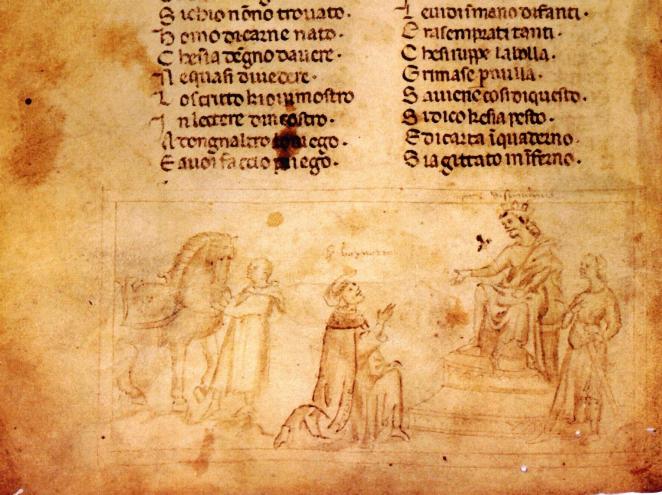
Laurentian Library, Brunetto Latino, Il Tesoretto, Brunetto Latino and Alfonso el Sabio
Brunetto Latino
had been sent to Spain in 1260 as ambassador to Alfonso el
Sabio. On his return he learned of his exile caused by the
Guelf Republic's defeat at the Battle of Montaperti. He was
later - while in exile in France - to compose an encyclopedic
dream vision poem in Italian, Il Tesoretto, which
borrowed heavily from the materials available in Spain, such
as Isidore of Seville's encyclopedic Etymologiarum4 and the translations into Latin
of encyclopedic Aristotle and Alfraganus, and the Castilian
and Gallegan works of Alfonso el Sabio,5 as well as the encyclopedic
French Roman de la
Rose,6 and which narrated the bitter
tale of learning of his exile in the Valley of Roncesvalles
in lines which echoed back to the French Chanson de Roland of crusades,7 and forward to the Italian Commedia of pilgrimage.8
Venendo per la valleBrunetto had already become established as an important figure in the Primo Popolo, lending his legal skills to the drawing up of peace treaties between Siena and Florence and Arezzo and Florence, in documents still to be found in Sienese and Florentine archives, written in his clear and lovely hand.10 This embassy was to secure the aid of the King of Castile, Alfonso X el Sabio, promising to aid him in turn with securing the title and crown of Emperor of the Romans, were he to combat Manfred and defend Guelf Florence against Siena. The embassy did not succeed and Montaperti spelled disaster for the mercantile Guelfs, the Sienese and King Manfred driving them from the city. Florence for six years became aristocratically Ghibelline. Her mercantile Guelf bankers were scattered into exile to Lucca and in a diaspora across the map of Europe. The Ghibellines were not enamoured of education. The Guelfs enjoyed high literacy and were able not only to maintain these standards for themselves when in exile but also to use their exile as opportunity for pluralistic encyclopedic cultural studies.11 Though many Florentines remained in Lucca, specifically in the San Frediano district, Brunetto himself tells us in the Tesoretto that he journeyed first to Montpellier (line 2541, "Intrai in monposlieri"). That city was rich, new and free, and had a flourishing university specializing in medicine and law. The archives in Montpellier demonstrate the importance of Italian merchants who linked that city with the great fair in Champagne at Bar-sur-Aube.12
Del piano di roncisvalle,
Incontrai uno scolaio
Sour un muletto baio,
Che venia da bolongnia
. . .
E io'l pur domandai
Novelle di toscana
In dolçe lingua e piana;
Ed e' cortesemente
Mi disse immantenente
Che guelfi di fiorença,
Per mala provedença
E per força di guerra,
Eran fuori de la terra,
E'l dannaggio era forte
Di pregione e di morte. 143-162 9[Going through the valley Of the plain of Roncesvalles I met a scholar Upon a bay mule, Who was coming from Bologna . . . And I also asked him For news of Tuscany In the sweet and clear tongue, And he courteously Told me immediately That the Guelfs of Florence Through ill fortune And through the force of war Were exiled from that land, And the penalty was great, Of imprisonment and death.]
Then we find legal and banking documents in the Vatican Secret Archives and in Westminster Abbey drawn up by Brunetto concerning loans made by Florentine bankers to English and the French ecclesiasts for the purpose of paying the papal decima or tithe for a "crusade" against Manfred. In these Latino appears to have become established amongst Lombard bankers, centered in Arras, in northern France, but the documents demonstrate that he also frequented the great fair at Bar-sur-Aube and had dealings in Paris.13 From the documents that survive from this period it is clear that Latino was part of the Florentine Guelf shadow cabinet, of its government-in-exile, and that that government was becoming increasingly oligarchic, comprising the great banking families of Guelf Florence who now proceeded to win back their republican comune with florins and marks sterling and with the aid of popes and imperial candidates.
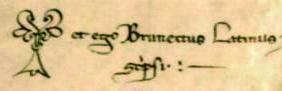
There are two documents penned and signed by Brunetto Latino from this period. They tell us much about the Guelf Florentines in exile. Though continuing under the papal interdict for the murder of the Abbot Tesoro of Vallombrosa, the Florentine Guelfs were paradoxically the allies of the Pope against King Manfred of Sicily. The Pope's response to Manfred's aggression against him was to declare him unthroned and uncrowned and to wage a mercenary crusade against him. With the aid of Lombard bankers, the Pope got churches in England and elsewhere to a tenth, a tithe, of their wealth, the decima, for this "holy" war.14 The Florentine Guelfs in exile, in reprisal for Montaperti, had already been able to have the English crown expel Sienese merchants from that island.15
The first letter was written to the Roman Curia from Arras about notarized events on September 15 and 24, 1263, concerning these dealings, and promised the loyalty of the exiled Florentine bankers in Arras and in Paris to the Pope's cause against Manfred, "quondam principis Tarentini." It named major Lombard bankers like Aymeri Cose, Pietro and Lotterio Benincase, Cante or Cavalcante della Scala, Thomas Spigliati and Ricco Cambi (Rucco di Cambio), some of whom had been on embassy to the Roman Curia, many of these individuals having been mentioned also in Brunetto's document for the Siena/Florentine peace accord of 1254 and that at Orvieto ratifying it.16 Giovanni Villani in his Cronica di Firenze likewise explained that the exiled Guelfs joined Charles of Anjou and Pope Clement against Manfred.17 A sixteenth-century volume of archival records, titled Antiquités d'Arras (Bibliothèque Municipale 1110), mentions the presence of Lombards and usurers by the Abbey of St. Vaast (which today houses that library and owns several Aristotelian manuscripts with Latino associations as well as a magnificent Li Livres dou Tresor manuscript).18
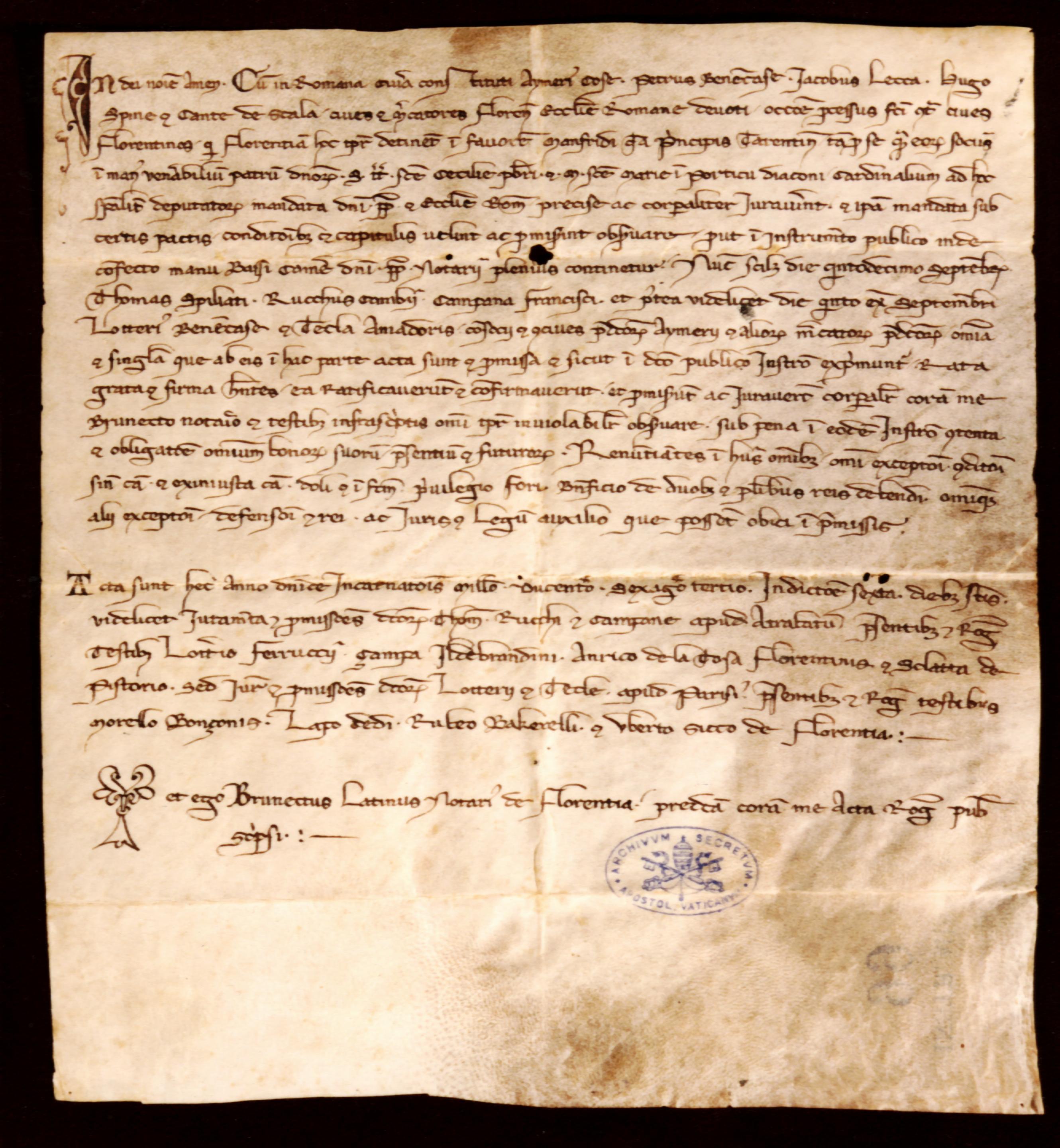 Vatican Secret Archives
The second letter, written from Bar-sur-Aube to England, April 17, 1264, directly concerned England's payment of the crusading decima.19 It contracted between the Bellindoti and Spinelli family members and other Florentine merchants and bankers to loan almost two thousand marks sterling for the Bishop of Hereford's payment to the Roman Curia. An extraordinary sentence in the document states that to borrow at interest from the Florentines had papal approval, and goes even further to state that such usury carried with it the crusading indulgence. There is a possibility that this was the amount, two thousand marks sterling, that the Roman Curia arranged to pay to Lucca for sheltering the exiled Florentine Guelfs in the parish of San Frediano.20 Similar documents name Cavalcante Cavalcanti, the father of Guido Cavalcanti, Brunetto's student and Dante's poet friend. Interestingly, one of the members of the Bellindoti family was Palamidesso di Bellindoti del Perfetto, listed in the Libro di Montaperti as "vessillifero dei balestrieri di Porta di Duomo." He likewise was a poet, he participated in the tenzoni written concerning Charles of Anjou, and Brunetto mentioned him in Il Favolello.21 Thus money and poetry are mixed with Florentine affairs.
II

The text includes a chronicle account of the events following Montaperti and concerning Charles of Anjou, which are updated in later versions of the text. In the original version that account commenced with the Emperor Frederick's death.
Et quant il fu traspases de cist siecle, si com a deu plot. Lempire vaca longuement sens Roi et sens empereor. ia soit ce qe Manfrois. fils dou devant dit frederic. non mir de droit marriage tint le roiaume de puille et de cecilie contra dey et contre rason. si come celui qi del tot fu contrante a sancte yglise. perce si stil mainte guerre et diverses persecusions contre toz les ytaliens qi se tenoient devers scte yglise, meesmement. contra la guelfe partie de florence. tant qil furent chachies hors de la ville. et lor cosses furent misses a feu. et a flante et a destrucion. et avec els en fucachies maistre Brunet latin e si estoit parcelle guerre essillies en france. quant il fist ces livres por amor de son amis, selonc ce qil dist a prologues devant.23It concludes with advice concerning how a podestà, hired by a republic, should uphold its people's laws, presenting an argument for both a constitutional monarch and a republican president - who swears to uphold the people's constitution.24 In that conclusion it gives the letter written to Charles of Anjou asking him to assume the Senatorship of Rome and presenting to him the contractual obligations of the position.25 That inauguration ceremony took place in June of 1265, with Charles of Anjou actually dressed in the Senatorial toga in the Franciscan church of Ara Coeli on the Capitoline.26 The Tresor was likely dedicated to Charles of Anjou in tandem with Arnolfo di Cambio's stern statue of that ruler in Roman senatorial garb, the capitoli or baton in his hand, a medieval crown upon his head, upheld by a lion throne, the statue sculpted to commemorate the event. Both the statue and the encyclopedia were works by Florentines who were making use of Roman Republican history in order to educate a French noble in how Italian comuni should be governed. This explains why a Florentine wrote his magnum opus in French - so Charles d'Anjou could read it and perhaps pay heed to its message.27
Thus this text was written to educate Saint Louis' most unsaintly brother, chosen by the Pope and the Florentines to rule Italy later as Vicar of Tuscany and King of Sicily and Jerusalem, though not selected by them to be the Emperor of the Romans. This intent is borne out in the illuminations which frequently show the book as presented to a ruler. That the text is sarcastic about wealth, continuing an earlier pun upon "Tesoro" of Vallombrosa, the murdered Pavian abbot, who was spoken of scathingly in a letter written by Brunetto as chancellor of Florence to the comune of Pavia, reflects back to problems Charles had already experienced when his subjects in Marseilles had revolted against his ponderous taxation,29 and which would recur in Palermo in the Sicilian Vespers, 30 indicating that the Florentine bankers were trying to curb their client's insatiable lust for money.
The text that influenced Il Tesoretto, Le Roman de la Rose, likewise had chronicled and gazetted Charles. In his encyclopedic masterwork, Jean de Meun has Reason tell the Lover not of ancient stories but modern ones. He placed the tale not in the sordid context of bank loans and ledger books but in the chivalric one of a chess game played out upon the board of Europe using players of flesh and blood.
Et se les prueves riens ne prisesJean de Meun, like Guillaume de Lorris before him, was from the Champagne region, close to Bar-sur-Aube. Both Jean de Meun and Brunetto Latino spoke pointedly of Tullius' Rhetoric32 and there is a possibility the two men knew and influenced each other. Another region of France with close associations to Charles d'Anjou was the region of Artois and Picardy, and specifically of Arras. We likewise find a poet from Arras (Arras in this period was extraordinarily active in literary productivity33), Adam de la Halle, or Adam de Bossu or Boçu, as associated with Charles, even journeying with him down to Italy, being his Poet Laureate, participating in the events around the Sicilian Vespers in 1282, and who would die in Naples in 1288 in the employ of the Count of Artois. It was Adam de la Halle who first wrote of the almost fairy tale of the four daughters of Count Raymond of Berengar and of the Chamberlain-become-Pilgrim Romeo who married them to four kings, including Beatrice to King Charles and Margaret to Saint Louis, to be retold by Dante and by Villani, as a narration in their works.34 Thus there was a circle of French writers, some of whom remained in France, others being in Italy, who were interacting with Italian politics. Interestingly, there is the French work, titled Le comte d'Anjou, the plot of which is constructed using diplomatic letters and whose Count is villainously incestuous.35 (It is an analogue to Chaucer's Man of Law's Tale.)
d'ancienes estoires prises,
tu les as de ton tens noveles,
de batailles fresches et beles
(de tel biauté, ce doiz savoir,
conme il peut en bataille avoir),
c'est de Mainfrai, roi de Secile,
qui par force tint et par guile
lonc tens em pez toute la terre,
quant li bons Charles li mut guerre,
contes d'Anjou et de Provance,
qui par devine porveance
est ore de Secile rais,
qu'ainsinc le veut Dex le verais,
qui tourjorz s'est tenus o li.
Cist bons rais Challes l'en toli,
non pas sanz plus la seigneurie,
ainz li toli du cors la vie.
Quant a l'espee qui bien taille,
en la prumeraine bataille,
l'assailli por lui desconfire,
eschec et mat li ala dire
desus son destrier aufferrant
d'un tret de paonet errant
ou mileu de son eschequier.
De Corradin parler ne quier,
son neveu, don l'exanple est preste,
don li rais Challes prist la teste
maugré les princes d'Alemaigne.
Henri, frere le rai d'Espaigne,
plein d'orgueill et de traïson
mist il morir en sa prison. 6601-6632 31[And if you take no proofs from ancient history, you can take them from modern news of battles fresh and fine, of as much beauty as one could say there could be in a battle. It is of Manfred, King of Sicily, who by force and by guile held for a long time all that land, when the good Charles, Count of Anjou and Provence made war against him, and by divine providence is now King of Sicily, as God truly willed it so is it always. This good king Charles took it, not without the rule in the course of his life. So well did he wield his sword in the first battle that he assaulted him to his discomfort, saying to him "Check," and "Mate" through a mere pawn in the middle of the board. Now of Conradin his nephew we speak, of which the example is given, when King Charles took off his head, despite the princes of Germany. Henry, brother of the King of Spain, full of pride and treason, he imprisoned for life.]
Besides these quasi-chronicle accounts in the Roman de la Rose and the Tresor the Italian poets associated with the various exiled banking families were conversing with each other in the writing of political tenzoni in which they debated whether the choice of Charles of Anjou as ruler was desirable or no. Brunetto had concluded the Tesoretto with the Favolello, a verse treatise on friendship written to a Ghibelline poet, Rustico di Filippo, in which he mentioned the Guelf Palamidesse di Belindotti del Perfetto.
E ciò che scritto mandoRustico di Filippo wrote, perhaps in reply to this work, a tenzone.
è cagione e dimando
che ti piaccia dittare
e me scritto mandare
del tuo trovato adesso
ch'e'l buon Palamidesso
mi dice, ed ho creduto,
che se''n cima saluto;
ond'io me n'allegrai.
Qui ti saluto ormai:
e quel tuo di Latino
tien per amico fino
a tutte le carrate
che voi oro pesate. 149-163[And that which is written I send and the reason I ask that it please you to say and to send to me writing of what you have found of the good Palamidesso, speak to me, and I will greet you from the summit, of which I shall rejoice. Thus I now greet you, and that you hold your Latino for a fine friend of all the burdens that you could have weighed]
A! voi che ve ne andaste per paura
Sichuramente potete tornare,
da che ci é dirizata la ventura,
ormai potete guerra inconinzare.
E più non vi bisogna stare a dura,
da che nonn é chi vi schomunicare,
ma ben lo vi tenete n'ischiagluira,
che non avete più casgion che dare.
Ma so bene, se Carllo fosse mortto,
che voi ci trovereste ancor casgione;
però del Papa nonn ò gran confortto.
Ma io non voglio con voi stare a tenzone
ca llungo temp'e ch'io ne fui accorto
Che'l ghibellino aveste per garzone.36
The series of tenzoni,
which became increasingly virtuose in performance, included
works by Guglielmo Beroardi, Brunetto's companion ambassador
in 1260,37 and
others.38 These
poems served to dissipate the rage between the two parties
while at the same time both sides discussed their anxieties
concerning Charles of Anjou. They played upon Arthurian
romance, including wittily discussing within that context
the Arthurian name of this poet, Palamidesse di Bellindoti
del Perfetto, whose family we remember to have been involved
in exilic banking in England.39 Some of these tenzoni appear to
have been written during the exile period, serving as
communication at the same time as propaganda between the two
sides - as it were a presidential media debate -, some, like
this one, are written after this period. In them the paper
war is turned into a poetic game; chronicles and chancery
letters of state are metamorphosed into sonnetti.40 Yet both serious and playful documents are
penned in the contexts of notarial, legal, banking, and
chancery chambers.
III
An especially famous manuscript is Montpellier Faculté de Medecine H 438 which was once joined to Laurentian Library, Ashburnham 1234, the first containing the Roman de la Rose, in French, and the Fiore, consisting of sonnets composed in Italian of the Roman, the second, the Detto d'amore. What is not generally noted is that this Roman de la Rose is clearly written by an Italian scribe who has carefully alternated the red and blue capitals not in French Gothic but in Bolognan libraria. The Fiore sonnets following43 are written in a chancery hand, like that of Francesco de Barberino, the scribe of the Trivulzian codex. That hand - or one very close to it - recurs in the Laurentian Detto d'amore where we see it mixed again with Bolognan libraria. It is of interest that the Trivulzian Commedia, acknowledged as the earliest manuscript we have of Dante's text, gives as its scribe a "Ser Franciscus Ser Nardi de barberino," who writes the text not in the expected Bolognan libraria but in the chancery script of notarial chambers. Another Dante codex in this hand is Laurentian Plut. 40.16. This hand is also similar to Yale's Etica, Marston 28, the latter being slightly more florid, but again in a manuscript that has associations with Brunetto Latino. Related to this Roman de la Rose is Modena's Biblioteca Estense's E.152=alpha.K.2.48, which gives four folios of the Roman de la Rose, likewise with capitals in Bolognan libraria. It was discovered in the archive at Monteferrate, given by Debenedetti to Giulio Bertoni, who deposited it in Modena's library.44 It is greatly similar to Poetarum Provinciali, E.45=alpha. R.4.4, dated August 12, 1254, of which more later.
The Fiore was not always at Montpellier, being acquired by Etienne Bouhier when he was a student in 1611 at Padua and taken first to Dijon, then Troyes, before being housed at Montpellier.45 That it should have traveled to the Veneto region can be explained by the later presence of two of Brunetto's students there, Francesco da Barberino and Dante Alighieri. Francesco da Barberino had, in fact, taught at Padua after having served in the employ of Corso Donati, podestà of Treviso. He would conclude his career by working for the Curia in Avignon. The manuscript in its entirety is precisely the kind that could have been generated by Brunetto's teaching, first in his French exile, then upon his return to Italy. That it incorporates both scripts, chancery and libraria, indicates its genesis within legal chambers - and even the astronomical diagrams and the ornamental designs of the Laurentian Detto d'amore section are typical of Latino's scriptoria in France and Italy. His student, Francesco da Barberino, in a similar vein, was to write the Documenti d'amore.46 Hence I would argue that it is of importance that we look again at this cluster of manuscripts, placing them back into that context of notarial chambers, of lawyers and bankers, especially in connection with the cluster of students associated with Brunetto Latino, reputed to have been the teacher of Guido Cavalcanti, Dante Alighieri and Francesco da Barberino, in order to understand these texts and their probable authors.
The Tesoretto manuscripts, composed in exile in France, are today housed in the main in Italian libraries, eight being in Florence, others being in the Vatican, Brescia, and Venice. One manuscript today is in France, Bibliothèque Nationale, lat. nouv. acq. 1745, and is a fragment within a later Florentine commonplace book. Another, bound with the Commedia, though in an earlier hand than it, was formerly in England and is today Bibliothèque Royale Albert Ier, Brussels, 14614-14616. A third is in Krakòv, formerly in Berlin. A fourth is today Cornell University 4. There were rumors of another manuscript being in the Marques de Santillana collection in Madrid.47 It is clear that this Italian poem did not have great currency in Francophone areas. Until Dante, French texts could be current coin in Italy, but not the reverse, of Italian texts in France. This may well have been a major reason for Brunetto's decision not to complete the Tesoretto - which was likely a presentation work for the imperial candidate, Alfonso el Sabio of Castile, who would have been able to understand written Italian - and why Latino took up the task of writing - in French of the Arras region - Li Livres dou Tresor, as a presentation work for the Roman senatorial candidate, Charles of Provence and Anjou, whom Italians called Carlo d'Angiò or Carlon, and who could only tolerate his own French.
Of Latino's Tresor in French we have a multitude of manuscripts. I now know of 80 of these scattered across Europe, two even reaching America (in Columbia University's Butler Library's Plimpton Collection and in the Pierpont Morgan Collection, New York). These manuscripts are largely still to be found in situ, where they would have been placed in the mercantile banking centers controlled by the Spigliati-Mozzi company, in Arras, Lyon, Rouen, Brussels, Cambrai, Amiens, Rennes, Saint Omer, Saint Quentin, Dunkirk (this one certainly lost to fire and actually acquired from England), Paris, London, Cambridge, Oxford, Escorial, Rome, Turin, Milan, Naples, Verona, Bergamo, Ferrara, Modena, Udine (these last five cities likely as the result of Brunetto's students' travels, Dante Alighieri into exile, Francesco da Barberino into notarial employment with Corso Donati, podestà of Treviso, then his teaching at Padua48), Karlsruhe, Strasbourg, Munich, and only one in Florence.49 They exist in two redactions, the first giving the history of the world up through Brunetto's exile from Florence following the Battle of Montaperti, the second continuing that chronicle account through Charles' victory over Manfred at the Battle of Benevento and the defeat of Conradin and his execution following the Battle of Tagliacozzo.50
It is clear that these second redaction manuscripts in French emanated from scriptoria and workshops after Brunetto supposedly had returned to Florence. That they did so is evidence of the continuing interest of the Florentine bankers - and Brunetto's own family - in the dissemination of this important Franco-Florentine encyclopedic book. They were propagated as well in Florentine (45 manuscripts), Sicilian, Bergamasco, Catalan and Castilian dialects and John Gower was to translate part of the Tresor even into English.51 I use for siglum those established by Chabaille and Carmody and add to these the Italian manuscripts Carmody did not find. Let me go through some of these manuscripts giving information concerning them that is relevant to this essay:
A1. Geneva, Bibliothèque Publique et Universitaire, 179. Bolognan libraria, Maître Honoré workshop illuminations, Paris provenance. 13/14th centuries.52
A3. Lyon, Bibliothèque Municipale, 781. French manuscript of Tresor in Italian hand, concluding with a French poem, likewise in Italian hand. Can be explained by presence of Italian scribes working in notarial/ banking chambers in France. Brunetto involved with Gregory X, who, in 1274, called the Council of Lyon to reconcile Eastern and Western Churches, at which were also present the future Popes Innocent V, John XXI, and Nicholas IV. The Tresor Chronicle section stresses Popes and Emperors.
A5. Lyon, Bibliothèque Municipale, 948. Internlinear corrections, Italian scribe. 13th century.
D2. Oxford, Bodleian Library, Douce 319. Formerly owned by Thomas Woodstock, Duke of Gloucester, to whom it was given by William Montague, Earl of Salisbury. It is thirteenth-century, in Picard French (of the Arras region), written in an Italian hand, in Bolognan libraria with some Chancery characteristics. Its presence in England can be explained by the dealings of Lombard bankers with raising the decima to combat Manfred of Sicily and to pay Charles of Anjou to do so - as manifested in the Westminster Abbey Muniment 12843 document. It was thus likely a presentation volume to royalty or nobility. Its unique full page prefatory mappa mundi emphasizes the British Isles. Otto Pächt and J. J. G. Alexander had thought it was produced in Italy with French contamination.53 It can now be seen as a production by Florentines in exile in France seeking to influence England politically.
M2. Mentioned by Carlo Morbio, "Novissimi studi su Brunetto Latino, Dante e Petrarca e sul loro soggiorno in Francia," as having been owned by Prince Albani and now sold.54 It became New York, Columbia University, Plimpton 287. The manuscript is late, the article of interest concerning manuscripts of the Tresor, and of the Tesoro, its Italian translation.
M3. El Escorial, Biblioteca, ii.L.3. French text with Florentine illuminations written in Bolognan libraria, second redaction, likely presentation copy to Alfonso el Sabio, much annotated in Latin in margins to parts of particular interest to that monarch. Florence possesses, perhaps as a diplomatic exchange in connection with Alfonso's continued quest for support for the imperial crown, a splendid Las Cantigas de Santa Maria, Biblioteca Nazionale, Banco rari 20.55
N. Paris, Bibliothèque Nationale, Fr. 570. Italian scribe, Bolognan libraria, French illuminations.
P. Paris, Bibliothèque Nationale, Fr. 571. Italian-like hand, beautiful French drawings, also illuminations with gold leaf. Fol. 122, colophon in code, Valenciennes; fol. 147v, Arras reference, Fauvel. Catalogue, Bibliothèque Nationale, dates as thirteenth century.
R. Bibliothèque Nationale, Fr. 726. French Faits des Romains, "Ici comencent li tests romains compile ensenble de Sallust, de Suetone de lucan. de Julius Cesar," and Tresor.56 Carmody noted scribes were Italian. The illumination for Caesar's murder "par les synnatores" shows Caesar with a gold crown, his toga pulled up to his eyes, the senators like contemporary Italians with eared Dante caps, fol. cviij.
R3. Vatican Reg. lat. l320. Illuminations a mixture, some French, fols. 1 (border with rabbits, horned deer, similar to Fiore dei filosafi manuscript), 20, 28v, others Florentine, fols. 19v, 23, 24, 27v, 33, annotations in French and Italian, fol. 36. Concludes, fol. l34v, "Li dit iulius cesar," fol. 155, "des governeours des chites," then, fol. 176, methods for dating Easter, horoscope, added fourteenth-century notes on births of children into Italian family.
R5. Vatican lat. 3203. French manuscript, later Italian ownership, Cardinal Bembo annotating French text in Italian, noting he purchased it in Gascony in 1472, second redaction.
S. Bibliothèque Nationale, Fr. 1109. Italian hand, French illuminations. Fol. 311, reference to "Adam le Bocu d'Arras," Adam de la Halle, Charles of Anjou's court poet in material at end other than Tresor.
T2. Turin, Biblioteca Nazionale, L.II.18. Early, complete Tresor, damaged by fire, script between French Gothic and Bolognan libraria, illuminations clearly French, Provençal poem at end of manuscript.
Y. Paris, Bibliothèque Nationale, 2024. Italian scribe, thirteenth century, Italian poem at end of manuscript, fols. 293, 293v.
Ferrara, Biblioteca Comunale Ariostea, II.280. First redaction, French text of Tresor, concluding with account of Jerusalem pilgrimage shrines, fly leaves, Italian poems, including tenzoni about kings of England, France, and Charles of Anjou, and Dante's "Guido, io vorra che tu e Lapo e io," fol. 1 and elsewhere.57
Naples, Biblioteca Nazionale, I.G.17. French Tresor, first redaction, originally in Farnesian collection, Rome, then Biblioteca Palatina de Parma, before coming to Naples.58
Bergamo, Cassaforte 2.5. Tresor, Italian scribe, conclusion has tenzoni, Catalan/Provençal poetry.59
Verona, Biblioteca Capitolare, DVIII. This later French manuscript was clearly obtained by Italians and used as a diplomatic presentation volume to a Venetian Doge's relative. Fine French illuminations, Italian binding.
Udine, Archivio di Stato. Tresor fragment of 31 folios found in chancery context in Veneto region. Northern French script.60
Modena, Biblioteca Estense E.5=alpha.P.G.l. Piccard extracts of Etica section of Tresor, in Bolognan libraria.61
An important work, which scholars have not tended very much to associate with Brunetto Latino, is the Franco-Italian manuscript containing the Fiori e vita di filosafi e d'altri savi e d'imperadori. Its editor, Alfonso d'Agostino, concluded that the text was later than Adam de Clermont's Flores historiarum, completed in 1267/1270.62 While he noted that siglum Na was one of the five complete manuscripts of the text, he was uncomfortable with its Tuscan dialect with echoes of Lucca and Pisa, Arezzo and Cortona. I believe he failed to examine the manuscript sufficiently. Na, Florence, Biblioteca Nazionale, Conv. Soppr. F.4.776, from Santo Spirito, is an intriguing manuscript, produced in Paris in 1268, "traslato e volgarizzatto ne la città di parigi negli anni di dio .M./cc.lx.viii."63 by Andrea da Grosseto for Italian ownership, giving first Albertanus of Brescia's Consolation, including the chapter on the Tale of Melibee which would become Chaucer's Tale in the Canterbury Tales,64 then the Fiore dei filosafi, with the explicit of "Explicit liber filosoforum," and finally an excellent collection of Provençal poetry.65 The flyleaves of the manuscript list the various owners of the book, all of them descendants of the Latino household. It is clearly a teaching text, with a fine illumination of Grammar as schoolmistress and her pupil as a young child at folio 3. Brunetto likely ordered it from Paris for his sons, not necessarily writing it himself but giving instructions to have it so be written. Though some scholars had thought that Brunetto might have been the author of the Fiore dei filosafi, this had been questioned.66 Nor was it clear that this was the version from which Dante had acquired the tale of Pope Gregory, Emperor Trajan (in the manuscript spelled "Troiano," as would Langland also spell it) and the Widow, which Dante would use in Purgatorio X on the terrace of Pride. Another manuscript, Vatican Chigiano L.VII.267, folio xxxviij, states that Brunetto Latino was the author of the tenzone between Cicero and Sallust. That "tençione" occurs here in the Fiore dei filosafi on folio 53. The manuscript concludes, from folio 60 on, with an anthology of Provençal poetry including such poets as Peire Cardenal and Folquet de Marseilha.67
Another fine collection of Provençal poetry is in the Modena, Biblioteca Estense, E.45=alpha.R.4.4, which, however, was written over a decade earlier, August 12, 1254, and which includes lyrics by Arnaut Daniel, Peire Vidal, La contessa de Dia, Sordels (Dante and Browning's Sordello), Bernart de Ventadorn, Fulquet de Marsella, Peire de Corbiac, Matthieu le Juif, and, surprizingly, includes a prose courtesy book by Moniez d'Arras. The script is Bolognan libraria. It attests to the presence, before Brunetto's exile, of an intense Italian awareness of French literature, of both the south and the north, the langue d'oil and the langue d'oc, perhaps as the means for communicating with Charles of Anjou and his bride, Beatrice of Provence. We should remember as well that the family of Simon de Montfort, so central to the infamous Provençal Albigensian Crusade, continued in the employ of Charles of Anjou in Italy, along with Adam de la Halle - though the evidence is that Brunetto Latino only worked for Charles for a brief while before returning to Florentine affairs. Like Brunetto, both Pierre de Corbiac and Sordello wrote works titled "Tresor." The other favorite title for these clusters of works was "Fiore." Yet further works belonging to this circle make use of the notarial and banking contexts of their production places and call themselves "Detto" and "Documenti," thus mixing up - as do these manuscripts - chancery and libraria scripts, ledgers and poetry, law and literature. Dante, of course, was to make use of Arnaut Daniel, Sordello, Bernart de Ventadorn, and Folquet of Marseilles, as well as the Roman de la Rose, within the pages of his Commedia.
Thus it is likely that a study of the Franco-Italian encyclopedic and lyric manuscripts connected with Florentine merchant bankers and especially their dealings concerning Saint Louis' brother, Charles of Provence and Anjou, can aid in explaining why so many contain elements of cultural pluralism, for instance, French illuminations and Italian script, and why they may include Provençal poetry or material connected with Arras or Champagne or all of these. The study can explain, further, why Dante Alighieri, whose teacher was Brunetto Latino,68 knew of French literary texts, both of the langue d'oil, such as the encyclopedic Roman de la Rose, and the langue d'oc, such as the Provençal lyric poetry, and why he used these culturally pluralistic texts intertextually within his text, reflecting himself in their lead-backed crystalline imported pages like some new Narcissus/Amant - with novel-reading Francesca of Inferno V as his new Echo, mirroring and echoing through this Italian tale, a British one in French - down the corridors of time.69
Notes
1Il Fiore e Il Detto d'Amore, ed.
Gianfranco Contini (Milan: Mondadori, 1984); Gianfranco
Contini, "Un nodo della cultura medievale: la serie Roman
de la Rose - Fiore - Divina Commedia," Lettere
italiane, 25 (1973), 162-189; also in Un idea di
Dante: saggi danteschi (Torino: Einaudi, 1976); Earl
Jeffrey Richards, Dante and the "Roman de la Rose": An
Investigation into the Vernacular Narrative Context of the
"Commedia" (Tubingen: Max Niemeyer, 1981), Beihefte
sur Zeitschrift für Romanische Philologie, 184; "Dante's
Commedia and its Vernacular Narrative Context," Ph.D.
Thesis, Princeton University, 1978; Julia Bolton Holloway, Brunetto
Latini: An Analytic Bibliography (London: Grant and
Cutler, 1981), pp. 91-95, 110-112. I wish to acknowledge the
National Endowment for the Humanities and the American
Association of University Women which funded travel to
European libraries.
2 Studies in this area are Robert
Davidsohn, Geschichte
von Florenz (Berlin:
Mittler, 1896-1927); Storia
di Firenze, trans.
Giovanni Battista Klein (Firenze: Sansoni, 1957); Giovanni
Ferretti, "Banchieri fiorentini in Francia nel Dugento, Fanfulla della domenica, 31 (1909), n. 32, cited in
Ferdinando Neri, Gli
studi franco-italiani nel primo quarto del secolo XX (Roma: Leonardo, 1928), p. 36;
Christian Bec, Les
marchands écrivains: affaires et humanisme à Florence, 1375-1434 (Paris: Mouton,
1967). See also Joan Ferrante, "Exchange and Communications,
Commerce and Language in the Comedy," The Political Vision of the
Divine Comedy
(Princeton: Princeton University Press, 1984), pp. 311-379;
R. A. Shoaf, Dante,
Chaucer and the Currency of the Word: Money, Images, and
Reference in Late Medieval Poetry (Norman, Oklahoma: Pilgrim Books, 1983); The Poem as Green Girdle:
Commercium in Sir Gawain and the Green Knight (Gainesville, Florida:
University Presses of Florida, 1984).
3 Studies of this encyclopedism
include Michele Scherillo, Alcuni capitoli della biografia di Dante (Torino: Loescher, 1896), pp.
116-221; Charles Victor Langlois, La Connaissance de la nature et du monde au
Moyen Age d'aprés quelques écrits français à l'usage des
laics (Paris:
Hachette, 1911); Aristide Marigo, "Lo Speculum ed il Tresor: cultura
letteraria e preumanistica nelle maggiori enciclopedie del
Dugento," GSLI, 68 (1916), 1-42, 289-326,
esp. 315-316; Paul Renucci, L'aventure de l'humanisme européen au Moyen Age (Paris: Les Belles Lettres,
1953); L. Jenaro MacLennan, "Autocomentario en Dante y
comentarismo latino," Vox romanica, 19
(1960), 102-117; Michelangelo Picone, "Glosse ad `Detto
d'Amore," Medioevo
Romanzo, 3 (1976),
402; connected with this material is the argument concerning
the "Vocabulary of Ideas," Paul Zumthor, "Pour une histoire
du vocabulaire français des idées," ZRP,
72 (1956), 350; P.A. Messelaar, Le Vocabulaire des idées dans le 'Tresor' de
Brunet Latin (Assen:
Van Gorcum, 1963); Siegfried Heinimann, "Zum Wortschatz von
Brunetto Latinis Tresor," Vox romanica, 27
(1968), 96-105.
4 Isidorus of Seville, Etymologiarum sive Originum
libri XX, ed. W. M.
Lindsay (London: Oxford University Press, 1962), 2 vols.
5 See Julia Bolton Holloway, "Alfonso el Sabio,
Brunetto Latini and Dante Alighieri," Thought, 60
(1985), 468-483; "Road through Roncesvalles: Alfonso el Sabio,
Brunetto Latini and Dante Aligheri," Emperor of Culture:
Alfonso X the Learned of Castile: His Thirteenth-Century
Renaissance, ed. Robert I Burns (Philadelphia:
University of Pennsylvania Press, ); "Arabesque," Twice-Told
Tales: Brunetto Latino and Dante Alighieri (New York:
Peter Lang, 1992).
6 Luigi F. Benedetto, Influssi del "Roman de la Rose"
sulla letteratura italiana (Halle: Niemeyer, 1910) Beiheft zur Zeitschrift für
Romanische Philologie, XX, pp. 89-100; Karl Vossler, Die Gottliche Komodie.
Entwicklungsgeschichte und Erklarung [Heidelberg: Carl Winter, 1908], 2 vols.
trans. as Mediaeval
Culture: An Introduction to Dante and his Times, by William C. Lawton [New
York: Ungar, 1958], II, 76-77), loathed this use of
encyclopedic allegory; Hans Robert Jauss, "Brunetto Latini
als Allegorischer Dichter," in Formwandel: Festschrift zur 65. Geburtag von
Paul Böckmann
(Hamburg: Hoffmann, 1964), pp. 47-92, and "The Alterity and
Modernity of Medieval Literature," New Literary History, 10 (1979), 173-192, esp, 185-186, praises
the allegory; Elio Costa, "Il
Tesoretto di Brunetto Latini e la Tradizione
allegorica medievale," in Dante e le forme dell'allegoresi, ed. Michelangelo Picone (Ravenna: Longo,
1987), pp. 43-58.
7 That work would undergo a
translation into Italian, becoming the Sicilian Paladin
puppet plays of today as well as being the subject matter of
Boiardo and Ariosto's epics and of Calvino's trilogy.
8 It would be possible for
Italian material finally to influence French literature with
the Franco-Italian Christine de Pizan's revisioning of Dante
in her Chemin de
Long Estudes.
9 Brunetto Latini, Il Tesoretto, ed. and trans. Julia Bolton
Holloway (New York: Garland, 1981), p. 10, transcribing
Laurentian MS Strozziano 146. The encounter scene is
illuminated, fol. 2. See also Il Tesoretto, ed. Giovanni Pozzi, in Poeti del Duecento, ed. Gianfranco Contini
(Milan: Ricciardi, 1960, II.168-284, 869-874; ed. Francesco
Mazzoni (Alpignana: Tallone, 1967); ed. Marcello Ciccuto
(Milan: Rizzoli, 1985).
10 Archivio di Stato, Siena, April
20, 1254, Le Sale della Mostra, #6; transcribed in Caleffio Vecchio, #567, II.779; Archivio di
Stato, Firenze, August 25, 1254, Capitoli di Firenze, Registri 29, fols. 189-191,
clxxxviii-clxxxxi.
11Today we see Japanese students, though rarely
American ones, avidly studying languages and the Humanities,
knowing that this places them at a significant trade advantage
on the world's markets.
12 Archives de la Ville de
Montpellier: Inventaire et documents, III: Inventaire des
Cartulaires de Montpellier (980-1789) (Montpellier: Serre et
Roumégons, 1901-7), pp. 101-2, # 712, 715, 716.
13 Edward J.L. Scott, "Brunetto
Latini's Home in France, A.D. 1260-6," Athenaeum, 3654 (Nov. 1897), 635; J. E.
Harting, "Brunetto Latini in France"; Paget Toynbee,
"Brunetto Latini in France," Athenaeum,
3655 (Nov. 1897), 674; "Brunetto Latini's Tresor," Athenaeum (Nov. 20, 1897), 710; J. F.
Hogan, pp. 710-711; F. W. Bourdillon, p. 711, the latter
four disagreeing with Scott's thesis that Brunetto was
living in Bar-sur-Aube. See also Antonio Cippico, "Il Canto
di Brunetto Latini," Florence, Orsanmichele, March 18, 1915
in Giornale dantesco, 23 (1915), 45-52.
14 Edouard Jordan, Les registres de Clement IV (Paris: Thorin, 1893), numbers
1456, 1469 (naming Thomas Spigliati, Manecto Spine and other
Florentine bankers associated with Brunetto Latino), 1472
(12 September, 1265, Perugia: "Regis Sicilie et omnium contra Manfredum et
Sarracenos Lucerie crucesignatorum terras sub sedis Apostilice
protectione suscepit"), 1473, 1475, all of which concern the
crusade against Manfred and the raising of the decima to carry
this out and frequently involving the Parisian church, Ste.
Geneviéve.
15 Letter of Andrea de Tolomei,
Troyes, 4 September, 1262, in Lettere volgare del secolo XIII scritte da
Senesi, ed. Cesare
Paoli, E. Piccolomini (Bologna: Romagnoli, 1871), p. 41,
cited, F. Donati, "Lettere politiche del secolo XIII sulla
Guerra del 1260 fra Siena e Firenze," Bulletino senese di storia
patria, 3 (1896), p.
259.
16 Vatican Secret Archives, Instr. Misc. 99,
September 15 and 24, 1263; M. Armellini, "Documento autografo
di Brunetto Latini relativo ai ghibellini di Firenze scoperto
negli archivi della S. Sede," Rassegna italiana, V/I
(March, 1885), p. 359-363; Hans Foerster, Mittalterliche
Buch und Urkundenschriften auf 50 Tafeln mit Erlauterungen
und Vollstÿaundinger Transkription (Berne: Haupt, 1946),
Plate XXV, comments, transcription, pp. 64-5 (my thanks to
David Anderson for this reference); Bruno Ketterbach and
Carolus Silva-Tarouca, Epistolae et Instrumentum saeculi
XIII, in Exempla scriptorum edita consilia et opera
procuratorum bibliothecae et tabularii vaticane, Fasc.
II (Roma, 1930), p. 20, Plate 21; Gino Arias, "Sottomissione
dei banchieri fiorentine alla Chiesa, 9 dic., 1263," in Studi
e documenti di storia del Diritto (Florence: Le Monnier,
1901), pp. 114-120, gives an important related document, again
naming Thomas Spigliati, Ricco Cambi, Pietro Benincasa, Hugo
Spine, Jacopo Lecci, Jacopo della Scala, Maynecto Spine,
Diritto Cambi, Aymeri Cose, Lotterio Benincase, etc.; E.
Jordan, De Mercatoribus camerae apostolicae saeculo XIII
(Paris, 1909), p. 97, notes that Thomas Spigliati was
associated with Arras, speaks also of Hugo Spine, pp. 25-30;
see also Richard Kay, "Rucco di Cambio de' Mozzi in France and
England," Studi danteschi, 47 (1970), 49-57; R. Bower,
"Italian Merchants in the Reign of Henry III," Southern
Quarterly, 6 (1968), 191-202, esp. 196, 201.
17 G. Villani, Cronica, "e mandarono loro ambasciadori a papa Clemente,
accioché gli raccomandasse al conte Carlo eletto re di
Cicilia, e profferendosi al servigio di santa Chiesa," (Florence,
1823; Rome: Multigrafica Editrice, 1980), VII.ii.
18 See Catalogue général des manuscrits des
Bibliothèques des Départments, IV: Arras-Avranches- Boulogne (Paris: Imprimérie
Nationale, 1872), p. 414. My thanks to Charles J. Ermatinger
for this reference.
19 Westminster Abbey Muniment 12843, April 17,
1264.
20 Robert Davidsohn, Geschichte von Florenz
(Berlin: Mittler, 1896-1927); Storia di Firenze,
trans. Giovanni Battista Klein (Florence: Sansoni, 1957),
II.754; III.30 notes 1268 payment of 6000 marks sterling
loaned by Lucca to Charles of Anjou, to be returned at fair of
Bar-sur-Aube in Champagne from France's crusading decima;
II.607-9, 701, 741, discusses Mozzi-Spini and Spigliati,
Ardinghelli, Aymeri Cose, Curia and England. One Tesoretto
manuscript, Riccardian 2908, is in Lucchese dialect, was
generally used as base text for editions of that poem.
21 Davidsohn, II.681,III.43;
Ruggero Palmieri, "Palamidesse Bellindote poeta fiorentina
del secolo XIII," Giornale
dantesco, 23 (1915),
132-140.
22 Kay, "Rucco di Cambio," notes,
p. 200, that Manectus Spine in 1249 had experienced the
"questionable hospitality of the king's prison" in England
at a time when the king had attempted to suppress usury.
Then, in 1253, the king expelled all merchants except two
Sienese and Manectus Spine and Rucco di Cambio.
23 I give here transcription of Naples I.G.17,
fols. 8,8v. For this passage, see also Li Livres dou
Tresor, I, part II, cap. xcix, ed. P. Chabaille (Paris:
Imprimérie Impériale, 1863), p. 102.
24 One wonders, did Philip Mazzei convey these
concepts to Thomas Jefferson?
25 Tresor, ed. Francis J. Carmody
(Berkeley: University of California Press, 1948), III.ii.v,
pp. 396-7; Le Comte Alexis de Saint Priest, Histoire de la
Conquête de Naples par Charles d'Anjou, frère de Saint Louis
(Paris: Amyot, 1858), II. 95-96, gives similar letter; see
also 1266 Vatican Secret Archives, Instr. Misc. 108.
26 Michele Amari, La guerra del Vespro
siciliano (Paris: Baudry, 1845), I.46; Saint Priest,
II.149.
27 There are passages specifically directed at
Carlo in the "Rettorica" section of the Tresor, ed.
Carmody: "Li tiers est sa vile: raison coment: nous
devons croire que cis hom soit bons drapiers por ce k'il est
de Provins. Li quars est de sa lignie: raison comment: bien
doit estre Karles loiaus, car il fu fius le roi de France," III.lii, pp.
360-361; "sachies que nous somes
in Franche . . . je ti pri ke tu soies prodom en ceste guerre," III.lxxi, p.
390.
28 1258, Vatican lat. 4957, fols.
79-80; Riccardiano 15438, fols. 199v-200v; Vatican Chigiano
L.VIII.267, states letter is by Brunetto Latino, fol. 177v.
29 1257, Saint Priest, II.53.
30 1282, Vatican Chigiano
L.VII.267, fols. cxxiii verso-cxxv, in
Italian; Paris, Bibliothèque Nationale, lat. 4042, fols.
92v-95v, in Latin.
31 Guillaume de Lorris et Jean de
Meun, Le Roman de la
Rose, ed. Félix Lecoy
(Paris: Honoré Champion, 1976), 3 vols, I. 203-4. Henry was
the traitor brother to Alfonso el Sabio who then also
betrayed Carlo.
32 MacLennan, p. 104.
33 For further literary texts
associated with Arras see Albert Pauphilet, Jeux et Sapience du Moyen Age (Paris: Gallimard, 1951,
Bibliothèque de la Pléiade, 61), p. 42, noting Jean Bodel
from Arras; pp. 109 ff, Courtois d'Arras; p. 159, Adam de la
Halle or le Bossu. See also listing of Latino manuscripts
with Arras associations.
34 Saint Priest, II.26, 304-6.
35 H.J. Chaytor, From Script to Print: An
Introduction to Medieval Vernacular Literature (New York: October, 1967), pp.
86-87, 145-146, citing Paris, 1931, Classiques français du
Moyen Age, edition.
36 Ernesto Monaci, Crestomazia
italiana dei primi secoli (Roma: Albrighi, Segatie,
1912), pp. 290-1; Le Rime di Rustico di Filippo, ed.
Vincenzo Federici (Bergamo, 1899), sonnetto xxxix, p. 22;
Mario Marti, "La coscienza stilistica di Rustico di Filippo e
la sua poesia," Cultura e stile nei poeti giocosi del
tempo di Dante (Pisa: Nistri-Lischi, 1953), pp. 41-58; Con
Dante fra i poeti del suo tempo (Lecce: Milella, 1971),
p. 117; Joan H. Levin, Rustico di Filippo and the Florentine
Lyric Tradition (Berne: Peter Lang, 1986); see also political
tenzoni in Poeti del Duecento: Poesia cortese
toscana e settentrionale, ed. Gianfranco Contini
(Torino: Einaudi, 1976), II.284-286, on imperial election
problem between Alfonso el Sabio of Spain and Richard of
Cornwall of England, and Charles of Anjou; Vatican MS 3793
contains canzone and tençioni of Palamidesse Bellindoti,
Guglielmo Beroardi, Rustico di Filippo, Brunetto Latino, etc.
Rustico di Filippo is also spoken of by Francesco da Barberino
in gloss to Documenti d'amore, ed. Francesco Egidi
(Roma: Società Filologia Romana, 1905-1927), I.190-191.
37 Davidsohn, II.687.
38 They are to be found in Vatican
lat. 3793, where poetry by Brunetto Latino is at fols. 57v,
58, Rustico Fillippi, fols. 141 ff., Palamidesse, fol. 148v,
Francesco da Barberino (Brunetto's coeval student with Dante
Alighieri), fols. 159 ff., etc, as well as poems by Pier
delle Vigne and Frederick II. Vatican, Biblioteca
Apostolica, Reg. lat. l603, fols. 35v-45, and Biblioteca
Casanatense 818, give further Latino lyrics in a later
commonplace book.
39 Davidsohn II.681, III.43; Julia
Bolton Holloway, "Brunetto Latini and England," Manuscripta, 31 (1987), 11-21, and Twice-Told Tales: Brunetto
Latino and Dante Alighieri (New York: Peter Lang, 1992).
40 See Alessandro Barbero, "Il
mito angioino nella cultura italiana e provenzale fra
Ducento e Trecento," Bolletino
storio-bibliografico subalpino, 1 (1981), 110-210.
41Notices et Extraits des Manuscrits de la
Bibliothèque Nationale et autres bibliothèques (Paris:
Imprimérie de la République, An. VII), V, 276.
42 Mayer, p. 85, noted Arsenal MS
3645, as composed in French, written in Italian hand, of the
thirteenth/fourteenth century. Several Brunetto Latino
manuscripts, including Arsenal 2677, share these traits.
43 Ed. Ferdinand Castets, "Il Fiore": Poème italien du
XIIIe siècle, en CCXXXII sonnets imité du "Roman de la Rose"
par Durante
(Montpellier: La Société pour l'Etudes des Langues Romanes,
1881); ed. Gianfranco Contini; for fuller bibliography, see
Gianfranco Contini, "Un nodo della cultura medievale: Roman de la Rose-Fiore-Divina
Commedia," pp.
162-189, and his edition; also Holloway, Brunetto Latini: Bibliography, pp. 91-95, 110-112.
44 Jole Ruggieri, "Uno sconosciuto
frammento del 'Roman de la Rose,'" Archivium romanicum, 15, fasc. 3, pp. 417-436, mistakenly gave
it as #162, instead of #152, considered the script,
erroneously, to be French.
45 Albert Ronsin, La Bibliothèque Bouhier:
Histoire d'une collection formée du XIVe au XVIIe siècle par
une famille de magistrats bourguignons (Dijon: Académie des Sciences,
Arts et Belles Lettres, 1971).
46 Vatican MS Barberino 4076, 4077; ed.
Francesco Ubaldini (Roma: Mascardi, 1640); ed. Francesco Egidi
(Roma: Società Filologica Romana); Thomas Antoine, Francesco
da Barberino et la litterature provençale en Italie au Moyen
Age (Paris: Thorin, 1883).
47 Brunetto Latini, Il Tesoretto, ed. Holloway, xxx-xxxv and
further research.
48 Gerolamo Biscaro, "Francesco da Barberino al
seguito di Corso Donati," pp. 255-262.
49 I have carried out further research on these
manuscripts since publishing Brunetto Latini: Bibliography,
pp. 20-26.
50 Carmody, p. xxxvi.
51 James J. Murphy, "John Gower's
Confessio Amantis and the First Discussion of
Rhetoric in the English Language," Philological Quarterly, 41 (1962), 401-411; James R.
East, "Book Three of Brunetto Latini's Tresor: An English Translation and Assessment of
its Contribution to Rhetorical Theory," Ph.D. Dissertation,
Stanford University, 1960.
52 Sion Segre-Amar, "Su un codice
parigino del 'Tresor,'" Studi francesi,
71 (1980), 256-261, who comments, p. 258, also, on
Bibliothèque Nationale, fr. 566, 567, 570, 571, 726, 1109,
1110, 1113, 2024, 12581 and Leningrad Tresor.
53 Illuminated Manuscripts in the Bodleian
Library, Oxford (Oxford: Clarendon Press, 1973), II, #
154. My thanks to Albinia de la Mare and the Bodleian Library,
Oxford.
54 Archivio storico italiano, 3 ser, 17
(1873), 192.
55 Antonio G. Solalinde, "El
Còdice florentino de la Cantigas y su
relaciòn con los demàs manuscritos," Revista de Filologia Espanola, 5 (1918), 143-179; John E.
Keller and Richard P. Kinkade, "Iconography and Literature:
Alfonso Himself in Cantiga 209," Hispania, 66 (1983), 348-352, in which Alfonso is himself
illuminated as cured from illness by the miracle of being
presented a copy of his own Cantigas
bound in red kermes dyed leather and sitting up in bed to
receive it.
56 Paul Meyer, Romania, 14 (1885), 23-6, suggested Brunetto could
have been the author/translator of Faits des Romains. This explains Dante's use of Catiline and
Fiesole in Inferno
XV. M.-J. Mincwitz, "Notice
de quelques manuscrits du Tresor," Romania,
38 (1909), 112-119, discussed some Faits des Romains and Tresor fragments in Berne,
Switzerland. It is of interest that these texts also exist
in Italian in Italian manuscripts as Fatti dei Romani. Tresor
tends to emphasize as well Berengar of the Lombards, as if
in reference to Charles of Anjou's father-in-law, Raymond
Berengar of Provence.
57 Picone, "Glosse al 'Detto d'Amore,'" p. 402,
notes connection between this lyric and the 333
hendacasyllabic Mare amoroso, once attributed to
Brunetto Latino; Il Mare amoroso di Brunetto Latini,
ed. Giusto Grion (Bologna: Fava e Garagnani, 1869, and Il
Propugnatore, I, pp. 3-30; Il Mare amoroso, ed.
Emilio Vuolo, Cultura neolatina, 12 (1952), 103-30; 16
(1956), 147-77; gloss, 17 (1957), 74-174; notes, 18 (1958),
5-52, and Il Mare amoroso (Roma: Istituto di Filologia
Modern, Università di Roma, 1962); Leo Spitzer, "A proposito
del Mare amoroso," Romanische Literaturstudien,
1936-1956 (Tubingen: Niemeyer, 1959, p. 508; and Cultura
neolatina, 16, 179-199, 17, 175-6, who believed author
was Richard di Fournival; Cesare Segre, "Per un' edizione del
mare amoroso," Giornale storico della Letteratura
italiana, 140 (1963), 1-29; Joy M. Potter, "La struttura
del Mare amoroso," Cultura neolatina, 23
(1963), 191-204. As with the Fiore, one can certainly
say these poems are the product of a school, a textual
community in exile, though exact authoriship is difficult to
ascertain.
58 Miola, Notizie di manoscritti neolatini
della Biblioteca Nazionale di Napoli, I (1895), 2-3.
59 O. Capasso, "Di un presunto originale del
'Livres dou Tresors,'" Bergamo, Civica Biblioteca,
Bolletino, 2 (1908), 252-263.
60 Cesare Scalon, Libri scuole e cultura nel
Friuli medioevale: "Membra Disiecta" dell'Archivio di Stato
di Udine (Padova:
Antenore, 1987), pp. 209-213. My thanks to Professor Cesare
Scalon for telling me of the manuscript.
61 Giulio Camus, "Alcuni frammenti
in antico dialetto piccardo dell' Etica
di Aristotele compendiata da Brunetto Latini," Memorie della Regia Accademia
di Scienze, lettere ed arti in Modena, ser. 2, vol. 7 (Modena: Società
tipografica, 1890), p. 8.
62 Fiori e vita di filosafi e
d'altri savi e d'imperadori, ed. Alfonso d'Agostino (Florence: La Nuova
Italia Editrice, 1979), pp. 29, 39. See also "Uber die
'Fiore e Vita di Filosofi ed Altri Savii ed Imperadori," ed.
Harmann Varnhagen (Erlangen: Junge, 1893); further studies
listed, footnote 66.
63 Fol. 26v.
64 Geoffrey Chaucer, The Riverside Chaucer, ed. Larry D. Benson (Boston:
Houghton Mifflin, 1987), pp. 217-239. Conv. Soppr. F.4.776,
fol. 8, "Qui e compiuta lo primo libro de la dottrina del
parlare e del tacere facto de albertano giudice &
avogado di leggio de la cata di brescia del a contrada di
santa agatha translatata in volgançata da andrea da grosseto
ne la città di parigio. Qui si comincia il secondo libro di
quegli huomini che non possono avere consolacione
dellaversita."
65 D'Agostino says, p. 10, the manuscript was
likely written in the Languedoc region of France, disregarding
the manuscript's declaration of its Parisian origin. Again, as
with Douce 319, scholars have not adequately taken into
account the possibility of exiled book-producing enclaves of
Italians on French soil.
66 Vincenzio Nannucci had noted
that Brunetto Latino's authorship of the Fiore dei filosafi was attributed to him in a
Venetian manuscript, Manuale
della letteratura del primo secolo della lingua italiana, III (Florence: Barberà,
1837), pp. 223-76; Antonio Cappelli, Fiore di filosofi e di molti
savi attribuito a Brunetto Latini: Testo in parte inedito,
citato dalla Crusca e ridotto a miglio lezione (Bologna: Gaetano Romagnoli,
1865, in Scelta di cuirosità letterarie inedite o rare dal
secolo XIII al XVI, vol. LXIII), p. vii, notes unascribed
Florence, Biblioteca Nazionale, Magliabechiano and
Biblioteca Laurenziana, Gaddiano manuscripts, and Venice,
Biblioteca Marciana, Farsetti manuscript with ascription,
"Detti . . . volgarizzati da Brunetto Latino"; D'Agostino,
p. 95-6.
67 D'Agostino, p.
10, notes the following studies of the manuscript, E. Stengel,
"Studi sopra i canzonieri provenzali di Firenze e di Roma," Rivista
di Filologia Romanza, 1 (1872), 20-45; P. Savj-Lopez,
"Il canzoniere provenzale J," Studi di Filologia Romanza, 9
(1903), 490-8; C. Brunel, Bibliographie des manuscrits
littéraires en ancien provençal (Paris, 1935), p. 88.
68 Though this came to be
questioned, it was asserted in near coeval materials and was
typical practice for notaries to train their sons or take in
apprentices, Pier delle Vigne, Brunetto's counter model,
being Chancellor to the Emperor Frederick II, Professor of
Law at the University of Naples and a poet: Armando
Petrucchi, Notarii:
Documenti per la storia del Notariatio italiano (Milan: Guiffré, 1958), p. 17
and passim.
69 Renato Poggioli, "Paolo and
Francesca," Dante: A
Collection of Critical Essays, ed. John Freccero (Englewood Cliffs: Prentice
Hall, 1965), pp. 61-77. I am influenced here by my
colleague, Edward Peter Nolan, Now Through a Glass Darkly: Specular Images
of Being and Knowing from Virgil to Chaucer (Ann Arbor: University of
Michigan Press, 1991), on mirrors and classical and medieval
texts.
Go to:
Brunetto Latino and Dante
Alighieri
I Bankers and
Their Books: Italian Manuscripts in French Exile
II Brown
Ink, Red Blood: Brunetto Latino and the Sicilian Vespers
III The
Vita Nuova's Pilgrimage Paradigms
IV
Stealing Hercules' Club: Inferno XXV's Metamorphoses
Geoffrey Chaucer
V Black and
Red Letter Chaucer
VI Fact
and Fiction: Women in Love
VII
Convents, Courts and Colleges
VIII The
Tomb of the Duchess Alice
Terence, Dante,
Boccaccio and Chaucer
IX God's Plenty: Terence in Dante,
Boccaccio, Chaucer and
Shakespeare New
Epilogue: Attica State Prison,
Boethius the Exile, Dante the Pilgrim

FLORIN WEBSITE
A WEBSITE
ON FLORENCE © JULIA BOLTON HOLLOWAY, AUREO ANELLO ASSOCIAZIONE,
1997-2022: ACADEMIA
BESSARION
||
MEDIEVAL: BRUNETTO
LATINO, DANTE
ALIGHIERI, SWEET NEW STYLE: BRUNETTO
LATINO, DANTE
ALIGHIERI, &
GEOFFREY CHAUCER
|| VICTORIAN:
WHITE
SILENCE:
FLORENCE'S
'ENGLISH'
CEMETERY
|| ELIZABETH
BARRETT BROWNING
|| WALTER
SAVAGE LANDOR
|| FRANCES
TROLLOPE
|| ABOLITION
OF SLAVERY
|| FLORENCE
IN SEPIA
|| CITY AND BOOK CONFERENCE
PROCEEDINGS
I, II, III,
IV,
V,
VI,
VII
, VIII, IX, X || MEDIATHECA
'FIORETTA
MAZZEI'
|| EDITRICE
AUREO ANELLO CATALOGUE
|| UMILTA
WEBSITE
|| LINGUE/LANGUAGES: ITALIANO,
ENGLISH
|| VITA
New: Opere
Brunetto Latino || Dante vivo || White Silence

Twice-Told Tales: Brunetto Latino and Dante Alighieri. New York: Peter Lang, 1993. xiv + 552 pp. Reviewed: Speculum; Parergon; Annali italianistica. ISBN 0-8204-1954-0. IN STOCK

Il Tesoro di Brunetto Latino, Maestro di Dante Alighieri, Il Tesoretto, Il Tesoro, Firenze: Regione Toscana, 2021. 428 pp.
with DVD
Le Opere di Brunetto Latino, Maestro di Dante Alighieri, La Rettorica, Il Tesoretto, Il Tesoro, Scribi, Guido Cavalcanti, Dante Alighieri Franciscus de Barberino?. A cura di Julia Bolton Holloway, Saggi di Richard Mac Cracken, Nicolino Applauso, Renato Stopani, Alison Stones, Sonia Minutello, David Napolitano, trascrizione di Michele Amari, trad. di Rosalynd Pio, Firenze: Regione Toscana. MLA Seal, Scholarly Edition.
  |
To donate to the restoration by Roma of Florence's
formerly abandoned English Cemetery and to its Library
click on our Aureo Anello Associazione's
PayPal button: THANKYOU! |
