TIME || SPACE || BIBLIOGRAPHY
|| COMPARING CEMETERIES
LA CITTA` E IL
LIBRO III
ELOQUENZA
SILENZIOSA:
VOCI DEL
RICORDO INCISE NEL
CIMITERO
'DEGLI INGLESI',
CONVEGNO
INTERNAZIONALE
3-5 GIUGNO
2004
THE CITY AND THE BOOK III
INTERNATIONAL CONFERENCE
'MARBLE SILENCE, WORDS ON
STONE:
FLORENCE'S 'ENGLISH
CEMETERY',
GABINETTO VIEUSSEUX AND
'ENGLISH CEMETERY', FLORENCE
3-5 JUNE 2004

SABATO, 5 GIUGNO/ SATURDAY, JUNE 5
VISITA A VILLA LANDOR, FIESOLE, CASTELLO DI VINCIGLIATA, MONASTERO DI VALLOMBROSA, BELLOSGUARDO, VILLA BRICHIERI-COLOMBI, VILLA LO STROZZINO
VISIT TO VILLA LANDOR, FIESOLE, VINCIGLIATA
CASTLE, VALLOMBROSA MONASTERY, BELLOSGUARDO'S VILLA
BRICHIERI-COLOMBI AND VILLA LO STROZZINO

Villa Landor, Photograph, Daniel Willard Fiske, Courtesy, Kristin Bragadottir
Vallombrosa:
Who lay intrans't
Thick as Autumnal Leaves that strow the Brooks
In Vallombrosa, where the Etrurian shades
High arverarch't imbow'r.John Milton, Paradise Lost
And Vallombrosa, we two went to see
Last June, beloved companion, - where sublime
The mountains live in holy families,
And the slow pinewoods ever climb and climbe
Half up their breasts, just stagger as they seize
Some grey crag - drop back with it many a time,
And straggle blindly down the precipice!
The Vallombrosan brooks were strewn as thick
That June-day, knee-deep, with dead beechen leaves,
As Milton saw them ere his heart grew sick
And his eyes blind.Elizabeth Barrett Browning, Casa Guidi Windows I.1129-1139
Not a grand nature. Not my chestnut woods
of Vallombrosa, cleaving by the spurs
To the precipices. Not my headlong leaps
Of waters, that cry out for joy or fear
In leaping through the palpitating pines,
Like a white soul tossed out to eternity
With thrills of time upon it. Not indeed
My multitudinous mountains, sitting in
The magic circle, with the mutual touch
Electric, panting from their full deep hearts
Beneath the influent heavens, and waiting for
Communion and commission. Italy
Is one thing, England one.Elizabeth Barrett Browning, Aurora Leigh I.615-627

Vallombrosa, Fete Champetre: Nic Peeters
Belgium, Judy Oberhausen USA, JBH, Kristin Björg Sveinsdóttir
& Kristin Bragadottir Iceland, Corinna Gestri Italia, ?,
Alison O'Connor UK, Michail Talalay Russia, ?, Charles Adler
USA, ?, ?, Patricia O'Connor UK, Doreen Jones UK, Mr O'Connor
UK, Carmela Rotonda Italia, ?, Jeffrey Begeal USA,
Photographer: David Gilbert
* See also 'spacetime', chronology and map,
City and Book International Conferences, I, II, Florence
1284 Porta a'
Pinti Gate and City Wall built
1472 Piero di
Jacopo del Massaio, Ptolomaei Claudii Cosmografia
1524-1527
Michelangelo, 'Aurora', Medici Tombs
1529-30
Michelangelo rebuilds Gate and Wall
1552-1553 'Legge
Livorniana' allowed for burial of non-Catholics at Livorno,
etc.
1584 Stefano
Bonsignori, Map with Porta a' Pinti
1690 Map by
Captains of the Guelf Party
1731 Map by
Odoardo Warren
1765 21 May,
'ordonnance du Parlement de Paris: "le sol ne pouvant plus
consommer de cadavres, les cimetières en ville doivent être
supprimés"'
1766 Birth of
Germaine Necker, daughter of Suzanne Curchod, adopted by
Necker the financier, natural father probably Edward Gibbon,
author of The Decline and Fall of the Roman Empire
1771 Emanuel
Swedenborg, Vera Christiana Religio
1774
Chateaubriand writes about tombs
1775 Walter
Savage Landor born
1777 San Frediano
Hebrew Cemetery
1783 Map by
Francesco Magnelli and Cosimo Zocchi
1787 Luc-Vincent
Thiéry writes about tombs
1797 Madame de
Staël (Germaine Necker) and Napoleon converse at ball given by
the Empress Josephine
1799 The
Death of Abel, Attempted from the German of Mr Gessner by
Mary Colyer
1801 Félicie de
Fauveau born in Livorno
1804 Code
Napoleon forbids cemeteries in churches and cities, controls
what may be shown on tombs, forbids titles of nobility, and
makes tombs impermanent, subject to recycling
1805 Birth of
Hiram Powers in Vermont, America
1806 Code
Napoleon, Saint Cloud, extended to Italy; Ugo Foscolo, Sepolcri,
Brescia; Elizabeth Barrett Moulton Barrett (Ba) born
1807 Edward
Barrett Moulton Barrett (Bro) born; Slave trade abolished;
Madame de Staël, Corinne ou l'Italie
1808 Tomb of
Michal Bogoria Skotnicki in Castellani Chapel, Sante Croce,
sculpted by Stefano Ricci
1809 William
Godwin, Essay on Sepulchres
1812 Gaetano
Cattaneo, Vite e ritratti di illustri italiani; Robert
Browning born
1813 Pietro
Giordani, 'Delle sculture ne' sepolcri'
1815 Battle of
Waterloo, Barretts, with their child Elizabeth, visit Paris
and battlefield
1816 Percy Bysshe
Shelley, 'On Death'; Madame de Staël praises America, except
its practice of slavery
1817 † Madame de Staël
1819 Founding of
the Gabinetto Scientifico Letterario Vieusseux; Monumenti
sepolcrali della Toscana, disegnati da Vincenzo
Gozzini, incisi da Giovan Paolo Lasinio, sotto la direzione
dei signori Cav. P. Benvenuti e de Cambray Digny; Powers
family comes to Cincinnati, Ohio.
1820 Elizabeth
Barrett, The Battle of Marathon; Florence Nightingale
born in Florence
1820-1830 Père
Lachaise Cemetery, Paris; Walter Savage Landor in Fiesole
1821 † John Keats,
Tuberculosis, Epitaph 'Here lies one, Whose name was writ in
water', Burial in Rome's Protestant Cemetery; Elizabeth
Barrett, 'Stanzas, Excited by Some Reflections on the Present
State of Greece'; Anna Jameson first comes to Italy
1822 Lareinty
writes to Giovan Pietro Vieusseux; † Percy Bysshe
Shelley drowns at La Spezia, body found with copy of Keats' Poems
opened in the pocket; Burial in Rome's Protestant Cemetery
1824 † Lord Byron at
Missolonghi; Elizabeth Barrett, 'Stanzas on the Death of
Lord Byron'
1825 Ferdinando
Malvica, Alcune iscrizioni di Luigi Muzzi; Anna
Jameson, The Diary of an Ennuyée; Tomb, Cesare
Lampronty, San Frediano
1826 † Félicie de
Fauveau's father, she supports her family
1827 Swiss
Evangelical Reformed Church purchases land beside Porta a'
Pinti from the Grand Duke of Tuscany for their cemetery, which
they open also to other non-Catholics; Luigi Muzzi publishes
300 tomb inscriptions; Francesco Orioli, Iscrizioni di
autori diversi con un discorso sulla Epigrafia italiana;
Elizabeth Barrett, An Essay on the Modern Pronunciation of
the Greek and Latin Languages: Félicie de Fauveau, Cristina
di
Svezia
rifiuta
la grazia al suo scudiero Monaldeschi
1828 Champollion
and Rosselini Expedition to Egypt and Nubia, funded by the
Grand Duke of Tuscany; Kalinna/Nadezda comes, at 14, to
Florence from Nubia, perhaps with the Champollion/Rosselini
Expedition; Morichini on Italian inscriptions; Carlo
Reishammer landscapes first 'English' Cemetery; † Jean David
Marc Gonin, first 'English' Cemetery tomb; Trollopes come to
Cincinnati and have Hiram Powers sculpt Dante's Commedia
in wax
1829 Bartolommeo
Gamba, Elogi di italiani illustri; John Flaxman, Lectures
on Sculpture; Burial of Varvara Il'nicna Kasincova; Anna
Jameson, The Memoirs of the Loves of the Poets by the
Author of the "Diary of an Ennuyée"
1830 Ferdinando
Malvica, Iscrizioni italiane; Greek War for
Independenc from Turkey ends
1831 Bernard
Zaydler, History of Poland; Félicie de Fauveau captured
with Félicie de la Rochejaquelin and imprisoned
1832 Epitaph,
Giuseppe Carmignani; Leopardi, Amore e morte del 1832;
Niccolò Puccini, garden at Pistoia with statues and epitaphs;
Epitaph to Cav. Francesco Lenzoni
1833 Abolition of
Slavery in British Empire; Ferencz Pulszky's first visit to
Italy
1834 Pietro
Giordani publishes over 200 inscriptions
1835 Giuseppe
Sacchi, Viaggio in Toscana
1836 Tombs of
Caroline Napier, wife of Captain Henry Edward Napier, R.N.,
Jean Claude Lagersward; Walter Savage Landor praises Elizabeth
Barrett's classical scholarship, they and William Wordsworth
dine together at John Kenyon's
1837 Pietro
Contrucci, Iscrizioni italiane; Hiram Powers settles
in Florence, advised by Lorenzo Bartolini to eschew
Neo-Classicism for Naturalism; Tomb of Walter Kennedy Lawrie;
Tomb of Countess Zofia Czartoryska Zamoyska in Santa Croce by
Bartolini
1838 Melchior
Missirini, Degli illustri italiani; † Hiram Powers's
son, James Gibson Powers, is enbalmed for shipping to America
but will later be buried in the 'English' Cemetery; Horace
Greenough sculpts 'Abdiel'; Elizabeth Barrett and Theodosia
Garrow both in Torquay convalescing; † 'Bro', Edward
Barrett Moulton Barrett, drowns at Torbay; Tombs of Ivan
Ivanovic Ivanov, Revd Hugh James Rose, beginner of Oxford
Movement
1839 Nicholas
Longworth requests of Hiram Powers a tomb sculpture for his
parents' monument in New Jersey
1839-1842 Hiram
Powers' two versions of 'Eve Tempted'
1840 Tomb of
Elizaveta Pavlovna Frolova; Karol Markò and his family settle
in Florence, at invitation of Grand Duke of Tuscany with a
Chair at the Accademia di Belle Arti; Félicie de Fauveau
settles in Florence in exile from France
1841 Oreste
Raggi, Monumenti sepolcrali eretti in Roma agli uomini
celebri per scienze, lettere ed arti; Horace Greenough
sculpts Lucifer; Tomb of Karl Philippe Stechling
1842 Nicholas
Longworth attempts a public subscription to purchase 'Eve
Tempted'; Michele Amari, I Vespri Siciliani
1843 Fantozzi
plans modern Florence; Hiram Powers' 'Greek Slave'; Trollopes
come to Florence; Elizabeth Barrett, Cry of the Children
1844 Elizabeth
Barrett, A Drama of Exile, participation in Richard
Hengist Horne's New Spirit of the Age; Theodosia
Garrow meets Thomas Adolphus Trollope; Burial of Count Boris
Sievers; Petr Kudrjavcev, thesis on Papacy and the Holy Roman
Empire in the ninth, tenth, eleventh centuries
1845 Elizabeth
Barrett publishes Lady Geraldine's Courtship, in which
she has her heroine propose to Alfred Tennyson and Robert
Browning; acquaintance with Robert Browning starts; Tomb of
Colonel James Hughes; John Henry Newman asks Dominic Barberi
to receive him into the Catholic Church
1846 Elizabeth
Barrett Browning elopes with Robert Browning to Paris, where
they meet with Anna Jameson, going on to Petrarch's Vaucluse,
and Pisa where EBB writes The Runaway Slave at Pilgrim's
Point
1846-47 Henry
Edward Napier, Florentine History from the Earliest
Authentic Records to the Accession of Ferdinand the Third,
Grand Duke of Tuscany
1846-1850 Irish
Potato Famine
1847 Francesco
Domenico Guerrazzi, 'Del modo di onorare gli illustri
defunti'; Elizabeth Barrett and Robert Browning reach
Florence, journey to Vallombrosa, acquire Casa Guidi for the
first time; Elizabeth Barrett Browning sees 'Eve Tempted' in
Hiram Powers' studio; Margaret Fuller meets Marchese Angelo
Ossoli in Rome; Camillo Cavour, Il Risorgimento
1848 Tomb of
Harriet Fischer Garrow, Death from Smallpox; Pre-Raphaelite
Brotherhood founded; Bernard Zaydler meets Adam Mickiewicz,
publishes History of Military Operations of the Polish
Legions in Italy; Elizabeth Barrett Browning writes
about Félicie de Fauveau, comparing her to Benvenuto Cellini;
Typhus Epidemic in Europe
1849 Giuseppe
Manuzzi publishes 750 epigraphs; Tomb with Epitaph of Andrea
Mayer; Lost Tomb, Alice Cottrell, Elizabeth Barrett Browning,
A Child's Grave in Florence, its epitaph; Tomb of
Harriet Frances Pellew by Félicie de Fauveau; Isa Blagden
settles in Florence; Brownings' son, Robert Weidemann ('Pen'),
born; Austrians occupy Tuscany; Elizabeth Barrett Browning in
Bagni di Lucca gives her husband the Sonnets from the
Portuguese written secretly during their courtship;
French beseige Risorgimento's Roman Republic; † Anita
Garibaldi and infant following childbirth during flight,
bodies buried in shallow sand, dug up by dogs; Ferencz Pulszky
sent by Lajos Kossuth to England, associating with Guiseppe
Mazzini
1850 'Eve
Tempted' shipwrecked off the coast of Spain; Elizabeth Barrett
Browning, Hiram Powers' The Greek Slave; † Margaret
Fuller, † spouse and † baby, and Hiram Powers' Calhoun in
shipwreck of the 'Elizabeth' off Fire Island; Queen Victoria
chooses Alfred Tennyson for Poet Laureate, instead of
Elizabeth Barrett Browning; Petr Kudrjavcev, Destiny of
Italy at the Fall of the Western Roman Empire to Charlemagne
1850-1863 Villino
Trollope; Isa Blagden and Miss Agassiz
1851 Tombs of
Nubian Kalima Nadezhda De Santis, Charles Wital; Crystal
Palace Exhibition, with Hiram Powers' Greek Slave at its
centre, visited by Queen Victoria and the Brownings; Elizabeth
Barrett Browning, Casa Guidi Windows; Isa Blagden,
Miss Agassiz in Rome; Harriet Beecher Stowe, Uncle Tom's
Cabin
1851-1853 John
Ruskin, The Stones of Venice
1852 Tomb of
Elizabeth Shinner, the Trollopes' maid; Burial of Grigorij
Cilikov Muradov; Isa Blagden cares for invalid Louisa
Alexander until Alexander leaves for India in 1855; Brownings
meet George Sand; Sir Culling Eardley Eardley's Evangelical
Alliance secures release from imprisonment of the Florentine
Madiai.
1853 Tombs of
Jacques Augustin Galiffe, Swiss historian and genealogist,
Sophia Hugel Lagersward, Valentine Grandi; Bice born to
Theodosia and Thomas Adolphus Trollope; John Roddam Spencer
Stanhope visits Florence; Giovan Pietro Vieusseux gives back
to Bernard Zaydler copies of his unsold History of
Military Operations of the Polish Legions in Italy;
Brownings in Bagni di Lucca; Harriet Hosmer sculpts Brownings'
'Clasped Hands'
1854 Florence
Nightingale in the Crimea; Jessie White Mario meets Garibaldi
in London
1855 Cholera
Epidemic; † Robina Wilson Cattani Cavalcanti, Scots
Protestant buried in English Cemetery, married to a Florentine
Catholic; Pozzi, plan for Florence, showing 'English'
Cemetery; Tennyson reads Maud to Brownings and Dante
Gabriel Rossetti; Tomb of Sir Charles Lyon Herbert by Félicie
de Fauveau
1856 Elizabeth
Barrett Browning, Aurora Leigh; Tomb of Nikolaj
Nikolaevic Chlebnikov
1856-1858 Gaetano
Sorgato, Memorie funebre
1857 Indian
Mutiny; Tomb of Joseph Garrow, Epitaph by Thomas Adolphus
Trollope; Burial of Aleksandr Michajlovic Zukovsky; † Frances
Powers; Elizabeth Barrett Browning writes about Isa Blagden's
Bellosguardo balcony, used in Aurora Leigh; Brownings
in Bagni di Lucca; Isa Blagden and Annette Bracken at Villa
Brichieri, and Bagni di Lucca, where Edward Robert Bulwer
Lytton ('Owen Meredith') falls ill, Isa nursing him back to
health; poet and diplomat, he would become Viceroy of India,
proclaiming Queen Victoria Empress of India; Anna Jameson
living in Via Maggio; Jessie White imprisoned in Genoa, meets
Alberto Mario; Harriet Beecher Stowe in Florence and Rome;
Harriet Hosmer exhibits 'Beatrice Cenci' at Royal Academy;
Tomb of Varvara Arsen'evna Kudrjaceva; Frances Power Cobbe, Italics,
describes Félicie de Fauveau
1858 Column with
Cross at centre of Cemetery given by Frederick William of
Prussia; Hawthornes live in Florence, Isa Blagden in
Madrid; Tombs of Boris Michajlovic Chrapovickli, Ivan
Nikolaevic Kantakusin; † Petr Kudrjavcev in Russia, following his
wife's recent death in Florence; Robert Browning says Félicie
de Fauvau is a 'divine woman'; Isa Blagden's essay on Félicie
de Fauveau in English Women's Journal
1859 Battle of
Solferino, Jean Henri Dunant, from witnessing lack of medical
care to its 14,000 Austrian, 15,000 French and Italian
casualties, will found Red Cross and Geneva Conventions;
Walter Savage Landor installed in Lily Wilson's lodging,
having been thrown out of his Villa Gherardesca by his family;
Elizabeth Barrett and Robert Browning with the Risorgimento
jewellers, the Castellani, in Rome; Kate Field comes to
Florence; Brownings staying at Villa Alberti, Siena, with them
Kate Field, Isa Blagden, William Wetmore Story, Walter
Savage Landor; Isa Blagden with Charlotte Cushman, Harriet
Hosmer and Emma Stebbins in Rome; Tombs of Eduard Bosse,
Countess Eleanora Emilia Stenbock-Fermor, Paul Polidorovic
Ventura; Burial of Victor Geyza Szilassy, disciple of Carol
Markò; Deposit of Eugenie Jesakoff de Kraft before shipment to
Russia; Isa Blagden, 'On the Italian colors being replaced on
the Palazzo Vecchio, Florence, April 27th, 1859'
1860 Tombs of
Theodore Parker (to be visited by Frederick Douglass), William
Somerville, husband to Mary Somerville; Susan Horner, A
Century of Despotism in Naples and Sicily; Building of
Gatehouse from cypresses in cemetery; Isa Blagden shares Villa
Brichieri with Frances Power Cobbe; Harriet Beecher Stowe,
George Eliot visit Florence; Elizabeth Barrett Browning, Poems
Before Congress; Robert Browning finds Old Yellow
Book in San Lorenzo Market; Brownings in Siena;
Nathaniel Hawthorne, Marble Faun; Ferencz Pulsky in
Turin as Kossuth's representative to Cavour, exhibits medieval
treasures at the Bargello in Florence and settles at Santa
Margherita a Montici, becoming close friend of Francesco
dall'Ongaro; Mary Young, The Life and Times of Aonio
Paleario; Death of Anna Jameson
1861 Death of
Camillo Cavour; Tombs of † Elizabeth Barrett Browning (death from
tuberculosis), † Arthur Hugh Clough, † Anne Susan
Lloyd Horner, † Admiral, the Hon Fleetwood Broughton Reynolds
Pellew and his wife Harriet Frances Pellew; Cemetery to be
closed; Hiram Powers begins an 'Adam and Eve'; Kate Field
returns to America; Susan and Joanna Horner in Florence;
Marchese Torrigiani sends Susan Horner Champollion's book on
Egypt and Nubia; Kingdom of Italy, Capital, Turin
1862 Tomb of † Ernst Gotthilf
Bosse, Burial of Marija Martyrnovna Dobrovol'skaya; Ferencz
Pulszky breaks with Kossuth, Mazzini, joins Garibaldi at
Aspromonte; Horners leave Florence
1862-72 Isa
Blagden publishes five novels, many articles
1863 Tombs of † Giovan Pietro
Vieusseux, † Fanny Trollope, †
Gyula Pulszky, † Sofia
Felicatovna Golikova, † Florence Powers, burial of three Powers'
children in one tomb in the 'English' Cemetery; In tribute to
Nicholas Longworth, 'Eve Disconsolate' given to Cincinnati Art
Museum; Walter Savage Landor, Heroic Idylls; Severinus
Goedke Officer of Poland's Revolutionary Government
1864 Algernon
Swinburne visits Walter Savage Landor; Tombs of † Walter Savage
Landor, † Severinus Goedke, who has died in Florence
from his wounds fighting for Poland, † Ivan Leontevic
Levickij, † Henri Schneider, †
Georgij Dmitrievic Renesov, † Allen Frances
Woodall, † Norma Woodall and † their son,
Hiram Powers caring for the Woodalls, Isa Blagden and Lily
Wilson for Walter Savage Landor; Burial of † Dorotea
Frederikovna De Thom; Isa Blagden and Charlotte Cushman in
Rome; † Leonard Horner, buried at Woking; John Roddam
Spencer Stanhope, because of asthma, settles in Florence,
paints his Christ in 'The Winepress'; Jean Henri Dunant founds
the International Red Cross
1864-1870
Giuseppe Poggi's proposal to modernize and expand Florence
1865 Tombs of † Antonina
Ivanovna Bernova, † Theodosia Garrow Trollope, Isa Blagden having
nursed her in her final stages of tuberculosis; Burial of † Aleksandr
Vichmenev; Florence, Capital of Kingdom of Italy; Pozzi, Plan
for Florence; Committee for new cemetery almost acquires land
for it outside the wall at Sante Croce; Poet Laureate Alfred
Austin meets Isa Blagden in Florence, will edit her Poems;
Isa in Venice; William Holman Hunt marries Fanny Waugh;
Great Britain and Canada add their names to the first ten
European countries who signed the Geneva Convention treaty,
setting up the International Red Cross
1866 Holman Hunts
in Florence, Cyril Benoni Holman Hunt born, Tomb of † Fanny Waugh
Hunt, sculpted by Holman Hunt, death following childbirth;
Ferencz Pulszky's wife, † Therese Walther, and their children † Henriette and
† Gabor,
in an epidemic, in Hungary; General Joseph Hauke Bosak tries
to form a Polish Legion to aid Garibaldi against Austria
1866-1868
Sarah Parker Remond, Afro-American,
with a letter from Giuseppe Mazzini, studies medicine at
Santa Maria Nuova Hospital, Florence.
1867 Tombs of † Mary Stanhope
Spencer, sculpted by John Roddam Spencer Stanhope, † Maurice
Baruch, † Mary Young, author of Aonio Paleario,
† Ivan
Nikolaj Giamari; Burial of † Paraskeva Rodionovna Dogadine; † Joanna Horner
Zileri in England, will be buried in Florence; Isa Blagden
again in Bagni a Lucca; Ferencz Pulszky returns to Hungary
1868 Holman Hunt
returns, Villa Medici, Fiesole; William Morris meets Icelander
Eirikur Magnusson; Robert Browning, The Ring and the Book;
Tombs of † Elena Nikiticna Dik, † Marie Petrovna
Kochanowskaja, † Alesandr Aleksandrovic Mordvinov
1869 Cemetery to
be re-landscaped; Committee buys land from the Mazzei for new
Cemetery of the Allori; Sophia Peabody Hawthorne, Notes in
England and Italy; William Rossetti finds Holman Hunt
still sculpting his wife's tomb in Fiesole; Ferencz Pulszky
Director of Hungarian National Museum
1869-1870
Medieval walls and gates (including Porta a Pinti) of
Florence, now capital of Italy, torn down, according to
Giuseppe Poggi's plan for Paris-like avenues
1870 Tombs of † Andrea
Casentini, † Ivan Markovic Danielovic, † Julia
Gottardovna de Manteuffel, † Baroness Ol'ga Ivanovna Nordenstamm; Burials
of † Vera Michajlovna Zeleznova, † Louisa
Catherine Adams Kuhn, sister of Henry Adams (The Education
of Henry Adams, 'Chaos' chapter), of Tetanus; Piazza now
named 'Donatello' instead of 'Porta a' Pinti'
1871 Tombs of † Arnold Savage
Landor, † Louis Rodolphe Gustave Adolphe Du Fresne, † Rosa Pulini
Madiai, † Vladimir Fedorovic Radeckij; William Morris
first visits Iceland; † General Hauk Bosak at Dijon in Franco-Prussian
conflict; Rome, Capital of Italy
1872 Isa
Blagden's last visit to England; Tombs of † Margaret
Edmond Zileri, † Louise Laure Sophie Alice and † Rodolphe
Guillaume Dalgas, † Evgenij Fedorovic Alisov, † Leonid
Aleksandrovic Gorodecklj, † Princess Vera Leonivona Urusova; Burial of † Olga
Dragomanova
1873 Isa Blagden
dies, Linda Villari at her bedside; Tombs of † Isa Blagden, † Hiram Powers,
† Anatolij
Mihajlovic Maslennikov, † Emil Kann, † Isabella Kann, †
Georg Emil Kann in an epidemic;
Burial of † Modest Nikolaevic Raznatovskij: Isa Blagden, Poems,
ed. Alfred Austin; Susan and Joanna Horner, Walks in Florence; John Roddam
Spencer Stanhope purchases Villa Nuti, Bellosguardo; William
Morris visits Florence, he also visits Iceland again; Villa
Palmieri acquired by Alexander Lindsay who frequently
purchases works by Félicie de Fauveau for their homes in
Scotland; Hiram Powers' The Last of Her Tribe
1874 Algernon
Swinburne writes to Clarence Stedman about Walter Savage
Landor; Burial of † Elizaveta Fedorovna Disson/Dixon; Tombs of † Nicolaj
Aleksandrovic Kolemin, † Ljudmila Borisovna Pavlovic, † Michail
Dmitrievich Zasseckij, † Elisabetta Fabianova Stahlberg; † Contessa Giulia
Guicciardini Marocchi, both converts to Protestantism, her
brother Piero dying in exile
1875 Epitaph, † Clara Arabella
Caccia, nata Birch; Servadio Chapel in Classical style;
Cemetery of the Allori consecrated by the Anglican Bishop of
Bombay; Thomas Adolphus Trollope, 'Some Recollections of Hiram
Powers', Lippincott's Magazine; Tomb of † Anna Cla Egia,
Epitaph in Romansch by her daughters and granddaughters
1875-1886 John
Roddam Spencer Stanhope with George Frederick Bodley,
Marlborough Chapel
1876 Tombs of † Baron Auguste
de Mannerheim, † F'dor Pavlovic D'Oussow, † Guglielmina
D'Oussow; Mary Edmonia Lewis, half Chippewa Indian, half
Afro-American, exhibits Cleopatra (used in Nathaniel
Hawthorne's Marble Faun), at Centennial Exhibition,
Philadelphia
1876-80 Robert
Bulwer Lytton, 'Owen Meredith', Viceroy of India, has one
sixth of all Civil Service posts go to Indians
1877 'English'
Cemetery officially closed, the Allori Cemetery taking its
place; Burials of † Maria Böcklin, †
Ekaterina Jur'evna Andrianovna,
nata Lisjanskaja, † Nikolaj Vladimirovic Kovaleskij, † Lydia
Sechavcova, nata Roberts, † Caterina Markò Nicary; Tombs of † Joel Hart,
American sculptor, † Elise Bosse; Susan and Joanna Horner, Walks
in Florence
1878 Cemetery of
the Allori opened
1879 Daniel
Willard Fiske travels to Iceland for the first time
1880 Hebrew
Cemetery, Rifredi; Arnold Böcklin, 'Island of the Dead',
Basle, New York; Chapel of the Cemetery of the Allori opened

1881 Levi Chapel
in Egyptian style
1883 Ripa Chapel
in Florentine Renaissance style; John Roddam Spencer Stanhope,
'Charon and Psyche'
Arnold Böcklin, 'Island of the
Dead', now in Berlin

1884 Mappà
with Epitaph to Daniele Finzi
1886-1887
Frederick Douglass, ex-slave, visits Theodore Parker's Tomb in
Florence; he also visits Afro-Americans Edmonia Lewis in her
studio and Sarah Parker
Remond M.D., and her family in Rome.
1886 Franchetti
Chapel in Renaissance Florentine style; Tomb of † Félicie de
Fauveau, San Felice a Ema
1887
Franchetti-Kohen Chapel in Neo-Moorish style, Padoa Modena
Chapel in Gothic style
1888 Tomb Epitaph
of Enrico Uzielli; Daniel Willard Fiske leaves Cornell
University for Fiesole's Villa Gherardesca, with a library of
Icelandic and Petrarcan materials
1889 † Robert
Browning in Venice, Tomb in Poet's Corner, Westminster Abbey;
† Ferencz
Pulszky in Budapest
1891 John Roddam
Spencer Stanhope involved with plans to reconstruct Holy
Trinity; William Morris, Kelmscott Press
1892-1894 Spencer
Stanhope, 'Memorial Chapel Altarpiece
1892-1896 Spencer
Stanhope paints Holy Trinity altarpieces; † William Morris
1892-1904 George
Fredrik Bodley builds Holy Trinity Church
1893 'Lupi'
Hebrew Cemetery, Livorno
1897 Zionist
Movement, Basle Congress
1900 Tomb,
Enrichetta, Quattrocento style, Rifredi; † John Ruskin
1901 † Arnold
Böcklin, Tomb in the Allori; Jean Henri Dunant, founder of Red
Cross, who had been living in poverty, awarded first Nobel
Peace Prize
1904 † Daniel Willard
Fiske
1905 † Adolfo
Mussafia, philologist
1906-1911 St
James English Church
1908 Tomb of † John Roddam
Spencer Stanhope, sculpted by himself; Stanislaw Brzozowski
comes to Florence, frequents Biblioteca Filosofica, founded by
Giuseppe Prezzolini and Giovanni Papini, at Piazzale
Donatello, 5
1910 † Holman Hunt, † Florence
Nightingale, her Epitaph: "F.N. BORN 1820. DIED 1910."
1911 Tomb of
Corrado Pergola
1912 Tombs of
'Barone' Adolfo Scander dei Levi; at the Allori Cemetery, † Robert
Weidemann Browning, at Asolo of his father's poem Pippa
Passes; Mrs Orr presents the Castellani ring to Balliol
College, Oxford
1915 Levi Chapel
in Renaissance Florentine style
1918 Tomb of
Elena Raffaelovich Comparetti
1922-1932 Clara
Louise Dentler publishes over 400 articles
1924 Clara
Dentler publishes biography of Katherine Luther
1937 Tomb of
Robert Davidsohn
1938 Hitler
visits Florence and 'English' Cemetery as 'Island of the
Dead'; Gladys Mulock Hunt presents matching paten to Holy
Trinity Church, Florence, in memory of †Cyril Benoni
Holman Hunt
1945 Clara Louise
Dentler, widowed, settles in Florence
1954 New Slab on
Walter Savage Landor's Tomb
1967 Holy Trinity
Church sold to Waldensians
1977 † Clara Louise
Dentler while visiting Perugia, Richard
Wunder purloins her work on Hiram Powers, publishing it under
his name.
1996 † Evgenij
Poljakov in Paris from AIDS, Tomb in 'English' Cemetery
2000 Mediatheca
'Fioretta Mazzei' nel Cimitero 'degli Inglesi'
2004 Convegno,
Aureo Anello e Gabinetto Vieusseux, 'La città e il libro III'
THE CITY OF FLORENCE
 aaEnglish
Cemetery,
Piazzale Donatello, is green oval top right
aaEnglish
Cemetery,
Piazzale Donatello, is green oval top right
Elizabeth Barrett Browning twice describes the silver arrow of the Arno River shooting through the city of Florence. In Casa Guidi Windows I.52-59
I can but muse in hope upon this
shore
Of
golden
Arno
as it shoots away
Straight through the heart of Florence, 'neath the four
Bent
bridges,
seeming
to strain off like bows,
And
tremble, while the arrowy undertide
Shoots
on
and
cleaves the marble as it goes,
And
strikes up palace-walls on either side,
And
froths
the
cornice out in glittering rows,
With
doors and windows quaintly multiplied,
And
terrace-sweeps,
and
gazers upon all,
By whom
if flower or kerchief were thrown out
From
any
lattice
there, the same would fall
Into
the river underneath no doubt,
It
runs
so
close and fast, 'twixt wall and wall.
How
beautiful.
And in Aurora Leigh VII.534-537:
Beautiful
The city lay
along the ample vale,
Cathedral, tower and palace, piazza and street,
The
river trailing like a silver cord
Through
all, and curling loosely, both before
And
after, over the whole stretch of land
Sown
whitely up and down its opposite slopes
With
farms and villas.
1* Duomo/Cathedral +; 2* Campanile di Giotto/ Giotto's Bell Tower; 3* Battistero/ Baptistry +; 4 Casa di Dante/ Dante's House; 5 Colonna dell'Abbondanza/ Column of Plenty in Piazza della Repubblica; 6 Badia/ Abbey Church +; 7* Bargello; 8*Palazzo Vecchio/ People's Palace; 9 Loggia dei Lanzi o dell'Orcagna; 10* Galleria degli Uffizi/ Uffizi Gallery; 11* Ponte Vecchio/ Old Bridge; 12* Orsanmichele +; 13 Poste e Telegrafi/ Post Office; 14 Palazzo Strozzi/ Strozzi Palace; 16 Palazzo Ferroni Spini; 17* Chiesa di Santa Maria Novella +; 18 Stazione Centrale/ Santa Maria Novella Station; 20* Chiesa di San Lorenzo e Cappelle Medicee/ Basilica of San Lorenzo +, Medici Tombs/ Laurentian Library (this last is in the cloister and upstairs, entered on the left from the church); 21*Palazzo Medici Riccardi with Benozzo Gozzoli Chapel; 22* Cenacolo di S. Apollonia (a free museum with magnificent fresco of Last Supper) +; 23* Accademia di Belle Arti; 24* Chiesa e Museo di San Marco/ Church and Museum of San Marco +; 25* Chiesa della Santissima Annunziata and Ospedale degli Innocenti +; 26* Chiesa di Santa Croce +; 27 Biblioteca Nazionale; 28 Giardino di Boboli; 29 Palazzo Pitti; 30 Chiesa di Santo Spirito +; 31Chiesa del Carmine +; 32* Museo di Storia della Scienza; 34 Teatro Comunale; 35 Fortezza da Basso; 37 Piazzale Michelangelo; 38 Forte di Belvedere; 39 Sinagoga; 41* Chiesa di Ognissanti +

English Cemetery
Piazzale Donatello
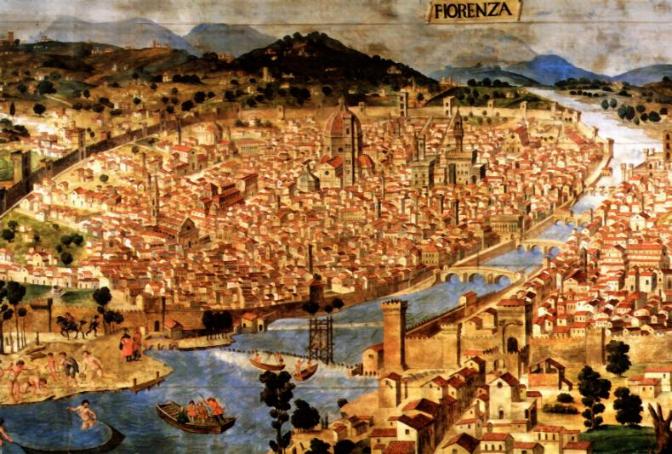
Before the Risorgimento, Florence's walls and city gates, built first by Arnolfo di Cambio, then by Michelangelo, had enclosed her. This map shows Florence as it was in the earlier nineteenth century, from Augustus Hare's Florence:
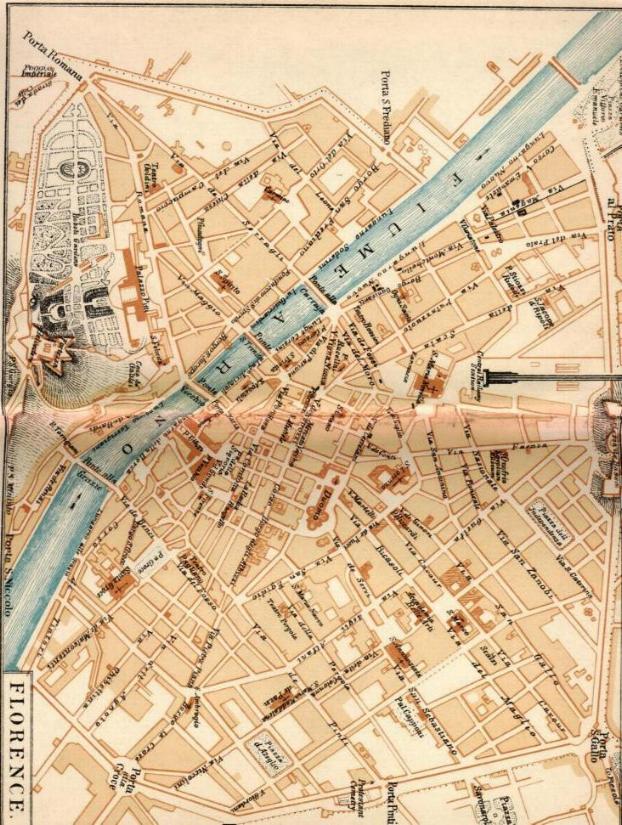
Protestant Cemetery
Before 1877

And now, Vasari's painting of Renaissance Florence, not essentially changed from the previous map.
THE VILLAS AROUND FLORENCE
Bellosguardo: Villa Brichieri-Colombi (Isa Blagden, etc.),Villa dello Strozzino (John Roddam Spencer Stanhope), Villa dell'Ombrellino, Torre di Montauto (Nathaniel Hawthorne). Hiram Powers and Felicie de Fauvau's studios were on the via de' Serragli to the other side of the Giardino Torrigiani and parallel to via Romana.

Cimitero agli Allori
Ferencz Pulszky at Santa Margherita a Montici,


Queen Victoria at Villa Palmieri, Walter Savage Landor and Daniel Willard Fiske at Villa Gherardesca, Villa Landor, now La Torriacia, Holman Hunt at Villa Medici.
*=Biblioteca e Bottega
Fioretta Mazzei, Cimitero degli Inglesi, holdings
Alfred Austin. The Autobiography. London: Macmillan, 1911.
*________. Ed. and Preface. Isa Blagden, Poems. Edinburgh and London: William Blackwood, 1873.
*Isabel Armstrong. 'Casa Guidi Windows: Spectacle and Politics in 1851'. In Unfolding the South: Nineteenth-Century Women Writers and Artists in Italy. Manchester: Manchester University Press, 2003.
*Giuliana Artom Treves. The Golden Ring. The Anglo-Florentines 1847-1862. London: Longman, 1956.
*________. Gli anglofiorentini di cento anni fa. Firenze: Sansoni, 1953.
________. “Come Firenze diventò Florence” Inghilterra e Italia nel Novecento. Atti del convegno di Bagni di Lucca, ottobre 1972. Firenze: La Nuova Italia, 1973. 9-17
Simon Avery and Rebecca Scott. Elizabeth Barrett Browning. London: Longman, 2003.
Baker, Paul R. The Fortunate Pilgrims: Americans in Italy 1800-1860. Cambridge, Ma.: Harvard UP, 1964.
*Clotilde Barbarulli. 'Dalla tradizione all'innovazione. "La ricerca straordinaria" di Elena Raffalovich Comparetti', L'educazione delle donne: Scuole a modelle di vita feminile nell'Italia dell'800, ed. S. Soldani (Angelo, 1989).
Enrico Barfucci. Giornate fiorentine: la città, la collina e i pellegrini stranieri. Firenze: Vallecchi, 1961.
*_________. Un Pantheon cosmopolita: Il Camposanto degli Inglesi in Piazza Donatello. Guida e Memoria. Firenze: A.L.E.F. editrice, 1951.
*Cosimo Bargellini e Leonardo Castellucci. Firenze:
Giardini per sognare. Firenze: I Cipressi, 1990. Pp.
77-86.
Hugh Blair. Lectures on Rhetoric and Belles
Lettres. 1783. Essays on Rhetoric: Abridged Chiefly
from Dr. Blair's Lectures on that Science. London: John
Murray, 1784.
*Elizabeth Barrett Browning. The Complete
Works. 6 vols. AMS, New York, 1900.
*_________. Sonetos Portugueses. Trad. Manuel Correa de Barros. Lisboa: Relogio d'Agua, 1945.
*_________. Sonette aus dem Portugiesischen.
Trad. Rainier Maria Rilke. Leipzig e Frankfurt am Main:
Insel Verlag, 1995.
*Elizabeth Barrett Browning's Florence. Ed. Julia Bolton Holloway, trad. AD.
*_________. The Letters of Elizabeth Barrett Browning. Ed. Frederic G. Kenyon. London: Macmillian, 1899.
*Robert Browning. Old Pictures in Florence. Firenze: Giulio Giannini & Son, 1923.
*_________. The Ring and the Book. Ed. Richard D. Altick. Harmondsworth: Penguin Books, 1971.
_________. Dearest Isa: Robert Browning’s Letters to Isabella Blagden. Ed. Edward McAleer. Westport, Conn.: Greenwood Press, 1951.
______ Letters of Robert Browning. Ed. Thurman L. Hood. London: John Murray, 1933.
______ New Letters of Robert Browning. Ed.
William Clyde De Vane e Kenneth Leslie Knickerbocker.
London, John Murray, 1951.
*The Browning Collections: A Reconstruction
with Other Memorabilia. Compiled, Philip Kelley and
Betty A. Coley. Winfield, Kansas, 1984.
*Mario Bencivenni e Massimo de
Vico Fallani. Giardini Pubblici a Firenze dall'Ottocento
a oggi. Firenze: Edizioni Firenze. pp. 98, 195-197.
Isa Blagden. Agnes Tremorne. London: Smith, Elder and Co., 1861.
_______. The Cost of a Secret. London: Chapman and Hall, 1863.
_______. “Gibson’s Studio.” All Year Around. Vol. XV, Marzo 1866: 205.
_______. “A Holiday in Venice.” Cornhill Magazine. Vol. XII, Ott. 1865: 441-51.
_______. “A Model and a Wife.” Fraser’s Magazine. Vol. LXVI, Luglio 1862: 95-113.
_______. Nora and Archibald Lee. London: Chapman and Hall, 1867.
*_______. Poems. Cura e introduzione di Alfred Austin. Edinburgh and London: William Blackwood, 1873.
*_______. 'Félicie de Fauvau'. English Women's Journal 2 (1858), 83-94. Courtesy, Alison Chapman
_______. “Santa; or a Woman’s Tragedy”. Once a Week. Vol. VII, Agosto-Sett. 1862: 225-343.
_______. “A Tuscan Village — A Tuscan Sanctuary.” Cornhill Magazine. Vol. X, Ott. 1864: 461-76.
_______. The Woman I Loved and the Woman who Loved me. A Tuscan Wedding. Pubblicato per la prima volta nel 1862. Leipzig: Tauchnitz, 1872.
*Attilio Brilli. Quando viaggiare era un’arte: il romanzo del grand-tour. Bologna: Il Mulino, 1995.
Mary Lynn Broe and Angela Ingram. Women’s Writing in Exile. Chapel Hill: The University of North Carolina, 1989.
Edward Robert Bulwer-Lytton, 1st Earl [pseudonym Owen Meredith]. Lucile. London: Paul, 1884.
________. Trad. Serbski Pesme; or, National Songs of Servía. [Selected and translated from A. Dozon's "Poésies populaires serbes."] Dozon: Louis Auguste Henri, 1861.
M. Castelli. Il soggiorno fiorentino di stranieri insigni. Firenze: Il Fauno, 1965.
Gaetano Cattaneo. Vite e ritratti di illustri italiani. 1812.
*Margherita Ciacci, et al. I giardini delle regine: il mito di firenze nell'ambiente preraffaelita e nella cultura americana fra Ottocento e Novecento. Livorno: Sillabe, 2004.
*Amalia Ciardi Dupré. Sculture e disegni (1980-2001). Firenze: Pagliai Polistampa, 2001.
Il cimitero acattolico a Roma. Ed. J. Beck-Friis. Roma, 1997.
*Katherine Chorley. Arthur Hugh Clough: The Uncommitted Mind. Oxford: Clarendon Press, 1962.
*Rupert Christianson. The Voice of Victorian Sex: Arthur Hugh Clough, 1819-1861. London: Short Books, 2001.
*Arthur Hugh Clough, ed. John Beer. London: Everyman, 1998.
*Arthur Hugh Clough. The Correspondence. Ed. F. Mulhauser. Oxford: The Clarendon Press, 1957. 2 vols.
*Clough: The Critical Heritage. Ed. Michael Thorpe. New York: Barnes and Noble, 1972.
*The Oxford Diaries of Arthur Hugh Clough. Ed. Anthony Kenny. Oxford: The Clarendon Press, 1990. Glenda White, Glasgow, U.K., 2003.
Frances Power Cobbe. Italics: Brief Notes on Politics, People and Places in Italy. London: Trübner and Co., 1864.
______. Life of Frances Power Cobbe By Herself. London: Richard Bentley, 1894.
C. Colbert. '"Each Little Hillock hath a Tongue" - Phrenology and the Art of Hiram Powers'. Art Bulletin, 19 (1986).
*Domenico Comparetti. Virgilio nel Medio Evo. Nuovo edizione a cura di Giorgio Pasquali. Firenze: La Nuova Italia, 1955. 2 vols.
Pietro Contrucci. Iscrizione italiane. Pistoia: Fratelli Bracali, 1837.
*Paolo Costantino e Italo Zannier. Itinerario Fiorentino: Le 'mattinate di John Ruskin nelle fotografie degli Alinari. Firenze: Alinari, 1986.
*Anna Maria Crino. 'La Firenze granducale dell'Ottocento negli scritti di Thomas Adolphus Trollope'. Nuova Rivista Storica 33: 4-6 (1949), 1-29.
*M. Gustave Dalgas. Notice historique sur le Cimitière de l'Eglisde évangelique réformée de Florence à Porta a Pinti (telle qu'elle fut publiée, en Décembre 1877). In Appendice I, Histoire de l'Eglise évangelique réformée, pp. 283-308.
William Dalrymple. White Mughals : Love and Betrayal in Eighteenth-Century India. London: Harper Collins, 2002
*Joseph Jay Deiss. The Roman Years of Margaret Fuller. New York, 1969.
Oreste Del Buono, Gherardo Frassa, Luigi Settembrini. Gli Anglo-fiorentini: una storia d’amore. Firenze: Edifir, 1987.
*Clara Louise Dentler. Katherine Luther of the Wittenberg Parsonage. Philadelphia: The United Lutheran Publication House, 1924.
*_________. Famous Americans in Florence. Firenze: Giunti/ Marzocco, 1976.
_________. Famous Foreigners in Florence: 1400-1900. Firenze: Bemporad Marzocco, 1964.
*_________. White Marble: The Life and Letters of Hiram Powers, Sculptor. Manuscript in the Smithsonian Institute.
Emma Detti. Margaret Fuller Ossoli e i suoi corrispondenti. Firenze: Le Monnier, 1924.
William Hepworth Dixon. Free Russia. London : Hurst and Hackett, 1870
Vicenzo Emiliani. 'Iscrizione italiane'. Giornale Arcadico, 37 (1828).
Encyclopaedia Judaica. Entries on 'Cemetery, Death,Epitaphs, Mourning, Tombs and Tombstones'. Jerusalem: Keter Publishing House Ltd., 1972.
Ludwig Andreas Feuerbach. The Essence of Christianity. Trans. Marian Evans/George Eliot. London, Chapman Brothers, 1854. Translation of Das Wesen des Christentums
Kate Field. “Elizabeth Barrett Browning.” Atlantic Monthly (1861): 368-76.
______ “English Authors in Florence.” Atlantic Monthly (1864): 660-71.
______ “The Last Days of Walter Savage Landor.” Atlantic Monthly (1866): 385-684.
*La Firenze dei Russi. Ed. Lucia Tonini, Michail Talalay. Firenze: Edizioni Polistampa, 2000.
Daniel Willard Fiske. Catalogue of Runic Literature, forming a part of the Icelandic collection bequeathed by Willard Fiske. Compiled by Halldór Hermanson. Publisher: London, 1918.
______________. Cornell University Library. Catalogue of the Icelandic Collection bequeathed by Willard Fiske. Compiled by Halldór Hermannsson. Ithaca, N.Y., 1960.
______________. Chess in Iceland and in Icelandic literature. [S.l.] : [s.n.], 1905
_____________. Mímir: Icelandic institutions with addresses MCMIII. Copenhagen, 1903.
John Flaxman. Lectures on Sculpture . . . As delivered by him before the president and members of the Royal Academy. With a brief memoir of the author. London : J. Murray, 1829.
Giovanna Foà. Elizabeth Barrett Browning and Italy. La Goliardica, Università Commerciale “Luigi Bocconi”, Milano, 1954.
Ugo Foscolo. I sepolcri: versi di Ugo Foscolo e d'Ippolito Pindemonte. Firenze : Molini, Landi, 1809.
Shirley Foster. Across New Worlds: Nineteenth Century Women Travellers and their Writings. New York: Harvester, 1990.
*Sheila Frodella. Elizabeth Barrett Browning e il percorso verso la rinascita della donna artista, tesi di laurea, Università di Firenze, A.A., 2000-2001.
*Katerine Gaja. '"Scrivendo nel marmo": lettere inedite tra Elizabeth Barrett Browning e Hiram Powers. Antologia Vieusseux 15-16 (2003).
Napione Galeani. Vita ed elogi d'illustri italiani. 1818.
Bartolommeo Gamba. Elogi di italiani illustri. 1829.
*Winifred Gregory Gerould and James Thayer Gerould. A Guide to Trollope. London: The Trollope Society, 1948.
Salomon Gessner. The Death of Abel. In Five Books. Attempted from the German of Mr Gessner by Mary Collyer. London: Dodsley, 1761. Original Swiss-German text: Der Tod Abels. Zurich: Zweyte Auflage, 1759.
*I 'Giardini' della Congregazione olandese-alemanne: Memoria e fede nella Livorno delle nazioni. Ed. Giangiacomo Panessa, Mauro Del Nista. Firenze: Regione Toscana, n.d.
William Godwin. Essay on Sepulchres. London. W. Miller, 1809.
The Greek Anthology. Ed. and trans. W.R. Paton. Cambridge: Harvard University Press, 1970. 5 vols. *Vol. V.
Ian Greenlees. “Gli Scrittori Inglesi.” Firenze cento anni fa. A cura di Sergio Camerani et al. Firenze: Remo Sandron, 1961. 73-92.
Hall W. Griffin. The Life of Robert Browning: with Notices of his Writings, his Family, and his Friends. London: Meuthuen and Co., 1910.
F.D. Guerrazzi. Orazioni funebri d'illustri italiani dettate da F.D. Guerrazzi. Firenze: Le Monnier, 1848.
Olive Hamilton. Paradise of Exiles: Tuscany and the British. London: André Deutsch, 1974.
*Augustus J.C. Hare. Florence. London: George Allen, 1896.
*Julian Hawthorne. Nathaniel Hawthorne and His Wife: A Biography. Boston: Hougton, Mifflin, 1884. 2 vols.
Nathaniel Hawthorne. The Marble Faun, or the Romance of Monte Beni. Pubblicato per la prima volta nel 1860. *New York: Signet Classics, 1961.
________. Il fauno di marmo. Trad. it. di Fiorenzo Fantaccini. Firenze: Giunti,1995.
________. The French and Italian Notebooks. Ohio: Ohio State UP, 1980.
*________. Passages from The French and Italian Notebooks. Boston: Houghton Mifflin and Company, 1881. 2 vols.
*Sophia Peabody Hawthorne. Notes in England and Italy. New York: Putnam & Son, 1872.
*Charles Hobday. A Golden Ring: English Poets in Florence from 1373 to the Present Day. London: Peter Owen, 1997.
*Julia Bolton Holloway. 'Charlotte's Jane Eyre and Elizabeth's Aurora Leigh'. Brontë Society Transactions 17 (1977), 126-132
*__________. 'Death and the Emperor in Dante, Browning, Dickinson and Stevens'. Studies in Medievalism 2 (1983), 67-72, eds. Leslie J. Workman, Kathleen Verduin.
*__________. 'Elizabeth Barrett Browning's Risorgimento: Aurora Leigh and Other Poems'. Paper read at the MLA, 1979; Lecture given with slides, British Institute, 1996.
*__________. Ed. Elizabeth Barrett Browning. Aurora Leigh and Other Poems. Harmondswworth: Penguin, 1995.
*__________. Elizabeth Barrett Browning's Florence.
Leonard Horner, trans. Pasquale Villari. The History of Savonarola and of His Times. London: Longman, Green, 1863.
Susan Horner. A Century of Despotism in Naples and Sicily. 1860
Susan Horner, trans. Pietro Colletta. History of the Kingdom of Naples, 1734-1825 : With a supplementary chapter, 1825-1856. Edinburgh : Constable, 1858. 2 vols.
Susan and Joanna Baillie Horner. Walks in Florence. London : D. Strahan & Co., 1873.
Harriet Hosmer. Letters and Memories. Ed. Cornelia Carr. New York: Moffat, Yard, 1912.
*Laurence Hutton. Literary Landmarks of Florence.
New York: Harper & Brothers Publishers, 1897.
Frontispiece, Villa Landor, pp.
55-58 and photograph, Walter Savage Landor's original tomb.
Douglas K.S. Hyland. Lorenzo Bartolini and Italian Influences on Amercian Sculptors in Florence (1825-50). Newark: University of Delaware Press, 1980.
Henry James. Letters. Cambridge: Belknap Press of Harvard UP, 1975-1984.
*_______. Princess Casamassima. Harmondsworth: Penguin, 1977.
_______. William Wetmore Story and His Friends: from Letters, Diaries and Recollections. New York: Grove, 1903.
Anna Jameson. Letters and Friendships (1812-1860). A cura di Steuart Erskine. London: T. Fisher Unwin, 1915.
Livio Jannattoni. Elizabeth Barrett Browning. Firenze: Sansoni Antiquariato, 1953.
Eugenio Kastner, Lettere inedite di Giuseppe Mazzini a Francesco Pulszky, "La rassegna italiana", a. XVI, serie III. n. 186, nov. 1933, pp. 771-780.
Jacob Korg. Browning and Italy. Ohio University Press, 1983.
Eligiusz Kozlowski. General Józef Hauke-Bosak, Wyd. Warszawa: MON, 1978.
Petre Nikolaevic Kudrjavcev.
*Walter Savage Landor. Imaginary Conversations. London: Walter Scott, 1886.
*Dorothy Nevile Lees. Tuscan Feasts and Tuscan Friends. London: Chatto & Windus, 1907.
Angela Leighton. Elizabeth Barrett Browning. 1986
Allison Levy, ed. Widowhood and Visual Culture in Early Modern Europe. Ashgate, 2003.
_______. ‘Framing Widows: Mourning, Gender, and Portraiture in Early Modern Florence,’ in Allison Levy, ed., Widowhood and Visual Culture, 211-231.
_______. ‘Good Grief: Widow Portraiture and Masculine Anxiety in Early Modern England,’ in The Single Woman in Medieval and Early Modern England: Her Life and Representation, eds Dorothea Kehler and Laurel Amtower (Tempe: Arizona Center for Medieval and Renaissance Studies, 2003), 258-80
_______. Doctoral Dissertation, ‘Early Modern Mourning: Widow Portraiture in Sixteenth-Century Florence’ (Bryn Mawr College, 2000).
Linda M. Lewis. Elizabeth Barrett Browning's Spiritual Progress. Columbia: University of Missouri Press, 1998.
*L’idea di Firenze. Temi e interpretazioni nell’arte straniera dell’800, Atti del Convegno. Firenze: Centro Di, 17-19/12/1986.
Dora Liscia Bemporad, A. M. Falco Tedeschi. Toscana: Itinerari ebraici. A cura di A. Sacerdoti. Venezia: Marsilio, 1995.
Listy legionistow Adama Mickiewicza z lat 1848-1849. A cura di H. Lutzowa e S. Kieniewicz. Wroclaw: Ossolineum.
Robert Lowth. De sacra poesi Hebraeorum: praelectiones academica Oxonii habitae, a Roberto Lowth . . . subjicitur Metricae Harianae brevis confutatio et oratio Crewiana. Oxonii : e typographeo Clarendoniano, 1763. De sacra poesi Hebraeorum; praelectiones academicae Oxonii habitae, subiicitur Metricae Haraniae brevis confutatio et oratio Crewiana / Cum notis et epimetris I.D. Michaelis suis animadversionibus adiectis edidit E.F.C. Rosenmuller. Insunt C.F. Richteri De aetate libri Iobi definienda atque C. Weisii de metro Hariano commentationes. Lipsiae: Weigel, 1815. Translated as Lectures on the Sacred Poetry of the Hebrews from the Latin of the late Robert Lowth, by G. Gregory; to which are added the principal notes of Professor Michaelis and notes of the translator and others. London: T. Tegg, 1839.
_______. Isaiah : A new translation: with a preliminary dissertation, and notes critical, philological, and explanatory. London: J. Dodsley and T. Cadell, 1779.
Percy Lubbock. Elizabeth Barrett Browning in her Letters. London: Smith, Elder and Co, 1906.
*Alta Macadam. Americans in Florence. Firenze: Giunti, 2003.
*Julia Maitland. Letters from Madras. Ed. Alyson Price. Otley: Woodstock Books, 2003.
Ferdinando Malvica. Alcune iscrizione di Luigi Muzzi. Roma: Aiani, 1825.
_________. Iscrizione italiane. 1830.
Sarolt Marinovich-Resch. 'The Dialogue of the Public
and Private Voice in Aurora Leigh'. In Private and
Public Voices in Victorian Poetry, ed. Sabine
Colesch-Foisner, Holger Kelin. Tübingen: Stauffenburg Verlag,
2000. Pp.
*Julia Markus. Across an Untried Sea:
Discovering Lives Hidden in the Shadow of Convention and
Time. New York: Alfred A. Knopf, 2000.
Karl Marx, Frederick Engels, Collected Works. London: Lawrence & Whisart, 1983.
*Maurizio Massetti. La Firenze dei Browning. Firenze: Pietro Chegai Editore, 2002.
Giuseppe Mazzini. Scritti. Imola: Cooperativa tipografico-editrice, 1906.
*Betty Miller. Robert Browning: A Portrait. London: John Murray, 1952.
Sara Mills. Discourses of Difference: An Analysis of Women’s Travel Writing and Colonialism. London: Routledge, 1991.
Czeslaw Milosz. Czlowiek wsród skorpionów. Warszawa: PIW, 1982
*John Milton. Paradise Lost. In Complete Poems and Major Prose. Ed. Merrit Y. Hughes. New York: Odyssey Press, 1957. Italian translation: Il Paradiso Perduto. Milano: L'ape della letterature per la gioventù, 1830.
Salvatore Minocchi. Bellosguardo a Firenze: memorie storiche e letterarie. Firenze: Ariani, 1902.
Melchior Missirini. Degli illustri italiani. 1838.
*Ellen Moers. Literary Women: The Great Writers. Garden City, 1977.
Monumenti sepolcrali della Toscana. 1819.
William Morris, trans. from the Icelandic. The story of Grettir the Strong. London : F. S. Ellis, 1869
William Morris, trans. from the Icelandic. Three northern love stories : and other tales. London : Ellis & White, 1875. [Contents: The story of Gunnlaug the Worm-tongue and Raven the Skald.--The story of Frithiof the Bold.--The story of Viglund the Fair.--The tale of Hogni and Hedinn.--The tale of Roi the Fool.--The tale of Thorstein Staff-smitten]
*Geoffrey C. Munn. Castellani and Giuliano, Revivalist Jewellers of the 19th Century. New York: Rizzoli, 1984.
Captain Henry Edward Napier, R.N. Florentine History from the Ealiest Authentic Records to the Accession of Ferdinand the Third, Grandduke of Tuscany. 6 vols. 1846-7.
Enrico Nencioni, 'Elisabetta Barrett Browning', Medaglione, 1884.
*Pamela Neville-Sington. Fanny Trollope: The Life and Adventures of a Clever Woman. London: Viking, 1997.
Anne O'Brien. 'Crossing Boundaries: Lady Morgan's Italy'.
_________. 'Florentine Shadows: Death, Duty and Santa Croce in George Eliot's Romola'. Journal of Anglo-Italian Studies 7 (2002), 63-80.
_________. 'Il Monumento a Dante: Storia di influssi internazionali'. Città di Vita 57 (2002), 508-520.
_________. 'S. Croce nell'occhio di viaggiatori britannici ottocenteschi'. Città di Vita 56 (2001), 557-566.
*Mrs Olifant. The Makers of Florence: Dante, Giotto, Savonarola, and their City. London: Macmillan, 1914.
Francesco Orioli. Iscrizioni di autori diversi con un discorso sulla Epigrafia Italiana. Bologna: Stampa dei Sassi, 1827.
Sutherland Orr. Life and Letters of Robert Browning. Boston: Houghton, Mifflin, 1891.
Ossian. Fingal: an ancient epic poem, in six books; together with several other poems composed by Ossian, the son of Fingal; translated from the Gaelic language by James Macpherson. London: T. Becket and P.A. De Hondt, 1762
Ossian. Poesie di Ossian trasportate dalla prosa inglese in verso italiano dall'Ab. Melchior Cesarotti. Padova, II ricorretta ed accresciuta, 1772.
Adolfo Padovan. Epigrafia. Milano: Hoepli.
G. Parnessa. Le comunità greche a Livorno.
Livorni, 1991.
John Pemble. The Mediterranean Passion: Victorians and Edwardians in the South. Oxford: Oxford UP, 1988.
Hiram Powers Papers:
1. Letters between Perkins and Powers are located in three repositories:
I. The Marsh Collection at the Special Collections Department, Bailey-Howe Library, University of Vermont has letters from 1847 to 1871.2. Documents and letters on the Longworth Powers’ line are preserved in the Powers’ Family Collection at the Winter Park Public Library in Florida. It is part of the Winter Park History and Archives Collection. A grandson, named Hiram Powers, who married Rose Mills, was active in real estate in the beautiful lakes around the Winter Park and Orlando area. He was also a Professor of Literature at what is now Rollins College in Winter Park which therefore has original statuary by the sculptor.
II. The Powers’ Papers at the Archives of American Art at the Smithsonian Institution in Washington, DC has numerous holdings on the artist.
III. The New York Historical Society.
3. Louise Greenough Powers (1838-1929) married Alfred Ibbotson. She maintained several diaries that remained in the family. Louise and Alfred built a villa near her father’s in Florence. Their daughter, Mary Florence Ibbotson, married Henri Michahelles of Florence and they had four children: Ernest, Mark, Roger and Christine. Dentler had access to the original diaries and information in private family correspondence from these Michahelles grandchildren.
4. A miscellaneous bound collection called the Sidney Brooks Letterbook. Pages 2-10, 30-31, 56, 60-61 and 79 hold direct correspondence between the two men.
5. The Miner Kilbourne Kellog Papers 1841-1863 are deposited in the Manuscript and Archives Collection of the Indiana Historical Society.
6. Letters from Powers to Eaton, 1845-1867, concerning these statues are found in The Eaton-Mayhew Papers in the Library of Maryland History belonging to the Maryland Historical Society.
7. The University Portrait Collection for the Harvard University Art Museums in Cambridge, Massachusetts contain several photographs of Powers and of his statues in their Archives and Manuscript repositories.
8. There is a Hiram Powers’ scrapbook of printed American articles and advertisements titled Notices of Powers Works, 1847-1849, 1873 and 1876 among a collection on Hiram Powers and Powers’ Family Papers transferred from the National Museum of American Art to the Smithsonian Institution between 1975 and 1985.
*Maddalena Pennacchi Punzi. Il mito di Corinne, viaggio in Italia e genio femminile in Anna Jameson, Margaret Fuller e George Eliot. Roma: Carocci, 2001.
Franco Pisa, Parnassìm, le grandi famiglie ebraiche italiane dal secolo XI al XIX, in Annuario di Studi Ebraici a cura di Ariel Toaff, X, 1980-1984. Roma: Carucci Editore. Pp. 291-491.
*The Poetics of Place: Florence Imagined. Ed. Irene Marchegiani Jones and Thomas Haeussler. Firenze: Olschki, 2001.
*Mary Sanders Pollock. Elizabeth Barrett and Robert Browning: A Creative Partnership. Aldershott: Aldgate, 2003.
Alexander Pope, Edward Young, Thomas Gray, Robert Blair, Thomas Parnell, John Philips, Oliver Goldsmith and William Shentsone. A Collection of Poems, Essays, and Epistles. Dublin: T. Armitage, 1771. [Contents include Pope's Essay on Man, The Universal Prayer, Eloisa to Abelard, Messiah, Young's Poem on the last day, Gray's Elegy, Blair's The Grave, Parnell's The Hermit, Philips' The Splendid Shilling, and Goldsmith's The Deserted Village, The Traveller.]
William Raymond. “Our Lady of Bellosguardo.” University of Toronto Quarterly, 12 (1943): 446-63.
*Regione Toscana, Giunta
Regionale. Giardini di Toscana. Firenze: Edizioni
Firenze, 2004. P. 39.
Ernst Renan. Life of Jesus. London: Mathieson, n.d. Translation of: Vie de Jésus, 13th ed
Donald Reynolds. Hiram Powers' Ideal Sculpture. New York: Garland Press, 1977.
_________. 'The "Unveiled Soul": Hiram Powers' Embodiment of the Ideal'. Art Bulletin 59 (1977).
I ricami datati della Sinagoga di Firenze. In I tessili antichi e il loro uso, atti del Convegno CISST. Torino: 1986. Pp. 76-77.
Anne Thackeray Ritchie. Records of Tennyson, Ruskin and Browning. London: Macmillan, 1893.
*Dante Gabriel Rossetti. Poems and Translations, 1850-1870. London: Oxford University Press, 1913.
Cecil Roth. Stemmi di famiglie ebraiche italiane. In Scritti in memoria di Leone Carpi. Saggi sull’Ebraismo italiano a cura di Daniel Carpi, Attilio Milano, Alexander Rofé, Milano-Gerusalemme, Editrice Fondazione Sally Mayer-Scuola Superiore di Studi Ebraici. Pp. 165-183.
*John Ruskin. Mornings in Florence. New York: Home Book Company, n.d.
__________. The Stones of Venice. London: J. M. Dent, [n.d.]
Giuseppe Sacchi. Viaggio in Toscana. Milano: Pirotta, 1835.
*Pastore Luigi Santini. Il Cimitero protestante detto 'degli Inglesi' in Firenze. Foto, Beatrice Künzi. Florence: Administration of Cimitero degli Allori, 1981.
*Pastore Luigi Santini. The Protestant Cemetery of Florence called 'The English Cemetery. Florence: Photography, Beatrice Künzi. Administration of Cimitero degli Allori, 1981.
Girolamo Savonarola. Libro della vita viduale. Firenze, 1491.
Juliana Schiesari. The Gendering of Melancholia:
Feminism, Psychoanalysis and the Symbolics of Loss in
Renaissance Literature. Ithaca: Cornell University
Press, 1992.
Pamela Shurmer-Smith, e Kevin Hannam. Worlds of Desire, Realms of Power: A Cultural Geography. New York: Edward Arnold, 1994.
*Robert Hilton Simmons.. 'Neglected work of a once-famed Yankee artist comes to Washington'. Smithsonian (January, 1973), 46-53.
Graham Smith. The Stone of Dante and Later Florentine Celebrations of the Poet. Firenze: Olschki, 1990.
Susan Sontag. Illness as Metaphor. New York: Farrar, Straus & Giroux, 1978.
Gaetano Sorgato. Memorie funebre. Padova: Tip. Del Seminario, 1856-1858.
*Madame de Staël. Corinne ou l'Italie. Ed. Simone Balayé.
Paris: Gallimard, 1985.
Emma Stebbins. Charlotte Cushman: Her Letters and Memories of Her Life. Boston: Houghton, Osgood, 1878.
*Storia delle arti in Toscana: L'Ottocento. Ed. Carlo Sisi. Firenze: Edifir, 1999-
*Wetmore William Story. Vallombrosa: taccuino di viaggio di fine Ottocento. A cura di Simonetta Berbeglia. Firenze: Editrice Clinamen, 2002.
Harriet Beecher Stowe. Uncle Tom's Cabin: or, Negro life in the slave states of America. London : C. H. Clarke, 1852.
David Friedrich Strauss. The Life of Jesus: Critically Examined. Trans. Marian Evans/George Eliot. London : Chapman Brothers, 1846. Translation of Das leben Jesu.
Sharon Strocchia, Death and Ritual in Renaissance Florence. Baltimore: The Johns Hopkins University Press, 1992.
János György Szilágyi, A Forty-Eighter's Vita Contemplativa. Ferenc Pulszky (1814-1889) , "The Hungarian Quarterly", Vol. XXXIX, n. 149, Spring 1998, pp. 3-17
Michail Talalay, A.M. Canepa. 'I sepolcri dei russi a Livorno'. In Nuovi Studi Livornesi (1994).
*Gardner Taplin. The Life of Elizabeth Barrett Browning. New York: Archon Books, 1970.
*David Tarallo. 'Cimitero degli inglesi però svizzero'. Toscana qui, 2, aprile 2003. Pp. 50-52.
*Bayard Taylor. The Poetical Works. Boston: Houghton, Mifflin, 1894-
*Anthony Trollope. Tales of All Countries. London: Chapman and Hall, 1869.
*_________. An Eye for an Eye . London: Anthony Blond, 1966.
*_________. Barchester Towers. Harmondsworth: Penguin, 1983.
*_________. Can You Forgive Her? Harmondsworth: Penguin, 1986.
*_________. Doctor Thorne. Harmondworth: Penguin, 1991.
*_________. Dr Wortle's School. Harmondsworth, Penguin, 1999.
*_________. The Duke's Children. Harmondsworth: Penguin, 1995.
*_________. The Eustace Diamonds. Harmondwworth: Penguin, 1986.
*_________. Framley Parsonage. Harmondsworth, Penguin, 1986.
*_________. He Knew He Was Right. Harmondworth: Penguin, 1994.
*_________. The Last Chronicle of Barset. Harmondsworth, Penguin, 1986.
*_________. Tales of all Countries. London: Chapman and Hall, 4th edition.
*_________. Phineas Redux. London: Chapman & Hall, 4th edition.
*_________. Phineas Finn, The Irish Member. Harmonsdworth: Penguin, 1995.
*_________. The Prime Minister. Harmonsdworth: Penguin, 1994.
*_________. The Small House at Allington. Harmondsworth, Penguin, 1991.
*_________. The Warden, ed. Robin Gilmour. Harmondsworth: Penguin, 2000.
*_________. The Way We Live Now. Harmonsdworth, Penguin: 1994.
*Frances Trollope. Domestic Manners of the Americans. Lithographs by Auguste Hervieu. London: The Folio Society, 1974.
*_________. Paris and the Parisians in 1835. Engravings, A. Hervieu. London: Richard Bentley, 1836. 2 vols.
*_________. Vienna and the Austrians, with some Account of a Journey through Swabia, Bavaria, the Tyrol, and the Salzbourg. Paris: Baudry's European Library, 1838. 2 vols.
*Thomas Adolphus Trollope. What I Remember. London: Richard Bentley, 1887. 2 vols.
________. 'Some Recollections of Hiram Powers'. Lippincott's Magazine of Popular Literature and Science 4 (1875).
Giampaolo Trotta. Cimiteri ebraici a Firenze. Per un itinerario attraverso i luoghi storici e urbani della memoria, in «Storia Urbana», LIX, 1992, pp. 127-151.
*__________. Luoghi di culto non-cattolici nella Toscana dell'Ottocento. Presentazione, Antonio Paolucci. Firenze: Becocci/Scala, 1997.
Henry Tuckerman. Book of the Artists: American Artist Life. New Yorek: Putnam, 1867.
Alan Underman, Dictionary of Jewish Lore and Legend, London, Thames and Hudson Ltd, 1991 [traduzione italiana: Dizionario di usi e leggende ebraiche, a cura di Anna Foa, Roma-Bari: La Terza, 1994].
*Unfolding the South. Nineteenth-century British
women writers and artists in Italy. Ed. Alison Chapman
and Jane Stabler. Manchester: Manchester University Press,
2003.
Pasquale Villari. Life and Times of Girolamo Savonarola. Trans. Linda White Villari. London : T. Fisher Unwin New York Charles Scribner's Sons, [1889]
Verena Von Der Heyden Rynch. I salotti d’ Europa. Milano: Garzanti, 1996.
Maria Przezdzieckich Walewska. Polacy w Paryzu, Florencji i Dreznie. Warszawa: Ksieg.F.Hoesicka, 1930.
Maisie Ward. The Tragi-Comedy of Pen Browning. New York, 1972.
*John Whitely. Oxford and the Pre-Raphaelites. Oxford: Ashmolean Museum, 1993.
Linda White. Tuscan Hills
and Venetian Waters.
Lilian Whiting. “Charlotte Cushman.” Our Famous Women: Lives and Deeds of Distinguished American Women of our Times. Hartford: Worthington, 1884. 207-229.
_______ The Florence of Landor. London: Gay and Bird, 1905.
_______ Italy: the Magic Land. Boston: Little and Brown, 1907.
_______ Kate Field: A Record. Boston: Little and Brown, 1899.
_______ Women Who Have Ennobled Life. Philadelphia: The Union Press, 1915.
*The Women of the Blue Grass [Issa Desha Breckinridge and Mary Desha]. 'The Work shall Praise the Master': A Memorial to Joel T. Hart, The Kentucky Sculptor. Cincinnati: Robert Clarke, 1884.
*Virginia Woolf. 'Aurora Leigh'. The Second Common Reader.
Nathalia Wright. American Novelists in Italy: The Discoverers, Allston to James. Philadelphia: University of Pennsylvania Press, 1965.
*Richard P. Wunder. Hiram Powers, Vermont Sculptor, 1805-1873. Newark: University of Delaware Press, 1991. 2 vols, Volume I: Life, Volume 2: Sculpture.
*Dr Richard P. Wunder Papers, Van Wylen Library, Hope College, Holland, Michigan, USA. Copied by Patti Carlson, Catalogued by Jeffrey Begeal, 2004.
*Mary Young. The Life and Times of Aonio Paleario or a Biography of the Italian Reformer in the Sixteenth Century. 2 vols. London: Bell and Baldy, 1860.
We invite photo essays of other historic cemeteries, particularly those in England, Ireland, Switzerland and America, for inclusion here.
Our 'English' Cemetery was once like a garden and filled with trees. Our Icelandic participant, Kristin Bragadottir, of the National and University Library, has sent us the following photographs of the cemetery in Reykjavik, visited by William Morris and Daniel Willard Fiske. On Iceland the sheep have destroyed the trees, the land being barren, except in walled cemeteries. The Black Death reached Iceland fifty years later than Europe for there had been no ships, from lack of wood, with which to sail the Atlantic, though when the Vikings had reached that island it had been thickly forested. Yet in the tombs in Reykjavik one can see the same shapes, the same materials, as are used for tombs in Florence.


Many
Protestant Irish serving in the British military forces in India
found burial in Florence. Meanwhile, in Ireland, at the time of
the English Cemetery in Florence, Catholics were dying in the
Potato Famine, and buried in umarked graves. See http://www.iol.ie/~anchorhold/HolyPlaces/famine2.jpg
www.iol.ie/~anchorhold/HolyPlaces/faminegraveyard.htm
http://vassun.vassar.edu/~sttaylor/FAMINE/
RETURN TO OPENING FILE
PROGRAMMA DEL CONVEGNO, ‘LA CITTA’ E IL
LIBRO III’/ THE CITY AND
THE BOOK III/ ELOQUENZA SILENZIOSA: VOCI DEL RICORDO
INCISE NEL CIMITERO ‘DEGLI INGLESI’/ MARBLE SILENCE, WORDS IN STONE:
FLORENCE'S ‘ENGLISH CEMETERY’
3-4 June 2004, Sala Ferri, Gabinetto G.P. Vieusseux, Palazzo Strozzi
Giovedì 3 giugno 2004/ Thursday 3 June 2004/ Ore 9.00/ 9:00 a.m.
SALUTI/ GREETINGS
Marcello Fazzini, Presidente
del Gabinetto G.P. Vieusseux
Eugenio Giani, Assessore alle
Relazioni Internazionali del Comune di Firenze
Giannozzo Pucci, Presidente
dell'Associazione Internazionale ‘Fioretta Mazzei’
Gerardo Kraft, Presidente dei
Cimiteri Evangelici di Firenze
Vanessa Hall-Smith, Director,
The British Institute of Florence
INTRODUZIONE/ INTRODUCTION
TEMPO/ SPAZIO/ BIBLIOGRAFIA //TIME/ SPACE/ BIBLIOGRAPHY
Si ringraziano
per la collaborazione
Lapo Mazzei, Carlo
Steinhauslin, Maurizio Bossi
AUREO ANELLO
ASSOCIAZIONE BIBLIOTECA E BOTTEGA FIORETTA MAZZEI
E AMICI DEL CIMITERO 'DEGLI INGLESI'
 FIDUCIARIA TOSCANA SPA
 ROTARY CLUB BISENZIO-FIRENZE
CHIESA EVANGELICA RIFORMATA SVIZZERA
 AGENZIA PER IL TURISMO FIRENZE
 GABINETTO
G.P. VIEUSSEUX
GABINETTO
G.P. VIEUSSEUX
 POLISTAMPA s.n.c.
FLEMING YOUTH S.r.l.

aFlorina aCity and BookaWebsites
FLORIN WEBSITE
A WEBSITE
ON FLORENCE © JULIA BOLTON HOLLOWAY, AUREO ANELLO ASSOCIAZIONE,
1997-2022: ACADEMIA
BESSARION
||
MEDIEVAL: BRUNETTO
LATINO, DANTE ALIGHIERI, SWEET
NEW STYLE: BRUNETTO LATINO, DANTE
ALIGHIERI, &
GEOFFREY CHAUCER
|| VICTORIAN:
WHITE
SILENCE:
FLORENCE'S
'ENGLISH'
CEMETERY
|| ELIZABETH
BARRETT
BROWNING
|| WALTER
SAVAGE LANDOR
|| FRANCES
TROLLOPE
|| ABOLITION
OF SLAVERY
|| FLORENCE
IN SEPIA
|| CITY AND BOOK CONFERENCE
PROCEEDINGS
I, II, III,
IV,
V,
VI,
VII
, VIII, IX, X || MEDIATHECA
'FIORETTA
MAZZEI'
|| EDITRICE
AUREO ANELLO CATALOGUE || UMILTA
WEBSITE
|| LINGUE/LANGUAGES: ITALIANO,
ENGLISH
|| VITA
New: Opere
Brunetto Latino || Dante vivo || White
Silence
To donate to the restoration by Roma of Florence's formerly abandoned English Cemetery and to its Library click on our Aureo Anello Associazione's PayPal button:
                THANKYOU!